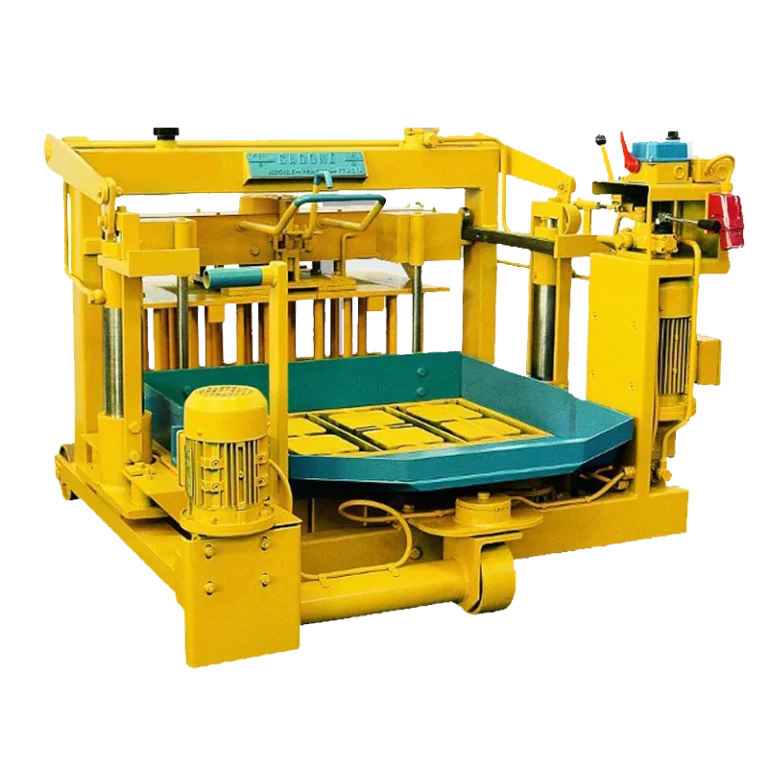
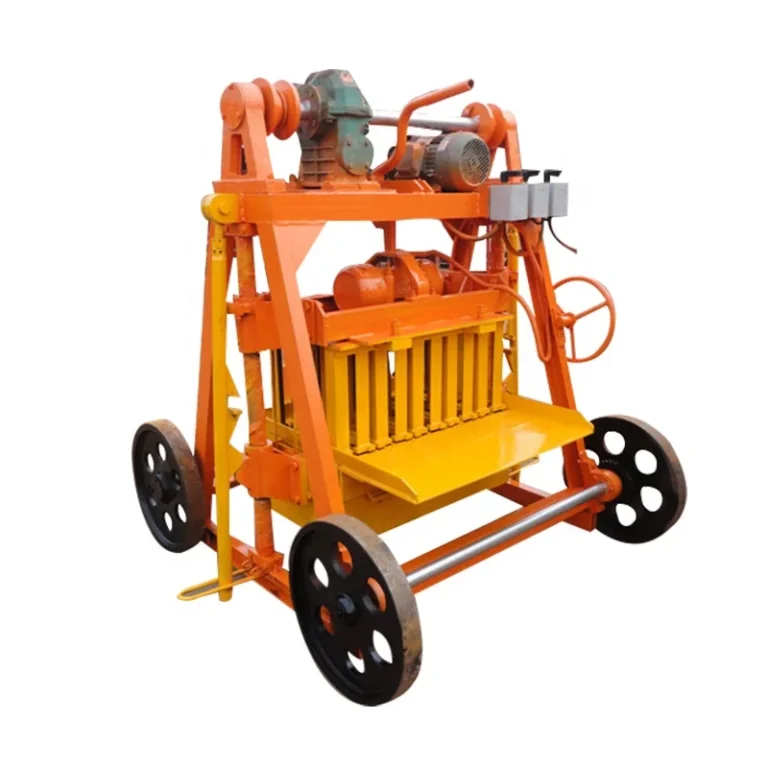
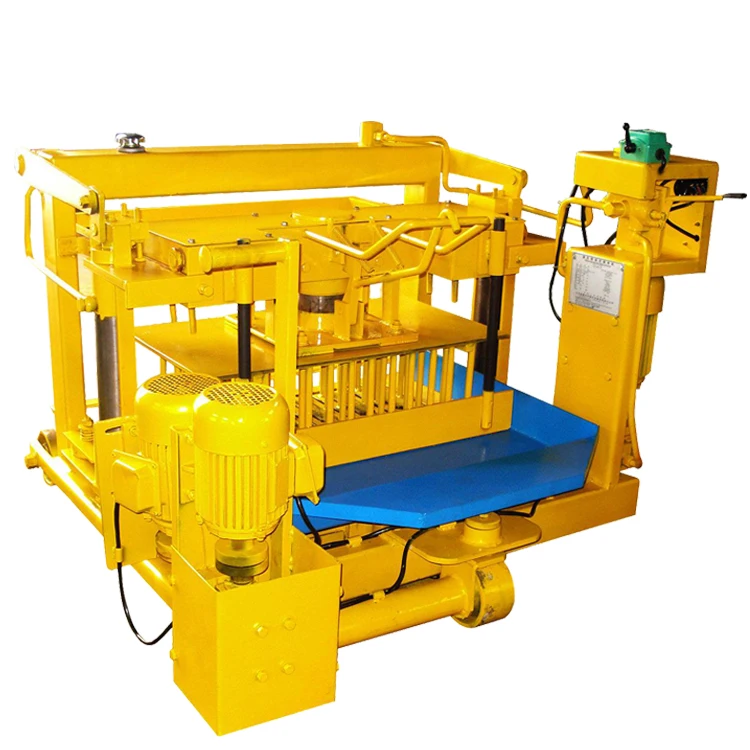
Matched System Design — Block machine, mould, and handling specified as one coordinated line rather than assembled from mismatched components, keeping the press from idling while upstream stations catch up.
Technical Specifications
| Parameter |
Value |
| Model |
QMR4-45 |
| Product Type |
Mobile Diesel Block Making Machine |
| Molding Cycle |
45 seconds (basis not stated in source — confirm block format and thickness) |
| Power Source |
Diesel Engine |
| Rated Power |
8 hp |
| Molding Form |
Vibration and Pressure |
| Vibration Force |
60 KN |
| Pallet Requirement |
No pallet required |
| Block Formats Supported |
Hollow block, solid block, paver brick, fly ash brick, concrete block |
| Basic Equipment Included |
JZC350 or JQ350 Diesel Concrete Mixer; Trolley |
| Overall Dimensions |
2420 × 1320 × 1650 mm |
| Total Weight |
800 kg |
| Automation Level |
Manual / Semi-automatic (basis not stated in source — confirm scope) |
| Control System |
(basis not stated in source — confirm PLC or manual) |
| Voltage & Frequency |
(basis not stated in source — confirm target market standard) |
Application Suitability
| Application |
Material or Output |
| On-site hollow block production for building contractors |
Crushed stone, sand, cement, water mix |
| Solid concrete brick making at housing project locations |
Local aggregate with cement binder |
| Paver brick production for small-scale entrepreneurs |
Fine aggregate and cement blend |
| Fly ash brick manufacturing near thermal plant zones |
Fly ash, sand, lime, gypsum, cement |
| Remote construction site block forming |
Diesel-powered operation without grid electricity |
What "45-Second Cycle" Actually Means for Your Daily Tally
A cycle time without a stated block format is not a capacity figure — it is a mechanical interval that must be converted against the product you actually sell.
Many mobile block machine quotes list a cycle duration and leave the buyer to assume a best-case hollow block. In practice, a paver brick with a thicker face demands longer vibration dwell, and a solid brick requires denser compaction, both extending the real cycle beyond the quoted number. A mobile block machine manufacturer that does not pair the cycle time with the assumed format is leaving the buyer to discover the gap only after the machine arrives and the first shift ends with fewer blocks than planned [NEED_CITE: block format effect on cycle time in vibration press operations].
The QMR4-45 operates on a 45-second molding cycle, but the daily output depends on which mould is mounted, the mix consistency feeding the hopper, and how quickly operators move the finished block clear of the forming zone. Without a pallet system, the block must cure in place, meaning floor space and walking paths around the machine directly limit how many cycles can run before the operator is blocked by freshly laid product.

Where the QMR4-45 Fits in the Mobile Range
This model sits at the entry tier of SHIYUE’s mobile block machine lineup. It addresses buyers who need to produce block directly where construction is happening — a contractor pouring walls on a housing development, or an entrepreneur testing block demand in a new market before investing in a fixed plant. The diesel engine removes dependency on grid availability, which matters on rural sites and early-phase project locations where power has not yet been connected.
The mobile block machine manufacturer designs this tier for operators who will handle material feeding and block clearing manually. If your project volume grows to require continuous production across multiple shifts, the range extends upward to higher-output models with pallet return systems and powered stacking — but that is a separate investment decision once market demand is proven.
Operating Without Pallets — Floor Is the Curing Rack
The no-pallet design eliminates one of the largest recurring material costs in block production. Pallets wear, splinter, and require storage when not in use. By laying block directly onto a prepared floor surface, the QMR4-45 shifts the curing area requirement from rack space to ground space. This means the site must provide a level, swept concrete or compacted earth surface large enough to hold a full shift’s output without operators walking on freshly formed units [NEED_CITE: floor preparation standards for egg-laying block machines].
The trade-off is that production flow is linear rather than stacked. Operators walk the machine forward along the production lane, and the lane length determines how long before the earliest blocks are dry enough to move. In humid or cool conditions, that interval stretches, and the lane must be longer to avoid bottlenecks.
Reading Vibration Force Against Mix Design
The 60 KN vibration force and pressure forming system must be evaluated against the buyer’s local aggregate. Hard, angular crushed stone transmits vibration differently than rounded river gravel or lightweight fly ash blends. A mix that is too dry will not consolidate under this vibration rating, leaving weak edges and high breakage at demoulding. A mix that is too wet will slump after the mould lifts, distorting the block shape before it sets.
The 8 hp diesel engine delivers mechanical vibration through the mould table. Unlike electric motor drives that hold a constant RPM regardless of load, diesel output varies with engine speed under the vibration load. Operators must learn the throttle position that sustains full vibration amplitude — running the engine too low saves fuel but produces under-compacted blocks that fail strength tests at the construction site.
The Cost of Skipping Format Confirmation Before Shipment
A buyer who orders a mobile block machine without confirming which moulds ship in the container may find that the machine produces only hollow blocks, while the local market demands pavers or interlocking bricks. Mould swaps on mobile machines require mechanical alignment and test cycles to dial in vibration time for the new format [NEED_CITE: mould changeover procedure for mobile block machines]. If the target format was never specified, the correct mould may not even be in stock, adding weeks of delay while it is manufactured and shipped separately.
Voltage and control language are equally easy to overlook on a diesel machine. If an electric generating unit powers any control components, the voltage and frequency must match the generator specification. A mismatched control panel display in a language the operator cannot read slows troubleshooting every time a sensor or limit switch needs adjustment.
Why Source This Tier from SHIYUE
The QMR4-45 is configured with the mixer and trolley as a matched set, so the buyer does not arrive on site with a mixer that cannot keep up with the press or a trolley that does not clear the machine frame. The diesel engine, vibration assembly, and mould are specified together so that vibration force and pressure match the compaction requirement of the intended block format.
Mould design supports the formats the buyer’s local market actually purchases — hollow, solid, paver, and fly ash brick — rather than a single default mould shipped with every unit. The supporting mixer selection between JZC350 and JQ350 lets the buyer match batching capacity to the pace of the 45-second cycle. Documentation covers the full line layout, mould drawings, and hydraulic and electrical schematics so that on-site commissioning does not stall over a missing wiring diagram.
Documentation & Verification
- Line layout drawing showing production lane length matched to daily output target
- Machine specification sheet confirming 60 KN vibration force and 8 hp diesel rating
- Mould drawing and format list for hollow, solid, paver, and fly ash brick
- Factory test record run on buyer’s confirmed block format before dispatch
- Operation and maintenance manual in buyer’s specified control language
- Packing photographs and container loading plan for shipment verification
Installation, Commissioning & Support
- Level concrete or compacted earth floor prepared to 2420 × 1320 mm machine footprint plus curing lane
- Diesel fuel supply and JZC350 or JQ350 mixer positioned within trolley reach of press hopper
- Machine placed and vibration assembly checked for shipping damage before first cycle
- First-day production run on target block format to confirm mix consistency and cycle timing
- Operator trained on throttle position for sustained vibration amplitude at full load
- Mould alignment checked and spare hydraulic seals supplied for first replacement cycle
Preparing Your Inquiry
Before requesting a quote, confirm the block format and dimensions your market requires, along with the daily volume your site can absorb given available curing floor space. Provide details on local aggregate type and cement grade so the mix can be evaluated against the 60 KN vibration rating. If any electric components will run from a site generator, specify the voltage and frequency to ensure control compatibility.
Frequently Asked Questions
Q: How should I calculate realistic daily output from the 45-second cycle time?
A: The cycle time must be matched to the specific block format you intend to produce. Paver bricks and solid blocks typically require longer vibration dwell than hollow blocks, extending the actual cycle. Ask the mobile block machine manufacturer to provide a capacity calculation that names the block format, dimensions, and assumed mix type so you can plan floor space and curing time accurately.
Q: Which block formats can the QMR4-45 produce, and are all moulds included?
A: The machine supports hollow block, solid block, paver brick, fly ash brick, and concrete block formats. However, the specific moulds shipped with the machine must be confirmed at order stage. Request a mould drawing and format list that shows which moulds are included in the base package and which require separate ordering, so there are no surprises at container opening.
Q: When should I choose diesel over electric power for a mobile block machine?
A: Diesel power suits construction sites without grid connection, remote housing projects, and early-phase locations where electrical infrastructure is not yet installed. The 8 hp diesel engine on the QMR4-45 provides independent operation. If your site has reliable three-phase power and production will run continuously across multiple shifts, an electric configuration may offer more consistent vibration amplitude and lower fuel cost over time.
Q: Where does the QMR4-45 sit in the mobile range, and when should I consider a higher tier?
A: This model occupies the entry tier, designed for contractors and first-time operators producing block on site without a fixed plant. If your daily volume requirement grows beyond what a single-shift manual operation can deliver, or if you need pallet-based stacking for multi-layer curing, the next tier in the range introduces powered pallet return and higher vibration force. Start here to prove market demand, then scale upward.
Q: What supporting equipment ships with the QMR4-45, and what must I source separately?
A: The basic package includes either a JZC350 or JQ350 diesel concrete mixer and a trolley for material transport to the press hopper. The buyer must provide the curing floor area, water supply for the mix, raw material stockpiles, and any hand tools for block clearing. Confirm at inquiry whether the electric generating unit option is required for any control components on your machine.

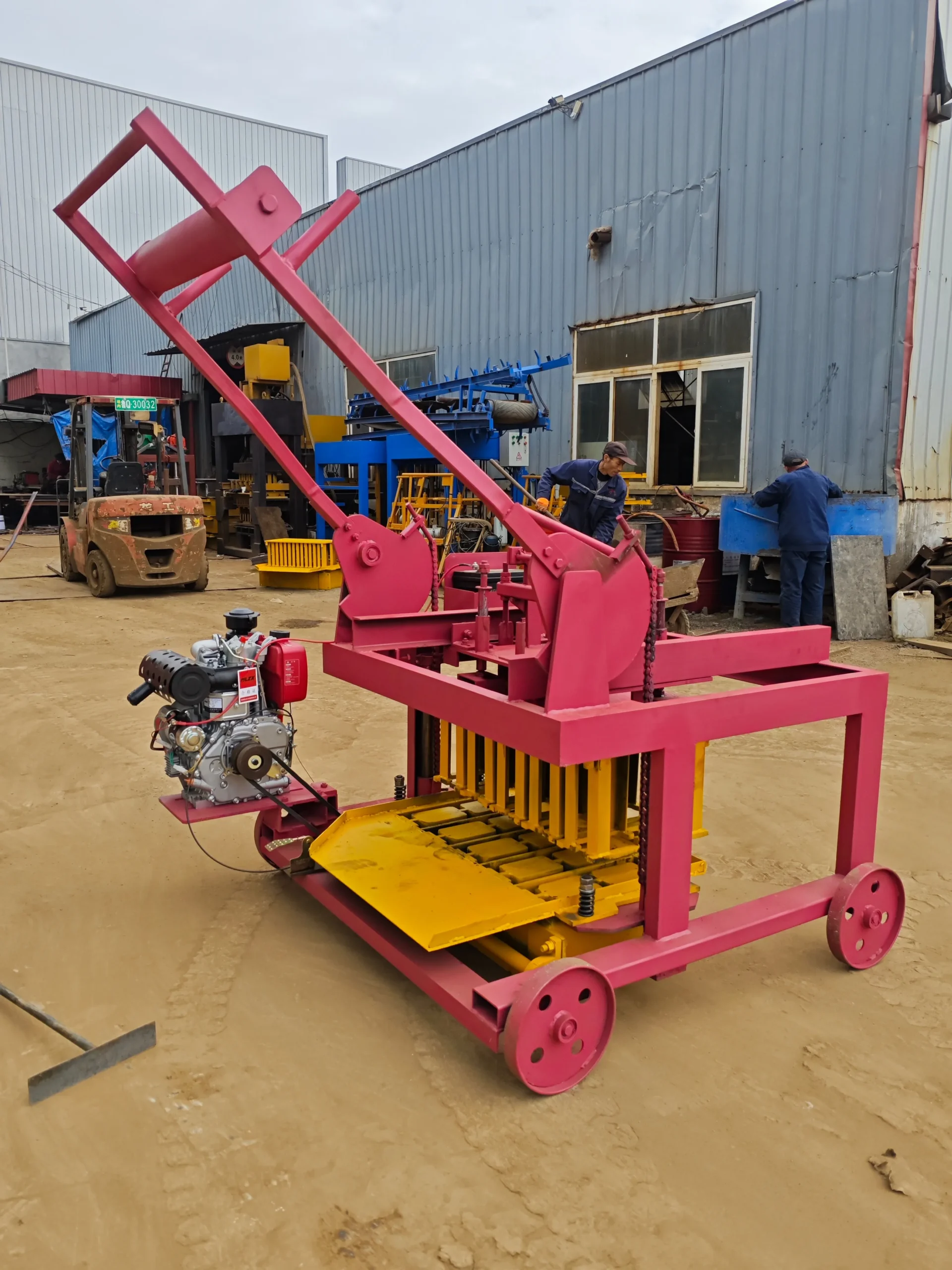
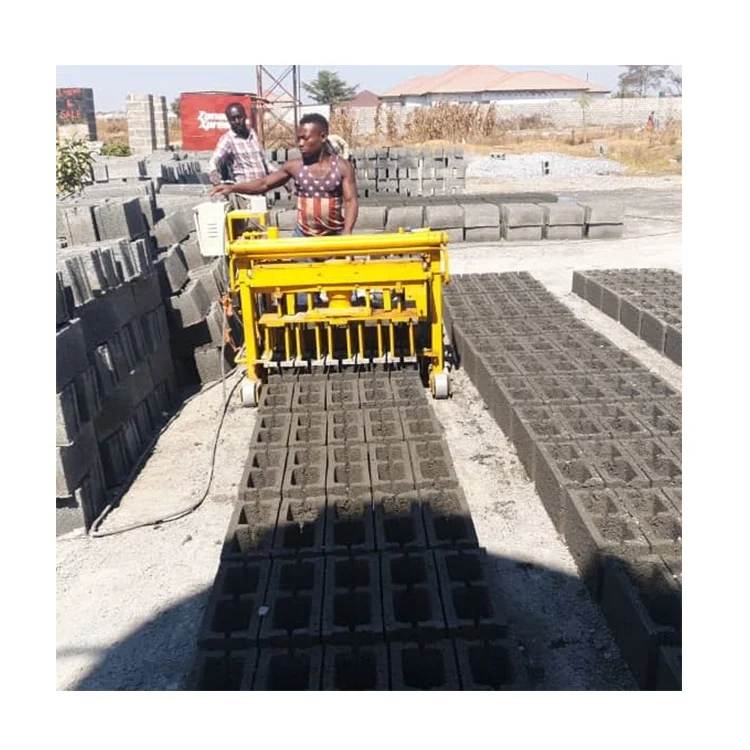 Mobile block machine