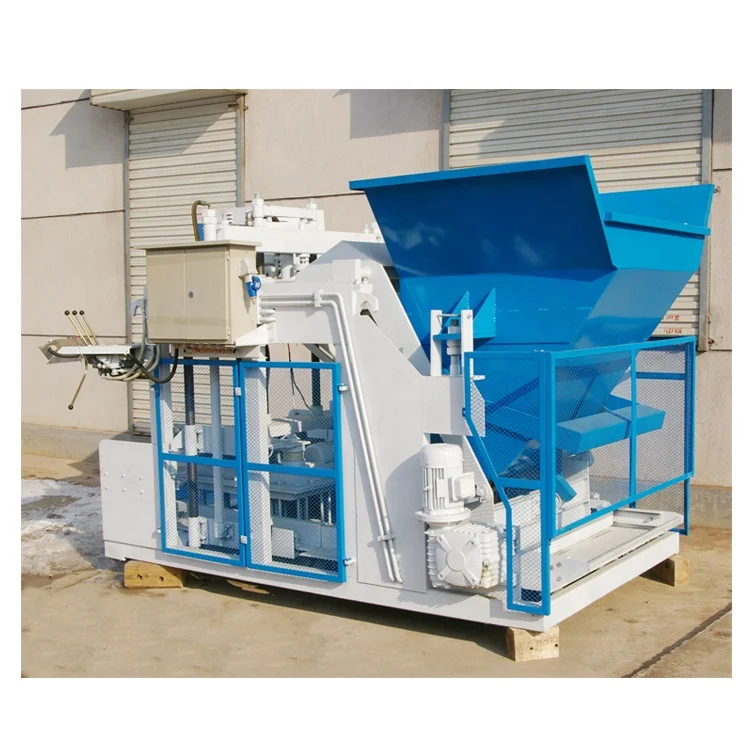
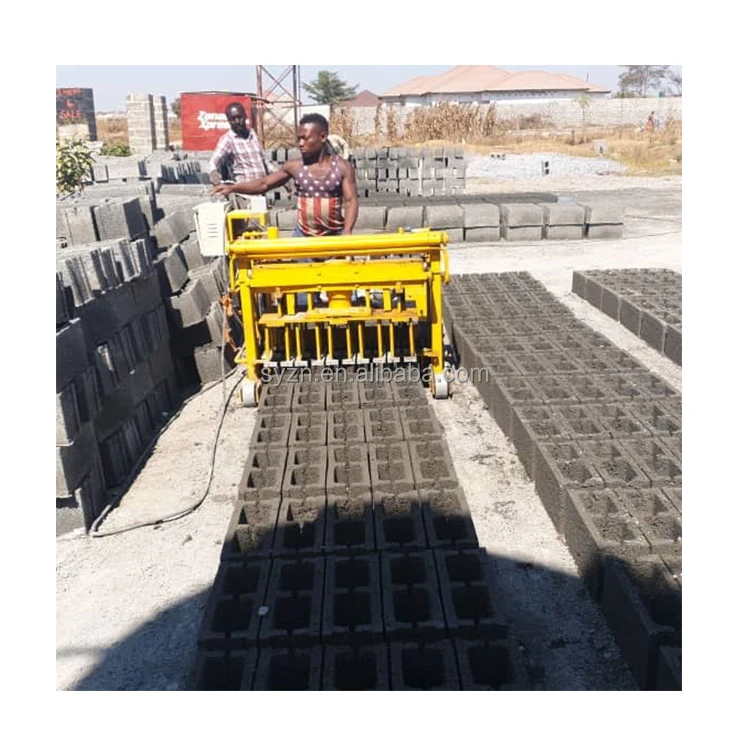
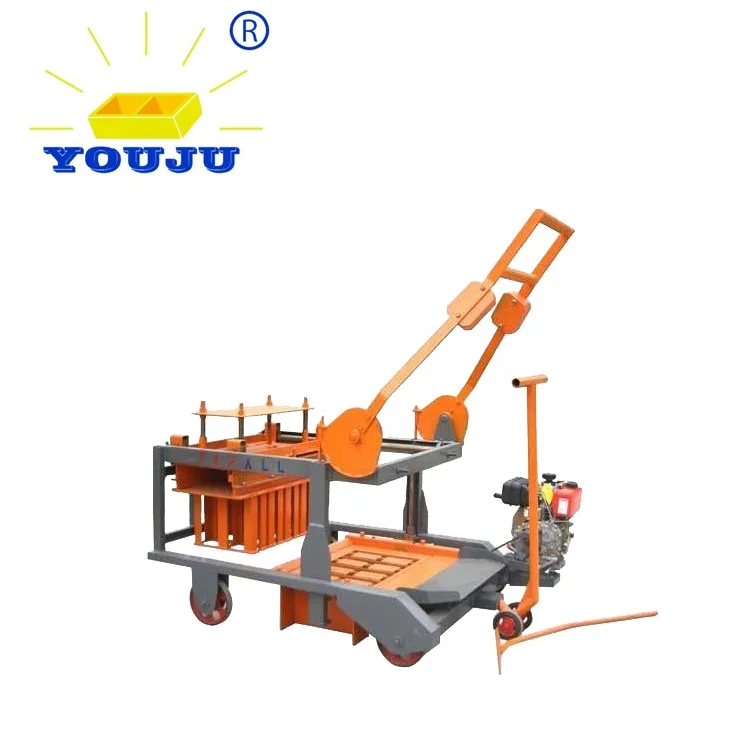
Matched System Specifying — the QMR4-45 is configured against your actual site conditions, local aggregate, and target block format rather than shipped as a catalogue default.
Technical Specifications
| Parameter |
Value |
| Model |
QMR4-45 |
| Product Type |
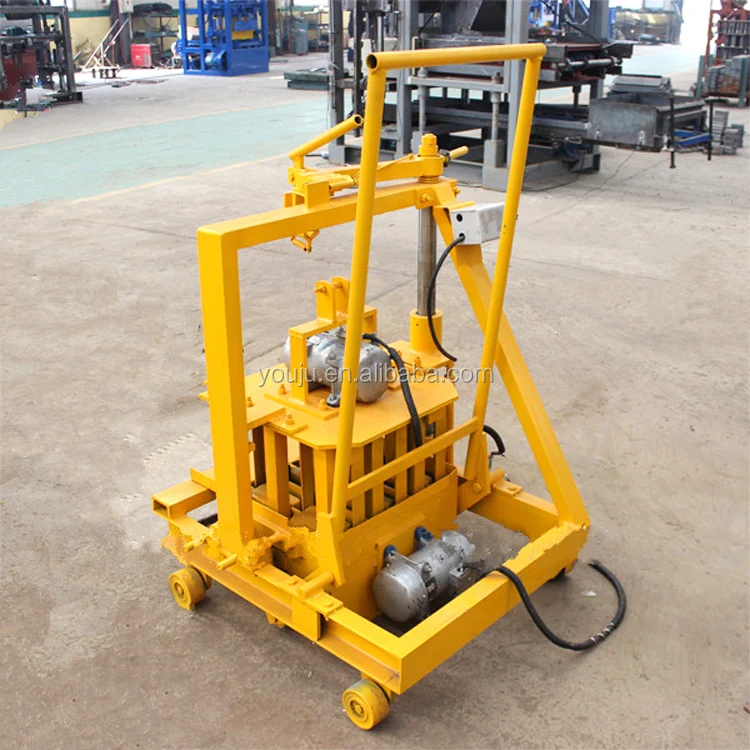
Mobile Egg-Laying Block Machine |
| Overall Dimensions (L×W×H) |
1100 × 950 × 2100 mm |
| Net Weight |
810 kgs |
| Molding Cycle |
30–45 s |
| Power Source |
Diesel / Petrol Engine / Electric (configurable) |
| Output Capacity |
2,560 pcs/day (basis not stated in source — confirm block format / material / thickness) |
| Pallet Requirement |
No pallet required (egg-laying type) |
| Mobility |
Mobile, moveable on-site |
| Basic Equipment |
JZC350 Diesel Concrete Mixer or JQ350 Diesel Concrete Mixer (Electric Generating Unit); Trolley |
| Structure |
Linear type, simple structure |
| Compatible Formats |
Paver brick, hollow block, concrete block, solid brick, fly ash brick |
| Warranty |
1 Year |
Application Suitability
| Application |
Material or Output |
| On-site hollow block production at housing projects |
Crushed stone, sand, cement, water |
| Remote or off-grid paver brick manufacturing |
Fly ash, sand, cement blends |
| Contractor-driven solid block production on construction sites |
Local aggregate with cement binder |
| Small-scale entrepreneur first block plant |
Various concrete mixes, fly ash mixes |
What "2,560 Pieces per Day" Leaves Out for a Mobile Block Machine
A daily output number without a stated block format is a marketing figure, not a planning figure.
I have seen buyers receive mobile block machine quotations promising a daily capacity, only to discover on arrival that the number assumed a small solid brick while their market actually demands 200 mm hollow blocks — cutting real output to a fraction. The QMR4-45 molding cycle runs between 30 and 45 seconds, and that cycle time shifts depending on block height, wall thickness, and mix consistency. When you are comparing a mobile block machine manufacturer offer against another, the first question must be: which exact block format and dimensions does that capacity number assume? [NEED_CITE: block format impact on cycle time and daily output] Without that answer, your production planning and revenue projections rest on guesswork.

Where the QMR4-45 Sits in the Complete Block Machine Range
Before committing to any press, a buyer needs to understand the full range and where each tier fits. The QMR4-45 occupies the mobile, egg-laying tier — purpose-built for contractors who produce blocks directly on a construction site without a fixed plant footprint. Unlike stationary semi-automatic or fully automatic lines that require a dedicated building, curing racks, and pallet circulation systems, this mobile block machine manufacturer offering lays blocks directly on prepared ground and moves forward as production progresses.
Power Source Flexibility for Off-Grid and Unstable-Grid Sites
Diesel, petrol, and electric power options mean the QMR4-45 can be matched to whatever your site actually offers. On remote housing developments where grid electricity has not yet reached the plot, a diesel engine paired with the JZC350 mixer keeps production running independently. Where grid power exists but voltage fluctuates, the electric generating unit option provides a buffer. Confirming the power source before production begins avoids the situation I once faced in Colombia — arriving at a site to find the machine specified for a voltage the local grid could not sustain, forcing days of rework before the first block was laid. [NEED_CITE: voltage and frequency standards by export market]
How Molding Cycle and Structure Shape Real Output
The 30–45 second molding cycle range reflects the spread across different block formats the QMR4-45 can produce. A thin paver brick completes its press cycle faster than a tall hollow block that requires longer vibration to consolidate the deeper cavity walls. The linear, simple structure means fewer hydraulic stages and a straightforward mechanical sequence — the press lowers, vibrates, lifts, and the machine is wheeled forward. This simplicity keeps on-site maintenance manageable: an operator with basic mechanical training can handle routine adjustments without waiting for specialist support, which matters when your production site is hours from the nearest service centre.
When Skipping Ground Preparation Becomes a Costly Mistake
Egg-laying machines deposit wet blocks directly on the ground, which means the surface condition is part of your production system whether you plan for it or not. An uneven or soft floor causes blocks to settle unevenly during curing, producing dimensional inconsistency and breakage when they are later moved. I have visited sites where the contractor skipped ground levelling to save a day of preparation, only to lose a significant portion of the first week’s output to cracking and warping. [NEED_CITE: ground surface preparation requirements for egg-laying block machines] The QMR4-45 eliminates pallet cost and handling labour, but it shifts that requirement to the ground itself.
Why Sourcing from a Single-Focus Manufacturer Matters
Block machinery is the sole product line here, which means the QMR4-45 machine, its moulds, the mixer, and the trolley are specified as one matched system rather than assembled from unrelated suppliers. Configuration is set against your actual mix design and local aggregate, not a generic default that may not suit your raw materials. Mould design covers the formats your market sells, with custom drawings available when standard options do not match. The automation level is selectable — you can start with this mobile unit and later step up to a semi-automatic or automatic line as demand grows. Installation support includes operator training on the exact machine you receive, not a generic video.
Documentation & Verification
- Line layout and capacity calculation stating the exact block format assumed for quoted output
- Machine specification sheet confirming power source, dimensions, and molding cycle range
- Mould drawing and format list showing every compatible block type and cavity count
- Voltage and control language confirmation when electric power source is selected
- Factory test record and packing photographs captured before container loading
Installation, Commissioning & Support
- Levelled and compacted ground surface prepared across the full production travel path before the 1100 × 950 mm machine arrives
- Diesel fuel supply or electric circuit rated for the selected JZC350 or JQ350 mixer power draw
- Machine delivered assembled on trolley — no heavy foundation or fixed plant construction required
- First-run molding cycle verified against your specific mix design and target block format on site
- Operator training covering mould change procedure, engine maintenance, and block curing protocols
- Wear parts and mould inventory list provided for planning your first replacement order
What to Include in Your Inquiry
When you are ready to size a mobile block machine for your project, share the exact block formats and dimensions your market requires, the daily output you need per format, and whether your site has reliable grid electricity or requires diesel power. If you already have a mixer or trolley on site, mention that so the quotation avoids duplicating equipment you do not need.
Frequently Asked Questions
Q: How is the 2,560 pcs/day output verified — which block format does it assume?
A: That figure requires confirmation of the specific block format, wall thickness, and mix design used during testing. A small solid brick cycles faster than a 200 mm hollow block, so the same machine produces different daily totals depending on what you press. We provide a capacity calculation that states the exact format assumed, so your planning is based on your actual product, not a generic number.
Q: Which power source suits my site conditions best?
A: Diesel suits remote or off-grid sites where no electrical supply exists. Petrol offers a lighter-fuel alternative for smaller operations. Electric works where grid power is stable and available at the correct voltage and frequency. We confirm your site’s power conditions before specifying the engine or motor, so the machine arrives ready to run.
Q: What block formats and mould options are available for the QMR4-45?
A: Compatible formats include paver brick, hollow block, concrete block, solid brick, and fly ash brick. Custom mould designs are available to buyer drawings when standard options do not match your market requirements. A full format list and mould drawing are provided before production begins.
Q: What are the site preparation requirements for egg-laying operation?
A: The ground must be levelled, compacted, and free of soft spots across the entire area where blocks will be laid. An uneven surface causes blocks to deform during curing. Unlike pallet-based machines, the QMR4-45 shifts the flatness requirement from purchased pallets to the ground itself, so site preparation is a production step, not an afterthought.
Q: Where does the mobile machine sit in the full range — when should I step up?
A: The QMR4-45 is the entry point for on-site production without a fixed plant. When your daily volume outgrows mobile capacity, or when you need multiple block formats running in the same shift with faster mould changes, a semi-automatic stationary line with pallet handling and stacking becomes the logical next step.

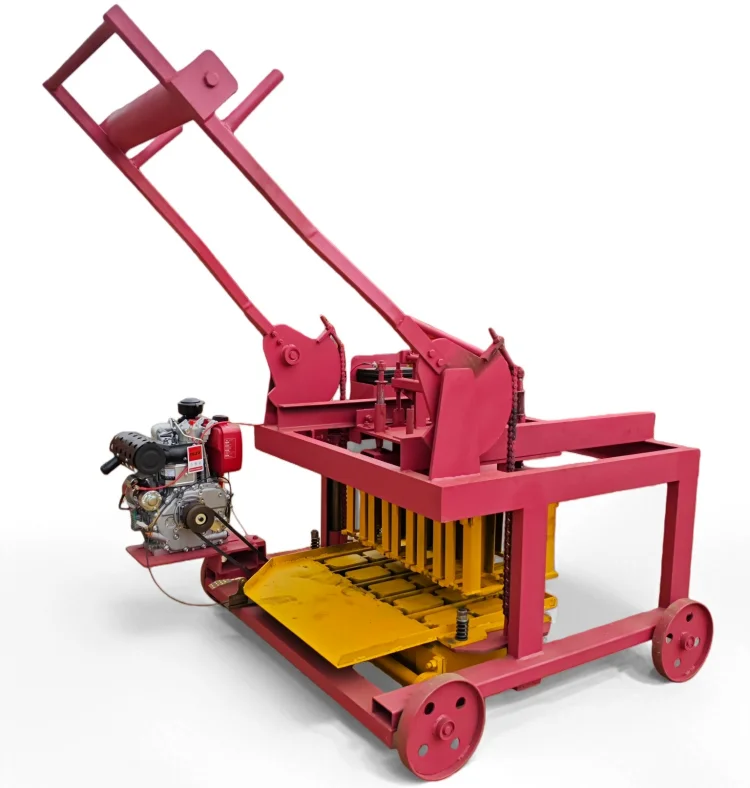
 Mobile block machine