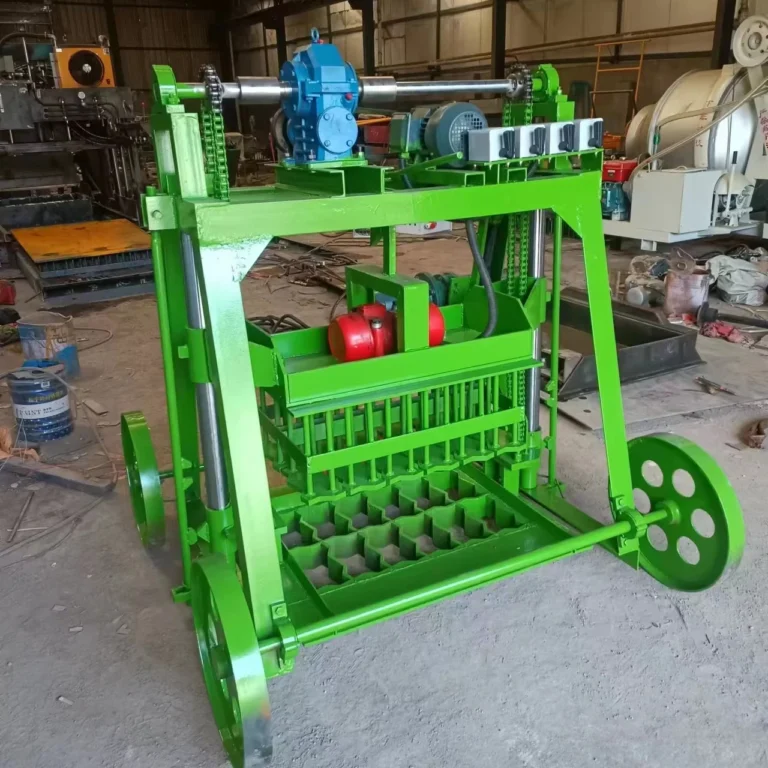
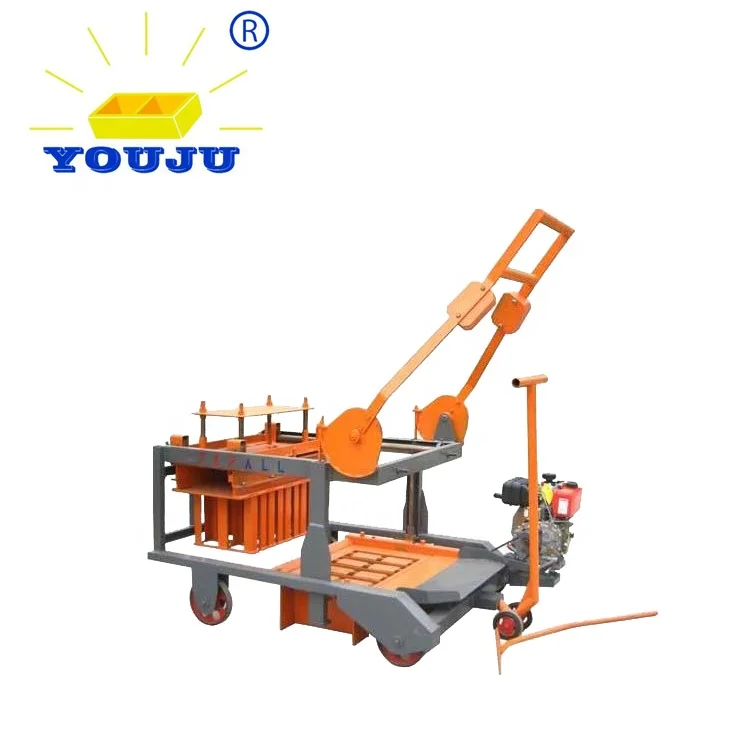
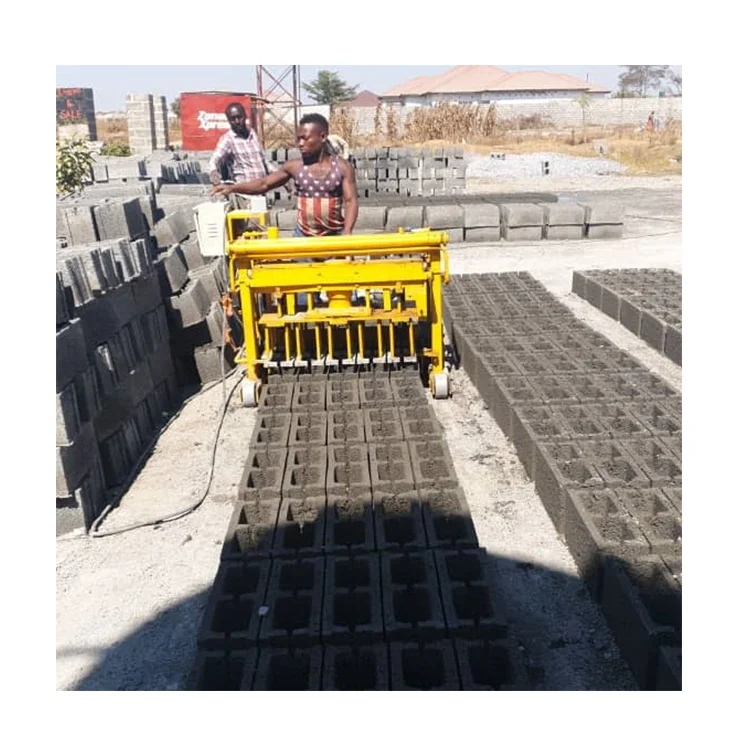
Matched System Design — Every QMJ2-45 configuration pairs the press, mould and pallet handling as one verified unit rather than separate catalogue picks, keeping site-level output predictable.
Technical Specifications
| Parameter |
Value |
| Model |
QMJ2-45 |
| Product Type |
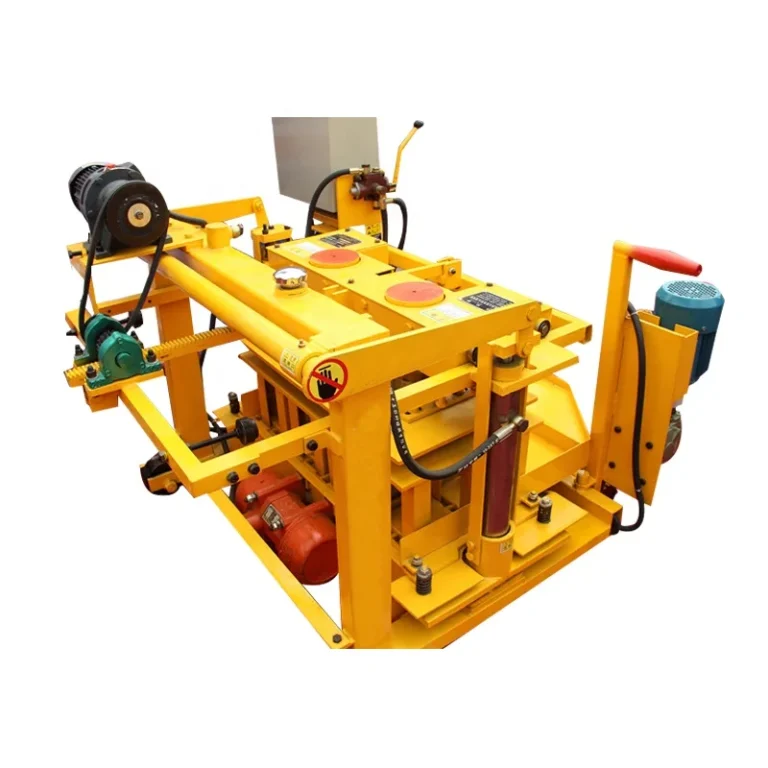
Mobile Concrete Block Making Machine |
| Pallet Requirement |
No pallets required |
| Labor Requirement |
1 to 3 workers |
| Mould Change |
Manual swap supporting multiple hollow brick formats |
| Cycle Time |
25–30 s |
| Output Capacity |
160 pcs/h (based on 400×200×200 mm hollow brick, 2 pcs/mould) |
| Output Capacity |
240 pcs/h (based on 400×150×200 mm hollow brick, 3 pcs/mould) |
| Output Capacity |
320 pcs/h (based on 400×100×200 mm hollow brick, 4 pcs/mould) |
| Daily Output (8 hr) |
1,280 pcs (based on 400×200×200 mm hollow brick) |
| Daily Output (8 hr) |
2,560 pcs (based on 400×100×200 mm hollow brick) |
| Power Source |
Configurable (verify against site supply) |
| Control System |
Manual operation (no PLC) |
| Automation Level |
Manual |
| Mobility |
Free-moving, no fixed plant required |
| Standards |
ISO 9001:2000, CE |
Application Suitability
| Application |
Material or Output |
| On-site housing project block production |
Hollow concrete blocks from crushed stone, sand and cement |
| Startup block plant in limited space |
Small-volume hollow brick runs without a fixed curing yard |
| Remote infrastructure contractor supply |
Intermittent hollow block batches moved between job sites |
| Building material distributor field unit |
Supplementary mobile block making machine for sale to temporary locations |
Why Quoted Capacity Numbers Mislead Buyers on Mobile Block Machines
A capacity figure is only honest when the block format behind it is stated in the same sentence.
Suppliers frequently quote the highest possible cycle rate of a mobile block making machine for sale without naming the block size that rate assumes. On a Latin American housing project I visited, the crew expected 320 blocks per hour because that was the number on the quotation, yet their market demanded the 200 mm width format which delivers closer to 160 pieces per hour on this machine class. The gap between expectation and reality stretched the build schedule by several weeks and forced overtime labor [NEED_CITE: common block format demand by Latin American market].

Where the QMJ2-45 Sits in the Full Mobile Range
The QMJ2-45 occupies the entry tier of the mobile block making machine range, aimed at contractors who need blocks produced directly on the ground without investing in pallets or a curing rack system. Buyers who anticipate steady daily volumes above the 1,280-piece mark on 200 mm hollow bricks typically step up to a semi-automatic tier that introduces pallet conveying and mechanical stacking.
Choosing the Right Tier Before the First Container Ships
Scaling up later costs more than selecting the correct tier at the outset. A semi-automatic line adds pallet feeding and a simple stacker, reducing manual handling but demanding a flat curing area large enough to hold a day’s output on pallets. If the site has no room for that curing footprint, the mobile block making machine for sale at this tier remains the practical choice, even when volume ambitions grow [NEED_CITE: pallet curing area requirements for small block plants].
Reading the Specs That Actually Shape Daily Output
Cycle time of 25–30 seconds governs the theoretical ceiling, yet real throughput depends on how quickly the operator feeds the mix and clears the finished block. Manual mould change means swapping to a different hollow brick width takes the line offline until the new mould is bolted and aligned, which is acceptable when format changes happen once a week but painful when they happen daily. Because no pallets are required, the curing area can be any flat ground, eliminating the cost of timber or bamboo pallets that wear out after a few dozen cycles.
What Happens When Wear Parts Are Overlooked Before Shipment
I once watched a crew in coastal Peru stand idle for nearly two weeks because the first set of vibration springs and hydraulic seals wore through and no spares had been packed. A machine this size carries a small spare parts envelope, yet missing even one seal can halt the entire site. The cost is not the part itself but the labor standing around waiting for air freight [NEED_CITE: typical lead times for air-freighted spare parts to remote sites].
Why Sourcing from a Single-Focus Block Machinery Supplier Matters
Block machinery is the only product line here, so the QMJ2-45 arrives with moulds, wear parts lists and handling accessories specified as one matched set rather than assembled from unrelated vendors. Configuration is adjusted to the buyer’s actual mix design and local aggregate instead of a catalogue default, reducing the chance that the machine arrives tuned for a sand grade the site cannot source. Mould design covers the hollow brick formats the buyer’s market actually sells, and custom drawings are available when local building codes demand non-standard dimensions. Automation level is selectable, letting a buyer start with manual operation and add pallet handling later without replacing the press.
Documentation & Verification
- Line layout stating the block format assumed in the capacity calculation
- Machine specification sheet with cycle time per hollow brick size
- Mould drawing and format list for cross-checking against local demand
- Factory test record run on the buyer’s target block dimensions before dispatch
- Operation and maintenance manual with wear parts replacement intervals
Installation, Commissioning & Support
- Verify site voltage and frequency before the QMJ2-45 leaves the factory to avoid motor rewinding delays
- Confirm ground flatness across the laying area so freshly pressed blocks do not tilt during initial cure
- Schedule operator training on mould change procedure to keep format swaps within a single shift
- Include a first set of vibration springs and hydraulic seals in the shipment to cover the initial maintenance cycle
- Agree on a daily greasing routine for the guide columns to extend wear part life between replacements
Next Steps for a Serious Inquiry
Share the hollow brick dimensions your market moves fastest, the daily volume you need to sustain, and the voltage standard at your site. If local aggregate differs from standard river sand, send a sieve analysis so the mix can be matched before the machine is built.
Frequently Asked Questions
Q: How is the output capacity calculated and which block format does each figure assume?
A: Every capacity figure listed for the QMJ2-45 is tied to a specific hollow brick size and a 25–30 second cycle time. The 160 pieces per hour rate assumes a 400×200×200 mm block with two cavities per mould, while the 320 pieces per hour figure applies to a narrower 400×100×200 mm block with four cavities per mould.
Q: When should a buyer step up from the QMJ2-45 to the next tier?
A: If daily demand consistently exceeds what a single eight-hour shift can deliver on the target block format, a semi-automatic machine with pallet feeding and mechanical stacking becomes the logical next step. The QMJ2-45 remains the right choice when site space is limited or capital must stay minimal.
Q: What voltage and power supply options are available for different export markets?
A: The QMJ2-45 can be configured to match common industrial voltage and frequency standards across Latin America, Africa and Southeast Asia. Buyers must confirm the exact site supply before production begins so the motor and control wiring arrive ready for immediate connection.
Q: How long does a mould change take, and what formats can be added later?
A: A manual mould swap on this machine class typically takes one operator a portion of a shift including alignment checks. Additional hollow brick moulds can be ordered to buyer drawings at any time, allowing new formats to be introduced without replacing the press.
Q: What installation support and operator training are included?
A: The supplier provides a commissioning guide covering ground preparation, first-run mix adjustment and mould change technique. On-site training can be arranged to walk the crew through daily maintenance routines and wear part replacement so the team is self-sufficient after handover.

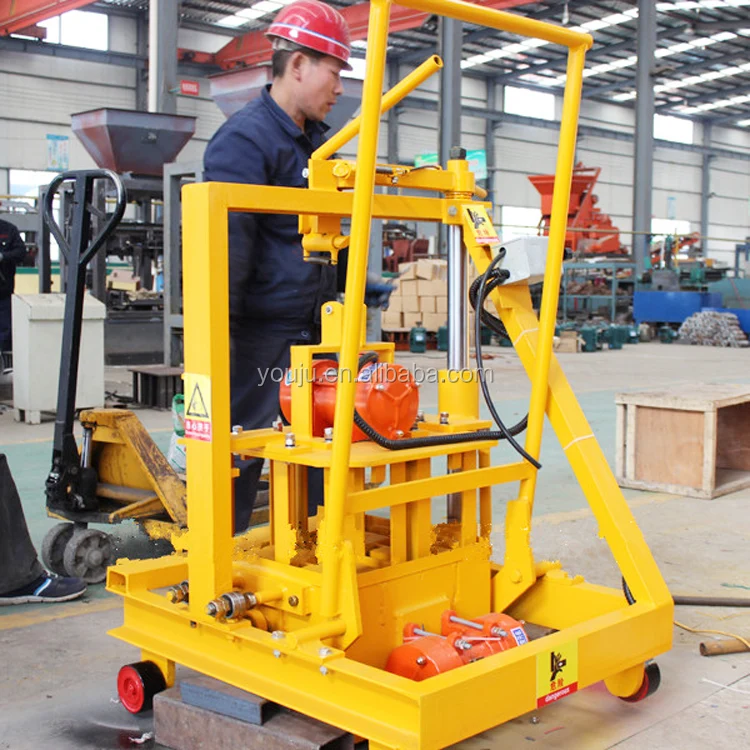
 Mobile block machine