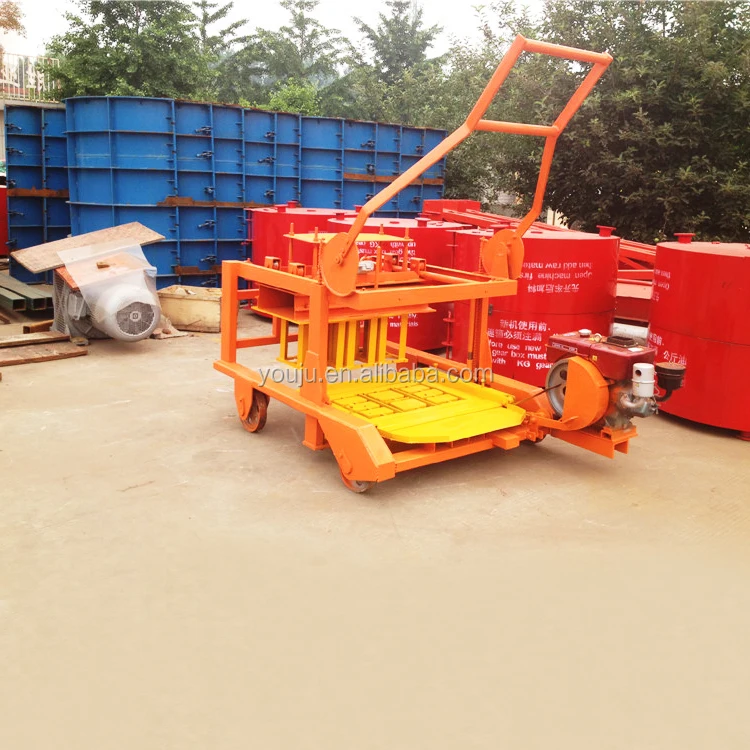
Single Focus Engineering — Block machinery is our only product line, so the QMJ2-45 mobile block machine for sale is specified as a complete system with matched mould and handling rather than a standalone press assembled from separate suppliers.
Technical Specifications
| Parameter |
Value |
| Model |
QMJ2-45 |
| Product Type |
Mobile Concrete Block Making Machine |
| Automation Level |
Manual |
| Power Source |
Engine (voltage and frequency N/A) |
| Mould Format |
Hollow brick |
| Block Size Option 1 |
400×200×200 mm, 2 pcs/mould |
| Output Capacity (Option 1) |
160 pcs/h based on 400×200×200 mm hollow brick |
| Daily Output (Option 1) |
1,280 pcs per 8-hour shift based on 400×200×200 mm hollow brick |
| Block Size Option 2 |
400×150×200 mm, 3 pcs/mould |
| Output Capacity (Option 2) |
240 pcs/h based on 400×150×200 mm hollow brick |
| Daily Output (Option 2) |
1,920 pcs per 8-hour shift based on 400×150×200 mm hollow brick |
| Block Size Option 3 |
400×100×200 mm, 4 pcs/mould |
| Output Capacity (Option 3) |
320 pcs/h based on 400×100×200 mm hollow brick |
| Daily Output (Option 3) |
2,560 pcs per 8-hour shift based on 400×100×200 mm hollow brick |
| Molding Cycle |
25–30 seconds |
| Pallet Requirement |
None (egg-laying on ground) |
| Labor Requirement |
1 to 3 workers |
| Mobility |
Move freely within small spaces |
| Mould Change |
Easily changed to produce different hollow brick formats |
| Overall Dimensions |
(basis not stated in source) |
| Net Weight |
(basis not stated in source) |
| Rated Power |
(basis not stated in source — confirm engine specification) |
Application Suitability
| Application |
Material or Output |
| On-site hollow block production for housing projects |
Concrete mix with crushed stone, sand, and cement |
| Small workshop block manufacturing |
Local aggregate blends with varying particle sizes |
| Contractor self-supply on remote construction sites |
Engine-driven operation independent of grid power |
| First-time block yard startups |
Low-capital entry with manual operation and no pallets |
What "Pieces per Hour" Actually Means for a Mobile Block Machine for Sale
Capacity figures are meaningless without the block format attached to them.
I have watched buyers compare two machines by the hourly number on the quotation, only to discover the higher figure assumed a smaller block the buyer never planned to sell. The QMJ2-45 produces 160 pieces per hour when moulded for 400×200×200 mm hollow blocks, but switches to 320 pieces per hour on 400×100×200 mm blocks — a doubling that has nothing to do with machine speed and everything to do with cavity count. When you are evaluating any mobile block machine for sale, always ask which exact block dimension the quoted capacity assumes before comparing numbers across suppliers [NEED_CITE: capacity calculation standards for concrete block machinery].

Where This Mobile Block Machine for Sale Fits in the Range
The QMJ2-45 sits at the entry tier of the mobile category: manual operation, engine-driven, no pallets, and no fixed plant infrastructure. Buyers who need higher daily volume or multiple block formats beyond hollow bricks will find semi-automatic stationary lines further up the range. This model targets contractors and first-time entrepreneurs who need to start production with minimal capital and maximum site flexibility.
Operating Without a Fixed Plant or Grid Connection
The egg-laying design deposits blocks directly onto a level concrete floor, removing the pallet purchase and pallet storage area from your budget entirely. The diesel engine eliminates dependence on local voltage and frequency, which matters when the project site has no transformer or when grid supply is unreliable. This independence is a practical advantage across regions where three-phase power is unavailable or where generators add a separate capital line item [NEED_CITE: power supply reliability in remote construction zones].
Reading the Specs That Matter
The molding cycle of 25–30 seconds sets the rhythm for your entire operation. Because this is a manual machine, the actual cycle depends on how quickly your operator feeds the mix and repositions the unit — a trained two-person team typically holds the lower end of that range while a single operator drifts toward the upper. The vibration force and the mix design must be matched: if your local sand is fine-graded, you may need to adjust the cement ratio to maintain block wall thickness and compressive strength. The mould change process is mechanical, requiring hand tools rather than hydraulic clamps, which keeps the swap simple but means your crew should practice the procedure before committing to a format change mid-shift. No pallets means no pallet wear cost, but it does require a smooth, level curing surface that is at least as large as your daily output footprint.
The Hidden Cost of Skipping the Mix Confirmation
When a buyer orders without sharing their local aggregate sieve analysis and cement type, the machine arrives configured for a standard mix that does not match what is actually available on site. The blocks crack during curing, wall density drops below specification, and the contractor blames the machine. In my experience, this mismatch accounts for more commissioning disputes than any mechanical fault. A manual mobile block machine for sale has fewer systems to troubleshoot than an automatic line, but the mix-to-mould relationship still determines whether the output meets the strength grade the buyer promised their client [NEED_CITE: concrete mix design variables affecting block compressive strength].
Why Source This Machine Here
Block machinery is our single product focus, so every QMJ2-45 leaves the factory with mould and engine matched as one system rather than sourced from separate vendors. We configure the machine against your stated block format and local aggregate, not a catalogue default. Mould design covers the hollow brick dimensions your market actually buys, and custom mould drawings are available when your specification falls outside the standard range. The automation level is selectable across our full range, meaning you can start with the QMJ2-45 manual tier and later transition to a semi-automatic line without changing suppliers. Installation and commissioning support includes operator training on mould change and daily maintenance routines.
Documentation & Verification
- Machine specification sheet confirming engine model, mould cavity count, and cycle time per block format
- Mould drawing showing hollow brick dimensions and wall thickness tolerances
- Capacity calculation stating which block size each output figure assumes
- Operation and maintenance manual with mould change procedure and lubrication schedule
- Factory test record run on your target block format before dispatch
- Packing photographs showing machine securing and container loading arrangement
Installation, Commissioning & Support
- Requires a level concrete floor with sufficient area to cure the daily output of up to 2,560 blocks based on 400×100×200 mm format
- Engine-driven unit with no electrical connection needed — confirm fuel type and local availability before dispatch
- Machine ships partially assembled; final assembly of mould frame and engine mount completed on site
- First production run supervised remotely to confirm cycle time and block density against your mix design
- Operator training covers manual feeding technique, mould swap procedure, and daily vibration motor inspection
- Wear parts list included with recommended spare mould liners and vibration block bushings for the first replacement cycle
Before You Request a Quotation
Tell us which hollow brick dimensions you plan to produce and your target daily output so we can confirm the QMJ2-45 is the right tier or recommend a higher-capacity model. Share your local aggregate type and cement grade so the machine can be set up for your actual mix. Let us know whether the site has grid power available or if engine-only operation is required, and specify any block formats beyond the standard hollow range you may want to add later.
Frequently Asked Questions
Q: What daily output can I expect from the QMJ2-45 on different block sizes?
A: The daily output depends entirely on which block format you run. On 400×200×200 mm hollow blocks, the machine produces 1,280 pieces per eight-hour shift. On 400×150×200 mm it reaches 1,920 pieces, and on 400×100×200 mm it produces 2,560 pieces. These figures assume a trained crew maintaining a 25–30 second molding cycle with consistent material feed.
Q: Can the QMJ2-45 operate in areas with no electricity?
A: Yes. The QMJ2-45 is engine-driven, so it does not require any electrical connection. This makes it suitable for remote construction sites where grid power is unavailable or unreliable. Before ordering, confirm the fuel type available at your site so the engine specification can be matched accordingly.
Q: How long does a mould change take on this manual mobile machine?
A: Mould changeover on the QMJ2-45 is mechanical and uses hand tools rather than hydraulic clamps. A trained two-person crew can complete the swap within a short break period. The exact time depends on the complexity of the new mould and how familiar the operator is with the procedure.
Q: Is this machine suitable if I plan to scale up production later?
A: The QMJ2-45 is designed as an entry-tier machine for small-scale or on-site production. If your volume grows, you can move to a semi-automatic or fully automatic block line within the same supplier range, keeping continuity in mould design and spare parts support.
Q: What information do I need to provide before ordering?
A: Share your target block dimensions, expected daily volume, local aggregate type and sieve analysis, cement grade, and whether the site has grid power or requires engine-only operation. This lets us configure the machine and mould to your actual conditions rather than a generic default.

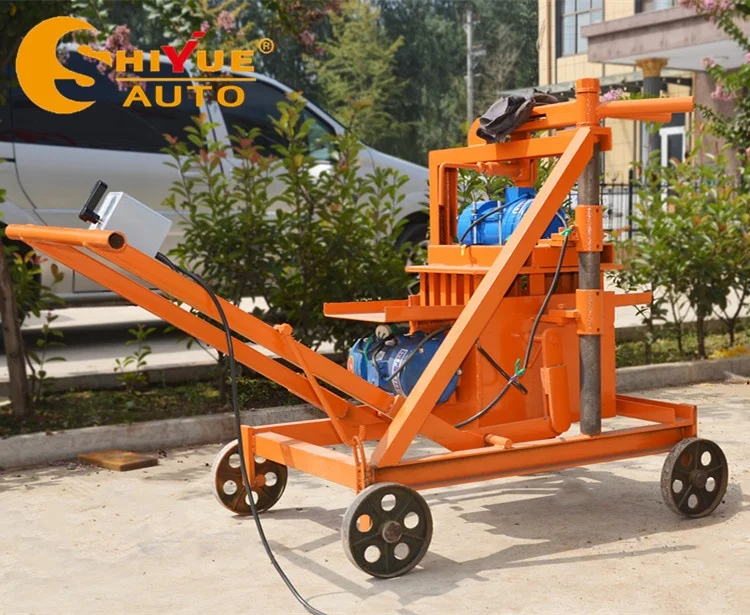
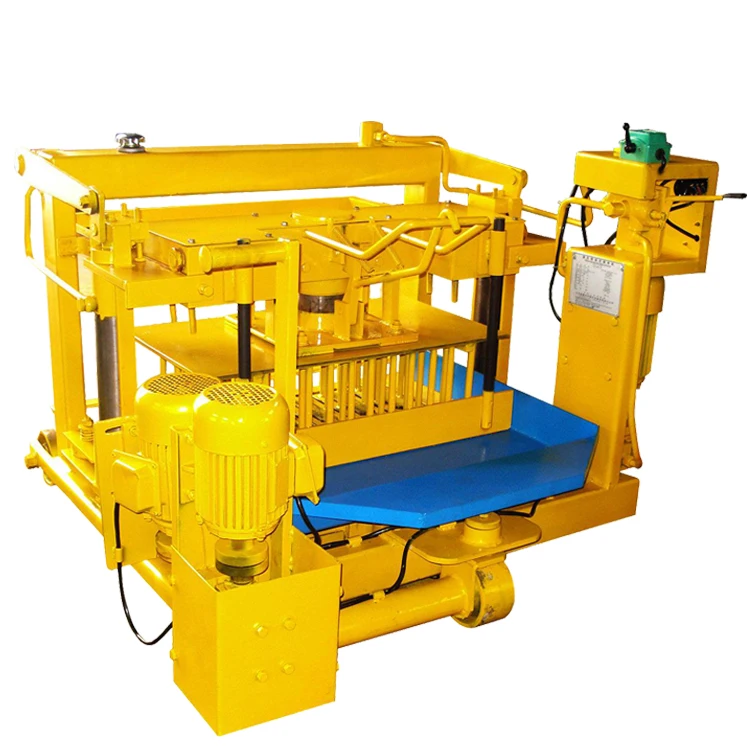 Mobile block machine