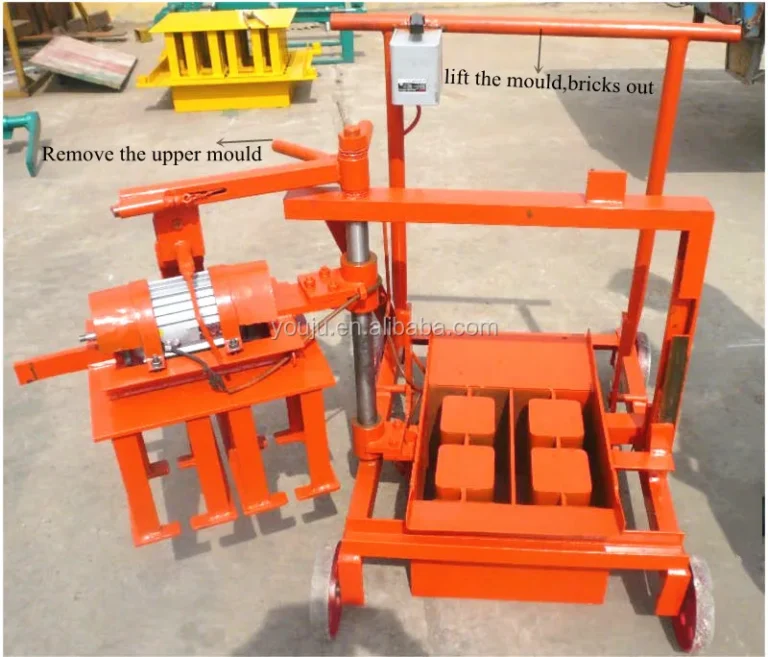
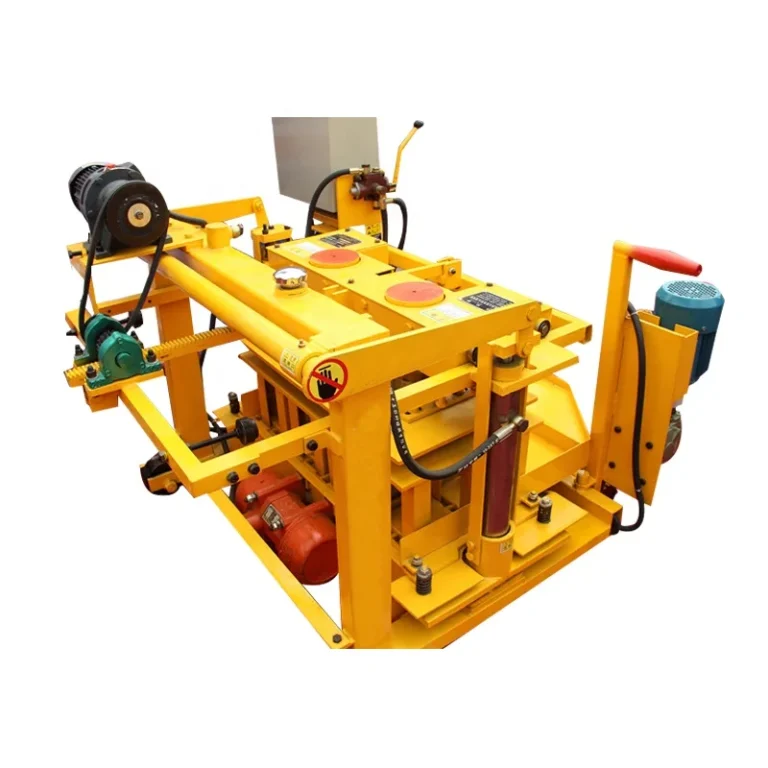
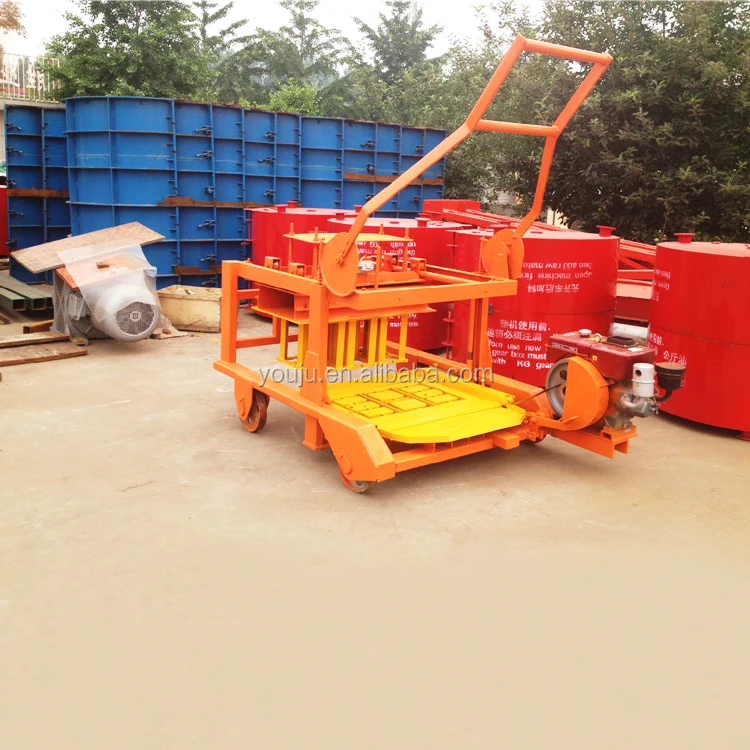
Matched System Design — The QMJ4-45 egg laying block machine manufacturer approach treats the press, mould, and pallet spec as a single configuration built around your local aggregate and target block format, not a catalogue default shipped as-is.
Technical Specifications
| Parameter |
Value |
| Product Type |
Manual Egg-Laying Block Making Machine |
| Model |
QMJ4-45 |
| Vibration Method |
Mold vibration (twice-vibration molding core) |
| Vibration Frequency |
2400 r/m |
| Molding Cycle |
40-45 S |
| Mould Format Options |
Hollow block (400×200×200mm, 400×150×200mm, 400×120×200mm) |
| Productivity by Format |
3000 pcs/day for 400×200×200mm; 3500 pcs/day for 400×150×200mm; 4500 pcs/day for 400×120×200mm (based on an 8-hour shift) |
| Demold / Turning Method |
Manual |
| Total Power |
6 KW |
| Power Source |
Diesel/Petrol engine |
| Automation Level |
Manual |
| Voltage & Frequency |
Not applicable (engine powered) |
| Control System |
Not applicable (manual operation) |
| Warranty |
One year guarantee for the whole machine |
Application Suitability
| Application |
Material or Output |
| On-site construction projects |
Hollow blocks formed from local crushed stone, sand, and cement without a fixed batching plant |
| Remote housing developments |
Engine-powered production where grid electricity is unstable or unavailable |
| First-time block entrepreneurs |
Low-footprint hollow block manufacturing with minimal material handling infrastructure |
| Existing cement product yards |
Adding hollow block formats to a current range using established curing areas |
What "4000 Pieces Per Day" Actually Means for Your Site
Daily output figures are meaningless unless they name the exact block format and shift length behind the number.
Many mobile block machine quotations list a single peak productivity number that assumes the smallest, lightest block in the mould range. When the buyer starts running the 400×200×200mm hollow block that their market actually demands, the real daily count drops noticeably. I have watched project timelines slip because the site engineer planned material orders around a catalogue number that never applied to their primary format [NEED_CITE: common discrepancies in mobile block machine output claims]. The QMJ4-45 egg laying block machine manufacturer documentation ties every output figure to a specific hollow block dimension and an eight-hour shift, so your procurement and curing space calculations start from a verified baseline rather than a best-case scenario.

Placing the QMJ4-45 Within the Mobile Range
The QMJ4-45 sits at the entry point of the mobile lineup, designed for buyers who need to produce hollow blocks directly on a project slab without investing in a fixed plant foundation, conveyor-fed mixer, or pallet return system. Its engine-powered configuration removes grid dependency entirely, which matters when you are setting up on a greenfield housing site where the temporary power supply cannot handle the starting current of larger hydraulic presses. This QMJ4-45 egg laying block machine manufacturer model fills the gap between hand-tamping and a full stationary line.
How Egg-Laying Operation Changes the Floor Plan
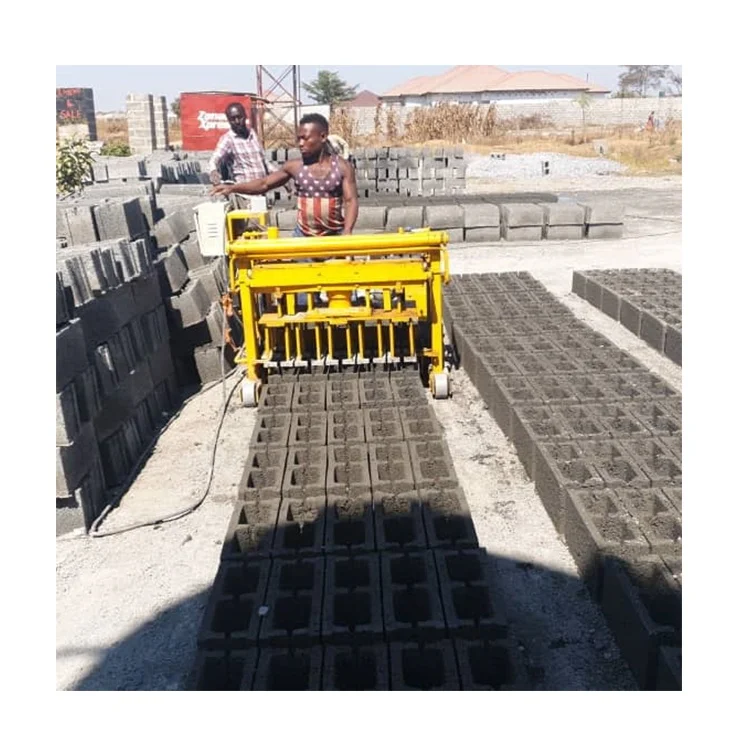
With an egg-laying press, the machine moves forward along the casting floor after each cycle, leaving the freshly formed block on the ground to cure in place. This eliminates the need for production pallets, pallet racks, and a dedicated pallet-handling crew. The trade-off is that the casting surface must be level, clean, and large enough to hold a full day’s output spread across the curing area. The QMJ4-45 is configured for this workflow, with manual demold and turning keeping the operator count low and the maintenance requirement straightforward [NEED_CITE: egg laying block machine floor space and curing area planning].
Reading the Specs That Dictate Block Density
The 2400 r/m vibration frequency and twice-vibration molding core work together to compact the concrete mix around the mould walls, producing a hollow block with more uniform density than a single-pass vibration system can achieve. Because the machine relies on mold vibration rather than a hydraulic ram, the final block strength depends heavily on how well the mix design matches the vibration energy available. A dry, well-graded aggregate blend will consolidate properly in the 40-45 second cycle, while a mix that is too wet or lacks fine particles will slump before the mould lifts. Matching the local sand and crushed stone to this vibration profile is the first conversation we have before confirming the order.
The Hidden Cost of Ignoring the Mix-Vibration Match
When a buyer sources a mobile machine without confirming that the vibration force suits their available aggregate, the blocks leave the mould looking acceptable but fail the drop test after curing. Replacing the sand source, adding a different cement ratio, or re-running an entire batch burns through raw material and delays the project schedule [NEED_CITE: concrete block strength inconsistency from unmatched vibration and mix design]. This is a problem that surfaces weeks after commissioning, when the blocks are already stacked and the wall masonry has started.
Why Source the Full Machine Range From One Point
Every mobile model in the range, including the QMJ4-45, is specified against the buyer’s target block format and local material sample rather than shipped with a default mould. Mould design and supply cover the hollow block sizes your regional market actually moves, with custom drawings available if your project calls for a non-standard dimension. The engine specification is confirmed alongside the machine, so the diesel or petrol unit arrives rated for the ambient temperature and altitude of your site. Automation levels remain selectable across the range, meaning a buyer can begin with this manual model and move to a semi-automatic or fully automatic tier as production volume grows, keeping the upgrade path inside a single supplier relationship.
Documentation & Verification
- Capacity calculation sheet stating daily output per hollow block format and shift length
- Mould drawing package listing included block dimensions and custom design options
- Engine specification confirmation matched to site altitude and ambient temperature range
- Factory test record on the buyer’s aggregate sample before dispatch
- Operation and maintenance manual with wear parts and mould replacement list
Installation, Commissioning & Support
- Level concrete casting floor required, with curing area sized to the confirmed daily output format
- Diesel or petrol engine arrives pre-fitted; fuel and oil specification confirmed before first start
- Manual demold and turning mechanism adjusted on site to the operator’s working height
- First production run supervised to dial in mix moisture against the 2400 r/m vibration frequency
- Wear parts list provided with recommended reorder intervals for mould liners and vibration mounts
Before You Send the Inquiry
To size the QMJ4-45 correctly, share the hollow block dimensions your market requires, the local sand and crushed stone grading you plan to use, and whether the casting floor will be indoors or exposed. Confirm the site altitude and typical daytime temperature so the engine can be rated accordingly. If you already have a curing area in place, provide its dimensions so the daily output format can be matched to the space available.
Frequently Asked Questions
Q: How is daily output calculated and which block format does it assume?
A: Output is calculated per block format over an eight-hour shift. For the QMJ4-45, the 400×200×200mm hollow block yields approximately 3000 pieces, the 400×150×200mm yields 3500, and the 400×120×200mm yields 4500. The capacity sheet provided with your quotation will state the exact format used for any quoted figure.
Q: What mould formats are available and can custom block sizes be designed?
A: Standard moulds cover 400×200×200mm, 400×150×200mm, and 400×120×200mm hollow blocks. Custom mould design is available to buyer drawings, provided the dimensions fit within the machine’s mould change envelope and vibration table footprint.
Q: Is grid power required or can the machine run entirely on a diesel engine?
A: The QMJ4-45 is configured for diesel or petrol engine power, so no grid connection is needed. The engine specification is confirmed during the order process to match the site’s altitude and ambient temperature conditions.
Q: What pallet size is needed and is pallet handling included?
A: This is an egg-laying machine, so it does not use production pallets. Blocks are formed directly on the casting floor and cure in place. No pallet handling, stacking, or rack equipment is required for this model.
Q: What is the lead time from order to site delivery and what installation support is provided?
A: Lead time depends on current production scheduling and mould configuration, typically running several weeks. Installation support includes on-site commissioning, mix adjustment against local aggregate, and operator training on manual demold and engine maintenance procedures.

![Industrial QMJ4-45 Manual Hollow Block Machine | Manufacturer 解析: 1. **Gate**:原标题不为空,继续。 2. **词汇锁**: – 原标题词汇:Industrial, QMJ4-45, Manual, Hollow, Block, Machine, Easy, Operation, Cement, Production, Line, Pavers, Blocks – 分类词汇:Mobile block machine – 草稿补充:Egg-Laying – 站点修饰词:Manufacturer 3. **第一层 (站点修饰词)**: – 目标站:`shiyueblockmachine.com` – 角色:FULL MACHINE RANGE -> Angle: the complete block machine range… Emphasis: helping a buyer place themselves on the range. – 修饰词池:Manufacturer / Factory Supply / Full Range 4. **第二层 (句式结构)**: – 记录ID:83145 – 数字之和:8+3+1+4+5 = 21 – 21 % 6 = 3 – 句式 3:`[应用或物料] [品类词] – [站点修饰词]` 5. **第三层 (修饰词选取)**: – 21 % 3 = 0 -> 选取第 0 个词:`Manufacturer` 6. **组合与调整**: – 应用或物料:Hollow Block / Cement Block – 品类词:Mobile Egg-Laying Machine (或 QMJ4-45 Manual Machine) – 站点修饰词:Manufacturer – 尝试句式 3:`Hollow Block QMJ4-45 Mobile Machine – Manufacturer` – 检查长度:50 字符。 – 优化实词:原标题有 “Industrial”, “Manual”。 – 变体:`Industrial QMJ4-45 Hollow Block Machine – Manufacturer` – 长度:54 字符。符合 50-70 区间。 – 包含:Industrial (原标题), QMJ4-45 (机型号), Hollow Block (物料), Machine (品类), Manufacturer (修饰词)。 – 标点检查:使用了连字符 `–`,规则禁止”连续标点”,单个连字符作为分隔符通常允许(规则示例中有 `–`),但为了严格遵守”禁连续标点”和避免歧义,可以使用竖线 `|` 或者空格,但句式模板指定了 `–`。规则4说”禁书名号/引号/emoji/句号/井号/全大写/连续标点”。单个 `–` 是允许的。 – 再次核对字数:`Industrial QMJ4-45 Hollow Block Machine – Manufacturer` (54 chars)。 备选方案 (如果 `–` 被视为风险): 句式 2 (余数若算错或调整): `[品类词] [机型号] | [站点修饰词]` `Mobile Block Machine QMJ4-45 | Manufacturer` (43 chars – 太短) `Industrial QMJ4-45 Mobile Block Machine | Manufacturer` (54 chars) – 句式 2 结构是 `[品类词] [机型号或规格] | [站点修饰词]`。 回到句式 3:`[应用或物料] [品类词] – [站点修饰词]` `Cement Hollow Block QMJ4-45 Machine – Manufacturer` (50 chars) – 刚好 50。 `Industrial QMJ4-45 Hollow Block Machine – Manufacturer` (54 chars) – 更自然,且 Industrial 来自原标题。 最终确认:Industrial QMJ4-45 Hollow Block Machine – Manufacturer Industrial QMJ4-45 Hollow Block Machine – Manufacturer](https://shiyueblockmachine.com/wp-content/uploads/2026/04/H1e598df9bd5f4d34ad16310595004352Y.webp)
 Mobile block machine