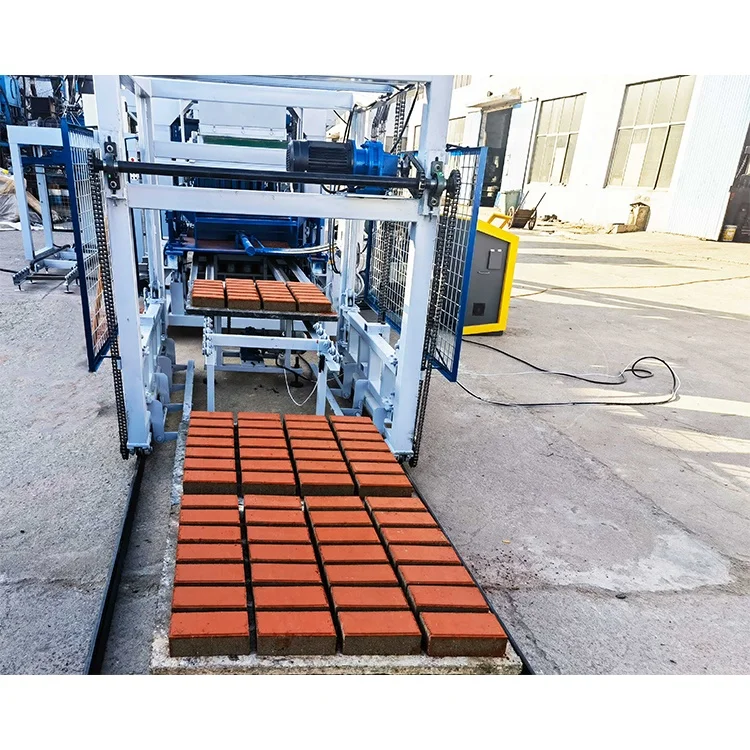
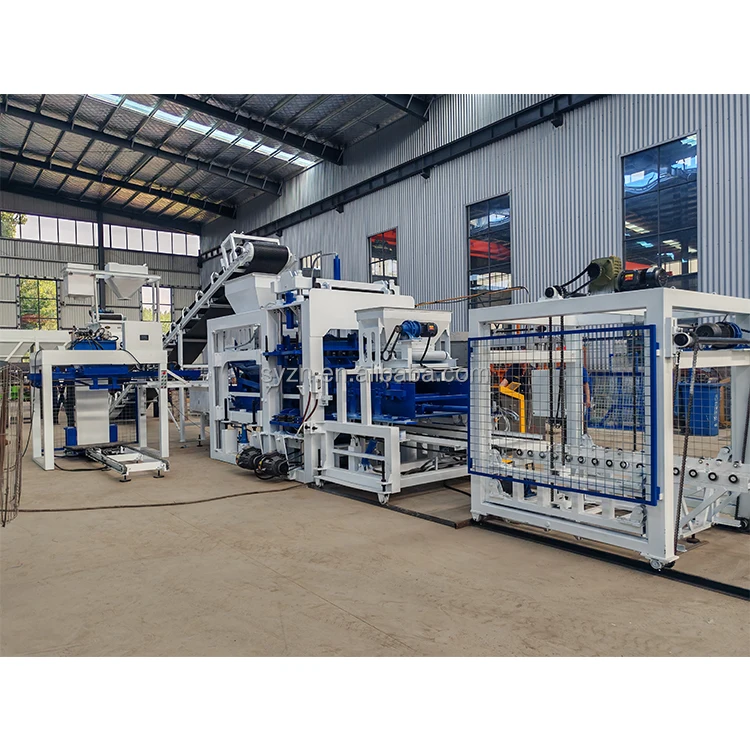
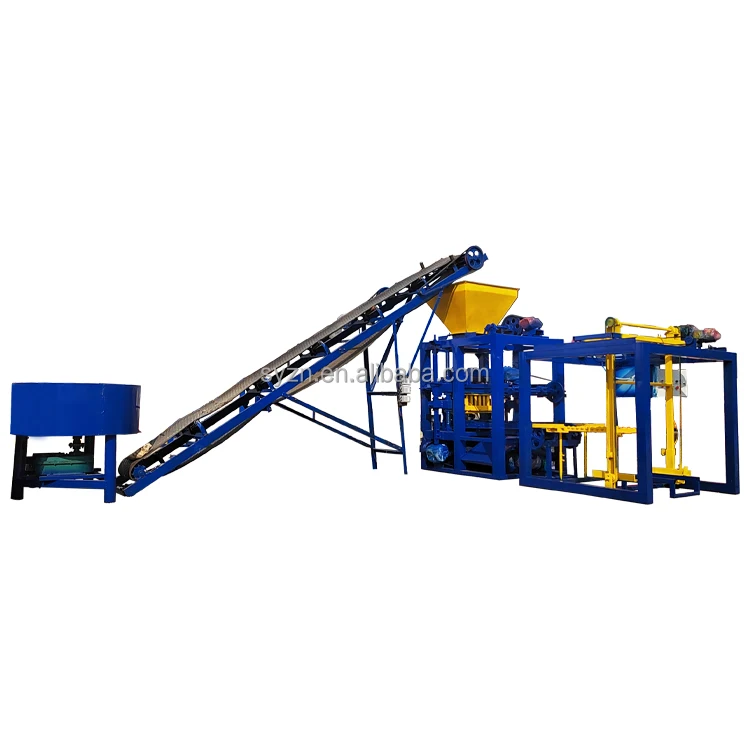
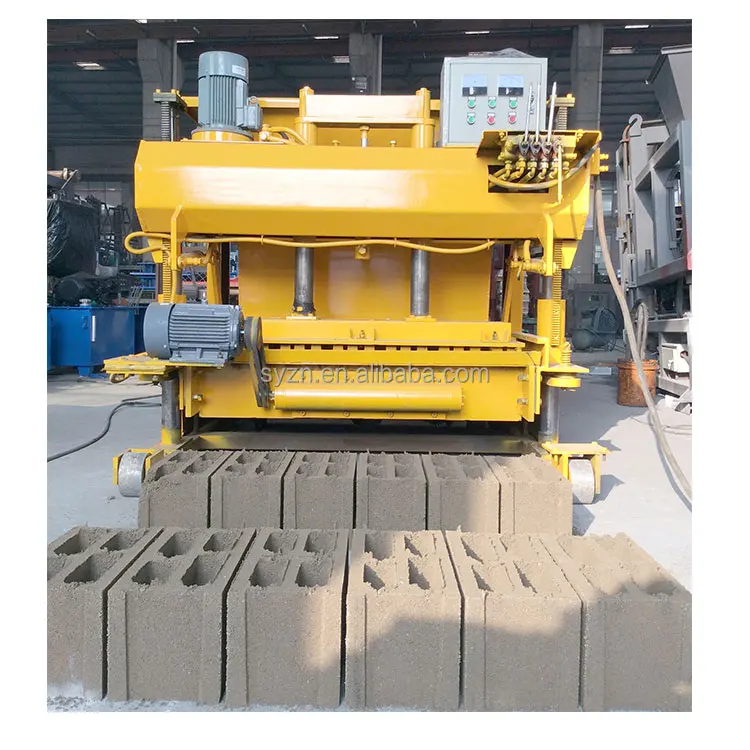
Mid-tier hydraulic press with PLC logic — QT6-15 bridges workshop scale and plant output, specified against your local aggregate rather than a catalogue default.
Technical Specifications
| Parameter |
Value |
| Model |
QT6-15 |
| Product Type |
Hydraulic Concrete Block Making Machine |
| Overall Dimensions (L×W×H) |
7400 × 1900 × 2660 mm |
| Molding Cycle |
15–25 s |
| Vibration Frequency |
4600 r/min |
| Exciting Power |
40–50 kN |
| Rated Power |
31.25 kW |
| Mixer Model |
JQ350 |
| Pallet Size |
850 × 550 × 25 mm |
| Net Weight |
7 T |
| Applied Products |
paver, solid brick, hollow block, curbstone |
| Raw Materials |
crushed stones, sand, cement, dust, fly ash |
| Control System |
PLC |
| Hydraulic Station |
included |
| Pallet Feeder |
included |
| Brick Conveyor |
included |
| Block Sweeper |
included |
| Output Capacity (Hollow Block 400×200×200mm) |
1200–1680 pcs/h (basis: 400×200×200mm hollow block, cycle 15–20s) |
| Output Capacity (Hollow Block 400×150×200mm) |
1800–2400 pcs/h (basis: 400×150×200mm hollow block, cycle 15–20s) |
| Output Capacity (Solid Brick 240×115×53mm) |
3240 pcs/h (basis: 240×115×53mm solid brick, cycle 15–20s) |
| Daily Output (8hr, Hollow Block 400×200×200mm) |
9600–13440 pcs/8hr |
| Daily Output (8hr, Hollow Block 400×150×200mm) |
14400–19200 pcs/8hr |
| Daily Output (8hr, Solid Brick 240×115×53mm) |
16200–19440 pcs/8hr |
| Automation Level |
semi-automatic with PLC control |
| Voltage & Frequency |
(basis not stated in source — confirm block format / material / thickness) |
| Mould Change System |
(basis not stated in source — confirm block format / material / thickness) |
| Stacking Method |
(basis not stated in source — confirm block format / material / thickness) |
| Hydraulic Pressure (MPa) |
(basis not stated in source — confirm block format / material / thickness) |
Application Suitability
| Application |
Material or Output |
| Hollow block production for commercial and residential walls |
Crushed stone, sand, cement, fly ash blends |
| Solid brick manufacturing for load-bearing masonry |
Dense aggregate mixes requiring high vibration force |
| Paver and curbstone output for municipal infrastructure |
Finer aggregate with cement-rich surface layers |
| On-site block production by construction contractors |
Locally sourced raw materials with variable gradation |
| First plant setup by entrepreneurs entering block market |
Standard formats with room to expand mould portfolio |
What "Cycles per Hour" Leaves Out When You Buy a Hydraulic Concrete Block Making Machine Manufacturer Unit
Capacity only means something when the block format is named beside it.
I stood next to a production line in Frankfurt where the owner showed me his monthly tally — barely sixty percent of what the brochure promised. The machine was running the same cycles, but his local crushed stone had a different moisture profile and particle shape than the test material used at the factory. Every Hydraulic Concrete Block Making Machine manufacturer quotes cycle speed, yet few tie that number to a specific block size, mix design, and raw material sample [NEED_CITE: block density standards vary by regional construction codes]. Without that linkage, you are comparing two machines on a figure that was never measured under your conditions. The QT6-15 outputs listed here each name the exact block dimension and cycle range they were measured against, so the daily volume you plan around has a traceable basis.

Where the QT6-15 Sits on the Output Spectrum
Buyers surveying their first block plant often start by asking which tier they need. The QT6-15 occupies the middle ground — it delivers hydraulic pressure and PLC-controlled logic at a footprint and investment level that does not require a fully automatic stacking and cubing system from day one. For entrepreneurs testing market demand or contractors producing blocks for a specific project, this semi-automatic configuration gives a production baseline you can run with a small crew while leaving room to add automation stations later. The full SHIYUE range extends from mobile egg-laying units at the entry level to high-capacity automatic lines at the upper end, and the QT6-15 helps you locate your position before committing to a fixed plant layout.
Matching the Press to Your Mould Portfolio
A block machine is only as flexible as the moulds it accepts and the time it takes to swap them. The QT6-15 handles hollow block, solid brick, paver, and curbstone formats on a single press with a pallet size of 850 × 550 × 25 mm — a dimension that must align with your curing racks and the forklift you already operate. When a buyer orders a pallet size without checking their existing curing area, the result is either wasted floor space or a pallet that the forklift tines cannot lift cleanly [NEED_CITE: pallet handling compatibility with curing infrastructure]. Specifying the press and the mould set together means every format you intend to sell has a confirmed cycle time, and the daily output per format is calculated before the machine ships rather than discovered after it arrives.
Reading the Numbers That Actually Shape Your Shift
Vibration frequency at 4600 r/min and exciting power of 40–50 kN together determine how densely the aggregate packs inside the mould cavity — higher frequency with insufficient force leaves hollow blocks with thin walls that crack during handling, while excessive force on a fine sand mix can fracture the block edges before curing begins. The rated power of 31.25 kW covers the hydraulic station, vibration motors, and pallet feeder simultaneously, so you need to verify that your site electrical supply can sustain this draw across an eight-hour shift without voltage sag. The JQ350 mixer feeds material at a rate matched to the 15–25 second molding cycle, meaning the press does not sit idle waiting for the next batch — a bottleneck that is common when the mixer is undersized relative to the press capacity. Hydraulic pressure and vibration must be tuned to your specific mix design; a fly-ash-heavy blend behaves differently under pressure than a crushed-stone-dominant mix, and the settings that produce strong blocks in one region will produce reject batches in another [NEED_CITE: aggregate gradation effect on block compressive strength].
The Hidden Cost of Skipping the Configuration Step
When voltage, frequency, and PLC display language are left unconfirmed before production, the machine arrives and sits in a crate while electricians source transformers and operators struggle with an interface they cannot read. I have seen commissioning delayed by several weeks because the control panel was in a language the local crew did not work in, and the voltage mismatch required an on-site transformer that was neither budgeted nor planned for [NEED_CITE: voltage and frequency standards by export market]. Pallet handling and stacking left out of the quotation means your crew is moving wet blocks by hand at the end of every cycle — a labour cost that erases the efficiency the press was supposed to deliver. These are not machine failures; they are configuration failures that a complete specification conversation would have prevented.
What You Get When the Machine Is Specified as a System
Block machinery is the single focus here, which means the QT6-15 press, its moulds, pallets, and handling equipment are specified as one matched set rather than sourced from separate vendors and forced to work together. Configuration is built around your actual mix design and target block format, not pulled from a default catalogue page. Mould design covers the formats your market actually sells, including custom drawings when your buyers request a dimension that is not in the standard range. The automation level is selectable — you can start with the semi-automatic QT6-15 and add pallet stacking or cubing stations as demand grows, without replacing the press itself. Installation support includes operator training so your crew understands mould change procedure, hydraulic pressure adjustment, and daily maintenance before the first production shift begins.
Documentation & Verification
- Line layout and capacity calculation stating the block format assumed for each QT6-15 output figure
- Machine specification sheet with hydraulic and electrical schematic for your confirmed voltage
- Mould drawing and format list showing every block type and its cycle time on the QT6-15
- Pallet specification matched to 850 × 550 × 25 mm with material and load rating noted
- Factory test record and packing photographs of your QT6-15 before container loading
- CE declaration documentation where applicable to your import market
Installation, Commissioning & Support
- Foundation plan sized to 7400 × 1900 mm footprint with anchor bolt positions for the QT6-15 frame
- Dedicated electrical circuit rated for 31.25 kW continuous draw at your confirmed voltage and frequency
- Machine arrives in assembly state confirmed at order; on-site reassembly and alignment of hydraulic station
- PLC display language set to your operator preference before dispatch, tested during factory run
- Mould change procedure and vibration frequency adjustment training for your production crew on site
- Wear parts list covering hydraulic seals, vibration springs, and mould liners with reorder part numbers
Before You Request a Quote
Send a sample of your local aggregate — crushed stone, sand, or fly ash — along with the block formats your market demands and the daily volume you need to hit. Confirm your site voltage, frequency, and the language your operators read on a control screen. If you already have curing racks and a forklift, share the dimensions so the pallet specification is built around what you have, not the other way around.
Frequently Asked Questions
Q: How do I verify the real daily output of the QT6-15 — and what block format is the capacity based on?
A: Every output figure listed for the QT6-15 names the specific block dimension and molding cycle it was measured against — for example, 1200–1680 pieces per hour is based on a 400×200×200mm hollow block at a 15–20 second cycle. Your actual daily output depends on your raw material sample, mix design, and shift length, which is why we request aggregate samples and calculate capacity per format before confirming the order.
Q: Where does the QT6-15 sit in the range — and when should I consider a fully automatic line?
A: The QT6-15 is the mid-tier semi-automatic press, suited to first plants or contractors who need hydraulic pressure and PLC control without a full stacking and cubing system. When your daily volume consistently exceeds what a manual pallet handling crew can manage, or when labour cost in your market makes automatic stacking pay for itself, stepping up to a fully automatic line becomes the logical next move.
Q: What plant footprint does the QT6-15 require compared to other output tiers?
A: The QT6-15 press itself occupies 7400 × 1900 mm, but the full line footprint includes mixer, pallet feeder, curing area, and block handling space. Smaller workshop models need less floor area, while high-capacity automatic lines require a larger building with overhead clearance for stacking equipment. We provide a line layout drawing showing every station before you commit to a building plan.
Q: Which voltage, frequency, and PLC display language options can be configured for my market?
A: Voltage and frequency are confirmed during the quotation stage based on your site supply — the machine is built to match, not adapted on arrival. The PLC display language is set to your operator preference before dispatch and verified during the factory test so your crew can read alarms and cycle parameters from the first shift.
Q: Can I start with the semi-automatic QT6-15 and add automation stations later?
A: Yes — the QT6-15 platform accepts add-on stations such as automatic pallet stacking and cubing as your production volume grows. The press itself does not need replacement; the upgrade involves adding handling equipment and updating the PLC program to coordinate the new stations with the existing molding cycle.

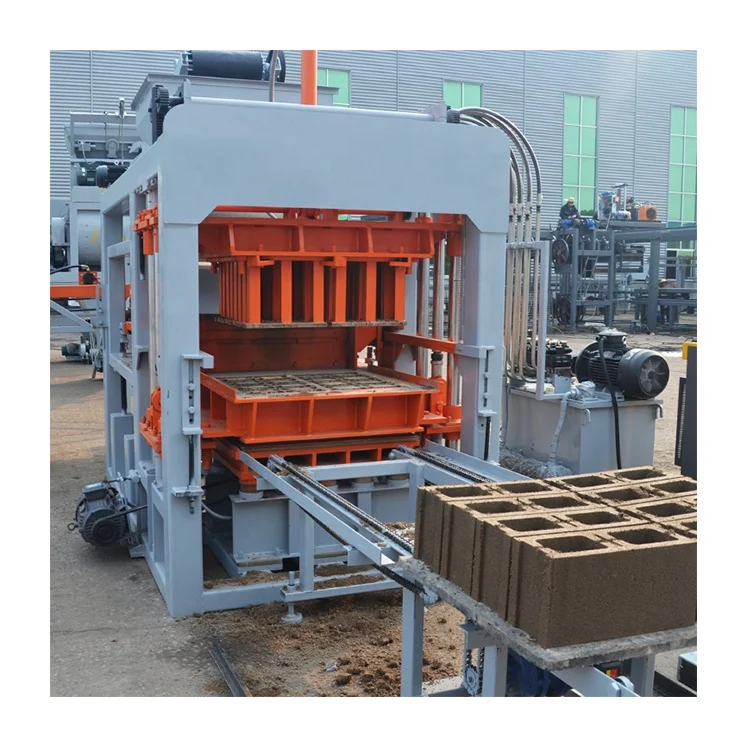
 High quality block machine