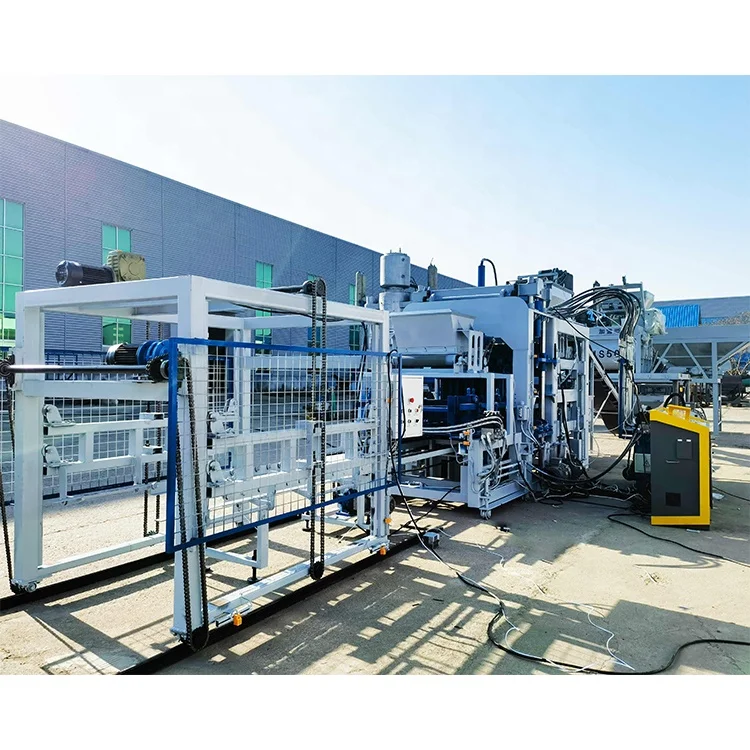
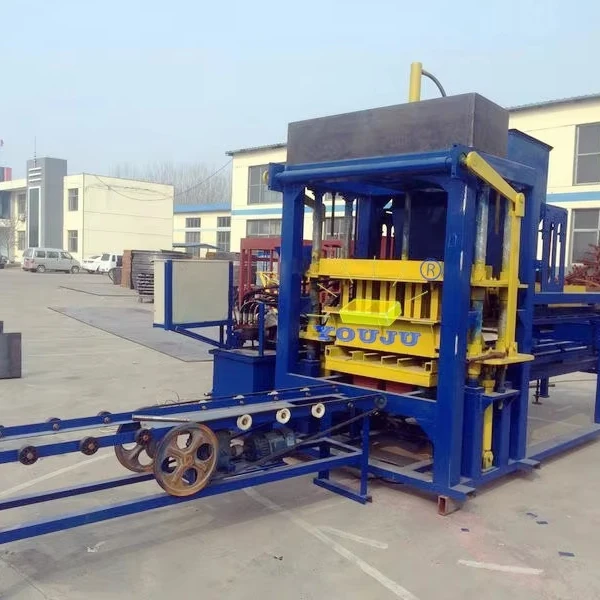
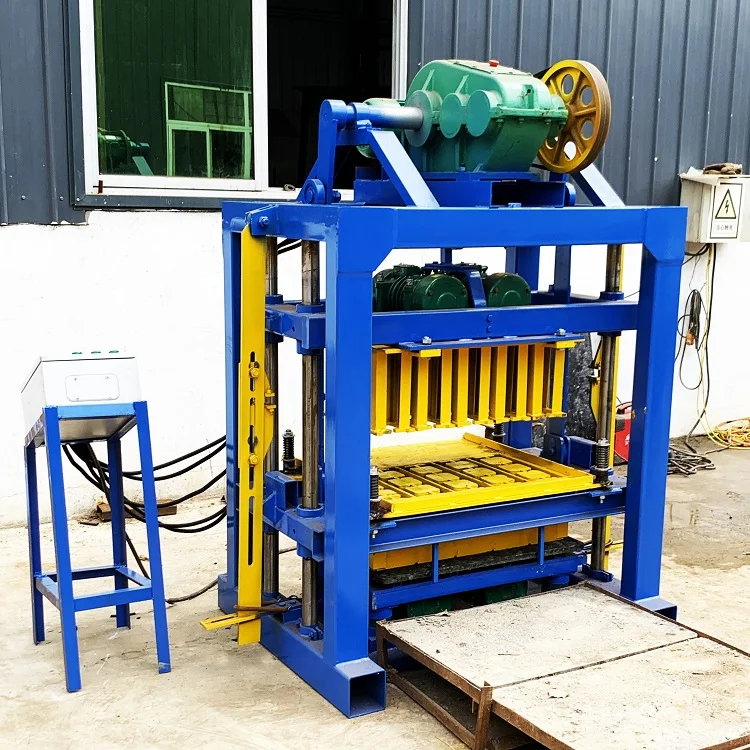
Integrated Line Engineering — The QT4-15 block machine, pallet, mould and handling equipment are specified as one matched system, so cycle time at the press never waits on upstream feeding or downstream stacking.
Technical Specifications
| Parameter |
Value |
| Model |
QT4-15 |
| Product Type |
Hydraulic Concrete Block Making Machine |
| Molding Cycle |
15–30 s |
| Platform Vibration Frequency |
50–70 Hz |
| Pallet Size |
900 × 500 mm |
| Product Height Range |
50–220 mm |
| Overall Power |
24.5 kW |
| Demolding Method |
Hydraulic |
| Control System |
PLC |
| Automation Level |
Automatic (PLC-controlled) |
| Mould Formats |
Hollow block (400×200×200, 400×150×200, 400×100×200 mm), Paver (200×100×60 mm), Solid brick (240×115×53 mm) |
| Cycle Time (Hollow block 400×200×200 mm) |
15–20 s |
| Cycle Time (Paver 200×100×60 mm) |
15–20 s |
| Cycle Time (Solid brick 240×115×53 mm) |
15–20 s |
| Output (Hollow block 400×200×200 mm) |
900–1200 pcs/h (4 pcs/mould, basis: 15–20 s cycle) |
| Output (Hollow block 400×150×200 mm) |
1080–1440 pcs/h (5 pcs/mould, basis: 15–20 s cycle) |
| Output (Hollow block 400×100×200 mm) |
1440–1920 pcs/h (8 pcs/mould, basis: 15–20 s cycle) |
| Output (Paver 200×100×60 mm) |
2880–3840 pcs/h (16 pcs/mould, basis: 15–20 s cycle) |
| Output (Solid brick 240×115×53 mm) |
5930–6720 pcs/h (28 pcs/mould, basis: 15–20 s cycle) |
| Block Compressive Strength |
>15 MPa |
| Raw Materials |
Fly ash, slag, gangue, sand, crushed stone, cement, water |
| Voltage & Frequency |
Configurable to target market (confirm before production) |
| PLC Language Options |
Configurable (confirm before commissioning) |
Application Suitability
| Application |
Material or Output |
| Hollow block production for building walls |
Fly ash, sand, crushed stone, cement mixes; 400×200×200 mm and 400×150×200 mm formats |
| Paver brick production for walkways and yards |
Dense aggregate and cement blends; 200×100×60 mm interlocking and rectangular formats |
| Solid brick production for masonry |
Sand, gangue, slag, cement; 240×115×53 mm standard brick |
| Mid-to-small scale block plants |
Multi-format production on a single 900×500 mm pallet line |
| On-site production using industrial residue |
Fly ash and slag blended with local aggregate for project-specific supply |
Why "1,200 Blocks per Hour" Tells Only Half the Story
Capacity numbers without a stated block format are impossible to plan around.
Sellers quote a single hourly figure and leave buyers to discover after commissioning that the number assumed a small solid brick, not the hollow block the local market actually buys. I have watched a block plant owner in West Africa arrive at his site expecting a daily volume that simply was not achievable on the 200 mm hollow block his customers wanted. [NEED_CITE: realistic block plant capacity planning by format]. The QT4-15 block machine manufacturer documentation you receive from us lists output per format with the cycle time and mould cavity count stated, so the number you plan your shift around is the number your press will actually produce.

Where the QT4-15 Sits in the Stationary Range
The QT4-15 occupies the mid-capacity tier of Shiyue’s stationary block machine lineup. Below it sits the semi-automatic tier where pallets are fed and collected by hand; above it, high-capacity automatic lines with full cubing and rack handling. This model gives a buyer PLC-controlled automatic cycling and hydraulic demolding while keeping the overall plant footprint moderate enough for a first installation or a satellite yard. A buyer moving up from a manual egg-laying machine finds the step manageable, and a contractor adding block production to an existing material supply business gets format coverage without over-investing.
Matching Machine Tier to Your Actual Market Demand
A buyer who sells primarily 200 mm hollow blocks for wall construction and only occasional pavers does not need a high-capacity line running at full tilt. The QT4-15 block machine manufacturer configuration is built around exactly this profile: enough automation to hold consistent cycle times across an eight-hour shift, enough mould flexibility to cover the two or three formats that generate real revenue. [NEED_CITE: block format demand patterns in developing construction markets]. The question to answer before selecting a tier is which block your customers buy by volume, not which machine has the largest headline number attached to it.
Vibration, Pressure and the Mix That Actually Arrives
Platform vibration at 50–70 Hz works together with hydraulic pressure to compact the mix into the mould cavity, and the balance between these two forces determines whether blocks leave the press at consistent density or crack during demolding. The 900 × 500 mm pallet size sets the mould footprint, which in turn determines how many cavities each format carries — four for a 200 mm hollow block, twenty-eight for a standard solid brick. Mould change time directly affects whether a plant can run two formats in one shift or must dedicate full days to each. [NEED_CITE: vibration frequency and hydraulic pressure matching in concrete block forming]. When the local aggregate is volcanic ash rather than quartz sand, the vibration amplitude and dwell time need adjustment before the first production pallet is cured, a step that is often skipped and discovered only after a week of weak blocks.
The Cost of Leaving Supporting Equipment Off the Quotation
A press that produces consistently but has no pallet return system, no stacking station and no curing rack handling simply pushes all that labour onto the plant floor. Workers carry loaded pallets by hand to a curing yard, and output that was quoted in machine cycles per hour quietly drops to whatever pace manual handling allows. [NEED_CITE: labour cost impact of manual pallet handling in block plants]. Before signing, confirm whether the quotation includes pallet feeding, stacking and curing rack handling or whether those stations will arrive as a second purchase order.
What You Actually Get When You Source Here
Machine, mould, pallet and handling are specified together so the press is never the bottleneck waiting on an upstream feeder. Every configuration is set against the buyer’s own mix design and local aggregate, not pulled from a catalogue default. Moulds are designed for the formats your market sells, including custom drawings when a regional format does not match standard cavity layouts. Automation is selectable — start with the QT4-15 in semi-automatic mode and add pallet return and stacking later as volume grows. Installation includes commissioning and operator training so the crew running the press on day one is the same crew that trained on it in the factory.
Documentation & Verification
- Line layout with capacity calculation stating the block format and cycle time assumed
- Machine specification sheet covering hydraulic pressure, vibration force and pallet size
- Mould drawing and format list showing cavity count for every block size ordered
- Pallet specification matched to the 900 × 500 mm press table and your curing area
- Voltage and control language confirmation record before production begins
- Factory test record on the buyer’s block format before dispatch
Installation, Commissioning & Support
- Foundation must bear the 24.5 kW overall power load with a dedicated circuit and correct voltage
- Machine ships in dismantled state; allow reassembly time on site before first production
- PLC language and display confirmed to the operator’s language before commissioning day
- Mould change procedure trained on site so format switches fit within one shift
- Hydraulic wear parts list supplied with first-order spares to avoid unplanned downtime
Before You Request a Quote
Send the block formats your customers buy most and the daily volume you need for each. Include your local aggregate type and any industrial residue you plan to blend, such as fly ash or slag. Confirm your site voltage, frequency and the language your operators read on a screen.
Frequently Asked Questions
Q: How is the QT4-15’s capacity calculated, and which block format does each figure assume?
A: Every capacity figure on this page states the block format, mould cavity count and cycle time it is based on. A figure for 400×200×200 mm hollow blocks assumes four cavities per mould at a 15–20 second cycle. We do not quote a single headline number and leave you to guess which format produced it.
Q: Where does the QT4-15 sit compared to semi-automatic machines and high-capacity lines?
A: It is the mid-capacity tier — PLC-controlled and automatic, but without the full cubing and rack handling of a high-capacity line. It suits a first plant or a yard that needs format flexibility without the investment and footprint of a fully automated system.
Q: What plant footprint and supporting equipment does the QT4-15 require?
A: The press itself is compact, but a working line needs space for raw material storage, a mixer, pallet return, a stacking station and a curing yard sized for the 900×500 mm pallets. Confirm supporting equipment scope in the quotation before ordering.
Q: Can I start with the QT4-15 semi-automatic and upgrade automation later?
A: Yes. The machine can be configured for manual pallet handling at first, with pallet feeding, stacking and cubing added as your volume grows. The PLC platform supports this upgrade path without replacing the press.
Q: What voltage, frequency and PLC language options are available for my market?
A: These are configurable and must be confirmed before production begins. Provide your site voltage, frequency and the language your operators use, and they will be set and verified during the factory test before shipment.

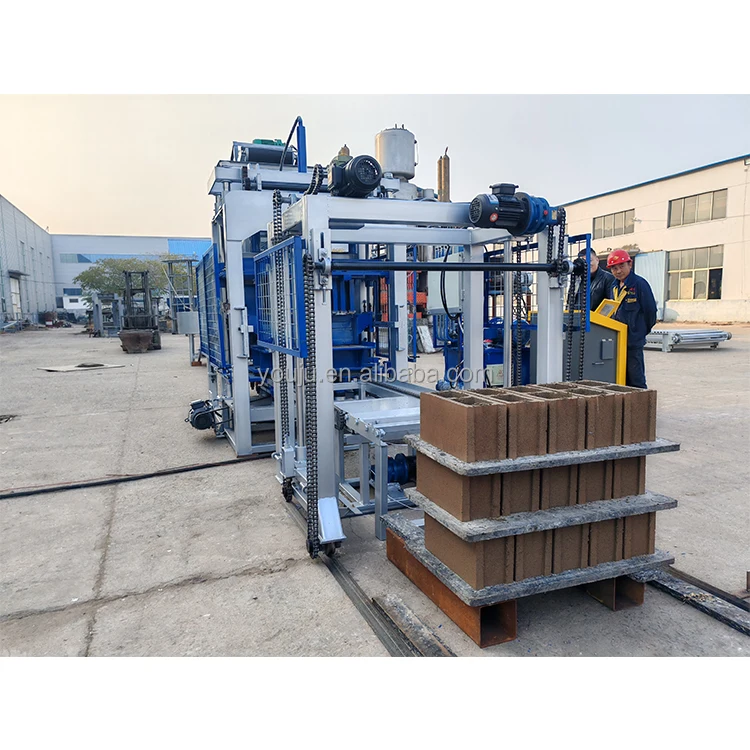
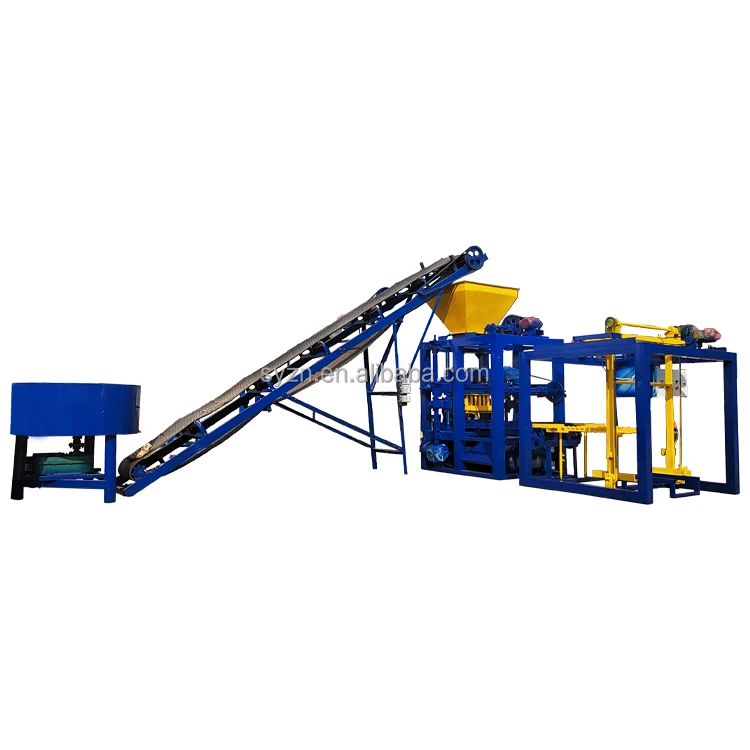 Stationary block machine