

Block Machine Market Opportunity in Mexico: Buyer Guide for Sale
Most buyers assume the cheapest block machine wins in Mexico. The real winners are those who solve voltage mismatches, local raw material adaptation, and customs compliance before the container leaves the port.
Mexico’s block machine market is surging because of a structural housing deficit and aggressive federal infrastructure spending, but success depends on matching machine configuration to regional power grids, volcanic aggregate availability, and NOM certification requirements—not on unit price alone. [NEED_CITE: Mexico’s national housing deficit estimates and federal infrastructure budget allocations]
I learned this the hard way. Years ago, I shipped a full automatic line to a buyer on the Yucatán Peninsula. The machine arrived, powered up, and within minutes two frequency inverters were dead. The local grid ran on a different voltage configuration than what we had assumed. The on-site electrician stared at me for a long while. Since that day, I have treated voltage plates, Spanish-language nameplates, and frequency converters as non-negotiable checklist items for every single Mexico-bound order.
The block machine market in Mexico is not a single market—it is several markets layered on top of each other, each with distinct raw material profiles, power quality, and buyer sophistication.
Why Is Mexico a Hot Market for Block Machines Now?
A structural housing gap and record infrastructure budgets are pulling block machine demand upward, but regional variation is enormous.
Mexico faces a cumulative housing deficit that runs into the millions of units, concentrated heavily in southern and central states. Federal programs channel billions of pesos into affordable housing construction every cycle, and state-level paving and public works tenders multiply the demand for concrete blocks, pavers, and curbstones. [NEED_CITE: Mexico federal housing program budget allocations and national housing deficit estimates]
At the same time, remittance-funded self-build housing in states like Puebla, Oaxaca, and Veracruz creates a steady baseline demand for small to medium block machines. Private investors in these regions typically start with semi-automatic lines and scale up as they secure municipal contracts.
In the north, particularly around Monterrey and the Bajío industrial corridor, the profile shifts toward large fully automatic plants serving commercial developers and infrastructure contractors. These buyers care about output tonnage, mold changeover speed, and PLC integration with batch plants.
I have watched block machine market Mexico inquiries split roughly along these geographic lines over the past several project cycles. Southern buyers ask about mold cost and manual override options. Northern buyers ask about cycle time and pallet circulation capacity. Neither is wrong—they are simply different markets.
The takeaway is straightforward: a buyer in Mérida and a buyer in Saltillo may both search for "block machine," but they need entirely different configurations. Ignoring this reality is the single most common reason shipments underperform after installation.
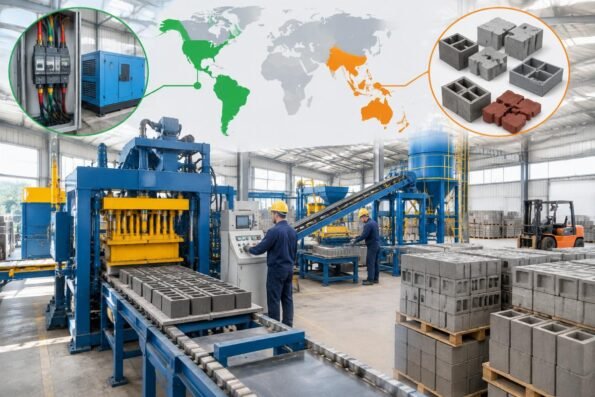
What Voltage and Grid Issues Must You Solve Before Shipping?
220V/60Hz is the baseline, but grid instability in industrial zones demands voltage stabilizers and elevated ingress protection ratings.
Mexico’s standard industrial voltage is 220V three-phase at 60Hz. That part is simple. What is not simple is the quality of power that actually reaches the machine terminal block in many industrial parks outside Mexico City and Monterrey.
Voltage sags, harmonic distortion from neighboring factories, and sudden phase loss events are routine in zones where grid infrastructure has not kept pace with industrial growth. A PLC-controlled block machine without proper protection will fault repeatedly, and repeated faults will destroy frequency inverters and servo drives within months. [NEED_CITE: Mexican industrial power quality standards and common grid disturbance patterns]
On one project near Monterrey, a client’s plant experienced phase imbalance events almost weekly. Their original machine—sourced from a supplier who had not asked about grid conditions—burned through multiple drive boards. When we reconfigured the system with line reactors, phase monitoring relays, and oversized voltage stabilizers, fault frequency dropped to near zero.
Here is what I now require before any block machine market Mexico quotation is finalized:
- Confirmed site voltage and phase configuration, measured at the machine location, not at the plant entrance
- Written disclosure of any known grid instability events in the prior year
- Specification of voltage stabilizer capacity, typically rated well above the machine’s nominal draw
- Ingress protection rating appropriate for the local dust environment—many Mexican block plants operate in conditions where standard IP ratings are insufficient
Buyers who skip this step pay for it twice: once in replacement electronics, and once in production downtime. The block machine market in Mexico rewards those who treat electrical engineering as a site-specific design problem, not a catalog specification.
Which Machine Type Fits Your Raw Material and Scale?
Volcanic aggregate and local sand chemistry determine mold design and vibration parameters; automation level should match local maintenance capability, not aspirational output targets.
Mexico’s geology gives block producers access to materials that do not appear in standard Chinese or European mix designs. Volcanic ash, tezontle, and crushed basalt are common in central and southern regions. These materials have different absorption rates, particle shapes, and compressive behavior than the river sand and limestone aggregate that machine designers typically assume.
I spent time at a plant outside Puebla where the buyer was producing blocks with a significant volcanic ash substitution for cement. The first mold set we provided produced blocks that looked correct but failed compressive strength tests after curing. The issue was not the machine—it was the vibration frequency and compression time, which had to be recalibrated for the lighter, more angular volcanic aggregate. After adjusting the vibration table parameters and extending the compression cycle, strength targets were met consistently. [NEED_CITE: Concrete mix design adaptation for volcanic aggregate in Mexican block production]
This is where the block machine market Mexico selection process breaks down for many first-time buyers. They choose a machine based on catalog output figures, without testing whether the machine’s vibration profile and compression force suit their actual raw materials.
Automation level is another decision point that buyers frequently get wrong. The instinct is to buy the most automatic machine available. But in regions where qualified industrial electricians and PLC technicians are scarce, a highly automated line becomes a liability. Every sensor fault and every servo alarm requires a specialist who may be hours away.
For first-time investors in states like Guanajuato or Michoacán, a semi-automatic line with robust mechanical components and simple electrical controls often delivers faster payback and higher uptime than a fully automatic system. The machine does the heavy work; the operator manages the process. As the local talent pool grows, the buyer can upgrade.
The right block machine for a Mexican buyer is the one that matches the material, the maintenance ecosystem, and the actual order pipeline—not the one with the highest brochure number.
How Do You Avoid Customs Delays and Certification Gaps?
NOM compliance verification and HS code pre-audit are mandatory before the vessel sails; paperwork errors cost weeks of port storage fees.
Mexico’s customs authority is rigorous, and the documentation requirements for industrial machinery are specific. The most common and most expensive mistake I see in the block machine market Mexico space is treating customs paperwork as an afterthought.
Every electrical component on a block machine sold in Mexico must comply with applicable NOM standards—particularly NOM-003-SCFI for electrical safety and labeling requirements. If the machine arrives without Spanish-language nameplates, without the correct conformity declarations, or with HS codes that do not match the physical contents, the container sits at the port. Storage fees accumulate daily. Demurrage charges follow. And the buyer’s forwarding agent starts asking uncomfortable questions. [NEED_CITE: Mexican NOM certification requirements for imported industrial machinery and HS code classification guidelines]
I have seen shipments held for extended periods because the HS code declared by the shipper classified the equipment under a general machinery heading, while Mexican customs expected a more specific classification for concrete block manufacturing equipment. The discrepancy triggered an inspection, the inspection triggered a reclassification, and the reclassification triggered a duty recalculation.
What works reliably is a pre-shipment documentation audit that includes:
- HS code verification against the Mexican tariff schedule, confirmed by the buyer’s customs broker before loading
- NOM compliance checklist for every electrical component, with test reports from accredited laboratories
- Spanish-language nameplates and warning labels installed at the factory, not added at the port
- Commercial invoice descriptions that match the packing list, the bill of lading, and the certificate of origin exactly
Buyers who invest time in this process before shipping clear customs in days. Buyers who do not invest that time clear customs in weeks, if they are lucky. In the block machine market in Mexico, documentation discipline is as important as machine quality.
What Does a Turnkey Setup Look Like in Mexico?
From mix design calibration to operator training, local commissioning service determines how quickly the plant reaches commercial production.
A block machine sitting in a crate is not a business. The distance between container arrival and first saleable block is where most of the real project risk lives.
Turnkey setup in the Mexican context means the supplier’s commissioning team works on-site through the entire startup sequence: foundation verification, mechanical alignment, electrical termination, hydraulic system pressurization, PLC parameter configuration, mold installation, and—critically—raw material mix design calibration.
I have walked into plants where the machine was mechanically sound but the blocks were failing because the local sand had never been tested for moisture content and particle distribution. The commissioning team’s job is not just to make the machine run; it is to make the machine produce blocks that pass local strength standards using the materials actually available at the site. [NEED_CITE: Concrete block compressive strength testing standards in Mexico]
Operator training is equally important. In my experience, a Mexican production team can reach full independent operation within a matter of weeks if the training is structured properly—covering daily maintenance routines, mold changeover procedures, fault diagnosis, and spare parts identification. Without this training, even a well-configured machine will suffer premature wear and unplanned stoppages.
The block machine market Mexico winners are the suppliers who treat commissioning and training as core deliverables, not optional add-ons. The machine is the easy part. Getting a Mexican team to run it profitably is the actual service.
Conclusion
Mexico’s block machine demand is real and growing, but equipment selection, electrical adaptation, customs compliance, and on-site commissioning determine whether an investment produces returns or losses.
The block machine market in Mexico rewards buyers and suppliers who invest in understanding regional power conditions, local raw material behavior, NOM certification requirements, and hands-on training. Machines that arrive configured for the actual site—not for a generic catalog specification—reach production faster, run longer, and generate the returns that make this market worth entering.

Industry expert sharing insights about concrete machinery, block making technology and turnkey production solutions.
View all posts →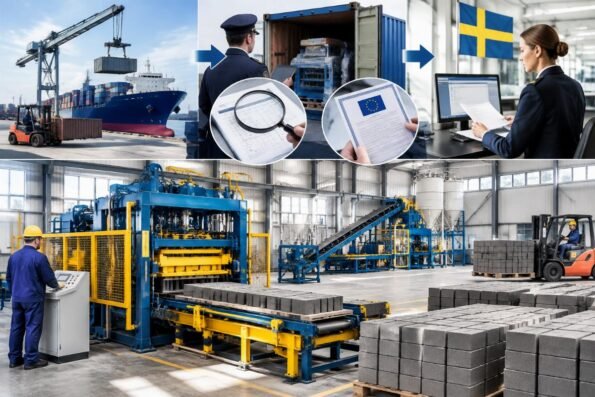
Leave a Reply