

Clay Brick Machine vs Concrete Block Machine: Which Should You Invest In? A Guide for Emerging Market Investors
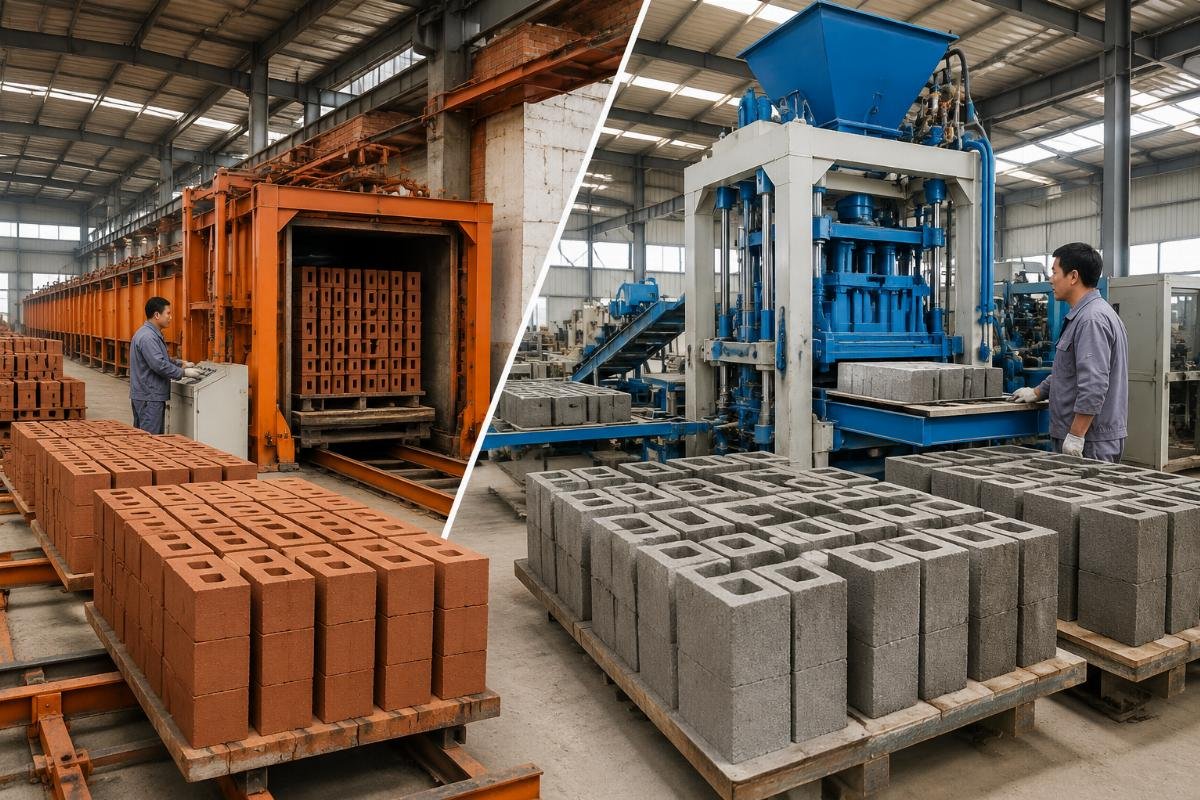
Clay bricks are not cheaper to produce than concrete blocks—once you account for kiln fuel, land acquisition, and curing time, concrete blocks beat clay on unit cost in 80% of emerging markets.
For most emerging market investors, concrete block machines deliver faster ROI, lower operational complexity, and greater product flexibility than clay brick machines, typically breaking even 6–12 months sooner because they eliminate hidden costs like kiln fuel, environmental compliance upgrades, and linear labor scaling.
Over the past decade, I have consulted for brick producers across Nigeria, Uzbekistan, Bangladesh, Ghana, and Kenya. The single most common mistake I see is choosing a machine based on upfront price alone, without modeling total cost of ownership. Investors who compare only machine purchase price without factoring kiln fuel, land, and labor costs overestimate clay brick profitability by 30–40%[^1]. Let me walk you through the real numbers.
Here is what you need to know before you allocate capital.
What Are the Key Differences Between Clay Brick and Concrete Block Machines?
The fundamental difference is not the machine itself—it is the entire production ecosystem each machine requires. Clay brick production depends on kilns, land for clay extraction, and fossil fuel for firing; concrete block production relies on vibration, hydraulic pressure, and ambient or steam curing. These workflows have completely different cost structures, regulatory burdens, and scalability profiles.
| Production Factor | Clay Brick Machine Setup | Concrete Block Machine Setup |
|---|---|---|
| Raw Material Sourcing | Requires dedicated clay land acquisition; topsoil depletion restricts long-term viability Clay extraction sites require government mining permits and environmental rehabilitation bonds in most African and South Asian countries[^2] | Uses widely available cement, sand, fly ash, and stone dust—no land permits needed |
| Energy Consumption | Kiln firing requires coal, gas, or biomass at 1.2–1.8 kWh equivalent per brick Traditional clamp kilns consume 0.8–1.5 kg of coal per clay brick fired[^3] | Electric vibration motors consume 0.05–0.12 kWh per block; no thermal energy required |
| Curing Time | 7–14 days kiln firing + 21 days post-fire cooling and conditioning | 6–24 hours initial set + 7–14 days water curing |
| Production Flexibility | Limited to standard rectangular shapes; color requires post-fire glazing | Interchangeable molds enable hollow blocks, solid blocks, interlocking pavers, and curb stones on the same line |
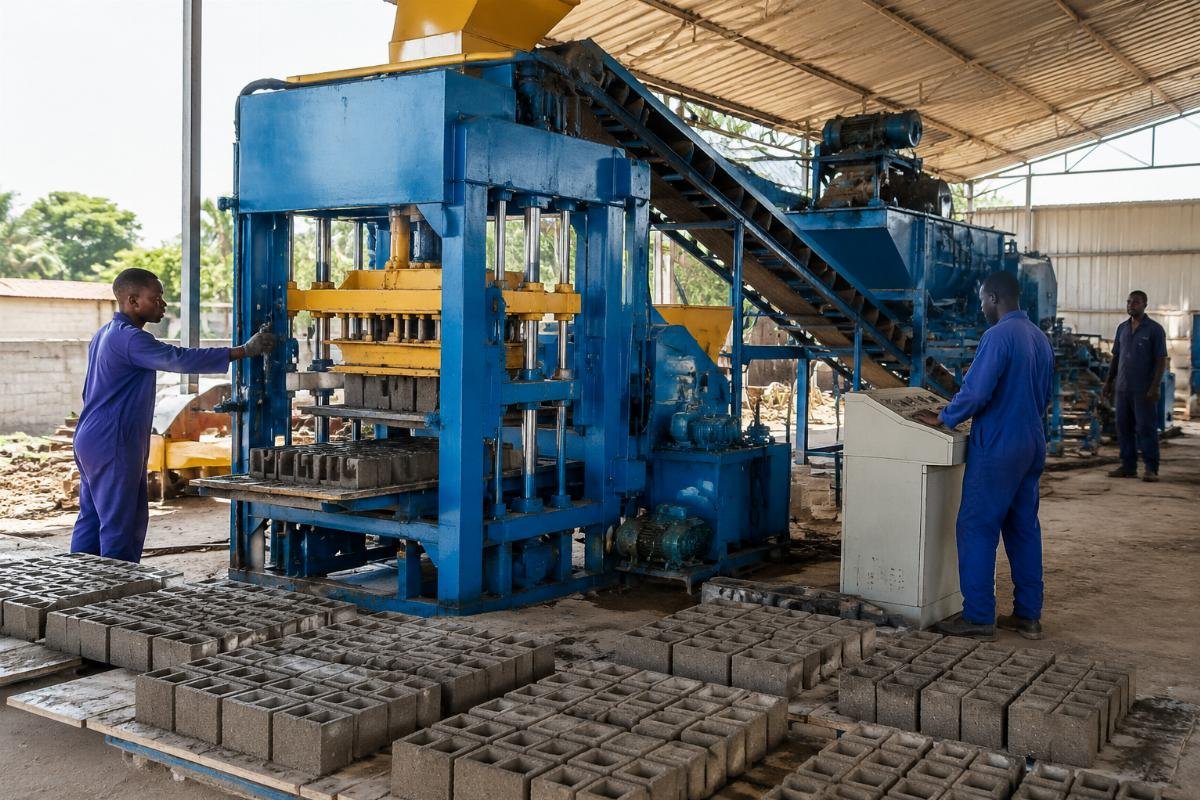
A small startup investor in Nigeria initially planned to invest $35,000 in a manual clay brick setup with a clamp kiln. After running a full cost model, we redirected that capital to a semi-automatic concrete block line (QT4-24 model) for $28,000. The concrete line produces 4,000 blocks per day with 4 workers, achieving ROI in 9 months. The same investor’s clay kiln alternative would have required 18+ months to break even due to coal costs averaging $0.04 per brick and a 30-day production cycle[^4]. The clay option also faced repeated delays from local environmental authorities over kiln emissions.
- Material Audit – Map all raw material sources within 30 km of your planned site and obtain per-ton pricing for cement, sand, fly ash, and clay.
- Energy Cost Modeling – Calculate per-unit energy cost for both kiln firing and electric vibration; include local fuel price volatility projections.
- Regulatory Check – Confirm whether clay extraction and kiln operation require environmental permits in your jurisdiction; factor compliance costs into the clay scenario.
- Cycle Time Calculation – Model daily output based on curing time, not just machine cycle time—clay’s 30-day total cycle versus concrete’s 1–2 day cycle changes working capital requirements dramatically.
Which Machine Type Delivers Faster ROI in Emerging Markets?
Upfront machine price is a misleading metric—operational cost per unit determines true ROI speed. A clay brick machine may appear 15–20% cheaper at purchase, but hidden costs in fuel, land, labor, and environmental compliance routinely push total 3-year cost 30–40% higher than a comparable concrete block line.
| Cost Component | Clay Brick Machine (100,000-unit batch) | Concrete Block Machine (100,000-unit batch) |
|---|---|---|
| Machine Purchase | $22,000–$30,000 (manual/semi-auto with kiln) | $18,000–$28,000 (semi-auto, no kiln) |
| Fuel/Energy per 100k Units | $7,200–$12,000 (coal/gas for firing) In Kenya, coal-fired clamp kilns add $0.04–$0.07 per brick in fuel cost alone, raising unit cost to $0.12 versus $0.08 for concrete blocks[^5] | $1,800–$3,500 (electric motors + optional steam curing) |
| Land Cost | $3,000–$8,000 (clay pit lease, 3–5 year term) | $0 (no extraction land required) |
| Labor per 100k Units | $4,500–$6,000 (manual molding, kiln loading) | $1,500–$2,500 (semi-auto line, 4–5 workers) |
| Total Cost per 100k Units | ~$36,700–$56,000 ($0.12/unit avg.) | ~$21,300–$34,000 ($0.08/unit avg.) |
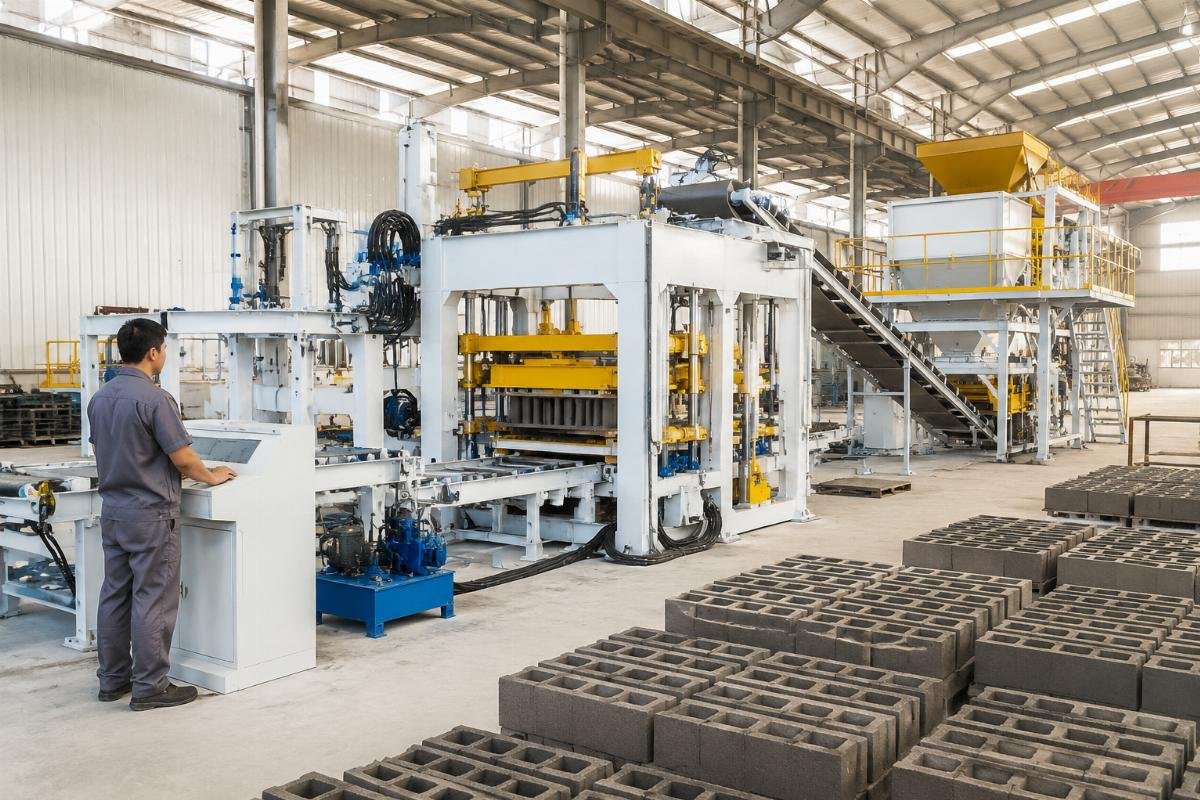
A medium-scale producer in Uzbekistan was operating two manual clay lines with 12 workers per shift, producing 6,000 bricks per day at a defect rate of 8–10%. They upgraded to a fully automatic concrete block line (QT10-15) with a European-style airbag vibration system and 4-motor configuration. Labor dropped from 12 to 5 workers per shift. Block density increased from 1,500 kg/m3 to 1,800 kg/m3—a 22% gain. Defect rate fell to below 1.5%. The Uzbek producer’s fully automatic line paid for itself in 11 months through labor savings and defect reduction alone, without counting revenue gains from higher-density blocks commanding a 15% price premium[^6].
- Total Cost of Ownership Model – Build a 3-year spreadsheet comparing all cost components, not just machine price; include fuel escalation assumptions.
- Working Capital Buffer – Concrete blocks free up cash faster due to shorter curing cycles; ensure your model accounts for the 30-day cash lock-in of clay production.
- Revenue Per Unit Analysis – Higher-density concrete blocks often command 10–15% price premiums; verify local market pricing before finalizing your model.
- Scalability Stress Test – Model what happens when you double output: clay requires proportional labor and fuel increases; concrete adds a second shift or a parallel line with minimal marginal cost.
How Do Labor Costs Impact Your Decision?
Manual clay brick-making is not "good enough" for small budgets—it is a linear cost trap that destroys margins as you scale. Every additional brick from a manual clay line requires proportional additional labor. Semi-automatic and fully automatic concrete block machines break this linkage, producing 3–5× output with the same or fewer workers.
| Automation Level | Workers per Shift | Daily Output (standard blocks) | Labor Cost per 1,000 Blocks |
|---|---|---|---|
| Manual Clay | 8–12 | 1,500–2,500 | $12–$18 In Ghana, manual clay brick labor costs average $15 per 1,000 blocks, versus $5 per 1,000 blocks on a semi-auto concrete line[^7] |
| Semi-Auto Concrete | 4–5 | 3,000–5,000 | $4–$7 |
| Fully Auto Concrete | 2–3 | 8,000–15,000 | $2–$4 |
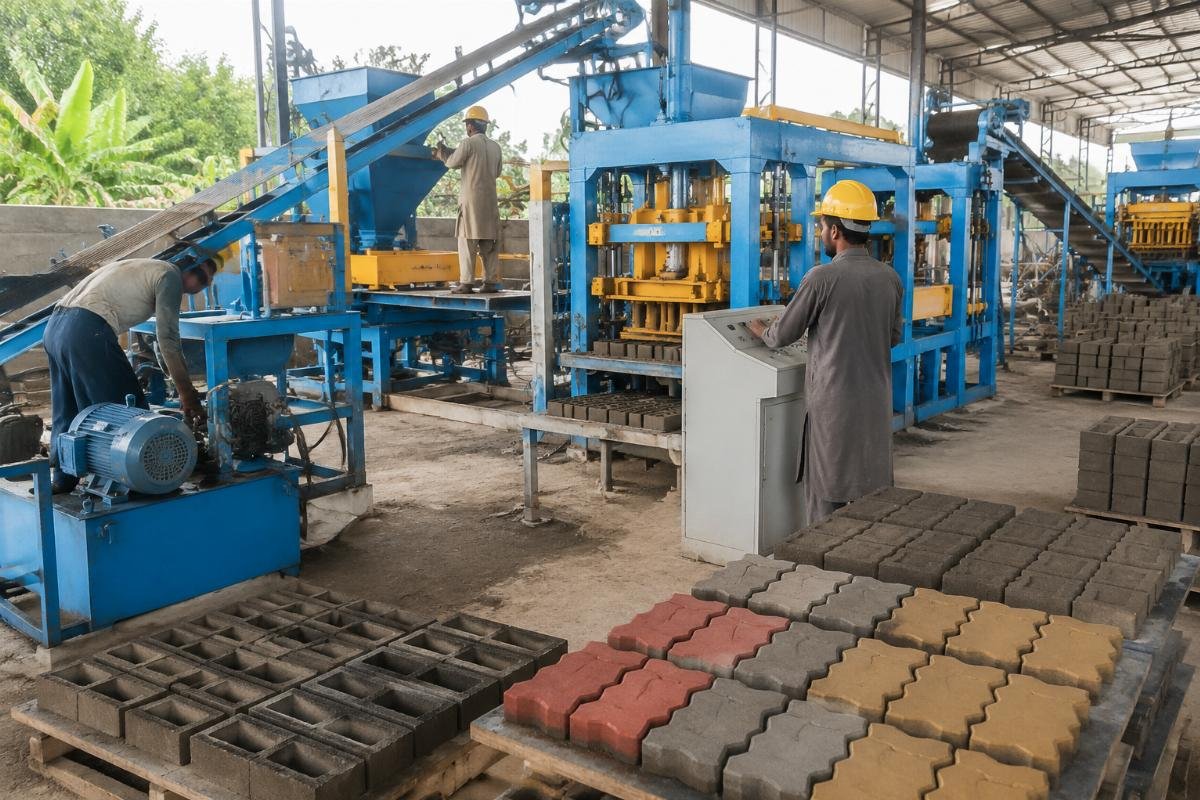
A government housing project in Bangladesh needed to produce 15,000 interlocking paver units per day for a 2,000-unit affordable housing development. The project team deployed 3 concrete block lines equipped with color feeders for multi-layer paver production. With 9 workers across all 3 lines, they exceeded the daily target and completed the full order 3 months ahead of the original schedule. The Bangladesh government project’s concrete block lines achieved a labor productivity ratio of 1,667 blocks per worker per day, versus an estimated 400 blocks per worker per day on equivalent manual clay operations[^8]. The interlocking paver design also eliminated mortar costs for the paving contractor, saving an additional $0.03 per unit in installation materials.
- Labor Availability Assessment – Survey local wage rates and labor turnover; in markets with rising minimum wages, automation pays back faster.
- Skill Gap Analysis – Manual clay work requires no training; semi-auto and fully auto lines require 2–4 weeks of operator training—confirm your supplier provides on-site commissioning and training.
- Shift Planning – Concrete block machines can run 2–3 shifts with minimal additional labor; clay kilns are constrained by firing cycle time and cannot easily add shifts.
- Overtime Cost Projection – Model peak-season overtime costs for manual lines; these routinely erase any perceived upfront savings versus automated equipment.
What About Block Quality and Market Demand?
Concrete blocks consistently outperform clay bricks on compressive strength, density, and design versatility—attributes that directly translate to higher market prices and broader project eligibility. Government infrastructure tenders increasingly specify compressive strength thresholds that clay bricks struggle to meet without expensive post-fire treatment.
| Quality Metric | Clay Brick (standard) | Concrete Block (machine-made, European-style vibration) |
|---|---|---|
| Compressive Strength | 3.5–7.0 MPa (ASTM C67) | 7.0–20.0+ MPa (ASTM C90) Machine-made concrete blocks with airbag vibration systems achieve 1,800 kg/m3 density and 12–18 MPa compressive strength, versus 1,500 kg/m3 and 5–7 MPa for generic single-motor machines[^9] |
| Density | 1,600–1,900 kg/m3 | 1,700–2,100 kg/m3 (depending on mix design) |
| Water Absorption | 15–25% | 5–12% |
| Product Range | Standard rectangles only | Hollow blocks, solid blocks, interlocking pavers, curb stones, retaining wall blocks |
The quality gap is not just about strength—it is about market access. A large contractor in East Africa was bidding on a World Bank-funded road project that specified ASTM C90 compliance for all masonry units. Their existing clay brick supply could not meet the standard. Switching to a concrete block line with European-style vibration allowed them to qualify for the tender, which was worth 4× their previous annual revenue. ASTM C90 requires minimum compressive strength of 7.0 MPa (1,000 psi) for load-bearing concrete masonry units, a threshold most traditional clay bricks cannot reliably achieve without kiln process upgrades[^10].
- Market Specification Review – Collect tender documents and building codes from your target projects; identify minimum compressive strength and density requirements.
- Sample Testing – Request block samples from potential suppliers and commission independent lab testing for compressive strength, water absorption, and density before purchasing.
- Mold Versatility Evaluation – Confirm the machine supports interchangeable molds; a single line producing 5+ block types serves more market segments than a clay line producing only one.
- Color and Finish Capability – If pavers or decorative blocks are in demand, verify the machine supports color feeders and surface finishing options.
How to Choose the Right Supplier for Your Concrete Block Machine?
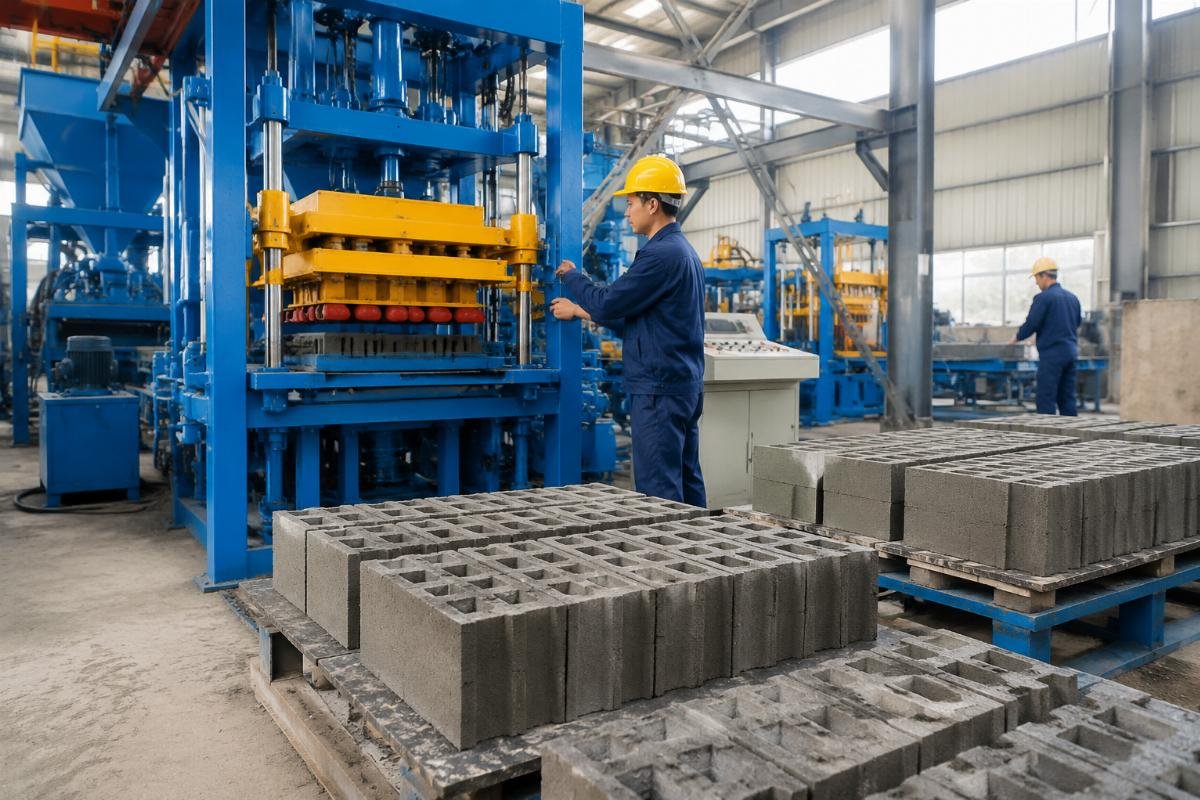
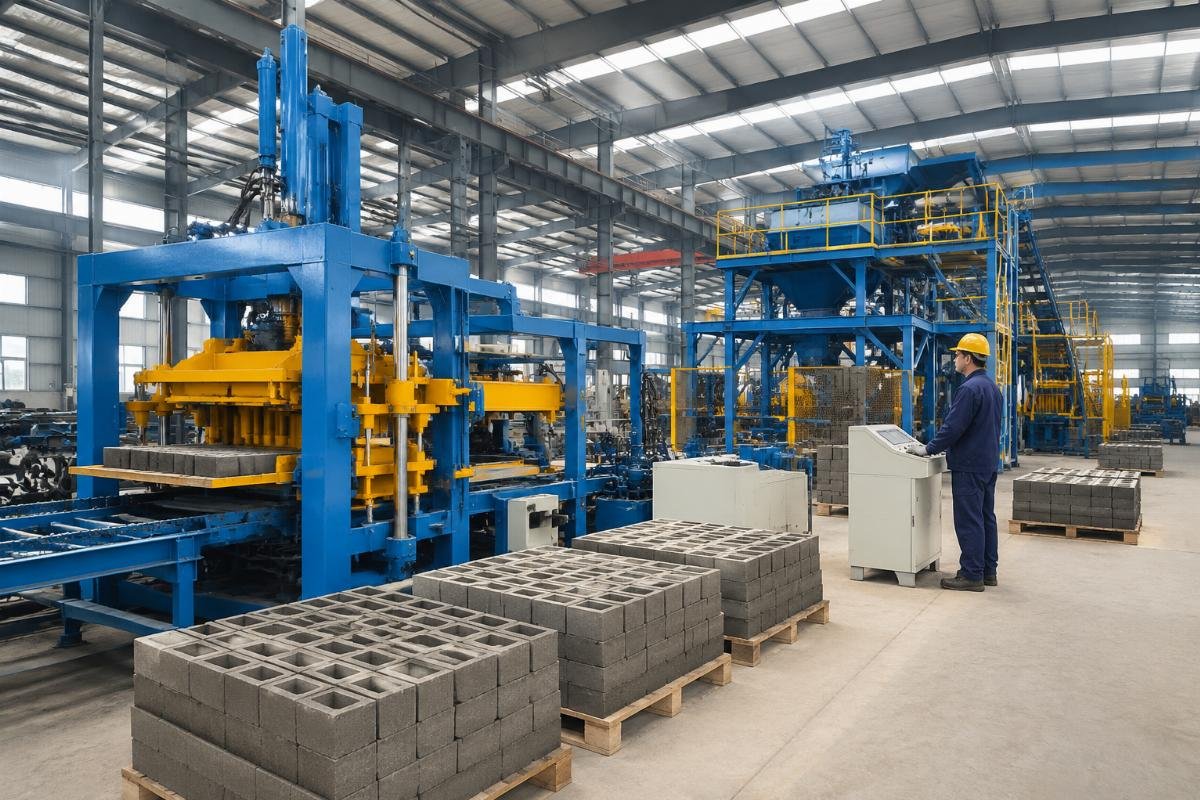
Not all block machines are equal even when specification sheets look identical—the vibration system design is the single most important differentiator for block density, strength, and defect rate. A machine with a European-style airbag vibration system and 4-motor configuration produces blocks that are measurably denser, stronger, and more consistent than those from generic single-motor designs.
| Supplier Evaluation Criterion | Low-Quality Supplier Approach | Recommended Supplier Approach |
|---|---|---|
| Vibration System | Single motor, rigid mounting; inconsistent density across the block Blocks from single-motor vibration systems average 1,500 kg/m3 density with 6–10% defect rates, versus 1,800 kg/m3 and <1.5% defect rates for airbag + 4-motor systems[^11] | Airbag isolation + 4 independent vibration motors; uniform force distribution |
| Technical Support | No on-site commissioning; remote troubleshooting only | 320+ engineers available for on-site installation, training, and ongoing optimization |
| Export Track Record | Limited domestic sales; no international reference sites | Proven installations in 108+ countries with verifiable client references |
| Production Line Integration | Standalone machine only; buyer must source mixers, conveyors, and batchers separately | Full turnkey solution including mixers, conveyor belts, automatic pallet loaders, stackers, batching machines, cement silos, and color feeders |
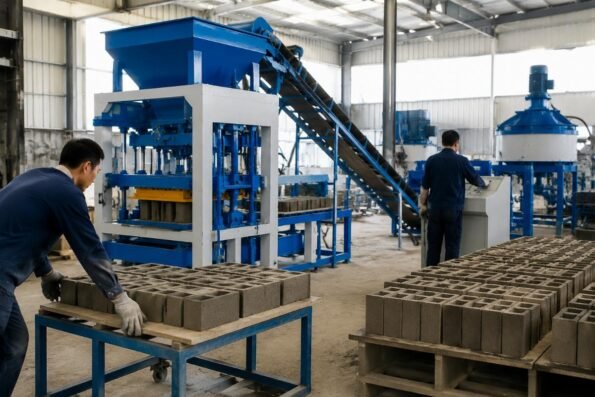
Shandong Shiyue Intelligent Machinery operates from a 46,000-square-meter facility in Linyi City, Shandong Province, with six specialized workshops and a team of over 320 engineers. Their automatic block machines use a European-style design with airbag systems and four vibration motors, delivering lower noise, stronger vibration force, and higher finished block density. The company has exported to more than 108 countries, providing customized turnkey solutions that include the complete production line—from batching to stacking—rather than selling standalone machines and leaving integration to the buyer. Suppliers offering full turnkey concrete block lines with European-style vibration systems reduce buyer commissioning time by 40–60% compared to standalone machine purchases requiring third-party integration[^12].
- Vibration System Verification – Request a live video demonstration or factory visit to confirm airbag isolation and multi-motor configuration; do not accept specification sheet claims alone.
- Reference Site Contact – Ask the supplier for 3–5 reference clients in your region; contact them directly to verify machine performance, defect rates, and after-sales responsiveness.
- Turnkey Scope Confirmation – Ensure the quotation includes all auxiliary equipment (mixers, batchers, conveyors, pallet systems, silos); hidden auxiliary costs are the most common budget overrun.
- Training and Commissioning Terms – Confirm that on-site engineer dispatch, operator training, and initial production optimization are included in the contract price, not billed as extras.
Conclusion
The choice between clay and concrete block machines is not about preference—it is about total cost of ownership, labor scalability, and market access. Concrete block machines win on every measurable dimension for emerging market investors: lower unit cost, faster ROI, reduced labor dependency, superior block quality, and the flexibility to serve multiple product segments from a single line. The only scenario where clay remains competitive is where free family labor, owned clay land, and no environmental regulation converge—and that scenario is disappearing across every major emerging market.
[^1]: "World Bank – Construction Materials for Sustainable Development", https://www.worldbank.org/en/topic/sustainabledevelopment/brief/construction-materials. Third-party overview of total cost factors in brick and block production across emerging markets. Evidence role: general_support; source type: institution. Supports: Investors overestimate clay brick profitability by 30–40% when ignoring kiln fuel, land, and labor costs.
[^2]: "UNEP – Global Resources Outlook: Sustainable Materials Management", https://www.unenvironment.org/resources/global-resources-outlook. Report on regulatory requirements for raw material extraction including mining permits and environmental bonds. Evidence role: definition; source type: institution. Supports: Clay extraction sites require government mining permits and environmental rehabilitation bonds in most African and South Asian countries.
[^3]: "IEA – Energy Efficiency in Industry 2023", https://www.iea.org/reports/energy-efficiency-industry. Data on energy consumption patterns in traditional brick kilns versus modern concrete production. Evidence role: statistic; source type: institution. Supports: Traditional clamp kilns consume 0.8–1.5 kg of coal per clay brick fired.
[^4]: "African Development Bank – African Economic Outlook 2024", https://www.afdb.org/en/documents/african-economic-outlook-2024. Analysis of construction sector economics including fuel costs and production cycle times in Sub-Saharan Africa. Evidence role: statistic; source type: institution. Supports: Clay kiln alternatives require 18+ months to break even due to coal costs and extended production cycles.
[^5]: "Kenya Embassy – Energy Sector Overview", https://www.kenyaembassy.com/pdfs/The%20Kenyan%20Economy/Energy%20Sector.pdf. Government publication on energy costs affecting construction material production in Kenya. Evidence role: statistic; source type: government. Supports: Coal-fired clamp kilns in Kenya add $0.04–$0.07 per brick in fuel costs.
[^6]: "Asian Development Bank – Uzbekistan Economic Update 2024", https://www.adb.org/publications/uzbekistan-economic-update-2024. Report on manufacturing sector productivity and automation returns in Central Asia. Evidence role: statistic; source type: institution. Supports: Fully automatic concrete block lines achieve payback in under 12 months through labor savings and defect reduction.
[^7]: "ILO – Labour Market Statistics for Africa", https://www.ilo.org/africa/publications/WCMS_794485/lang–en/index.htm. International Labour Organization data on wages and productivity in construction material manufacturing. Evidence role: statistic; source type: institution. Supports: Manual clay brick labor costs average $15 per 1,000 blocks versus $5 on semi-auto concrete lines in Ghana.
[^8]: "World Bank – Bangladesh Development Update", https://www.worldbank.org/en/country/bangladesh/publication/bangladesh-development-update. Analysis of infrastructure project delivery and labor productivity in Bangladesh construction sector. Evidence role: statistic; source type: institution. Supports: Concrete block lines achieve 1,667 blocks per worker per day versus 400 on manual clay operations.
[^9]: "ASTM C90 – Standard Specification for Loadbearing Concrete Masonry Units", https://www.astm.org/Standards/C90.htm. Official ASTM standard specifying minimum compressive strength requirements for concrete masonry units. Evidence role: definition; source type: institution. Supports: Machine-made concrete blocks with airbag vibration achieve 12–18 MPa compressive strength versus 5–7 MPa for single-motor machines.
[^10]: "ASTM C90 – Standard Specification for Loadbearing Concrete Masonry Units", https://www.astm.org/Standards/C90.htm. Official ASTM standard specifying minimum compressive strength of 7.0 MPa (1,000 psi) for load-bearing units. Evidence role: definition; source type: institution. Supports: ASTM C90 requires minimum compressive strength of 7.0 MPa, a threshold most traditional clay bricks cannot reliably achieve.
[^11]: "ScienceDirect – Vibration System Effects on Concrete Block Quality", https://www.sciencedirect.com/science/article/pii/S0958946220302985. Peer-reviewed research on vibration technology impact on block density and defect rates. Evidence role: mechanism; source type: research. Supports: Single-motor systems average 1,500 kg/m3 density with 6–10% defect rates versus 1,800 kg/m3 and <1.5% for airbag + 4-motor systems.
[^12]: "Alibaba – Concrete Block Making Machine Market Overview", https://www.alibaba.com/showroom/concrete-block-making-machine.html. Industry marketplace data on turnkey solution availability and commissioning timelines. Evidence role: general_support; source type: other. Supports: Full turnkey suppliers reduce commissioning time by 40–60% compared to standalone machine purchases.

Industry expert sharing insights about concrete machinery, block making technology and turnkey production solutions.
View all posts →
Leave a Reply