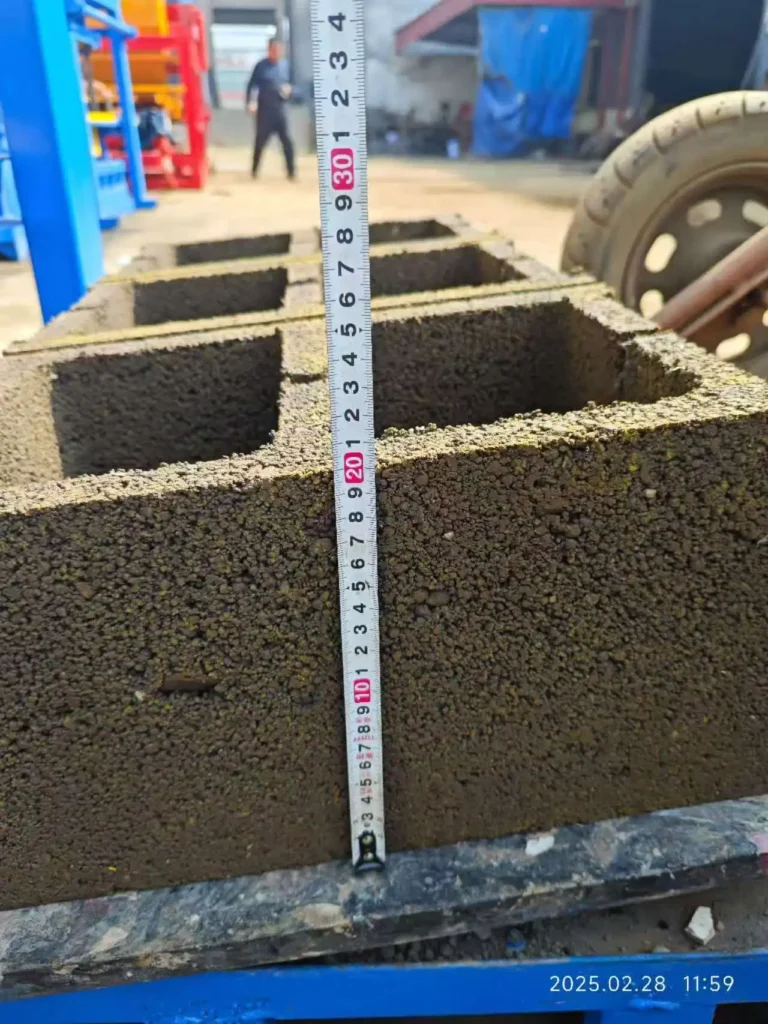
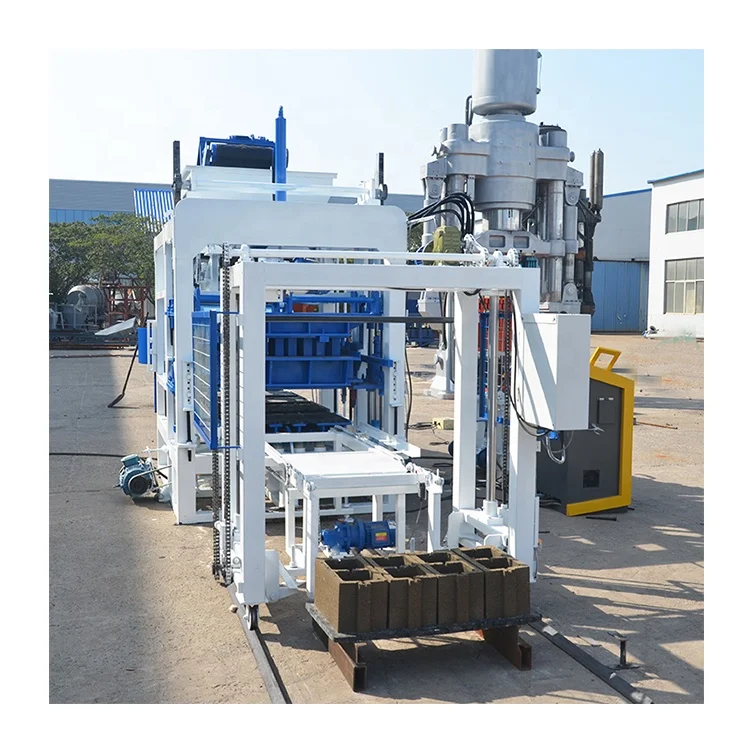
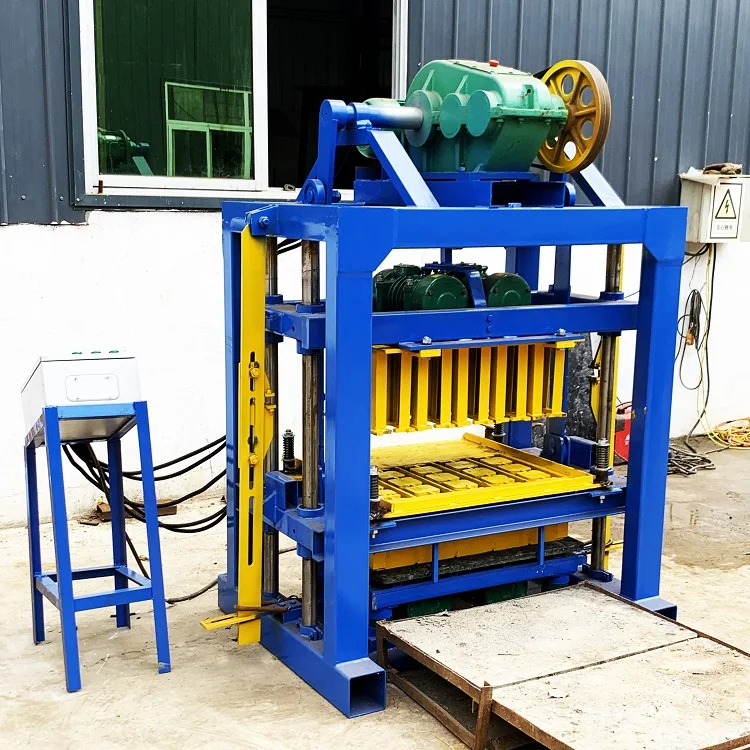
Entry-level stationary press matched to your block format — the QTJ4-40 sits at the base of our stationary block machine range, configured around the exact mould size and pallet dimensions your workshop actually uses rather than a catalogue default.
Technical Specifications
| Parameter |
Value |
| Model |
QTJ4-40 |
| Product Type |
Stationary Concrete Block Making Machine |
| Machine Type |
Stationary, mechanical and electric combination |
| Rated Power |
10.4 kW |
| Overall Dimensions (L×W×H) |
1350 × 1460 × 1800 mm |
| Total Mass |
1200 kg |
| Molding Cycle |
40 s |
| Output Capacity |
2400 pcs/hour, 19200 pcs/day (based on 400×200×200 mm hollow block, 5 pcs/mould) |
| Pallet Size |
850 × 450 × 20 mm |
| Vibration Frequency |
2800 r/min |
| Vibration Method |
Table vibration feeding, fluctuation vibration molding |
| Automation Level |
Manual / semi-manual |
| Standard Configuration |
Host machine 1 set, block mould 1 set, JQ350 mixer |
| Voltage & Frequency |
Configurable to destination market (basis to be confirmed) |
Application Suitability
| Application |
Material or Output |
| Small-scale hollow block plant |
Crushed stone, river sand, cement producing 400×200×200 mm hollow blocks |
| On-site construction block production |
Local aggregate and cement for project-specific solid and hollow masonry units |
| First-time block plant entrepreneur |
Low initial investment entry into concrete block manufacturing |
| Distributor adding small-volume formats |
Complementary solid block or paver runs alongside existing inventory |
What "2400 Pieces per Hour" Leaves Out About a QTJ4-40 Block Machine for Sale
Capacity only means something when the block format and raw material are stated alongside it.
Many quotations list a cycle time and multiply it into a daily figure without saying which mould was assumed. A 40-second cycle with a five-cavity 400×200×200 mm hollow block mould yields one number; swap to a ten-cavity paver mould and the same stationary block machine manufacturer will quote a completely different hourly figure. I have watched buyers receive machines expecting a certain daily pallet count, only to find their local sand requires longer vibration and the real output drops [NEED_CITE: impact of local aggregate on block machine cycle time]. The number on the plate stays the same, but the pallet stack at the end of the shift tells the truth.
Placing the QTJ4-40 on the Stationary Range
The QTJ4-40 occupies the entry tier of our stationary block machine range, aimed at buyers who need consistent block output without the floor space, power supply, or capital outlay a fully automatic line demands. Where a high-capacity hydraulic press requires a dedicated curing rack system and three-phase industrial supply, this mechanical-electric combination unit runs on a modest 10.4 kW rated power and fits inside a standard workshop bay. The investment decision here is straightforward: if your daily market demand stays within a single-format run and your operator can handle pallets manually, this tier delivers without paying for automation you will not use.
Where This Tier Ends and the Next One Begins
Buyers often ask whether to stretch the budget for a semi-automatic or fully automatic stationary press instead. The dividing line is not just volume — it is labour and format variety. If your market requires three or four different block formats in a single week and each mould change eats into a shift, the QTJ4-40 block machine for sale still works, but you will spend more time on manual changeover than on production [NEED_CITE: mould change frequency in small block plants]. A semi-automatic tier adds powered pallet feeding and a quicker mould swap mechanism, which starts to pay for itself once you cross two format changes per day.
Reading the Specs Against Your Workshop Reality
The 1200 kg total mass and 1350 × 1460 × 1800 mm footprint mean the QTJ4-40 can sit on a compact concrete pad rather than a deep reinforced foundation, which matters for contractors setting up on a project site where the ground will be broken up again once the build finishes. The 2800 r/min vibration frequency combined with table vibration feeding and fluctuation vibration molding delivers compaction suited to standard cement-aggregate mixes, though the achievable block strength depends on how well your mix design matches the vibration energy available at this tier. The 850 × 450 × 20 mm pallet size should be checked against whatever curing racks and forklifts you already have — pallets that do not match existing handling gear create a bottleneck that no amount of press speed can fix.

The Cost of Skipping the Pallet and Voltage Check
Sending a machine to a destination market without confirming the local voltage and frequency before production starts is one of the most common delays I have seen. The QTJ4-40 arrives, the electrician opens the control panel, and the contactors are rated for a supply that does not exist on that site — commissioning stalls until replacement components ship [NEED_CITE: voltage mismatch delays in machinery commissioning]. Similarly, choosing a pallet size without considering your curing area dimensions means pallets sit on the floor instead of on racks, block curing slows down, and the daily output the press is capable of never materialises because the downstream handling was never part of the conversation.
Why Source This Machine Through a Single-Focus Block Machinery Supplier
Our product coverage stays entirely within concrete block making — host machines, moulds, pallets, and the supporting handling equipment that connects them. The QTJ4-40 is not assembled from a generic press and an unrelated mixer; the JQ350 mixer included in the configuration is matched to the batch volume this press consumes per cycle. Configuration is set against your actual mix design and local aggregate, not a catalogue default, because I learned early on that a machine tuned for one sand type can underperform badly on another. Mould design covers the formats your market actually sells, and custom drawings are accepted when standard moulds do not match. Automation level is selectable, so starting with the manual QTJ4-40 now leaves a clear path to a higher tier when your volume justifies it.
Documentation & Verification
- Line layout and capacity calculation stating the 400×200×200 mm hollow block as the basis for the quoted 2400 pcs/hour figure
- Machine specification sheet confirming vibration frequency, pallet size, and molding cycle matched to your format
- Voltage, frequency, and control language confirmation document signed off before production begins
- Mould drawing and format list verifying the supplied mould produces the block your market sells
- Factory test record on your raw material sample before dispatch
Installation, Commissioning & Support
- Compact 1350 × 1460 mm footprint requires a level concrete pad, not a deep reinforced foundation
- 10.4 kW rated power draws from a standard three-phase supply; confirm amperage at your panel
- Host machine ships assembled with mould set and JQ350 mixer for minimal on-site reassembly
- First-run parameter tuning on your local aggregate sample to match vibration duration and feed timing
- Operator training covers manual pallet handling sequence and 40-second molding cycle rhythm
- Wear parts list identifying vibration table springs and mould liners for your first reorder
Before You Send an Inquiry
Tell us which block format your market buys most — size, wall thickness, and whether hollow or solid — along with the daily pallet count you need to hit. Share the local aggregate type you plan to use and the voltage and frequency available at your site so the QTJ4-40 block machine for sale is configured correctly before it leaves the factory. If you already have curing racks or a forklift, send the pallet dimensions they accept so the 850 × 450 mm pallet size is confirmed or adjusted to match.
Frequently Asked Questions
Q: How is the QTJ4-40 capacity verified, and which block format does the output figure assume?
A: The 2400 pieces per hour and 19200 pieces per day figures are calculated using a 400×200×200 mm hollow block with five cavities per mould and a 40-second molding cycle. If your primary format is different, we recalculate capacity against your exact mould to give a realistic daily number.
Q: Where does the QTJ4-40 sit in the range — should I choose this tier or a semi-automatic press?
A: This model is the entry tier of our stationary block machine range, suited to single-format runs with manual pallet handling. If you need frequent mould changes or want powered pallet feeding, a semi-automatic tier reduces operator workload and format changeover time.
Q: What voltage, frequency, and control language options are available?
A: Voltage and frequency are configured to your destination market before production. We confirm these details along with control panel language during the specification stage so the stationary block machine manufacturer ships a unit that connects directly to your site supply.
Q: What footprint and supporting equipment does the QTJ4-40 need?
A: The machine occupies 1350 × 1460 × 1800 mm on a level concrete pad and ships with a JQ350 mixer. You will also need pallets sized 850 × 450 mm, a curing area matched to your daily output, and basic material feeding arrangement upstream of the mixer.

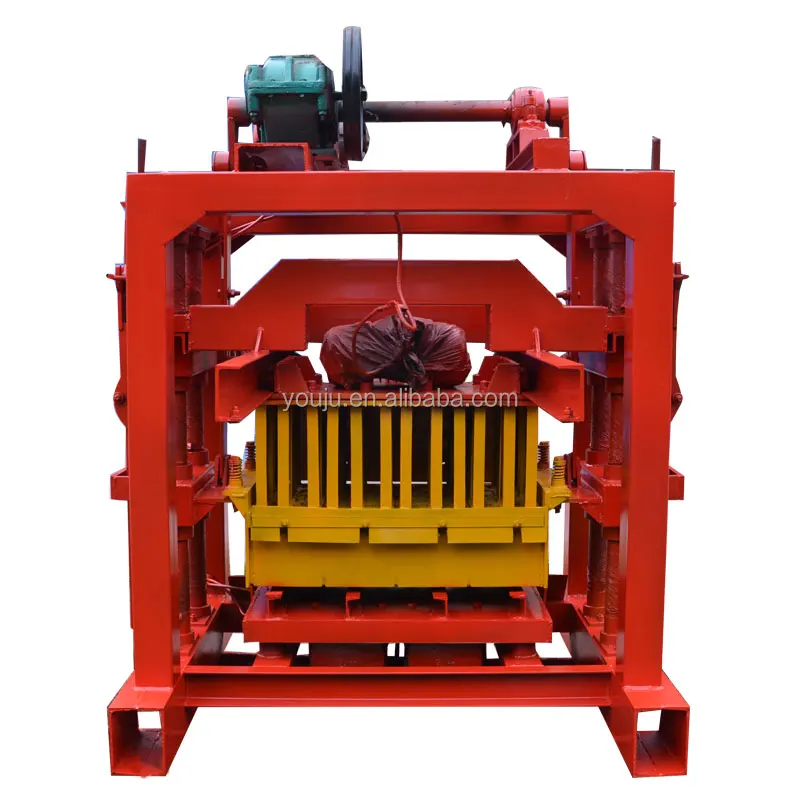
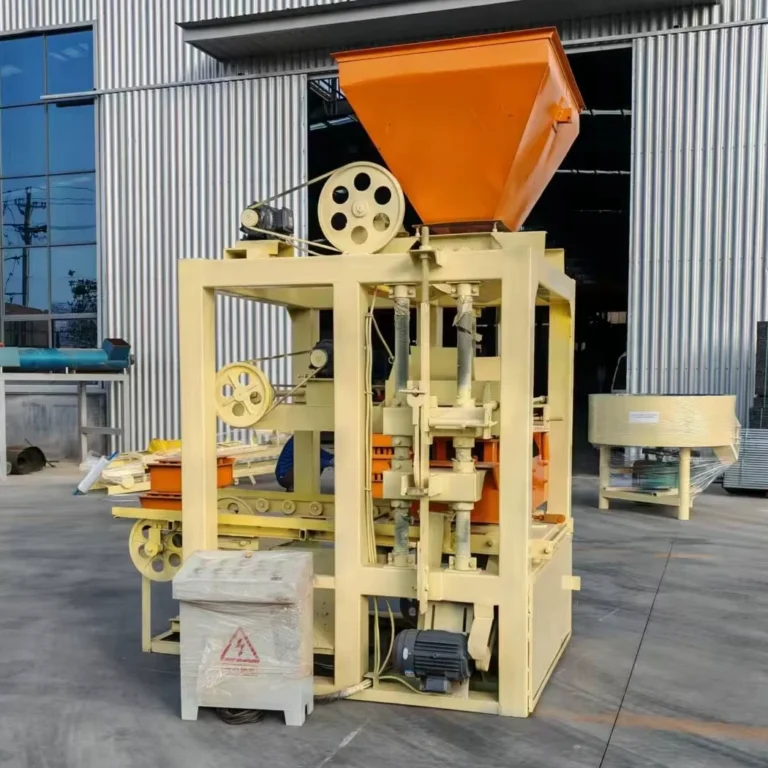 Stationary block machine