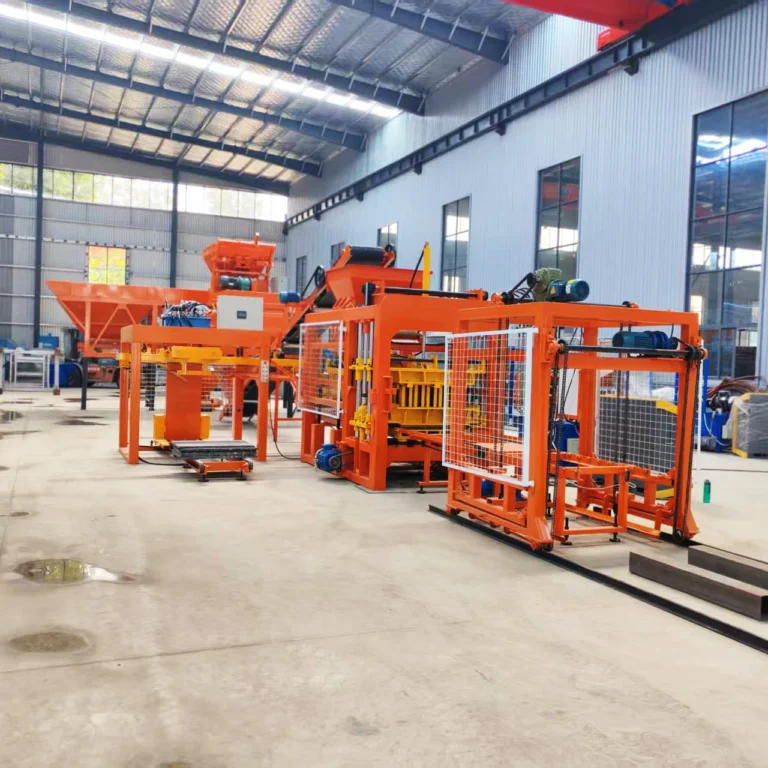
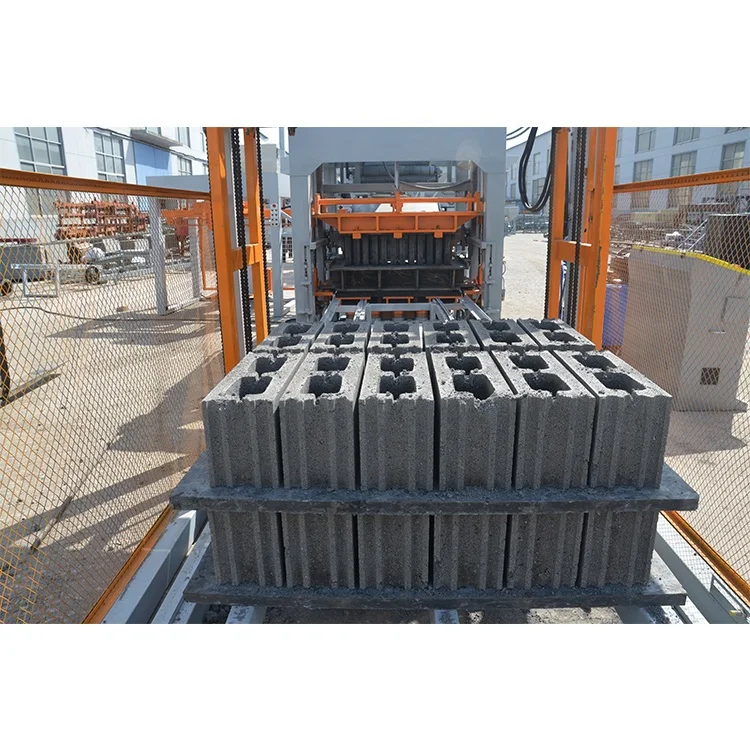
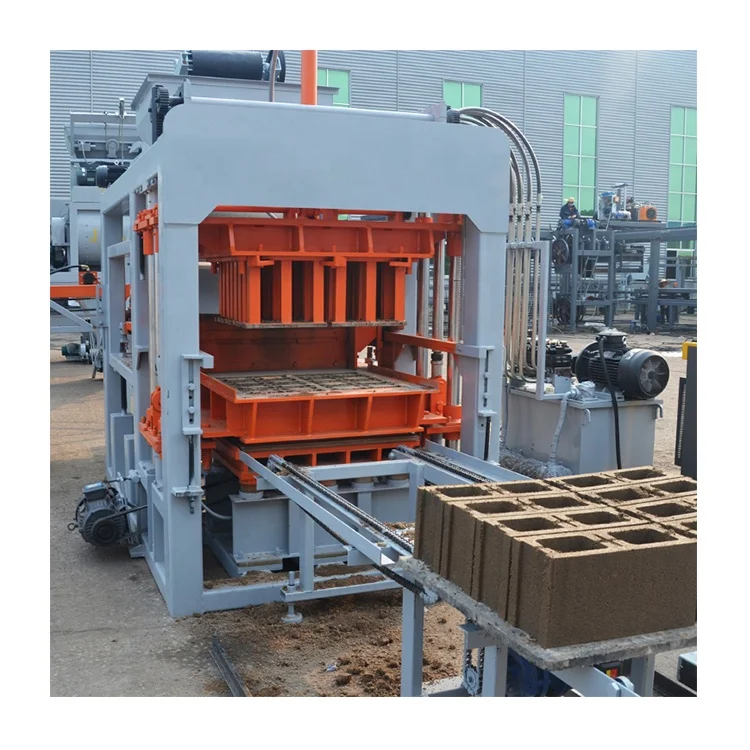
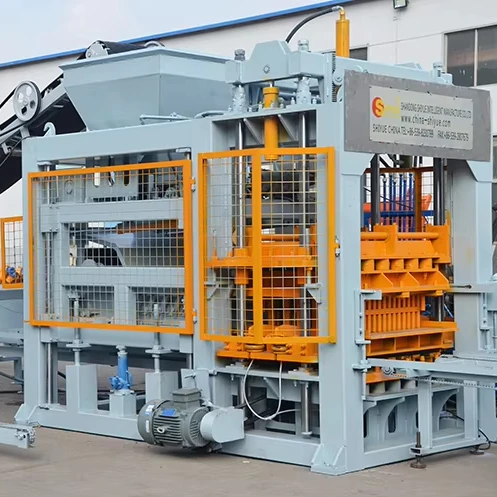
Matched System Integration — Press, mould, pallet and handling specified as one coherent block production line, preventing the mismatched component issues that typically surface only during commissioning.
Technical Specifications
| Parameter |
Value |
| Model |
QT8-15 |
| Product Type |
Hydraulic Concrete Block Making Machine |
| Overall Dimensions (L×W×H) |
8300×1860×3000 mm |
| Rated Pressure |
21 MPa |
| Main Vibration Form |
Platform Vibration |
| Vibration Frequency |
2800–4500 r/min |
| Vibration Force |
45 kN |
| Pallet Size |
950×900 mm |
| Molding Cycle |
15–20 s (basis to be confirmed per block format and material) |
| Overall Power |
55.5 kW |
| Total Mass |
8 T |
| Demolding Method |
Hydraulic |
| Factory Area |
300 m² |
| Applied Products |
Concrete blocks, hollow/solid blocks, pavers, interlocking blocks, curbstone, colored pavers |
| Raw Material |
Crushed stone, sand, cement, dust, fly ash, gravel, slag |
| Voltage & Frequency |
Configurable (to be confirmed before order) |
| Control System |
PLC based (brand and display language to be confirmed) |
| Automation Level |
Selectable from semi-automatic to fully automatic with stacking and cubing |
| Warranty |
1 year (whole machine, excluding spare parts) |
| Loading |
1×40HQ container (basic equipment) |
Application Suitability
| Application |
Material or Output |
| Hollow block production plants |
Crushed stone, sand, cement, fly ash blends |
| Solid block manufacturing |
Gravel, slag, cement mixes for load-bearing units |
| Paving block and colored paver lines |
Fine aggregate, cement, pigment for interlocking and curb formats |
| On-site contractor production |
Locally sourced aggregate for project-specific block formats |
| Building material distributors |
Multi-format output from a single hydraulic press platform |
What "15–20 Second Cycle Time" Actually Means for Your Daily Output
Cycle time without a stated block format is meaningless for capacity planning.
When a quotation lists a molding cycle of 15–20 seconds, it rarely specifies whether that figure applies to a standard hollow block, a thin paver, or a tall curbstone. In practice, a hollow block may cycle within that range while a dense interlocking paver requires extended vibration and pressurization, pushing the actual cycle longer. I have seen buyers plan their entire production schedule around the shortest cycle figure, only to find their real daily output falling well short once the machine runs their primary product format. The QT8-15 block machine manufacturer approach requires confirming the cycle against your specific block format, mix design, and target strength before any capacity calculation is finalized [NEED_CITE: block format impact on hydraulic press cycle time].

Positioning the QT8-15 Within the Output Tier Spectrum
The QT8-15 occupies the mid-to-high tier of our block machine range, serving buyers who have outgrown small workshop machines but do not yet need the footprint or investment of a high-capacity automatic line. It bridges the gap for entrepreneurs scaling from manual pallet handling into semi-automatic operation, as well as established producers replacing aging presses with a proven hydraulic platform. Understanding where this model sits helps you evaluate whether stepping up to a larger tier is justified by your market volume, or whether the QT8-15 block machine manufacturer configuration already covers your daily format requirements.
Matching Machine Tier to Plant Footprint and Investment
A 300 m² factory area requirement means the QT8-15 fits within a moderate plant layout that still leaves room for raw material storage, curing racks, and pallet return paths. Buyers comparing tiers should consider not just the press itself but the supporting equipment footprint — mixer capacity, pallet feeding mechanism, stacking station, and curing rack handling all need to keep pace so the press is never left waiting. The 8 T total mass and 55.5 kW overall power also define your foundation requirements and electrical supply specifications, factors that differ noticeably between tiers [NEED_CITE: block plant layout considerations for hydraulic press installation].
How Hydraulic Pressure and Vibration Force Define Block Quality
The 21 MPa rated pressure and 45 kN vibration force on the QT8-15 work together to compact the mix into a dense, consistent block. Hydraulic pressure alone compresses the material, but without sufficient vibration, air pockets remain trapped in the mix, weakening the final product. Platform vibration at 2800–4500 r/min fluidizes the aggregate particles during compression, allowing them to settle into a tighter matrix. This combination must be tuned to your specific raw material — a fly ash-heavy mix responds differently than one based on coarse crushed stone, and the vibration frequency range allows adjustment across material types. The 950×900 mm pallet size determines how many blocks are formed per cycle, and this dimension should align with your existing curing rack spacing and forklift capacity to avoid costly handling adaptations after installation.
The Hidden Cost of Unmatched Pallet and Handling Configuration
When pallet size is chosen without considering the curing area layout, buyers end up reconfiguring their entire yard or purchasing new forklifts to handle non-standard dimensions. Similarly, when a quotation covers only the press and omits pallet feeding, stacking, and curing rack handling, the buyer discovers after delivery that output must be moved and stacked manually — negating the automation investment. These gaps typically surface only when the machine arrives and the production line cannot run as a continuous system [NEED_CITE: block production line integration common oversights].
Why Sourcing from a Single-Focus Manufacturer Matters
Block machinery is our only product category, which means the QT8-15 is specified alongside its moulds, pallets, and handling equipment as one matched system rather than assembled from unrelated suppliers. Configuration decisions are based on your actual mix design and local aggregate, not pulled from a catalogue default. Mould design covers every format your market sells, including custom drawings when standard options do not match local demand. Automation level is selectable, so you can begin with semi-automatic pallet handling and add stacking and cubing modules as production volume grows. Installation support includes operator training on your specific block formats, and wear parts and mould replacements remain available through the same supply channel.
Documentation & Verification
- Line layout drawing with capacity calculation stating the assumed block format for each output figure
- Machine specification sheet confirming voltage, frequency, and PLC display language before production begins
- Mould drawing and format list covering every block type included in your order
- Pallet specification matched to your curing rack dimensions and forklift capacity
- Factory test record run on your target block format before dispatch
- Hydraulic and electrical schematic for local maintenance reference
Installation, Commissioning & Support
- Foundation prepared to support 8 T total mass across the 8300×1860 mm machine footprint
- Dedicated electrical circuit sized for 55.5 kW overall power with confirmed voltage and frequency
- Basic equipment loads in one 40HQ container; on-site assembly and alignment follow arrival
- First-run commissioning includes vibration frequency and pressure tuning to your raw material
- Operator training covers mould change procedure, cycle adjustment, and daily maintenance checks
- Wear parts list and mould replacement schedule provided at handover
What We Need Before Quoting Your Line
To configure the QT8-15 correctly for your project, share your target block formats with dimensions, your local raw material type and any available test reports, and your daily output requirement stated per format. Confirm your site voltage and frequency, the PLC display language your operators need, and whether your existing forklift and curing racks constrain the pallet size. Let us know if you are starting with semi-automatic handling or require full stacking and cubing from day one.
Frequently Asked Questions
Q: Where does the QT8-15 sit in the full block machine range, and when should a buyer step up?
A: The QT8-15 sits in the mid-to-high tier, suited for buyers who have outgrown small workshop machines but do not require a high-capacity automatic line. Step up when your daily output across multiple formats consistently exceeds what a single 950×900 mm pallet press can deliver, or when your market demands formats that require a larger pallet size.
Q: How is daily output calculated per block format for this machine?
A: Daily output depends on the molding cycle for each specific block format, the number of blocks per pallet, and your operating hours. We calculate capacity separately for hollow blocks, solid blocks, and pavers because each format has a different cycle time and mould cavity count. The 15–20 second range is a starting point, not a guaranteed figure across all formats.
Q: Can I start with semi-automatic operation and add automation later?
A: Yes. The QT8-15 is available with selectable automation levels. You can begin with manual pallet handling and add automatic pallet feeding, stacking, and cubing modules as your production volume grows, without replacing the press itself.
Q: What confirmations are required before the machine enters production?
A: We confirm voltage, frequency, and PLC display language against your site specifications. Pallet size is verified against your curing area and forklift. Block format and mould drawings are approved, and a capacity calculation is provided stating the assumed format for each output figure.

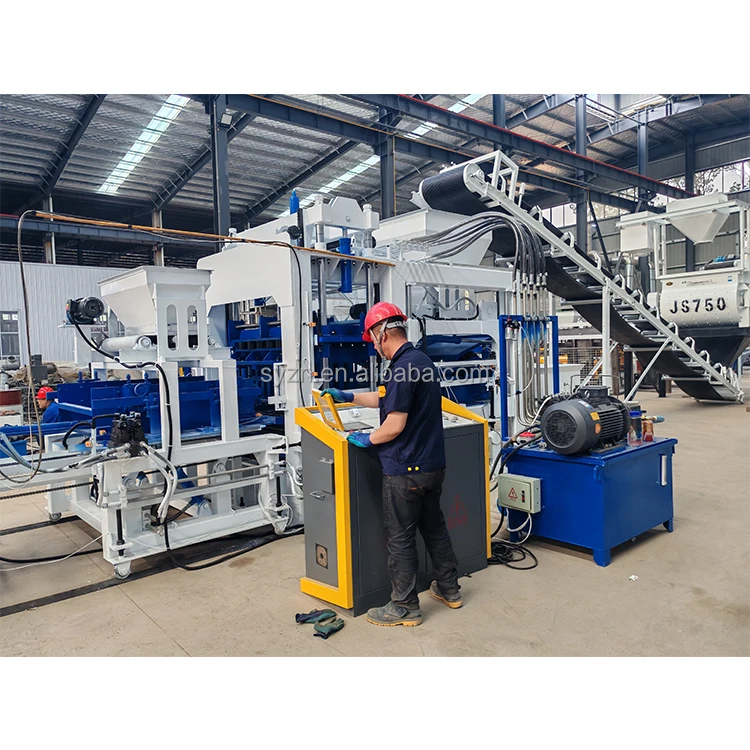
 High quality block machine