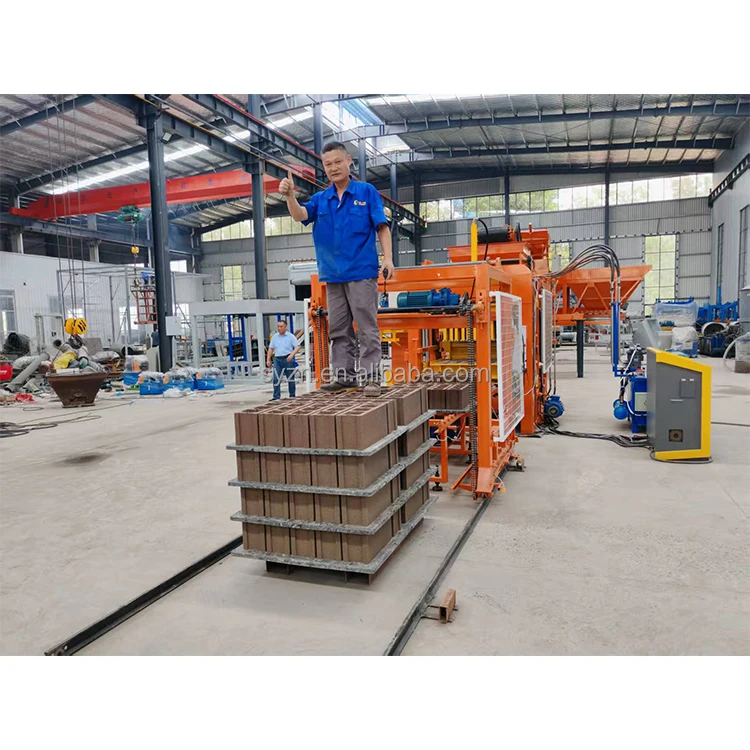
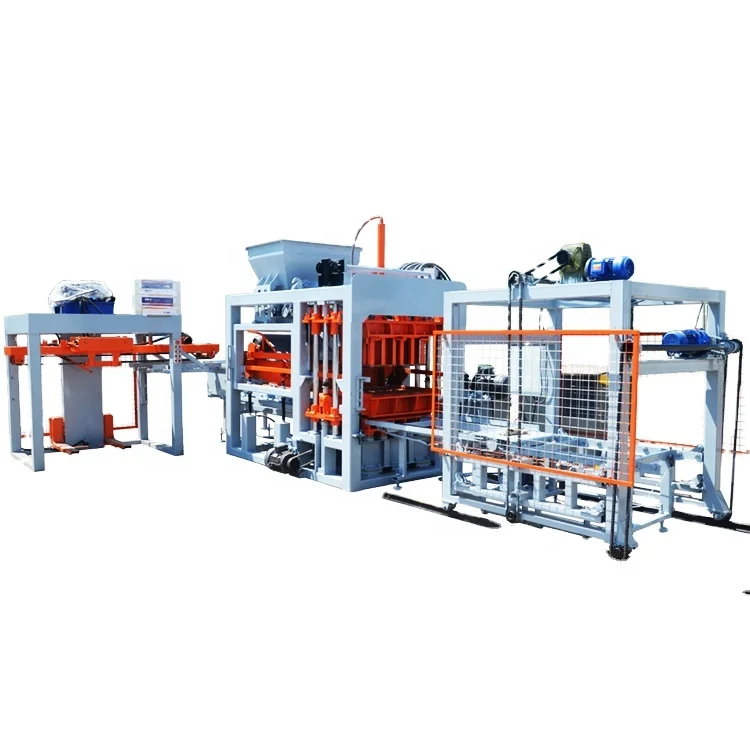
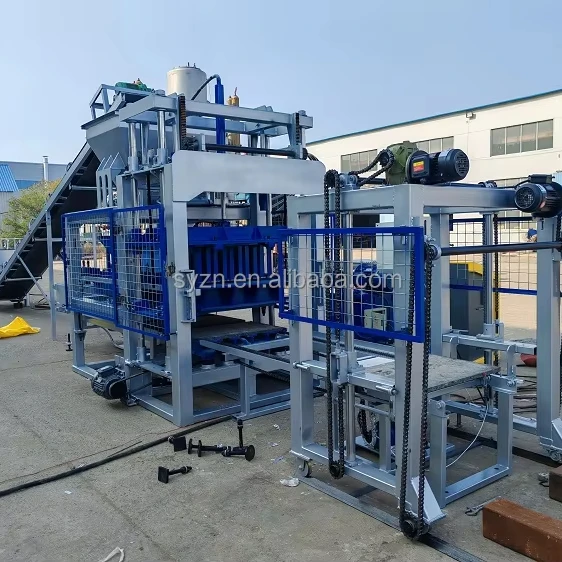
Matched System Engineering — the QT8-15 automatic block making machine for sale ships with hydraulic station, PLC, pallet feeder and mould specified as one tested line, not a collection of separate purchases assembled on your floor.
Technical Specifications
| Parameter |
Value |
| Model |
QT8-15 |
| Product Type |
Automatic Hydraulic Concrete Block Making Machine |
| Overall Dimensions (L×W×H) |
8300 × 1860 × 3000 mm |
| Molding Cycle |
15–20 s |
| Vibration Force |
55 KN |
| Total Power |
37.2 kW |
| Mixer |
JS750 |
| Pallet Size |
1020 × 900 mm |
| Total Weight |
8 T |
| Control System |
PLC control system |
| Hydraulic Station |
Included |
| Included Equipment |
Block making machine, hydraulic station, PLC control system, pallet feeder, brick conveyor, block sweeper, material feeder, block mould |
| Output Capacity |
1920 pcs/hour (basis not stated in source — confirm block format / material / thickness) |
| Applied Products |
Paver, solid block, hollow block, curbstone |
| Raw Materials |
Crushed stones, sand, cement, dust, fly ash |
Application Suitability
| Application |
Material or Output |
| Interlocking paver production for driveways and walkways |
Crushed stone and sand mixes with cement binder |
| Hollow block manufacturing for residential and commercial walls |
Fly ash, cement and aggregate blends |
| Solid block output for load-bearing construction |
Dense aggregate and cement combinations |
| Curbstone forming for road and pavement edging |
High-strength crushed stone and cement mixes |
Why "Pieces per Hour" Means Nothing Without the Block Format
Capacity only becomes real once you know exactly which block you are pressing and what your local aggregate looks like.
A supplier quoting the QT8-15 automatic block making machine for sale at a headline cycle rate rarely mentions that the number assumes a specific format, thickness and mix moisture content. Swap from a thin paver to a tall hollow block and the same press takes a noticeably different time per cycle. Add high-moisture local sand and the vibration force must be adjusted or the blocks crack before they reach the curing area [NEED_CITE: effect of aggregate moisture on concrete block cycle time]. I once watched a line stall for an entire shift because wet blocks collapsed on the pallet and jammed the conveyor — the machine was fine, the capacity assumption was not.

Where the QT8-15 Sits on the Full Machine Range
Buyers surveying their first plant often struggle to place a mid-tier automatic press against smaller semi-automatic or mobile options. The QT8-15 occupies the space between entry-level workshop machines and high-capacity lines that demand a dedicated building. It delivers full PLC-controlled automation with an included pallet feeder and conveyor, yet its 8.3-meter footprint still fits inside a standard industrial shed. For a buyer moving up from a manual egg-laying machine, this model removes the pallet-handling bottleneck without requiring the floor space of a twin-press layout.
How Automation Level Affects Your Daily Operation
The included PLC control system governs the hydraulic station, material feeder and block sweeper as a coordinated sequence. An operator selects the mould profile, and the press adjusts vibration duration and pressure hold accordingly. This matters because format changes — say from hollow block in the morning to paver in the afternoon — require the control logic to match, not just a physical mould swap [NEED_CITE: PLC parameter sets for multi-format block production]. Buyers starting with the base configuration can later integrate automatic stacking or cubing modules, provided the PLC has available I/O channels and the curing rack layout is planned from day one.
Reading the Spec Sheet Against Your Actual Production Needs
The 55 KN vibration force works in tandem with the hydraulic station to compact the mix inside the mould cavity. Higher vibration alone does not guarantee denser blocks; the hydraulic pressure must hold the mould head down while vibration consolidates the material, and the 15–20 s cycle window gives the operator room to tune both parameters for different formats. The 1020 × 900 mm pallet size determines how many blocks fit per press stroke and how many pallets your curing area must hold at any given time. If your existing forklift tines are spaced for a smaller pallet, you will need new handling equipment before the first production run. The JS750 mixer pairs with the material feeder to keep the press supplied, but its batch size must be calculated against the specific block volume you intend to produce — a hollow block consumes far more mix per cycle than a thin paver. Total power of 37.2 kW across the full line means you need a dedicated circuit with adequate breaker rating, not just a socket on an existing panel.
The Hidden Cost of Skipping the Pallet and Curing Conversation
Ordering a QT8-15 automatic block making machine for sale without confirming pallet dimensions against your curing racks and forklift creates a chain of delays that only surfaces after the container arrives. Pallets that do not stack on your existing racks force you to buy new racking or handle blocks manually, which cancels out the automation you paid for. Voltage and frequency mismatches discovered at commissioning mean the PLC display stays dark while you source a transformer, and a control language the operator cannot read leads to parameter errors that show up as inconsistent block strength weeks later [NEED_CITE: commissioning delays caused by unconfirmed electrical specifications]. These are not machine defects; they are specification gaps that a thirty-minute conversation before the order would have prevented.
Why Buyers Source This Line Here
Block machinery is our single focus, so the QT8-15 arrives with its mould, pallet and handling equipment specified as one matched system rather than assembled from separate suppliers. We configure the press against your actual mix design and local aggregate, not a catalogue default, which means the vibration force and hydraulic pressure are set for the material you will actually feed. Mould design covers the formats your market sells, and custom drawings are available when your buyer demands a non-standard paver profile. Automation level is selectable, so you can start with the base QT8-15 and add stacking or cubing as your volume grows. Installation support includes on-site commissioning and operator training so the first production run is not a learning experiment.
Documentation & Verification
- Line layout and capacity calculation stating the block format assumed for the quoted output figure
- Machine specification sheet with hydraulic pressure and vibration values matched to your mix
- Mould drawing and format list confirming included and custom-designed block profiles
- Voltage, frequency and PLC display language confirmation sheet before production starts
- Factory test record on your target block format before dispatch
- CE declaration documentation where applicable to your import market
Installation, Commissioning & Support
- Foundation pad sized to the 8300 × 1860 mm footprint with anchor bolt template provided
- Dedicated 37.2 kW circuit with correct breaker rating for the full included line
- Machine arrives dismantled for container loading; reassembly guided by the hydraulic schematic
- First-run parameter tuning on your local aggregate with PLC cycle settings adjusted on site
- Operator training covering mould change procedure, PLC navigation and daily maintenance checks
- Wear parts and mould list supplied with recommended replacement intervals for hydraulic seals and vibration components
What We Need From You Before Quoting
Send us the exact block formats your market demands, including dimensions and target compressive strength, so we can calculate a realistic cycle time per format. Confirm your local aggregate type, moisture range and cement source so the mix design matches what you can actually buy. Provide your workshop voltage, frequency and available floor area so the QT8-15 automatic block making machine for sale arrives ready to run instead of waiting for electrical work.
Frequently Asked Questions
Q: How is the 1920 pcs/hour capacity figure determined, and does it apply to every block format?
A: That figure is quoted without a stated block format, material or thickness assumption, so it cannot be used for daily planning as written. We provide a revised capacity calculation per format once your target block dimensions, mix design and local aggregate are confirmed. The 15–20 s molding cycle applies across formats, but actual hourly output varies noticeably between a thin paver and a tall hollow block.
Q: How does the QT8-15 compare to semi-automatic or mobile block machines in output and investment?
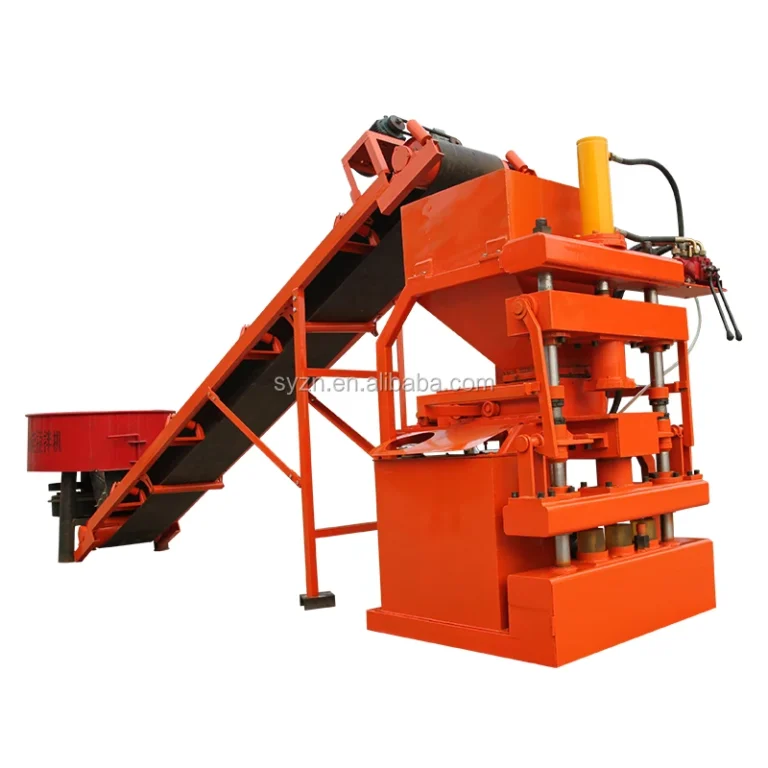
A: The QT8-15 sits in the mid-to-high automatic tier, delivering PLC-controlled pressing with an included pallet feeder and conveyor. Semi-automatic machines require manual pallet handling and lower initial investment but cap daily output. Mobile egg-laying machines eliminate pallets entirely and suit on-site production but cannot match the format range or consistency of a stationary hydraulic press.
Q: What pallet size does the QT8-15 use, and how do I check compatibility with my curing setup?
A: The machine uses a 1020 × 900 mm pallet. Before ordering, measure your curing rack spacing and forklift tine dimensions to confirm they accommodate this size. If your existing racks are built for a different pallet, you will need to plan new racking or select a different pallet dimension during the configuration stage.
Q: Can I start with a basic QT8-15 and add automatic stacking or cubing later?
A: Yes, provided the PLC has reserved I/O channels and the curing area layout is planned with future automation in mind. We confirm the upgrade path during the initial configuration so the control hardware and mechanical interfaces are ready when you decide to add stacking or cubing modules.
Q: What electrical and language options are available for different export markets?
A: Voltage and frequency are configured to your local supply standard before production. The PLC display language is confirmed at the same stage to ensure your operators can navigate menus and read diagnostics. Both details are documented in the pre-production confirmation sheet to avoid commissioning delays after arrival.

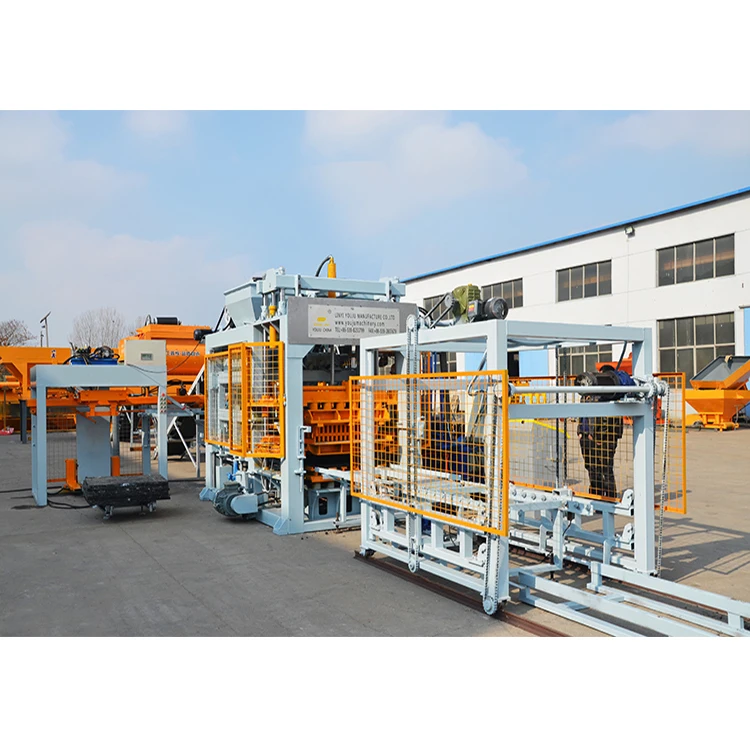
 High quality block machine