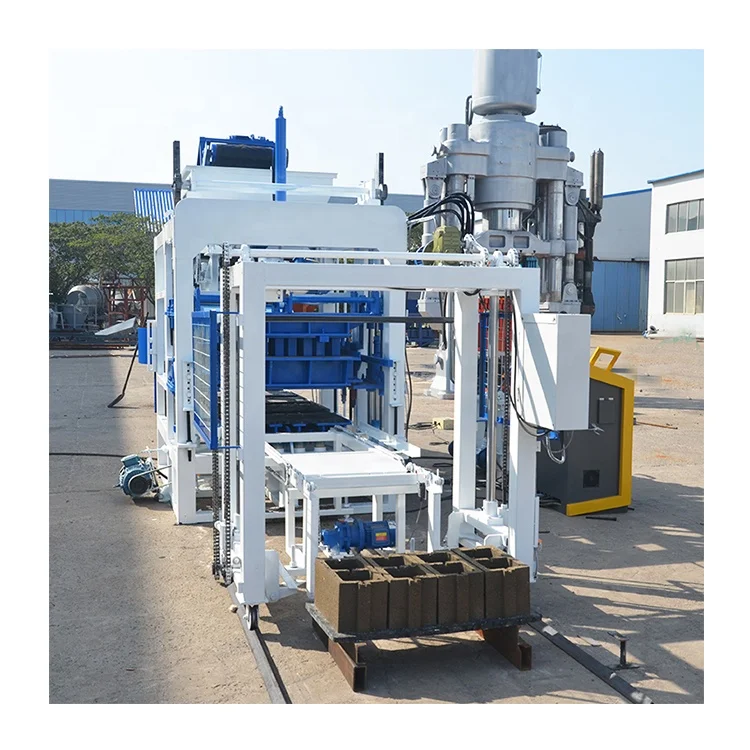
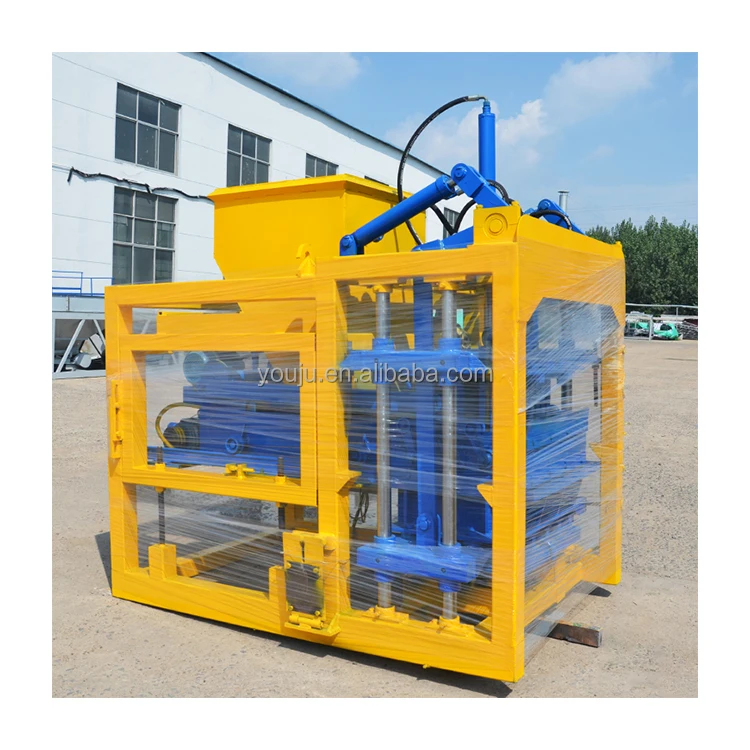
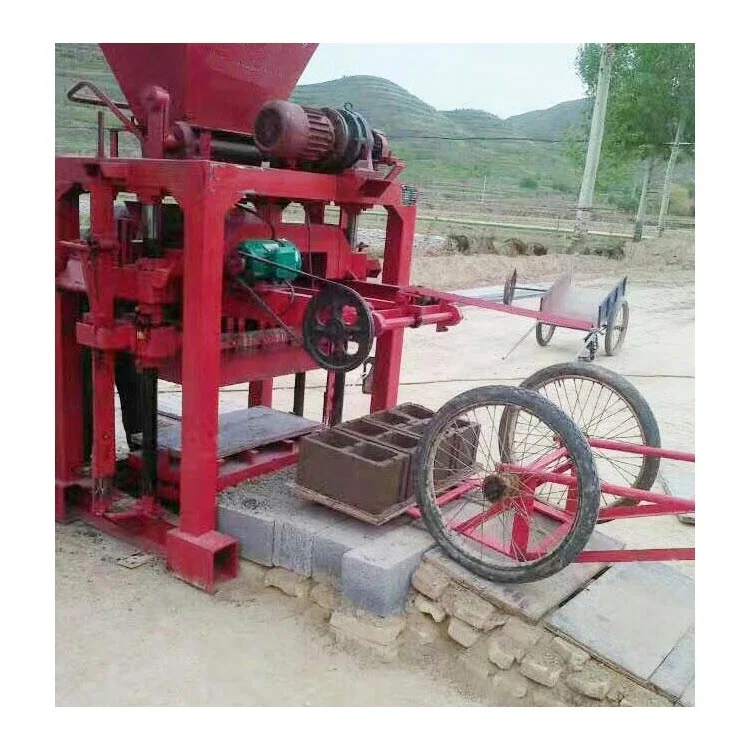
Pallet-matched configuration — every QT4-18 quotation locks in pallet size, curing footprint and forklift reach before the order is placed.
Technical Specifications
| Parameter |
Value |
| Model |
QT4-18 |
| Product Type |
Semi-Automatic Concrete Block Making Machine |
| Overall Dimensions (L×W×H) |
2500×1750×2200 mm |
| Rated Pressure |
16 MPa |
| Vibration Form |
Platform Vibration |
| Pallet Size |
950×550 mm |
| Molding Cycle |
18–25 s (basis not stated in source — confirm block format / material / thickness) |
| Overall Power |
27.5 kW |
| Control System |
PLC with frequency converter |
| Electrical Components |
Schneider |
| Automation Level |
Semi-automatic (pallet feeder hydraulically driven, manual or machinery conveying to curing yard) |
| Mould Lifting Mechanism |
Double-sided synchronous gears |
| Material Feeding |
Distribution belt hopper |
| Supporting Equipment Options |
JQ500 concrete pan mixer, 6 m / 8 m belt conveyor, stacker, block clamper, cement silo, batching plant, trolley, extra custom moulds |
| Mould Change System |
Manual bolt release (M24 bolts) |
Application Suitability
| Application |
Material or Output |
| Hollow block production |
Crushed stone, cement, sand with controlled aggregate grading |
| Solid block manufacturing |
Dense concrete mixes for load-bearing walls |
| Paving block production |
Fine aggregate blends for interlocking or rectangular pavers |
| On-site block production for contractors |
Local aggregate with portable batching setups |
| First-plant entrepreneurs |
Small-to-medium daily output with scalable automation |
Why "18–25 Seconds per Cycle" Means Nothing Without the Block Format
Cycle time is a machine stat, not a plant stat — real daily output depends on which block sits on that 950×550 mm pallet.
When a semi-automatic block machine manufacturer quotes cycles per hour, the figure silently assumes a specific block format. A hollow block that is 150 mm thick and a paving tile that is 60 mm thick do not share the same molding cycle, even on the same press. Buyers who skip this question end up with a machine that technically runs at spec but produces far fewer units per shift than the business plan assumed. In my years on Middle Eastern job sites, I have watched an entire crew stand idle while a supervisor tried to reconcile a brochure number with the stack of blocks actually sitting on the pallets. [NEED_CITE: block format and cycle time relationship in concrete masonry production]

Where the QT4-18 Sits in a Semi-Automatic Range
This model bridges the gap between mobile egg-laying machines that produce blocks directly on the ground and stationary lines that run full shifts with automated stacking. The QT4-18 uses a fixed pallet system with hydraulic pallet feeding, so the operator no longer slides pallets by hand but still manages downstream conveying and curing rack loading. For a semi-automatic block machine manufacturer, placing a buyer correctly on this spectrum matters more than quoting a peak cycle rate. The machine footprint at roughly 2.5 m long by 1.75 m wide fits inside a standard industrial bay without demanding a dedicated building.
Pallet Size as the Real Capacity Gatekeeper
The 950×550 mm pallet defines every mould this press can accept, which in turn governs how many blocks fit per cycle. A four-cavity hollow block mould and an eight-cavity paver mould both ride the same pallet, but their cycle times and output rates diverge sharply. Before any semi-automatic block machine manufacturer locks in a quotation, the pallet size must be cross-checked against the curing yard dimensions and the forklift fork width already on site. Mismatched pallets mean blocks are restacked by hand before curing, negating whatever time the press itself saved. [NEED_CITE: pallet-to-curing-yard workflow matching in block plants]
Pressure, Vibration and the Aggregate Question
The 16 MPa rated pressure works in tandem with platform vibration to compact the concrete mix inside the mould cavity. Higher pressure alone does not guarantee block strength if the vibration force cannot fluidise the mix around the aggregate particles. This is where local material matters: sand with high clay content absorbs water differently, changing the effective moisture at the moment of pressing. I once spent three days on a Gulf project retuning pressure and vibration on a semi-automatic block machine manufacturer’s line because the local wadi sand carried far more fines than the mix design had assumed. Getting the hydraulic and vibration settings right for the actual aggregate is not an optional calibration — it determines whether the blocks survive the forklift trip to the curing rack.
What Happens When Voltage and Language Are an Afterthought
Arriving at a site to find the local supply is 415 V / 60 Hz while the panel was wired for 380 V / 50 Hz turns commissioning into a multi-day salvage operation. The PLC display language matters just as much: an operator who cannot read fault codes will call the supervisor for every alarm, slowing the entire line. Confirming voltage, frequency and display language before the QT4-18 enters production avoids these delays and keeps the semi-automatic block machine manufacturer responsible for delivering a machine that actually starts when the power is switched on. [NEED_CITE: voltage and frequency standards by export market]
Why Buyers Choose This Configuration
Block machinery is the sole focus here, so the press, mould, pallet and handling equipment are specified as a matched system rather than assembled from unrelated suppliers. The QT4-18 configuration is set against the buyer’s actual mix design and target block format, not pulled from a catalogue default. Mould design covers the formats the local market sells, including custom drawings when standard cavities do not fit. Automation level is selectable — a buyer can start with manual pallet conveying and add a stacker later without replacing the press. Installation support includes on-site commissioning and operator training so the first production shift is not a guessing game.
Documentation & Verification
- Line layout showing QT4-18 placement with pallet flow and curing rack distances
- Capacity calculation per block format, not a single blanket output figure
- Machine specification sheet confirming 16 MPa pressure and 950×550 mm pallet
- Voltage, frequency and PLC language confirmation signed off before production
- Mould drawing and format list for every cavity on the 950×550 mm pallet
- Factory test record with photographs taken before crating
Installation, Commissioning & Support
- Foundation pad sized for 2500×1750 mm footprint and dynamic vibration load
- Dedicated electrical circuit rated for 27.5 kW total draw with confirmed voltage
- Machine shipped partially assembled; pallet feeder and hopper bolted on site
- First-run parameter tuning for hydraulic pressure and vibration matched to local aggregate
- Operator training covering mould change sequence with M24 bolt release
- Wear parts list identifying mould liners, hydraulic seals and vibration springs
Before You Send an Inquiry
A useful quotation starts with the block format you intend to sell, the daily volume your market absorbs and the aggregate sources within trucking distance of the plant. Include your site’s existing voltage and frequency, the curing area dimensions and any pallets or forklifts already on hand. If you are replacing a machine, note the current pallet size so the semi-automatic block machine manufacturer can match or adapt the downstream workflow. The more specific the input, the less guesswork ends up in the proposal.
Frequently Asked Questions
Q: How do I calculate real daily output from the QT4-18 molding cycle?
A: Take the molding cycle range of 18–25 seconds and match it to a specific block format on the 950×550 mm pallet. Multiply cycles per hour by the number of cavities in that mould, then factor in pallet loading time and curing rack transfer. The result is format-specific, not a single number for all products.
Q: Can I upgrade from semi-automatic to fully automatic later?
A: The QT4-18 press can accept an automatic stacker and cubing system as an add-on. The hydraulic pallet feeder is already in place, so the upgrade mainly covers downstream conveying. Confirm the pallet size and curing layout early so the future automation fits the existing workflow.
Q: What must I confirm about voltage before the machine ships?
A: Supply the exact voltage, phase configuration and frequency at your site. The control panel and motor ratings are set during production, and changing them after arrival means rewiring the entire electrical cabinet. PLC display language is confirmed at the same stage.
Q: How does the 950×550 mm pallet affect my curing yard design?
A: Pallet dimensions dictate curing rack spacing, forklift fork width and the total curing area needed for your target daily volume. Share your curing yard layout so the rack system and pallet circulation are planned together with the QT4-18 output.

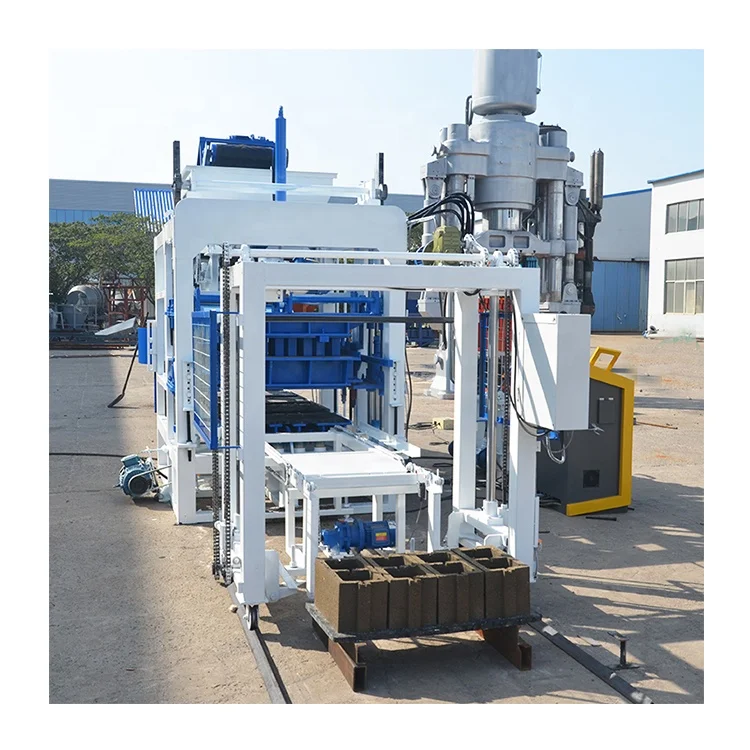
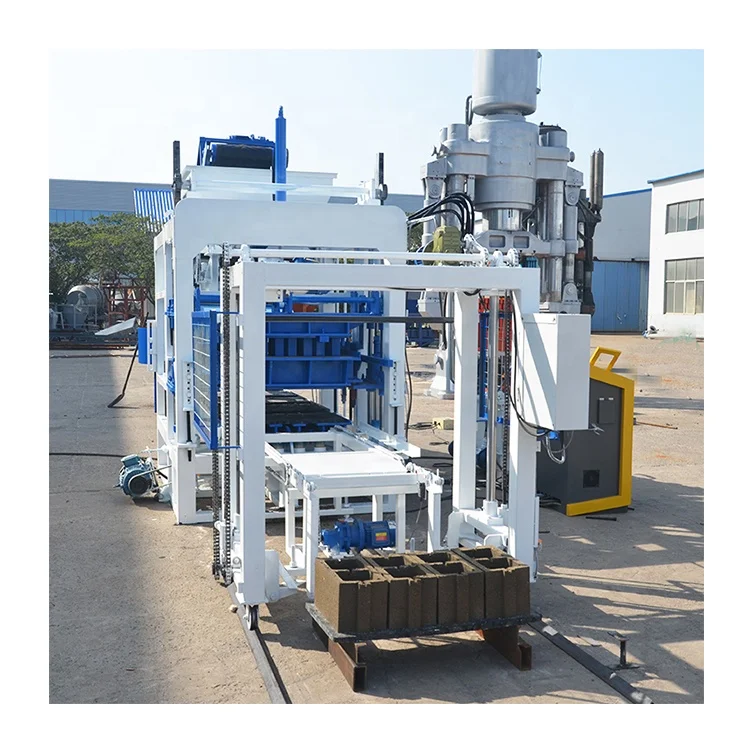 Semi automatic block