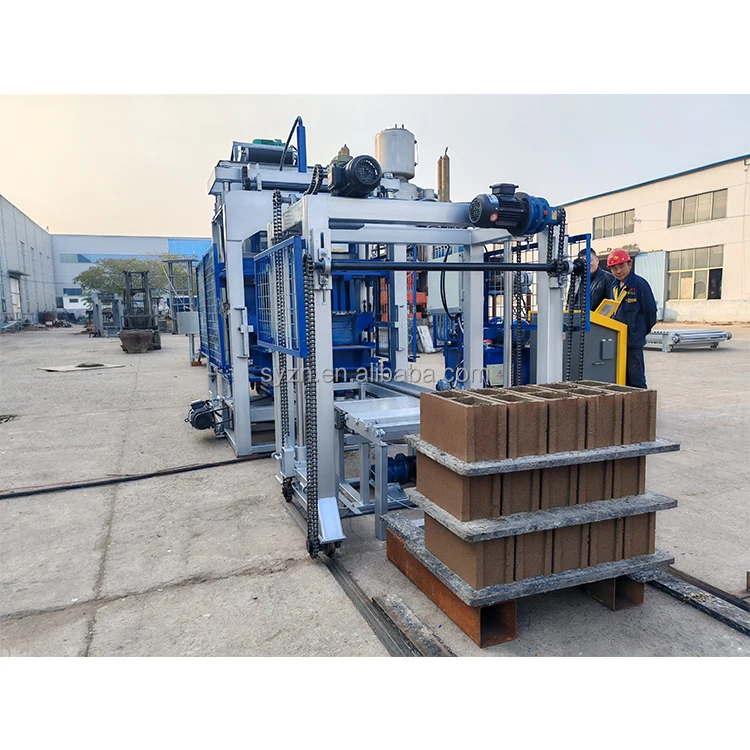
Integrated System Match — press, mould, pallet and handling specified as one working unit rather than sourced separately and forced to fit together on your floor.
Technical Specifications
| Parameter |
Value |
| Model |
QT4-15A |
| Product Type |
Hydraulic Block Making Machine |
| Overall Dimensions (L×W×H) |
4100×1600×2600 mm |
| Rated Pressure |
16–21 MPa |
| Main Vibration Form |
Platform Vibration |
| Vibration Frequency |
4200 r/min |
| Vibration Force |
55 kN |
| Pallet Size |
880×550 mm |
| Molding Cycle |
25–30 s |
| Overall Power |
18.45 kW |
| Demolding Method |
Hydraulic |
| Total Mass |
4 T |
| Recommended Factory Area |
300 m² |
| Warranty |
1 year (whole machine, excluding spare parts) |
Application Suitability
| Application |
Material or Output |
| Hollow block production |
Crushed stone, sand, cement, fly ash, gravel |
| Solid block manufacturing |
Sand, cement, slag, stone dust |
| Paving block and colored paver runs |
Fine aggregate with cement and pigment |
| Interlocking block and kerbstone forming |
Standard concrete mix with coarse and fine aggregate |
What "One Cycle Every 25 Seconds" Actually Means for Your Daily Output
The molding cycle only tells part of the story — real daily volume depends entirely on which block format sits on the 880×550 mm pallet.
I have watched buyers commit to a block making machine manufacturer based on a cycles-per-hour figure, only to discover that number assumed a small solid block while their market actually buys large hollow blocks. With the QT4-15A, a 25–30 second cycle might place four hollow blocks on a pallet or ten small pavers. Multiply that difference across a ten-hour shift and the gap between expectation and reality becomes a serious cash-flow problem. That is why our proposals always state the assumed format beside every capacity figure [NEED_CITE: block format assumptions in capacity quotations].

Positioning the QT4-15A Across the Machine Range
The QT4-15A sits in the mid-tier of a complete block machine range, filling the space between small workshop machines that run a few hundred blocks a day and high-capacity automatic lines built for continuous three-shift operation. For a block making machine manufacturer, offering this middle tier matters because most first-time plant buyers do not need — and cannot justify — a fully automatic cubing and stacking system on day one. The 300 m² recommended factory area keeps the footprint manageable while still leaving room for curing racks and a forklift lane around the press.
How the Range Scales When Your Market Grows
Buyers who start with the QT4-15A often begin with manual pallet handling and a basic mixer, then add automatic pallet feeding and stacking once local demand justifies the investment. The 880×550 mm pallet size is shared across several tiers in the range, so moulds you purchase now can transfer to a larger press later without being scrapped [NEED_CITE: mould compatibility across machine tiers]. This upgrade path matters for building material distributors who import a machine tier for their market today but may need to offer a higher-output model to the next customer who walks in.
Reading the Core Specs Beyond the Brochure Numbers
The 16–21 MPa rated hydraulic pressure and 55 kN vibration force work together during compaction — hydraulic pressure squeezes the mix from above while platform vibration at 4200 r/min settles aggregate particles into voids from below. If either force is mismatched to your local aggregate gradation, blocks leave the press looking dense but crack during curing. The 18.45 kW total power draw tells you what electrical supply the press demands before you add the mixer and conveyor motors, so your transformer sizing starts from a known baseline rather than a guess.
The Cost of Skipping the Mix-Design Conversation
I once saw a mid-tier hydraulic press shipped with default vibration settings calibrated for clean river sand, arriving at a site where the only available sand carried high clay content. The blocks crumbled at the edges straight out of the mould, and the buyer blamed the machine. After recalibrating pressure and vibration parameters to the actual aggregate, output quality recovered — but two weeks of production were lost and the buyer nearly refused delivery [NEED_CITE: aggregate variability impact on block quality]. Matching vibration force and hydraulic pressure to your specific mix design before the machine leaves the factory prevents this entirely.
Why Buyers Specify From This Range
Every machine in the range is quoted as a matched system — press, mould, pallet and handling equipment sized to work at the same cycle rate, so the press never waits for a pallet and the stacker never falls behind. Mould design covers the formats your local market actually sells, including custom drawings when a project calls for a non-standard interlocking profile. Voltage, frequency and PLC display language are confirmed before production starts, eliminating the commissioning delays that happen when a 380V machine arrives at a 415V site. Installation support includes operator training on the specific mould set you ordered, not a generic overview.
Documentation & Verification
- Line layout drawing showing QT4-15A placement with curing rack zones and forklift circulation space
- Capacity calculation sheet stating the exact block format assumed for each output figure
- Mould drawing and format list covering every block type included in your order
- Factory test record documenting actual cycle time and block dimensions before shipment
- Voltage and control language confirmation signed off before production begins
Installation, Commissioning & Support
- Foundation pad leveled to the 4100×1600 mm footprint with anchor bolt pockets cast in place
- Dedicated power circuit sized for the 18.45 kW press load plus mixer and conveyor draw
- Hydraulic system filled and bled on site, then pressure verified against the 16–21 MPa range
- First production run supervised with vibration frequency and cycle timing adjusted to your mix
- Operator training covering mould change procedure and daily platform vibration inspection
- Wear parts list provided with recommended reorder intervals for hydraulic seals and vibration springs
What We Need to Quote the Right Configuration
Tell us which block formats sell in your market and the daily volume you need for each one. Share your local aggregate type and any existing mix design report so we can match vibration and pressure settings before the QT4-15A leaves the factory. Confirm your site voltage, frequency and preferred control display language, and let us know what handling equipment — mixer, pallet feeder, or stacker — you already have on the floor.
Frequently Asked Questions
Q: What block formats can the QT4-15A produce and what is the realistic daily output for each?
A: The press handles hollow blocks, solid blocks, pavers, interlocking bricks and kerbstones through mould changes on the 880×550 mm pallet. Daily output depends entirely on which format you run — a hollow block yields fewer pieces per cycle than a small paver. Every proposal we issue states the assumed format beside the capacity figure so there are no surprises after delivery.
Q: Where does the QT4-15A sit compared to semi-automatic and fully automatic tiers?
A: It occupies the mid-tier of the range, suited to buyers who need reliable hydraulic compaction without the capital outlay of a fully automatic stacking and cubing line. Semi-automatic tiers below it reduce initial investment, while automatic tiers above it cut labour costs. The pallet size is shared across several tiers, supporting future upgrades.
Q: What plant footprint does the QT4-15A require including curing space?
A: The press itself measures 4100×1600×2600 mm, and we recommend around 300 m² total factory area once you include raw material storage, curing racks and forklift circulation paths. Exact layout depends on your ceiling height and whether pallets return manually or via a conveyor loop.
Q: How is the pallet size chosen and does it match standard forklift setups?
A: The 880×550 mm pallet is sized to balance block count per cycle with the curing rack dimensions common at this output tier. We confirm pallet material — bamboo, steel or PVC — against your curing method and the forklift tine spacing you already use on site before finalizing the order.
Q: What supporting equipment should be paired with this tier?
A: A pan mixer matched to the QT4-15A cycle rate, a pallet feeder if you want to reduce manual handling, and a simple stacking station for green blocks. The exact combination depends on your daily target and available labour, which we calculate together during the proposal stage.

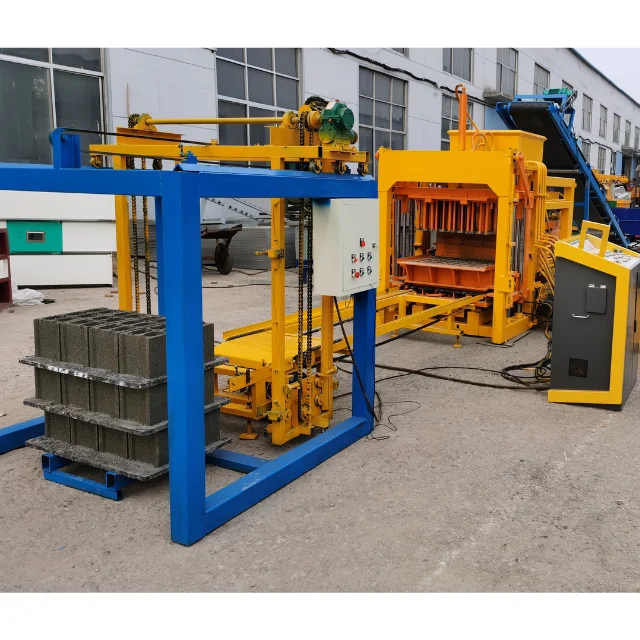
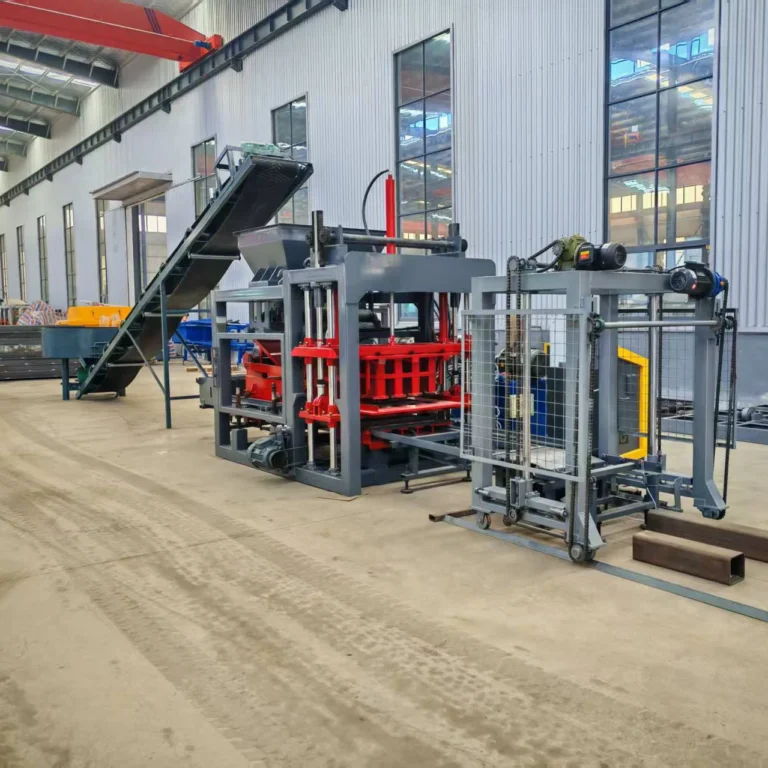 High quality block machine
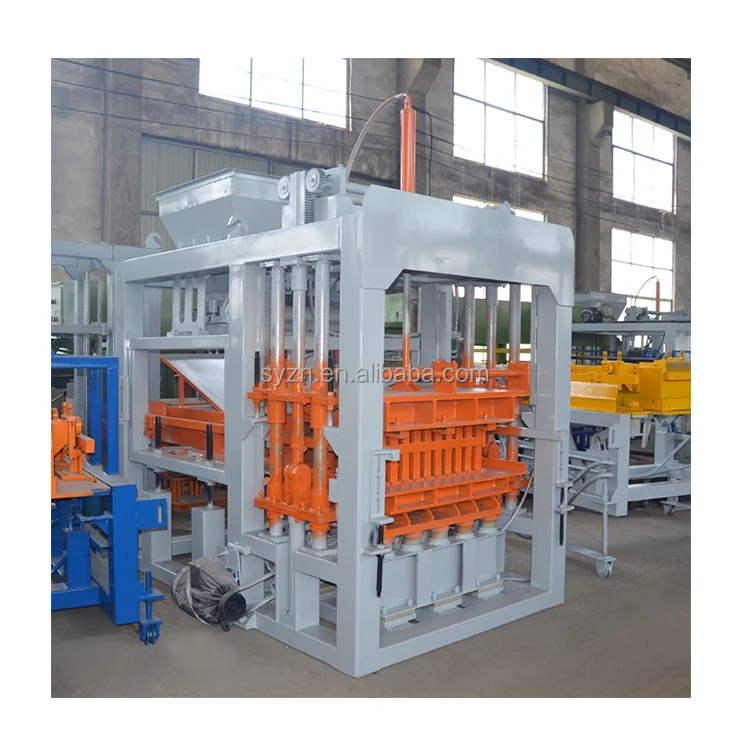
![QTJ4-35 Block Making Machine for Hollow Block – Manufacturer 记录ID 80035 数字之和:8+0+0+3+5=16 第一层:shiyueblockmachine.com → FULL MACHINE RANGE → 全品类目录类角色 → Manufacturer / Factory Supply / Full Range 第三层:16 % 3 = 1 → Factory Supply 第二层:16 % 6 = 4 → [品类词] with [核心配置] – [站点修饰词] Block Making Machine with Belt Conveyor – Factory Supply](https://shiyueblockmachine.com/wp-content/uploads/2026/04/H226555bf51f44687a8dd9cee247a6ab2c.webp)