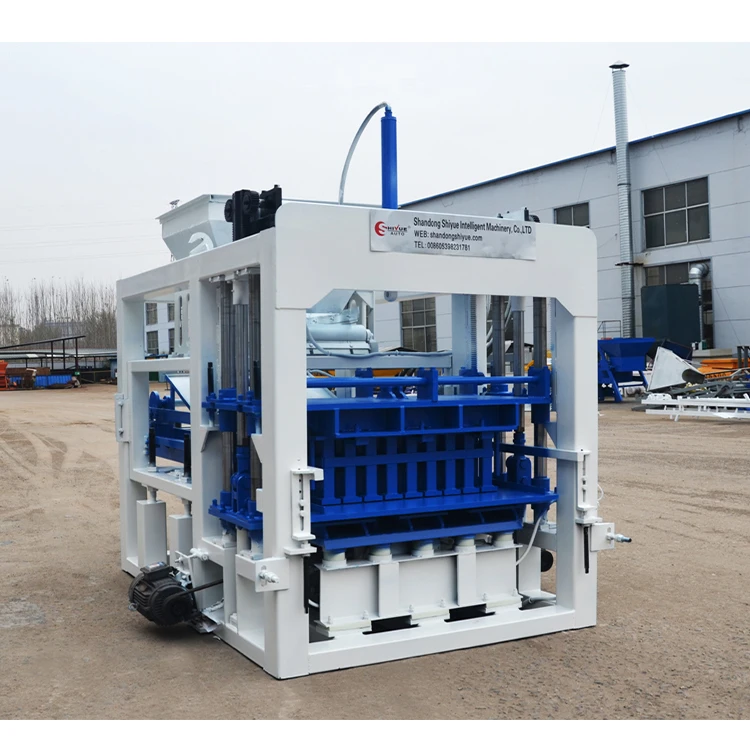
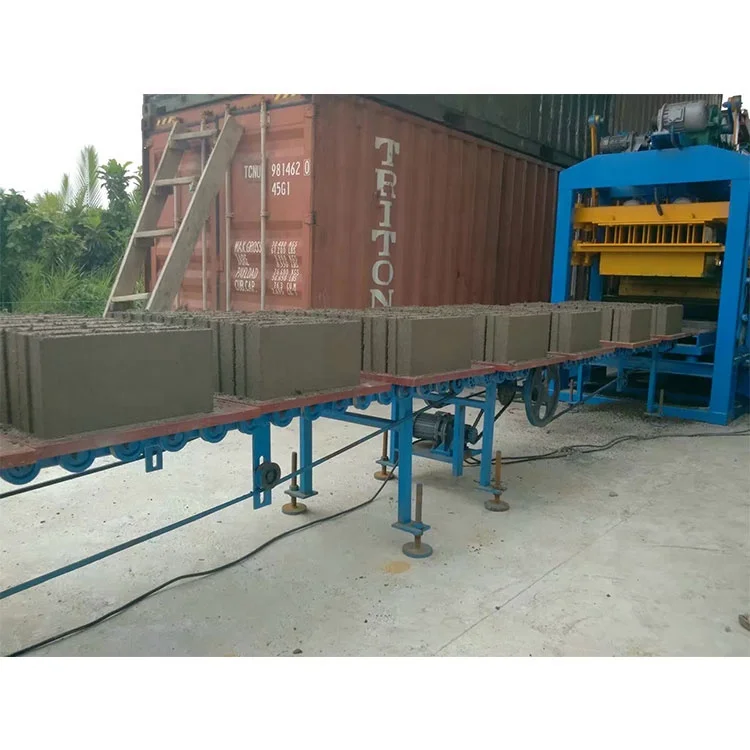
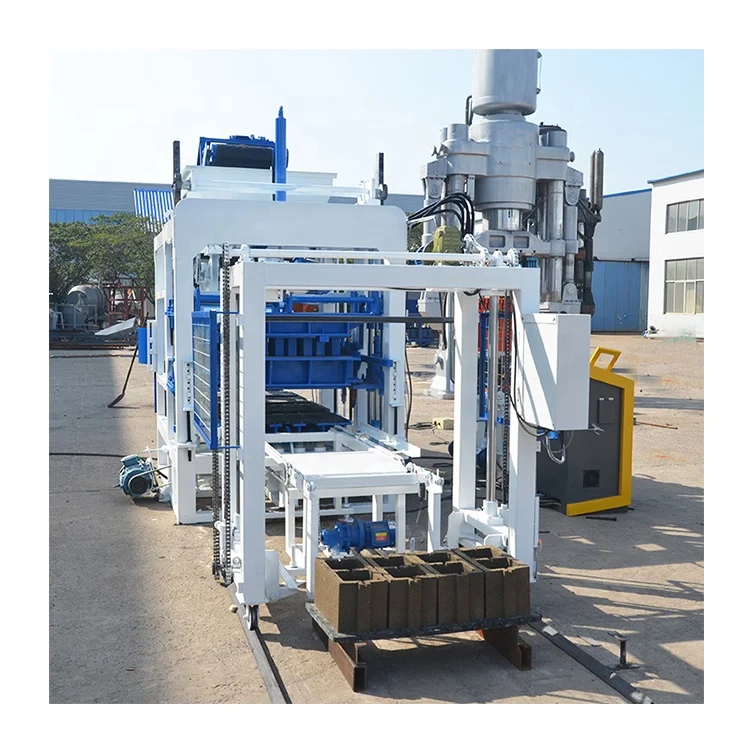
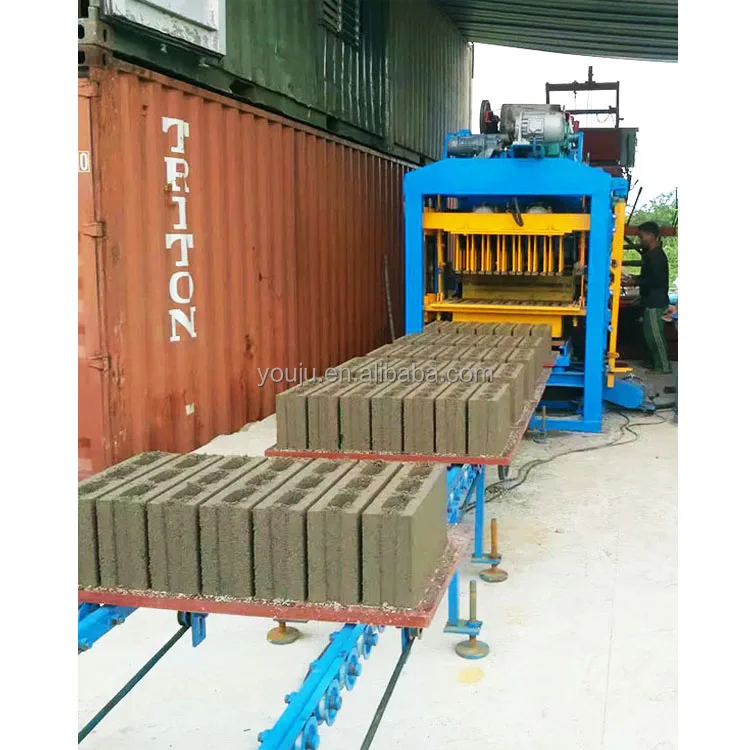
Matched System Integration — the QT4-15 block machine is configured with its moulds, pallets, and handling equipment as a single coordinated line rather than assembled from disconnected suppliers.
Technical Specifications
| Parameter |
Value |
| Model |
QT4-15 |
| Product Type |
Hydraulic Automatic Concrete Block Making Machine |
| Control System |
PLC computer-controlled, fully automatic |
| Vibration Mode |
Multiaxis synchronizer vibration (vertically downward) |
| Hydraulic System |
High thermal efficiency, low heat productivity |
| Mixer System |
Multiaxis forced mixer |
| Guide System |
Long-period over-length guide bearing |
| Frame Construction |
High-strength rack with special welding technique |
| Automation Level |
Fully automatic |
| Cycle Time |
15–20 seconds per mould cycle |
| Hollow Block 400×200×200mm |
4 pcs/mould, 900–1,200 pcs/h, 7,200–9,600 pcs/8hr (basis: 15–20s cycle) |
| Hollow Block 400×150×200mm |
5 pcs/mould, 1,080–1,440 pcs/h, 8,640–11,520 pcs/8hr (basis: 15–20s cycle) |
| Hollow Block 400×100×200mm |
8 pcs/mould, 1,440–1,920 pcs/h, 11,520–15,360 pcs/8hr (basis: 15–20s cycle) |
| Paver 200×100×60mm |
16 pcs/mould, 2,880–3,840 pcs/h, 23,040–30,720 pcs/8hr (basis: 15–20s cycle) |
| Solid Brick 240×115×53mm |
28 pcs/mould, 5,930–6,720 pcs/h, 47,400–53,700 pcs/8hr (basis: 15–20s cycle) |
| Warranty |
1 year (whole machine, excluding spare parts) |
| Rated Power |
To be confirmed |
| Voltage & Frequency |
To be confirmed |
| Overall Dimensions |
To be confirmed |
| Pallet Size |
To be confirmed |
| Hydraulic Pressure |
To be confirmed |
| Vibration Force |
To be confirmed |
Application Suitability
| Application |
Material or Output |
| Hollow block production |
Crushed stone, sand, cement, fly ash aggregates |
| Multicellular brick production |
Lightweight aggregate and cement blends |
| Paving brick production |
Dense aggregate mixes for high-compression pavers |
| Standard solid brick production |
Sand-cement and crushed stone-cement mixes |
| Porous brick production |
Permeable aggregate blends for drainage applications |
| On-site concrete block manufacturing |
Locally sourced raw materials adapted via forced mixer |
What "9,600 Blocks Per Shift" Actually Means for Your Plant
Output figures only hold when the block format, mould count, and cycle time are all stated together.
Buyers regularly receive quotations that promise a certain daily capacity without naming which block size that number assumes. A QT4-15 automatic block machine for sale might show 9,600 pieces per eight-hour shift, but that figure applies specifically to 400×200×200mm hollow blocks at a 15–20 second cycle. Switch the mould to a smaller 100mm hollow block and the per-cycle count rises, while switching to interlocking pavers changes the output entirely. I once watched a buyer in Southeast Asia plan a curing yard based on a headline number, only to find the actual pallet throughput demanded nearly twice the space once the real format was factored in [NEED_CITE: block format assumptions in capacity quotations].

Where the QT4-15 Sits on the Full Machine Range
The QT4-15 occupies the mid-tier position in the Shiyue automatic block machine lineup. Below it, semi-automatic models require manual pallet handling and suit smaller workshops with lower investment capacity. Above it, high-capacity lines add fully automatic stacking, cubing, and curing rack handling for continuous production at larger plants. The QT4-15 automatic block machine for sale targets buyers who need PLC-controlled automation and consistent output but do not yet require the infrastructure of a fully integrated high-volume facility.
Understanding Output Tiers Before You Commit
Choosing the right tier starts with mapping your market demand to specific block formats, then matching those formats to realistic per-shift output. A building material distributor adding hollow blocks and pavers to an existing catalogue will evaluate the QT4-15 differently from a contractor producing a single block type for a housing project. The investment-to-output ratio shifts depending on whether you run one format all day or change moulds between batches [NEED_CITE: mould change frequency and production planning]. This is why every capacity figure in our documentation ties back to a named block size, mould cavity count, and cycle window.
How Vibration, Hydraulics, and Frame Design Shape Block Quality
The multiaxis synchronizer vibration on the QT4-15 directs force vertically downward, which compacts the concrete mix uniformly across the mould cavity. This matters because uneven vibration creates density variations — blocks that are strong on one side and fragile on the other. The hydraulic system operates with high thermal efficiency to keep fluid temperatures stable during long shifts, preventing pressure drops that would reduce compaction force over time. The long-period over-length guide bearing keeps the upper mould and mould box aligned through thousands of cycles, reducing wear on the mould edges and maintaining dimensional accuracy. A high-strength welded frame absorbs the vibration shock that would otherwise crack conventional frames after extended service, directly affecting how long the machine holds tolerances before major structural maintenance is required.
The Cost of Overlooking Pallet Size and Curing Area
When pallet dimensions are selected without checking the buyer’s existing forklift and curing rack spacing, blocks arrive at the curing area and cannot be stacked as planned. Workers end up restacking by hand, turning what was supposed to be a continuous line into a bottleneck. The pallet size for the QT4-15 must match both the mould output area and the curing yard layout the buyer already has on site. I have seen entire first-week production runs delayed because the pallets ordered did not fit the curing racks that were already welded and in place [NEED_CITE: pallet and curing area coordination in block plants]. This is a specification that should be confirmed before production, not after arrival.
Why Buyers Source the QT4-15 Through This Range
Block machinery is the single focus here, so the QT4-15 is specified together with its moulds, pallets, and handling equipment as one matched system rather than pulled from separate catalogues. Configuration is set against your actual mix design and local aggregate, not a default setting meant to cover every market. Mould design covers the formats your market actually sells, including custom drawings when standard cavity layouts do not match. The automation level is selectable — a buyer can begin with the QT4-15 in semi-automatic operation and add automatic stacking later. Installation support includes operator training so your team understands PLC parameter adjustment and mould change procedures from day one.
Documentation & Verification
- Line layout drawing showing QT4-15 position within the full block production line
- Capacity calculation sheet stating output per block format with cycle time basis
- Mould drawing and format list matched to buyer’s target market products
- Voltage and PLC control language confirmation document before production begins
- Factory test record run on buyer’s specified block format before dispatch
- Hydraulic and electrical schematic for local maintenance reference
Installation, Commissioning & Support
- Foundation plan specifying load points and curing area clearance for the QT4-15 frame dimensions
- Electrical circuit requirements confirmed for the QT4-15 PLC system voltage and frequency before shipping
- Machine arrives in designated assembly state with dismantling instructions for container loading
- On-site commissioning includes PLC parameter tuning to match local mix design and aggregate
- Operator training covers mould change procedure, cycle time adjustment, and daily maintenance checkpoints
- Wear parts and mould replacement list provided with recommended reorder intervals
What to Share Before Requesting a Quotation
To size the QT4-15 correctly within your production plan, share the block formats your market demands, the daily output target per format, and the raw materials available locally. Include your site’s voltage and frequency standards, preferred PLC display language, and the curing area dimensions you have available. If you already operate pallets, forklifts, or upstream mixers, provide those specifications so the line can be configured around your existing equipment.
Frequently Asked Questions
Q: How is the QT4-15 positioned within the full automatic block machine range?
A: The QT4-15 sits in the mid-tier, between entry-level semi-automatic models and high-capacity automatic lines. It offers PLC full automation with multiaxis vibration and hydraulic pressing, suited for buyers who need consistent daily output without the infrastructure investment of a fully integrated stacking and cubing facility.
Q: What block formats does the QT4-15 cover and what is realistic daily output?
A: The QT4-15 covers hollow blocks from 100mm to 200mm width, pavers, and solid bricks. Output ranges from 7,200–9,600 hollow blocks (400×200×200mm) to 47,400–53,700 solid bricks (240×115×53mm) per eight-hour shift, based on a 15–20 second cycle time per format.
Q: What voltage, frequency, and PLC language options are available?
A: Voltage, frequency, and PLC display language are confirmed with each buyer before production begins. This ensures the QT4-15 automatic block machine for sale arrives with controls that match your local power grid and operator language, avoiding commissioning delays.
Q: What plant footprint does the QT4-15 require?
A: The footprint depends on the pallet size, curing rack arrangement, and auxiliary equipment selected. A line layout is prepared during the proposal stage showing the QT4-15 press position, mixer station, pallet feeder, and curing area to confirm total floor space before order.
Q: How does the QT4-15 compare to semi-automatic models for future upgrades?
A: The QT4-15 supports selectable automation levels. A buyer can start with manual pallet handling and add automatic stacking or cubing modules later, allowing the block production investment to grow alongside market demand without replacing the core press.

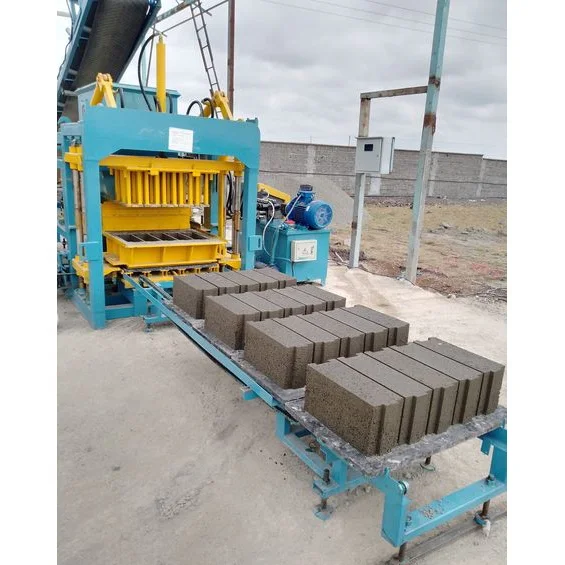
 Automatic block machine