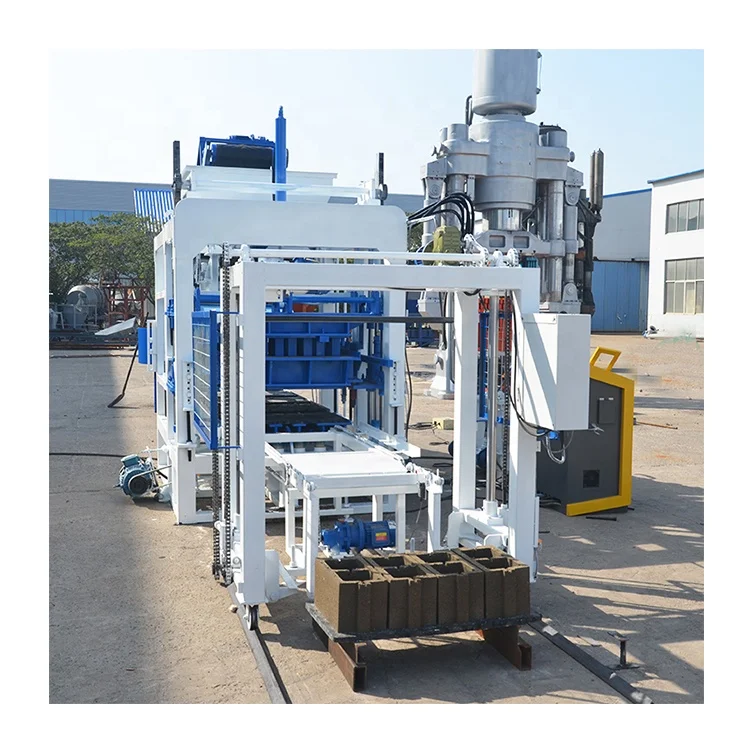
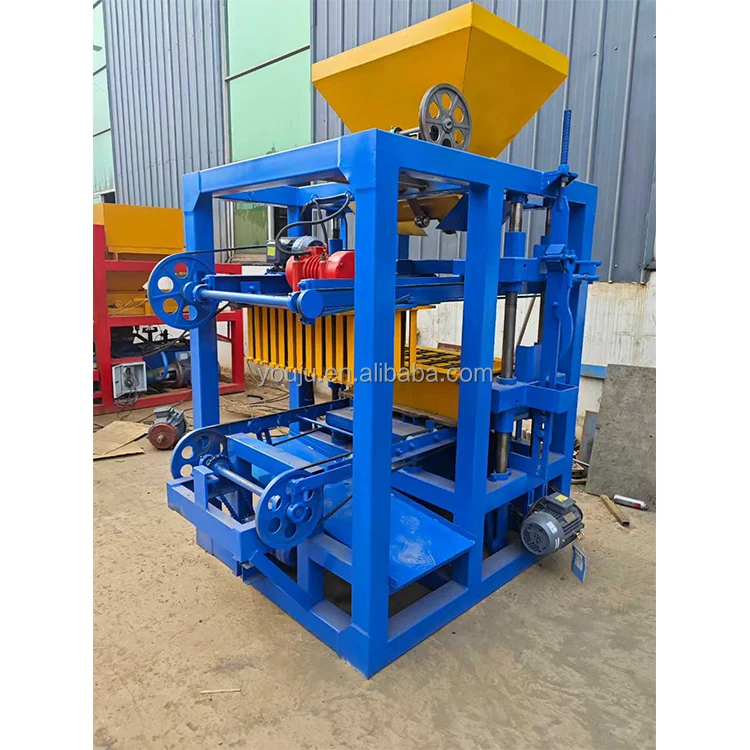
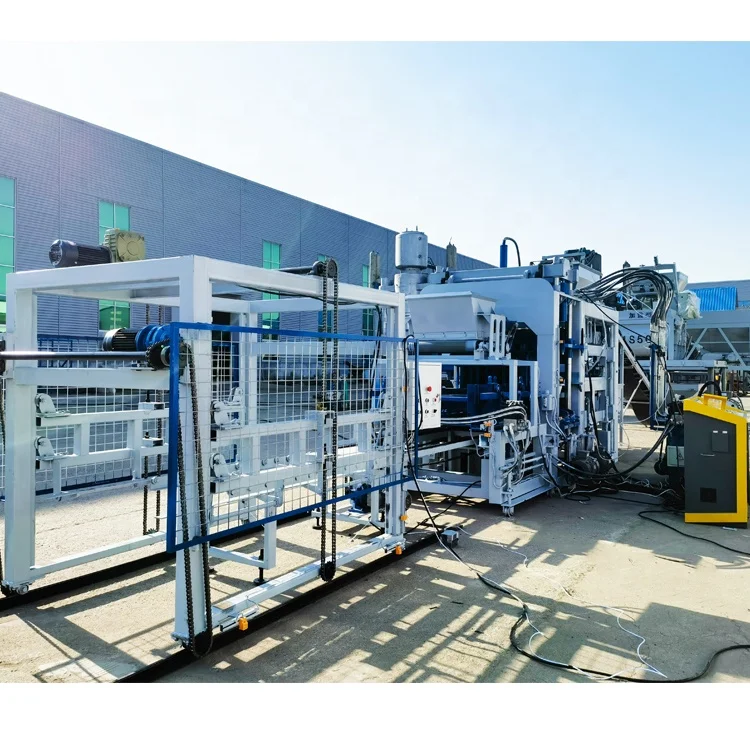
Matched System Approach — rather than assembling the press, mixer and pallets from separate sources, the QT4-15 is specified as one coordinated line where vibration force, mould size and pallet dimensions are locked together before production.
Technical Specifications
| Parameter |
Value |
| Model |
QT4-15 |
| Product Type |
Hydraulic Concrete Block Making Machine |
| Rated Power |
27.5 kW |
| Voltage |
380V (frequency to be confirmed for target market 50/60 Hz) |
| Control System |
Computer controlled directional vibration (PLC brand/model to be confirmed) |
| Vibration System |
Table and mould vibrating together, low-frequency feeding / high-frequency vibrating |
| Vibration Force |
40 kN |
| Moulding Cycle |
15s (basis not stated in source — confirm block format / material / thickness) |
| Pallet Size |
1020×570 mm |
| Overall Dimensions (L×W×H) |
7100×1600×2610 mm |
| Net Weight |
5 T |
| Mixer Model |
JS500 |
| Water Consumption |
4T/every day (source value — verify against manufacturer catalog) |
| Workers Required |
3~4 |
| Workshop Area |
150 m² |
| Motor |
Siemens Motor |
| Hopper |
Swing-type cutting device for uniform material feeding |
| Photoelectric Control |
Host keeping material controlled by photoelectric sensor |
| Block Stacking |
Stackable immediately after forming |
Application Suitability
| Application |
Material or Output |
| Hollow block production plants |
Crushed stone, sand, cement and water mix for standard load-bearing and non-load-bearing hollow blocks |
| Construction contractors producing on-site |
Cement brick and solid block output from locally sourced aggregate at a housing project |
| Building material manufacturers adding formats |
Paving blocks and kerbstones on the 1020×570 mm pallet, subject to mould configuration |
| First-time block plant entrepreneurs |
Mid-tier automatic output of hollow blocks and cement bricks within a 150 m² workshop constraint |
What the 15-Second Cycle Time Actually Means
A cycle figure without the block format attached is not a capacity number — it is a stopwatch reading.
Buyers regularly see a moulding cycle quoted in isolation and multiply it across a ten-hour shift, only to find the real daily output falls far short once pallet exchange, material feed and curing rack handling are factored in. I have stood on sites where the press itself was running to spec, but the line around it was bottlenecking every third cycle [NEED_CITE: cycle time calculation methodology for concrete block presses]. The concrete block making machine for sale under this model designation requires the buyer to confirm which block format, mix design and pallet material the 15-second figure assumes before any daily throughput projection holds up.

Where the QT4-15 Sits in the Full Range
The QT4-15 occupies the mid-tier automatic position, sitting above semi-automatic models that rely on manual pallet handling and below high-capacity automatic lines that require a substantially larger plant footprint and capital allocation. For a buyer surveying the complete block machine range, this model represents the entry point into computer-controlled directional vibration and consistent cycle timing without committing to a full-scale production plant. The 150 m² workshop requirement keeps the investment within reach for entrepreneurs setting up a first block plant or contractors producing hollow blocks directly on a housing project site.
Automation Level and the Upgrade Path
Automation on the QT4-15 block machine manufacturer configuration starts with computer-controlled vibration and photoelectric material sensing, removing the guesswork from feed distribution and pressing intensity. Pallet feeding and block stacking can be specified from manual handling through to automatic stacking and cubing, depending on what the buyer is ready to invest in at the point of order. This selectable approach means a buyer can start with a simpler pallet return system and add automatic stacking later, without replacing the press itself [NEED_CITE: automation upgrade paths in stationary block machinery].
Reading the Specs Against Your Actual Production
The 40 kN vibration force and the table-and-mould vibrating system work together to compact the concrete mix, but the density achieved depends directly on the buyer’s aggregate grading and moisture content — a high-clay sand will absorb vibration energy differently from clean crushed stone. The swing-type hopper cutting device is designed to distribute material uniformly across the moulding box, which matters most when producing hollow blocks where wall thickness is narrow and uneven fill shows up as weak corners. The JS500 mixer is matched to the press cycle so that fresh mix arrives before the mould is ready for the next charge, preventing the press from sitting idle between cycles. Voltage at 380V must be confirmed against the target market’s frequency standard before the motor and PLC are wired at the factory [NEED_CITE: voltage and frequency standards by export market].
The Cost of Skipping Configuration Details
When voltage and PLC display language are not confirmed before the machine leaves the factory, commissioning stalls the day the container is opened and an electrician has to rewire the control panel on site. I have watched a machine sit for a week because the PLC screen was in a language the operators could not read, and the local electrician did not have the schematic to trace the fault. Pallet size chosen without checking the buyer’s existing curing racks and forklift capacity means the pallets either do not stack in the curing area or the forklift cannot carry a full rack [NEED_CITE: pallet specification matching for block curing operations]. These are not machine defects — they are configuration gaps that turn a straightforward installation into a multi-week delay.
Why Buyers Specify the Line Here
Block machinery as a single focus means the QT4-15 is not assembled from a catalogue press, a third-party mixer and generic pallets — every station is specified to match the cycle time so no component leaves the press waiting. Configuration is set against the buyer’s actual mix design and local aggregate rather than a default setting, which matters on sites where the available sand or stone differs from the factory test material. Mould design and supply covers the formats the buyer’s market actually sells, including custom drawings for non-standard block shapes. The automation level is selectable, so a semi-automatic buyer can step into the QT4-15 now and add automatic stacking later. Installation support includes operator training on the specific vibration parameters matched to the buyer’s mix, not a generic startup sequence.
Documentation & Verification
- Line layout drawing with capacity calculation stating the block format assumed for the 15-second cycle
- Machine specification sheet confirming voltage, frequency and PLC display language for your market
- Mould drawing and format list showing every block type producible on the 1020×570 mm pallet
- Hydraulic and electrical schematic for on-site troubleshooting before the service engineer arrives
- Factory test record on your mix design and target block format before dispatch
- Operation and maintenance manual with wear parts and mould replacement intervals
Installation, Commissioning & Support
- Foundation plan sized to the 7100×1600 mm footprint with vibration isolation for the 40 kN force rating
- Dedicated 380V circuit at 27.5 kW with breaker rating confirmed for your market’s frequency standard
- Machine arrives in dismantled shipment configuration with reassembly supervised on site
- First-run commissioning includes vibration frequency adjustment against your local aggregate sample
- Operator training covers PLC navigation, mould change procedure and photoelectric sensor calibration
- Wear parts list and mould spares schedule provided before the first replacement cycle is due
What to Include in Your Inquiry
To size the QT4-15 correctly for your operation, share the specific block formats you intend to produce and the dimensions of each, along with the daily output you are targeting per format. Confirm the aggregate available locally — type, grading and typical moisture content — so the vibration parameters and mix ratio are set before the machine ships. State your workshop dimensions including ceiling height, the voltage and frequency at your site, and the PLC display language your operators need. If you have existing pallets, curing racks or a forklift, send the dimensions and load rating so the pallet specification is matched rather than defaulted.
Frequently Asked Questions
Q: The 15-second cycle is quoted — but for which block format does it apply?
A: The 15-second figure requires confirmation against a specific block format, wall thickness and mix design. Daily output changes significantly between a standard hollow block, a solid block and a thinner paver, because mould fill depth and vibration duration differ. Request a capacity calculation that states the exact format assumed, rather than relying on a single cycle number multiplied across a shift.
Q: Where does the QT4-15 sit in the range, and when should I look at a higher-tier machine?
A: The QT4-15 is the mid-tier automatic option, suited to buyers stepping up from semi-automatic production or starting a first plant within a 150 m² workshop. If your daily volume requirement exceeds what a single mid-tier press can deliver on your target format, or you need continuous high-capacity output with automatic cubing, a higher-tier automatic line is the appropriate next step.
Q: What plant footprint and supporting equipment does the QT4-15 need?
A: The press itself sits within a 7100×1600×2610 mm envelope, and the full line including the JS500 mixer, pallet feeder and curing area requires approximately 150 m². Ceiling height must accommodate the 2610 mm machine height plus clearance for maintenance access. Supporting equipment specifications are confirmed during the line layout stage so each station matches the press cycle time.
Q: Can I start with manual pallet handling and add automation later?
A: The automation level is selectable at the point of order. A buyer can begin with manual pallet return and stacking, then add automatic pallet feeding and stacking systems later without replacing the press. The computer-controlled vibration and photoelectric sensing remain in place regardless of the handling configuration chosen.
Q: What voltage options are available and is the PLC language configurable?
A: The standard voltage is 380V, and the frequency must be confirmed as 50 Hz or 60 Hz depending on your market. The PLC display language is confirmed before production so operators can read the interface on day one. Both parameters are locked in during the quotation stage to prevent commissioning delays after arrival.

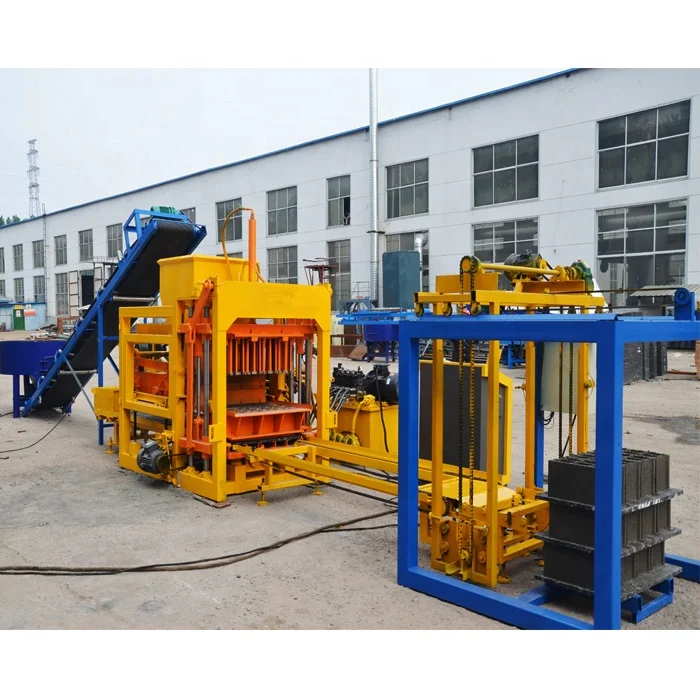
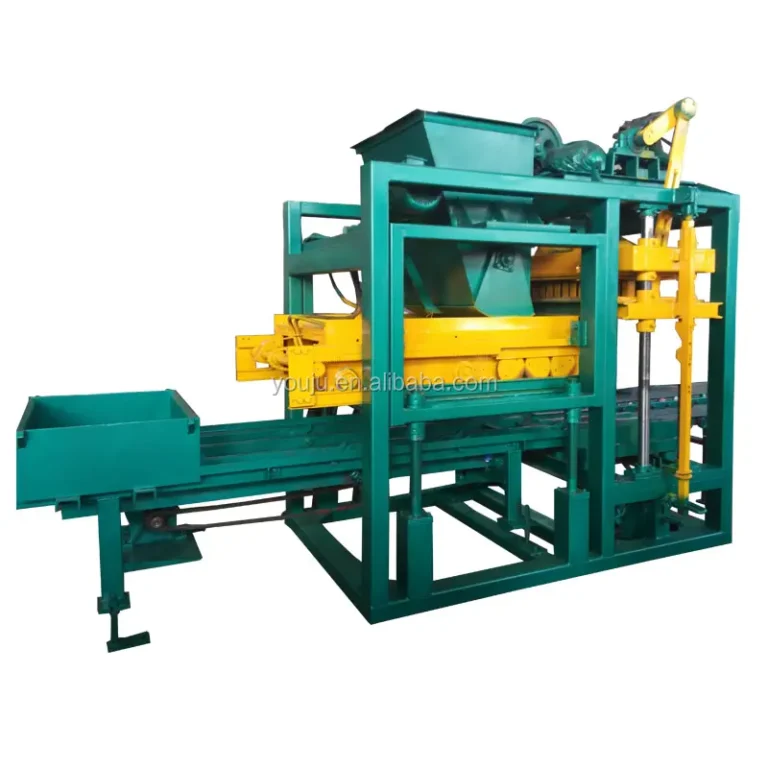 Stationary block machine