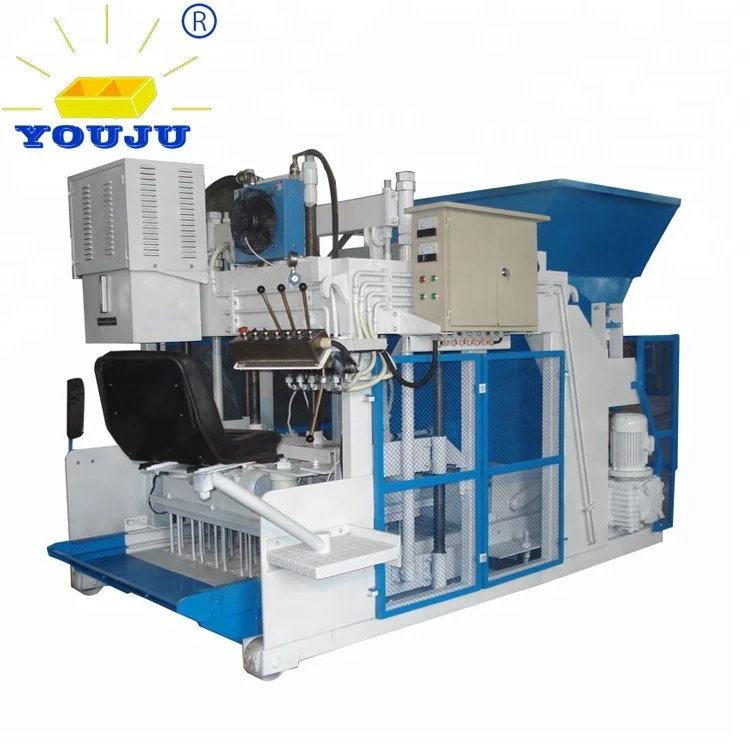
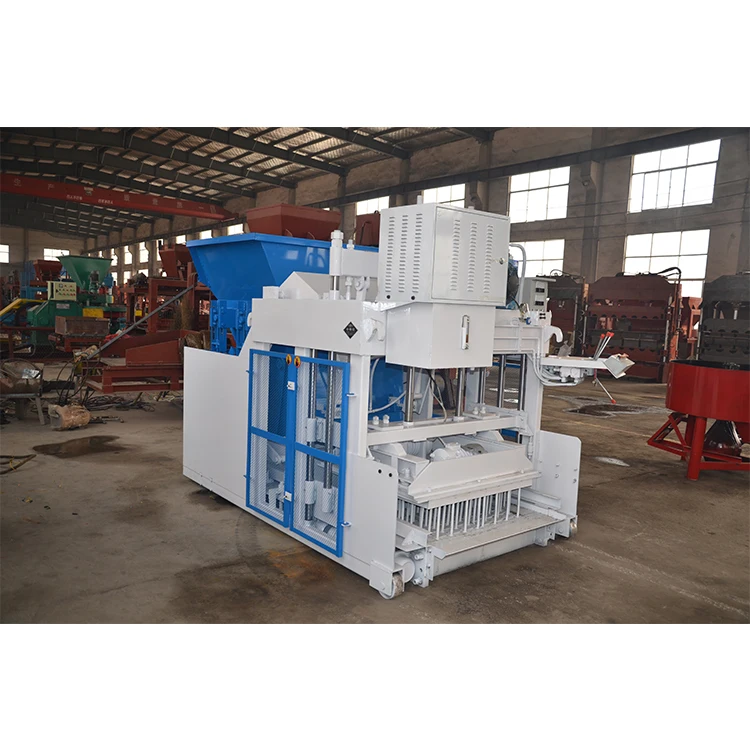
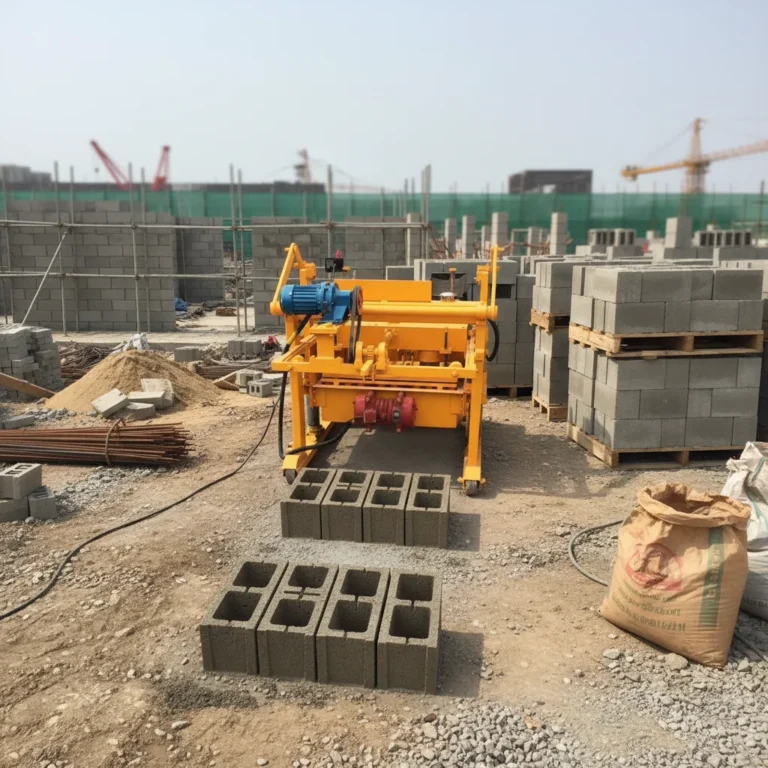
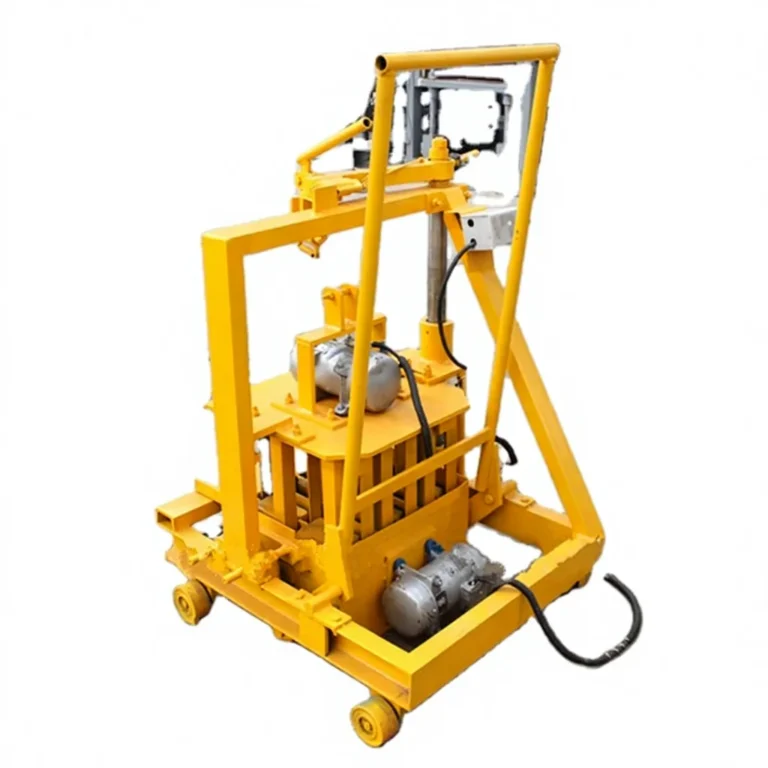
Single-Focus Block Line Design — the QMJ4-45 egg-laying model removes pallets and curing racks from your project footprint, letting you place yourself on the range before committing to a stationary plant.
Technical Specifications
| Parameter |
Value |
| Model |
QMJ4-45 |
| Product Type |
Mobile Egg-Laying Concrete Block Making Machine |
| Rated Power |
7.4 kW |
| Molding Cycle |
45 s |
| Output Capacity |
2,400 pcs/8 h (based on 400×200×200 mm hollow block, 4 pcs/mould); 3,200 pcs/8 h (based on 400×150×200 mm block, 5 pcs/mould) |
| Production Rate |
300 pcs/h (based on 400×200×200 mm hollow block); 400 pcs/h (based on 400×150×200 mm block) |
| Raw Material Compatibility |
Concrete, sand, cement, fly ash, lime, gypsum |
| Net Weight |
1 T |
| Overall Dimensions |
1550×1335×1580 mm |
| Pallet Requirement |
None (egg-laying type lays blocks directly on the ground) |
| Voltage |
Configurable to buyer’s local supply (confirm before order) |
| Control System |
Manual force control combined with jog control |
| Orientation Mechanism |
Four poles oriented with ultralong orientation bearing |
| Mould Change |
Multi-format via mould replacement |
| Electrical Components |
Imported electrical appliances, sealing parts and hydraulic components |
| Automation Level |
Semi-automatic / mobile egg-laying |
Application Suitability
| Application |
Material or Output |
| On-site construction projects |
Hollow and solid blocks from local crushed stone and cement |
| First-time entrepreneur block plants |
Interlocking pavers and road blocks from fly ash and sand |
| Housing development contractors |
Curb stones and wall blocks relocated between project phases |
| Remote or off-grid building sites |
Standard masonry blocks produced without fixed plant infrastructure |
| Small-scale paver production |
Interlocking bricks and porous bricks via mould swap on the same host |
What a Mobile Block Machine Manufacturer Means When Quoting Output
Capacity only matters when tied to a specific block format and mould cavity count.
Buyers often compare machines on a single headline number, but a mobile block machine manufacturer quoting cycles per hour without naming the assumed block shape leaves you guessing what lands on the ground at the end of a shift. The QMJ4-45 reaches 2,400 pieces per 8-hour day on a 400×200×200 mm hollow block with four cavities, and 3,200 pieces on a 400×150×200 mm solid with five cavities [NEED_CITE: block format assumptions in capacity quotations]. When the mix uses high-clay local soil, cycle extension may be needed to maintain block integrity, shifting the realistic daily figure downward. I once watched a contractor in West Africa size a full crew around an unqualified number and run out of cured stock before the bricklayers arrived. Honest capacity starts with the format your market actually buys.

Where the QMJ4-45 Sits on the Full Range
The QMJ4-45 occupies the entry tier for buyers who want to produce without a fixed plant, pallet inventory or curing rack layout. It lays blocks directly on a prepared concrete floor or compacted ground, so the site footprint shrinks to the machine’s own travel path plus curing space. For a contractor producing at the building site or an entrepreneur testing market demand before committing to a stationary line, this mobile block machine removes the pallet investment that typically doubles the working capital of a small plant.
Stepping Up from Egg-Laying to Stationary
When daily demand outpaces what a single operator can manage with jog control, or when the block format requires vibration and hydraulic pressure beyond manual force, the buyer moves to a semi-automatic stationary press with pallet circulation. The QMJ4-45 serves as a proving ground: you learn your local aggregate behaviour, your market’s preferred formats and your crew’s throughput rhythm before scaling [NEED_CITE: progression from mobile to stationary block production]. Many buyers keep the egg-laying unit for remote jobs even after installing a stationary line at their main yard.
Reading the Specs That Shape Daily Output
The 7.4 kW rated power drives both vibration and orientation, meaning the machine relies on mechanical vibration rather than high-pressure hydraulics to compact the mix. The 45-second moulding cycle is the baseline for free-flowing aggregates; sticky red soil or high-fly-ash mixes may require a longer dwell to prevent cracking during demoulding. The four-pole orientation with ultralong bearing keeps the mould and pressure head aligned over repeated cycles, which directly affects dimensional consistency — a wobble here shows up as uneven block height across a production run. The 1550×1335×1580 mm envelope dictates your aisle width: the machine must travel its own length plus clearance to lay the next row without disturbing freshly placed blocks.
What Happens When Ground Conditions Are Ignored
An egg-laying machine deposits wet concrete directly onto the surface beneath it. If that surface is uneven, soft or poorly drained, the bottom course of blocks absorbs moisture inconsistently and warps before the crew can move them to the stacking area. Buyers who skip a simple concrete pad or gravel base end up with a rejection rate that no machine adjustment can fix [NEED_CITE: ground preparation requirements for egg-laying block machines]. The cost of a day’s site preparation is small compared to a week of scrapped output and frustrated masons refusing to lay misshapen stock.
Why Buyers Source This Range Here
Block machinery is the single focus of this operation, so the QMJ4-45 is specified as part of a matched system — mould, orientation mechanism and control logic designed together rather than assembled from separate vendors. Configuration is set against your actual mix and local aggregate, not a catalogue default; if your sand is high-clay, the vibration timing is adjusted before dispatch. Mould design covers the formats your regional market sells, and custom drawings are accepted when standard cavities do not match your product list. Automation level is selectable, so you can start with the egg-laying unit today and move to a pallet-based line tomorrow without relearning your process. Installation support includes operator training on your specific format set.
Documentation & Verification
- Line layout showing egg-laying travel path and curing area sized to your block format
- Capacity calculation sheet stating mould cavity count and cycle per assumed block dimension
- Mould drawing and format list for every product in your initial production plan
- Voltage and control language confirmation matched to your site supply before production
- Factory test record on your specified mix and block format before crating
- Wear parts and mould catalogue so first replacements are planned, not emergency-ordered
Installation, Commissioning & Support
- A level concrete pad or compacted gravel base is required across the full egg-laying travel area before the 1 T unit arrives
- Dedicated electrical circuit rated for the 7.4 kW motor, with voltage confirmed to your local standard before production begins
- Machine ships as a single skid at 1550×1335×1580 mm, requiring a flatbed and forklift for offloading
- First-day commissioning includes vibration timing calibration on your local aggregate and mix proportions
- Operator training covers jog control rhythm, mould swap procedure and basic electrical fault tracing
- Wear parts list supplied with initial shipment so bearings and seal replacements do not halt your first month
Before You Send an Inquiry
To receive a configuration that matches your project rather than a catalogue default, share the block formats your market demands, the daily output you need per format, and the raw materials available at your site — especially whether your sand runs high in clay or silt. Confirm your local voltage, frequency and the language you prefer on any control interface. If you plan to relocate the machine between sites, note the ground conditions at each location so the pad recommendation fits both.
Frequently Asked Questions
Q: How is the output capacity of the QMJ4-45 verified against a specific block format?
A: Every capacity figure we quote is tied to a named block dimension and mould cavity count. For the QMJ4-45, 2,400 pieces per 8 hours assumes a 400×200×200 mm hollow block with four cavities at a 45-second cycle. If your target format differs, we recalculate based on your mould and confirm with a factory test on your mix.
Q: When should a buyer move from this mobile block machine to a semi-automatic stationary press?
A: The step up makes sense when daily demand exceeds what a single operator can sustain with jog control, or when your market requires block strength that only higher vibration force and hydraulic pressure can deliver. The egg-laying unit is ideal for proving demand before you invest in pallet circulation and curing racks.
Q: What ground conditions does an egg-laying machine require to produce consistent blocks?
A: The surface must be level, firm and well-drained. A poured concrete pad gives the best results; compacted gravel is acceptable for shorter campaigns. Soft or uneven ground causes the freshly laid blocks to settle unevenly, producing dimensional variation that no machine setting can correct after the fact.
Q: Can custom moulds be designed for block formats not in the standard catalogue?
A: Yes. We accept buyer drawings or develop mould designs from your dimensional specifications and target block weight. Each custom mould goes through a factory test with your specified mix before it ships, so the first production run on your site uses a proven cavity.
Q: How are voltage and electrical standards confirmed before the machine is built?
A: We ask for your site voltage, frequency and phase during the inquiry stage and confirm these values in writing before production begins. The motor, control wiring and any indicator labels are then built to match, so the machine can be connected the day it arrives without transformer delays.

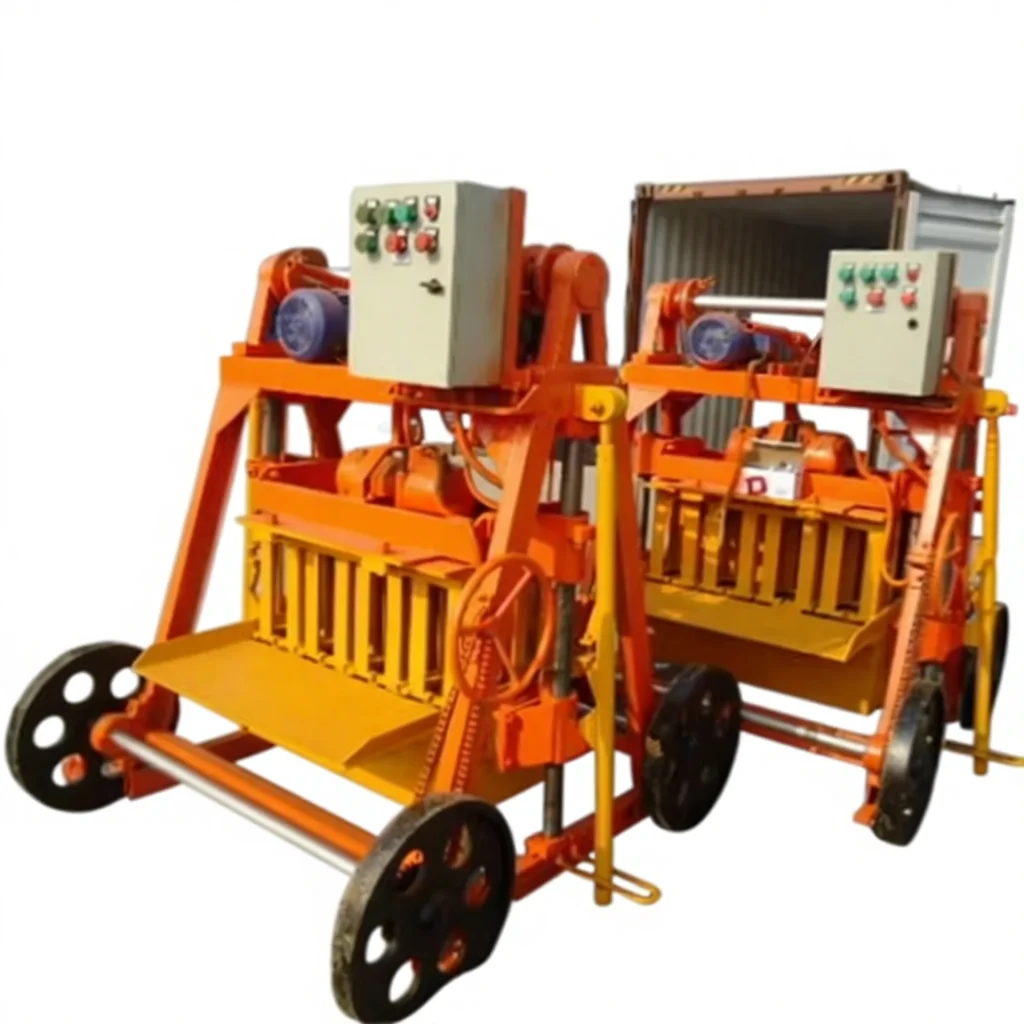
 Mobile block machine