Engineered as a matched system — the QMJ4-45 is specified against your actual block format, local aggregate, and site conditions rather than shipped as a catalogue default.
Technical Specifications
| Parameter |
Value |
| Model |
QMJ4-45 |
| Product Type |
Mobile Egg-Laying Block Making Machine |
| Molding Capacity |
4 pcs/mould (400×200×200 mm hollow block) |
| Vibration Frequency |
2400 r/min |
| Hydraulic Method |
Mould vibration |
| Molding Cycle |
40–45 s |
| Demold Method |
Manual |
| Turning Method |
Manual |
| Total Power |
6 kW |
| Power Source |
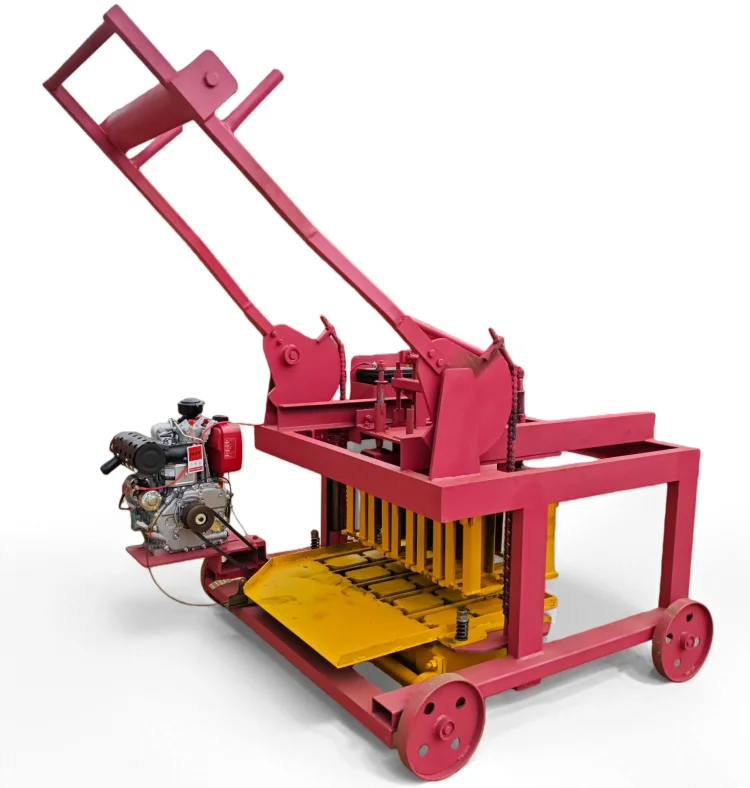
Diesel / petrol engine |
| Automation Level |
Manual egg-laying |
| Warranty |
One year for the whole machine |
| Standards |
CE (certificate to be verified) |
Application Suitability
| Application |
Material or Output |
| On-site hollow block production for building contractors |
Crushed stone, sand, cement blends laid directly on prepared ground |
| Small-scale block plant start-up |
Local red soil, river sand, or quarry dust with cement binder |
| Housing project block supply under tight deadlines |
Standard hollow block formats (400×200×200, 400×150×200, 400×120×200 mm) |
| Paving block and interlocking brick runs |
Fine aggregate mixes with pigments where mould is available |
Why the Daily Output Figure Needs a Block Format Attached
A capacity number without a block format is not a capacity number — it is a guess.
When I commission a QMJ4-45 on site, the first question I ask is which hollow block size the buyer actually sells. Quoted productivity of 2600–4000 pcs/day is often based on an assumed format the buyer never produces, and the real daily count falls well short once the correct mould is fitted [NEED_CITE: realistic block machine output assumptions by format]. The mobile block machine manufacturer you work with should state output per format, not as a single range.
The QMJ4-45 egg laying block machine for sale in this listing is rated at approximately 3000 pcs/day for 400×200×200 mm hollow blocks, 3500 pcs/day for 400×150×200 mm, and 4500 pcs/day for 400×120×200 mm, each based on an 8-hour shift and a 40–45 second moulding cycle. Those numbers move when your local aggregate changes the mix behaviour or when ground conditions slow the laying pace.

Where the QMJ4-45 Sits in the Block Machine Range
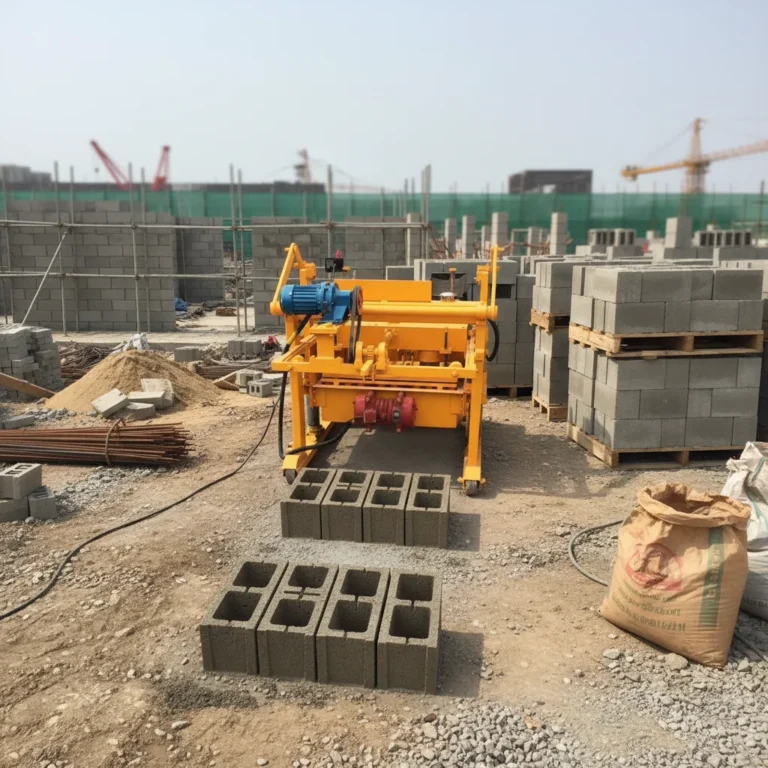
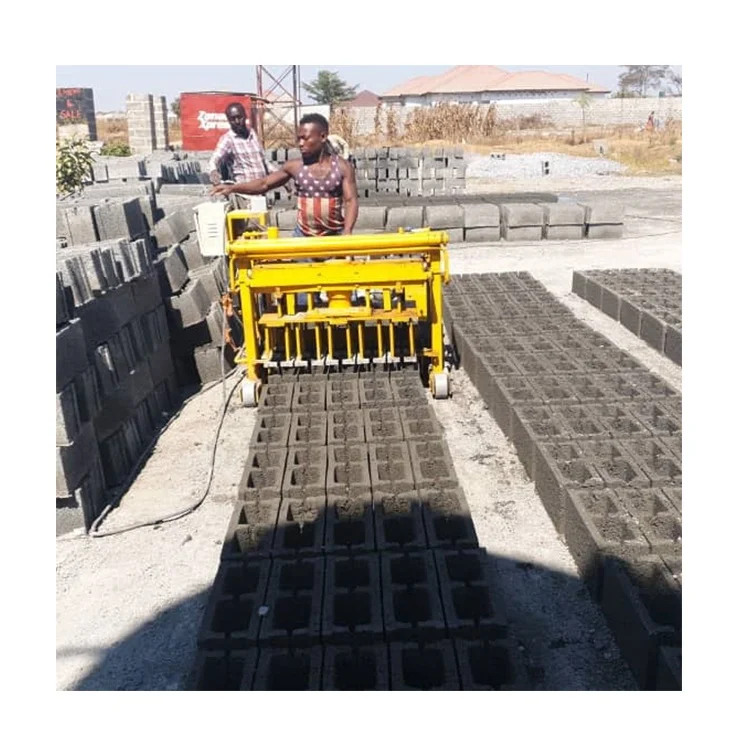
The QMJ4-45 occupies the entry tier of the mobile block machine range — an engine-driven unit that lays blocks directly on the ground without pallets, conveyors, or a fixed plant. For a contractor producing blocks on a job site or an entrepreneur funding a first block venture, it removes the capital outlay for pallet inventory, curing racks, and factory flooring. You place concrete, the machine vibrates and demoulds, and it rolls forward to repeat.
This is the simplest point on the range before semi-automatic machines introduce pallet feeding and stacking, and before fully automatic lines add batching, cubing, and PLC control. Buyers who need format flexibility and higher throughput typically move up to those tiers.
Engine-Driven Production Beyond the Grid
Diesel or petrol power means the QMJ4-45 operates where grid electricity is unreliable or absent — a common reality on rural housing projects and remote development sites across Africa and Southeast Asia [NEED_CITE: off-grid construction equipment requirements in developing markets]. The 6 kW total power draw is well within the output of a small single-cylinder diesel engine, keeping fuel cost predictable per shift.
On sites I have worked, the engine-driven configuration also sidesteps the voltage and frequency mismatch problems that delay commissioning of electric machines. No transformer, no phase converter, no argument with the local utility about three-phase availability.
Reading the Specs That Actually Matter on Site
Vibration frequency at 2400 r/min determines how densely the mix is compacted inside the mould. Higher frequency generally yields tighter blocks, but only if the mix moisture and aggregate grading are matched to that frequency — I have watched blocks crack on demould because the local red soil held more water than the standard sand the machine was tested with, and we had to adjust both water ratio and vibration duration to stabilise output.
The 40–45 second moulding cycle sets the pace of the entire operation. With manual demould and manual turning, cycle time also depends on operator rhythm. Two experienced operators can sustain the rated cycle; a single operator or a crew still learning the machine will run slower, and daily output drops accordingly.
The egg-laying design eliminates pallets entirely. Blocks cure on the ground where they are laid, so the site surface must be level, compacted, and free of standing water. Ground preparation is the hidden cost that buyers overlook — a poorly graded yard produces uneven blocks and breakage during the first days of curing.
The Cost of Skipping the Format Conversation
When a buyer orders a mobile block machine without confirming which block sizes the local market actually buys, the machine arrives with a single mould that does not match demand. Mould change on a manual egg-laying unit is straightforward, but only if the replacement mould was included in the shipment — sourcing a 400×120×200 mm mould locally in a market that only stocks 400×200×200 mm is not possible, and production stalls for weeks [NEED_CITE: mould availability in regional block markets].
Equally, specifying a mix design the local quarry cannot supply forces the buyer to import aggregate or reformulate, both of which compress margin. The QMJ4-45 mobile block machine manufacturer should confirm your available sand, stone, and cement types before finalising the mould and vibration settings.
Why Source This Machine Through a Single-Focus Block Machinery Supplier
Block machinery is the sole product line here, so the QMJ4-45 is not assembled from unrelated components sourced across different factories. The mould, engine mount, vibration motor, and frame are specified as one matched unit.
Configuration is set against the buyer’s target block format, local aggregate sample, and site conditions — not pulled from a default catalogue page. Mould drawings are provided for every format the buyer’s market sells, including custom sizes built to buyer-supplied drawings.
The automation path is open: a buyer starting with the QMJ4-45 can move to a semi-automatic pallet-fed machine later, with the same supplier handling both the original and the upgrade. Installation support includes on-site commissioning and operator training so the crew understands mix ratios, cycle pacing, and basic maintenance from day one.
Documentation & Verification
- Line layout showing the QMJ4-45 working area and curing yard dimensions per block format
- Machine specification sheet confirming vibration frequency and cycle time for your chosen mould
- Mould drawing and format list covering every block size your market requires
- Engine specification sheet with fuel type, power output, and service intervals
- Factory test record run on your target block format before dispatch
- Operation and maintenance manual with wear parts list and replacement schedule
Installation, Commissioning & Support
- Level, compacted ground required across the laying path — no concrete slab needed for the 6 kW engine-driven QMJ4-45
- Engine fuel supply and daily oil check procedure briefed to operators during commissioning
- Vibration motor wiring inspected and motor mount bolts torqued to spec on arrival
- First production run supervised on your local aggregate to confirm mix water ratio and cycle rhythm
- Mould change procedure demonstrated so format switching takes minutes rather than hours
- Wear parts list supplied with recommended reorder points for vibration springs and mould liners
What to Share Before Requesting a Quotation
Tell the supplier which hollow block sizes your market buys, your target daily output, and the type of sand and stone available within hauling distance of your site. Share whether your site has any power supply or whether engine-only operation is mandatory. If you already own a curing yard or forklift, mention the dimensions so the laying pattern can be planned around your existing layout.
Frequently Asked Questions
Q: How is the 2600–4000 pcs/day productivity range calculated for the QMJ4-45?
A: That range covers multiple hollow block formats across an 8-hour shift. Specifically, 400×200×200 mm blocks yield around 3000 pcs/day at 4 pcs per mould, 400×150×200 mm yields around 3500 pcs/day at 5 pcs per mould, and 400×120×200 mm reaches approximately 4500 pcs/day at 6 pcs per mould, each with a 40–45 second cycle.
Q: Can the QMJ4-45 produce paving blocks or interlocking bricks?
A: Yes, provided the correct mould is fitted. The egg-laying design works with paving block and interlocking brick moulds as long as the mix uses fine aggregate suitable for surface finish. Confirm available mould formats with the supplier before ordering, since not every paving shape is held in standard stock.
Q: Does the egg-laying design truly eliminate pallets?
A: It does. Blocks are laid directly on the ground and the machine rolls forward. The trade-off is that your site surface must be level and well-compacted. Uneven ground causes tilted blocks and breakage during early curing, so budget time for yard preparation before first production.
Q: Where does the QMJ4-45 sit compared to semi-automatic block machines?
A: It is the entry point of the range — no pallets, no conveyor, no PLC. Semi-automatic machines add pallet feeding and require a fixed plant with a curing area. The QMJ4-45 suits contractors producing on their own job site or entrepreneurs starting with minimal capital before scaling up to a pallet-based line.

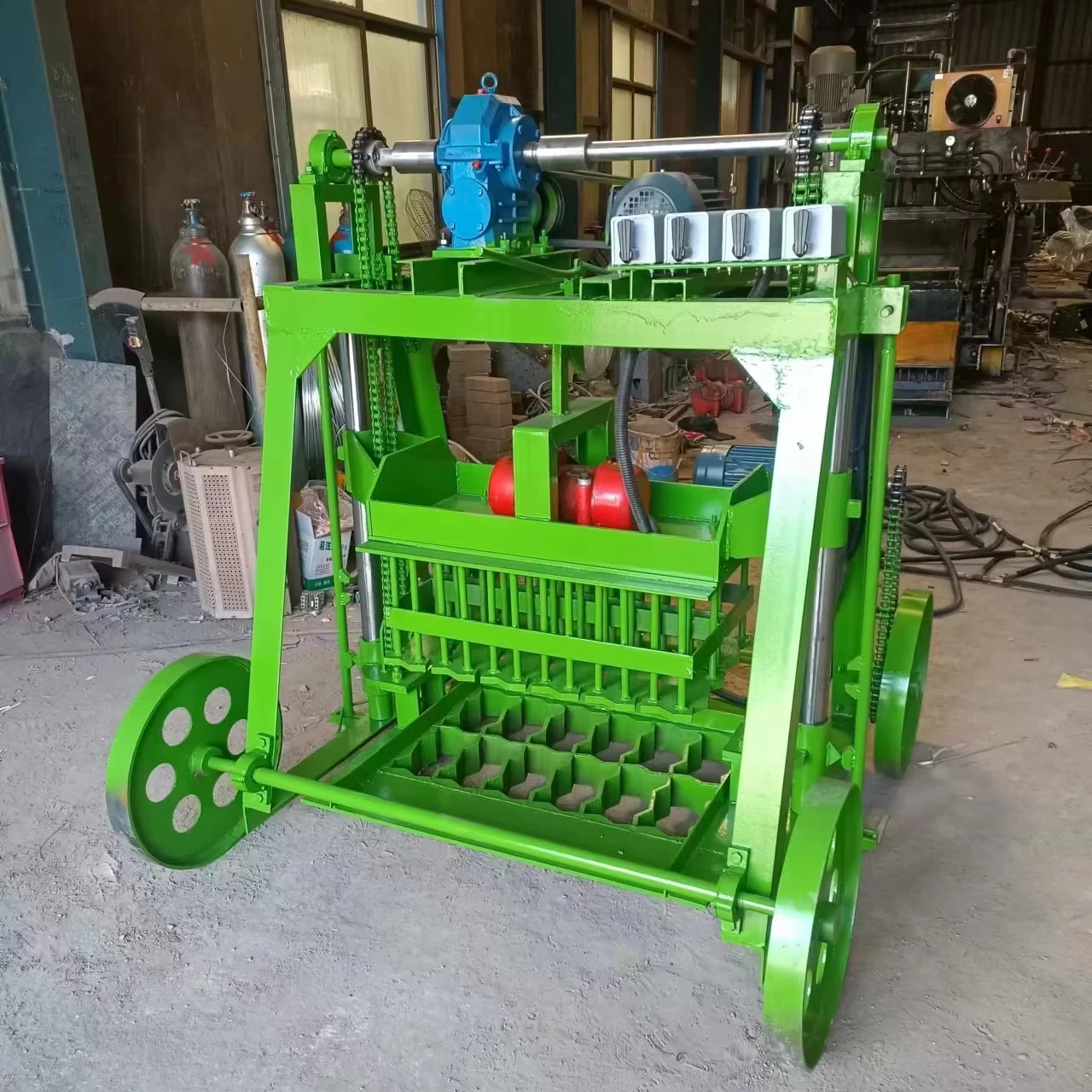
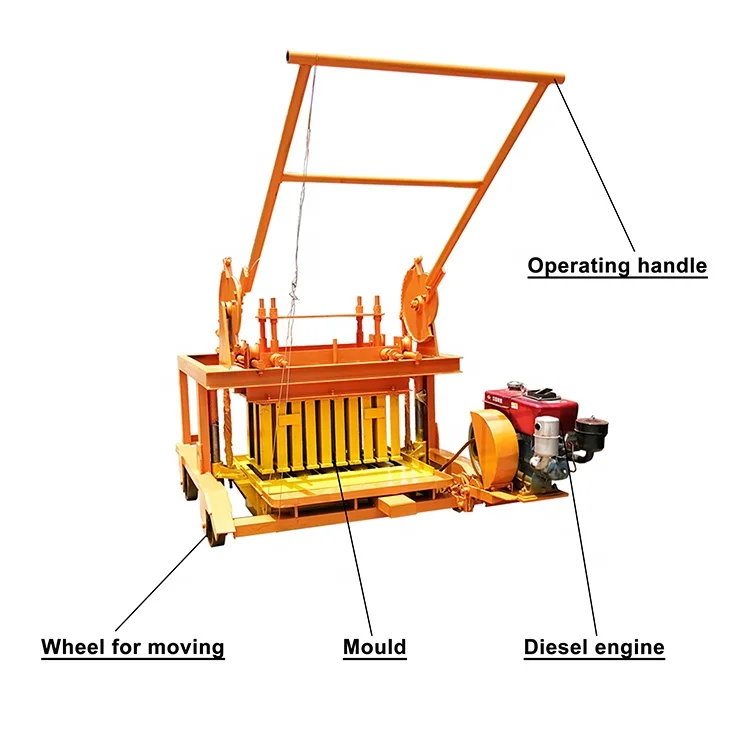 Mobile block machine