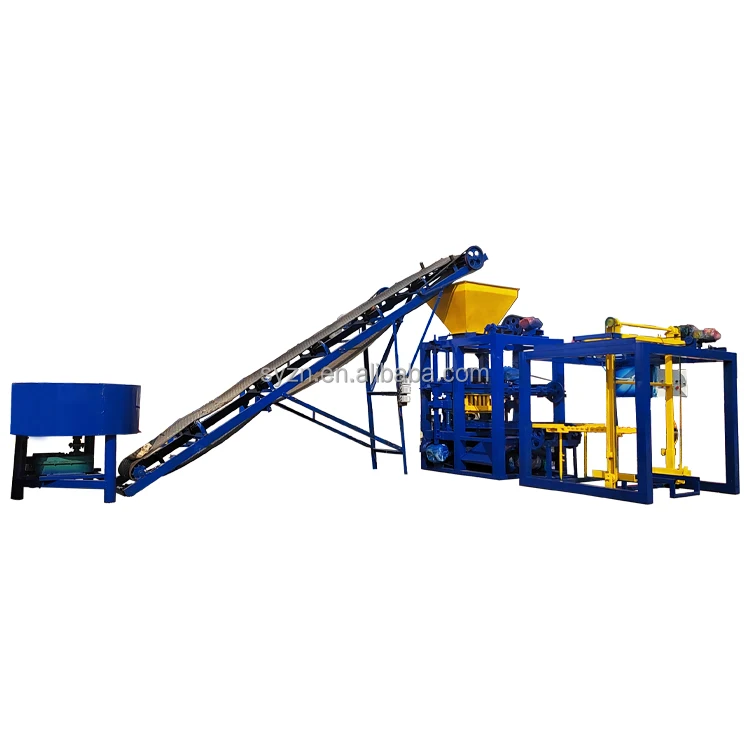
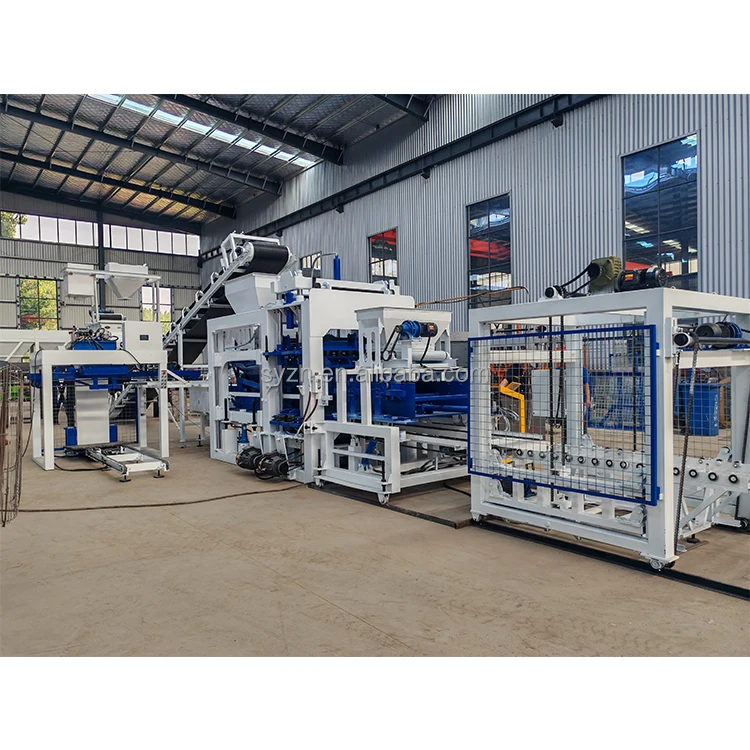
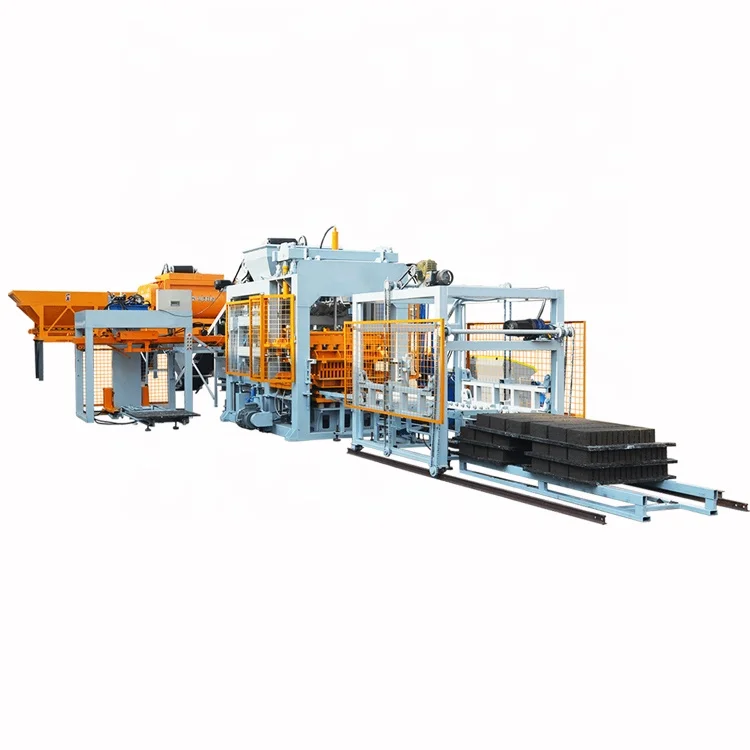
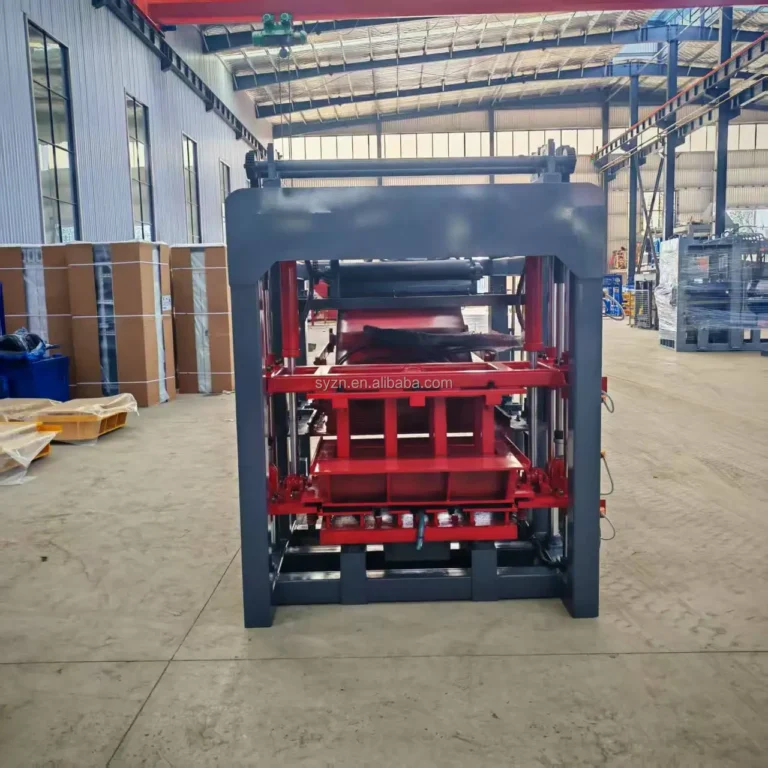
Matched System Specified — The QT18-15 block machine, moulds, pallets and handling equipment are configured as one integrated line, not assembled from mismatched suppliers.
Technical Specifications
| Parameter |
Value |
| Model |
QT18-15 |
| Product Type |
Automatic Hydraulic Concrete Block Making Machine |
| Overall Dimensions (L×W×H) |
9350×2520×2950 mm |
| Net Weight |
18 T |
| Rated Power |
90 kW |
| Voltage & Frequency |
380 V or customizable to target market standard |
| Control System |
PLC (brand and display language configurable) |
| Demoulding Method |
Hydraulic |
| Pallet Size |
1350×1350×30 mm |
| Vibration System |
Four external vibration motors |
| Upper Mould Synchronization |
Dual-side synchronous gear, four-point stabilization |
| Material Feeder |
European design with turning arm cylinder |
| Noise & Vibration Damping |
Airbag system with adjustable air pressure |
| Output Capacity |
4320 pcs/h based on 400×200×200 mm hollow block, 18 pcs/mould |
| Output Capacity |
5760 pcs/h based on 400×150×200 mm hollow block, 24 pcs/mould |
| Daily Output |
34560 pcs/day based on 400×200×200 mm hollow block, 8-hour shift |
| Daily Output |
46080 pcs/day based on 400×150×200 mm hollow block, 8-hour shift |
| Hydraulic Pressure |
To be confirmed based on buyer mix design |
| Vibration Force |
To be confirmed based on target block format |
| Cycle Time per Format |
To be confirmed per block type |
| Standards |
ISO 9001:2008, CE |
| Warranty |
1 year |
Application Suitability
| Application |
Material or Output |
| High-capacity hollow block production |
Crushed stone, sand, cement, and water at standard ratios |
| Interlocking brick manufacturing |
Laterite, volcanic ash, or local aggregate with cement binder |
| Paver and kerbstone production |
Fine aggregate mixes with hydraulic pressing and vibration |
| Large-scale contractor supply |
Continuous 8-hour shift output for housing and infrastructure projects |
Why the Capacity Number on the Nameplate Is Not the Whole Story
Every output figure depends on which block format the machine is actually running at that moment.
A buyer in North Africa once received a block machine rated at several thousand pieces per hour, only to find that figure assumed a hollow block his market did not buy. When he switched to the smaller solid brick his distributors needed, the cycle stretched and daily output dropped noticeably. The machine was not faulty — the capacity claim simply did not travel with its format assumption [NEED_CITE: block format and cycle time relationship in concrete block production].
This is the gap that causes more disappointment than almost any mechanical failure. When evaluating the QT18-15 automatic block machine manufacturer options, ask which format each output number assumes and request the cycle time for the block your market actually purchases.

Where the QT18-15 Sits in the Full Machine Range
The QT18-15 occupies the high-capacity tier of the automatic block machine lineup, positioned above semi-automatic and smaller automatic models that serve workshop-scale operations. Buyers moving up from a semi-automatic line will notice the shift immediately: hydraulic demoulding replaces manual release, the PLC manages cycle sequencing, and the pallet size supports larger mould formats.
For a first-time plant owner surveying the range, the key distinction is daily volume. The QT18-15 is built for operations targeting continuous production across an eight-hour shift, with output figures stated per block format so you can match the tier to your market demand.
How Automation Level Shapes the Rest of the Line
The QT18-15 is supplied as an automatic press, but the automation question extends beyond the machine itself. Pallet feeding, stacking, and cubing may or may not be included in a given quotation, and leaving those stations manual means the press spends part of each cycle waiting for an operator to move cured blocks off the line [NEED_CITE: automation level impact on block plant throughput].
This is where specifying the press as part of a matched system matters. The automation level is selectable, so a buyer can begin with the press and manual pallet handling, then add automatic stacking and cubing as production volume justifies the investment. The machine control system is designed to integrate these downstream stations without replacing the PLC.
Reading the Specs That Actually Shape Your Output
Hydraulic pressure and vibration force work together to determine block density and strength. The QT18-15 uses four external vibration motors with an airbag damping system that allows air pressure adjustment — this lets the operator tune vibration amplitude when switching between a lightweight hollow block and a denser paver format. Without this tunability, a single vibration setting either under-compacts one format or over-stresses the mould on another.
The dual-side synchronous gear on the upper mould provides four-point stabilization during pressing. This prevents uneven pressure distribution that causes one side of the block to be weaker than the other, a common source of inconsistent strength test results.
The European-design material feeder with a turning arm cylinder distributes raw material across the mould cavity faster than a gravity-feed hopper. Faster distribution shortens the feed portion of each cycle, which contributes directly to the cycle time per format.
The 1350×1350 mm pallet size determines how much curing floor space each shift occupies and what forklift capacity the plant needs. A buyer whose existing curing yard was designed around a smaller pallet will need to recalculate rack spacing before the line arrives.
What Happens When Voltage and Language Are Decided After Arrival
A block machine that arrives with the wrong voltage frequency cannot be commissioned until a transformer is sourced locally — a delay that can stretch into weeks depending on the market. The PLC display language is equally practical: an operator reading fault codes in a language they do not recognize will call for support on issues that a clear display message would have resolved in minutes [NEED_CITE: PLC language and commissioning delays in exported machinery].
These two items cost nothing to confirm before production starts, yet they are responsible for a disproportionate share of post-arrival delays. The QT18-15 quotation process includes voltage, frequency, and control language confirmation as a required step before the machine enters the production schedule.
Why Buyers Source the Full Range Here
Block machinery is the single focus of this operation, which means the QT18-15 press, its moulds, pallets, and handling equipment are specified as one matched system rather than assembled from separate suppliers who do not coordinate cycle times.
Configuration is set against the buyer’s actual mix design and local aggregate, not a catalogue default. The vibration force and hydraulic pressure are matched to the material the buyer can actually source, avoiding the costly reformulation that occurs when a machine arrives tuned for a mix that does not exist locally.
Mould design covers the formats the buyer’s market sells, including custom drawings when a standard mould does not match the required dimensions. The automation level is selectable so the investment can grow with the operation.
Installation includes on-site commissioning with operator training, and mould and wear parts support continues after the first production run. Documentation covers the full line layout with capacity calculations that state the block format assumed for every output figure.
Documentation & Verification
- Line layout with capacity calculation stating block format for each output figure
- Machine specification sheet confirming hydraulic pressure and vibration force ratings
- Mould drawing and format list for every block type in the quotation
- Voltage, frequency, and PLC display language written confirmation before production
- Factory test record on buyer-specified block format before dispatch
- Pallet specification matched to curing area dimensions and forklift capacity
Installation, Commissioning & Support
- Foundation plan sized to the 9350 mm machine length and 18 T operating weight
- Dedicated power circuit rated for 90 kW continuous draw at confirmed voltage and frequency
- Machine arrives fully assembled; on-site team handles final alignment and pallet track leveling
- First-run commissioning includes cycle time measurement on buyer’s actual block format
- Operator training covers PLC fault codes, mould change procedure, and airbag pressure tuning
- Wear parts and mould replacement list provided with lead times for each item
What to Include in Your Inquiry
To receive a configuration that matches your actual production conditions, include your target block format with dimensions, the daily output you need for that specific format, and the local raw materials you plan to use — including a sieve analysis if available. State your site voltage and frequency, preferred PLC display language, and whether your existing curing area and forklift are already sized for the 1350×1350 mm pallet. If you are comparing tiers, mention whether semi-automatic or smaller automatic models are also under consideration so the full range can be presented side by side.
Frequently Asked Questions
Q: How is the QT18-15 daily output calculated, and which block format does each figure assume?
A: Each output figure in the specification is tied to a specific block format and mould cavity count. The 4320 pieces per hour figure assumes a 400×200×200 mm hollow block with 18 pieces per mould, while the 5760 figure assumes a 400×150×200 mm hollow block with 24 pieces per mould. Daily output multiplies the hourly rate by an eight-hour shift. If your market buys a different format, request the cycle time and output calculation for that specific block.
Q: Where does the QT18-15 sit in the full machine range compared to semi-automatic and smaller automatic models?
A: The QT18-15 is the high-capacity tier, designed for continuous shift production with hydraulic demoulding and PLC-controlled cycling. Semi-automatic models serve smaller plants with lower investment and manual pallet handling, while mid-range automatic models offer moderate output with partial automation. The right tier depends on your target daily volume and whether you plan to add automatic stacking and cubing from the start or upgrade later.
Q: What pallet size does the QT18-15 use, and how does it affect curing area and forklift requirements?
A: The QT18-15 runs on 1350×1350×30 mm pallets. This size determines the curing rack spacing, total floor area needed per shift of production, and the forklift capacity required to move loaded racks. Buyers with existing curing infrastructure should confirm that their rack dimensions and forklift rating accommodate this pallet size before finalizing the line layout.
Q: Can the automation level be configured — does the quotation include stacking, cubing, and pallet handling?
A: The automation level is selectable. The press itself is automatic, but downstream stations like pallet feeding, stacking, and cubing can be included or omitted depending on your budget and production plan. A buyer can start with manual pallet handling and add automatic stacking later, as the PLC is designed to integrate these stations without replacing the control system.
Q: What voltage, frequency, and PLC language options are available, and when must they be confirmed?
A: The standard voltage is 380 V, but the machine can be configured to match the target market’s electrical standard. The PLC display language is set before production. Both items must be confirmed in writing before the machine enters the build schedule — not after arrival — to avoid commissioning delays caused by transformer sourcing or unreadable fault codes.

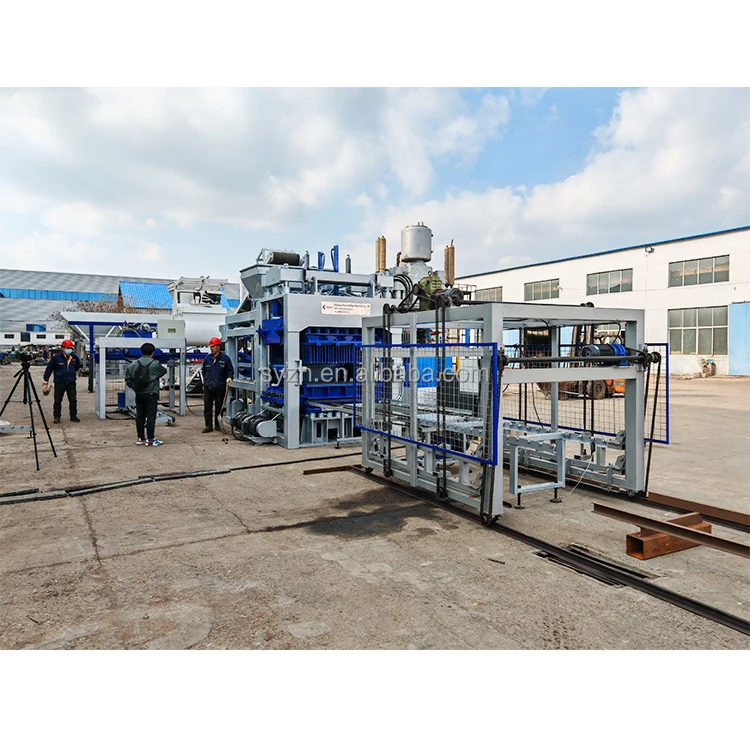
 High quality block machine