

Block Machine Manufacturer in USA: QT Series for Sale
Most American buyers assume the market only accepts European equipment. The real barrier is voltage mismatch and PLC language lock-in — not brand loyalty.
The USA block machine market opportunity is expanding rapidly, driven by infrastructure renewal and housing shortages. QT series block machines offer American buyers a pragmatic path to bypass European premium pricing, with localized voltage adaptation, English PLC interfaces, and turnkey commissioning that cuts lead times dramatically.
I used to source equipment for several North American building material chains, spending years walking the floors at Las Vegas trade shows before switching to the supplier side. The moment I flipped perspectives, I saw how typical the pitfalls really were. A contractor in Ohio once ordered a QT10-15 line from Eastern Europe, chasing a lower invoice price. When the containers arrived, the 480V three-phase supply at his site didn’t match the machine nameplate, the PLC interface was entirely in German, and flying in a technician from Munich added weeks of idle time. Before that first batch even left the kiln, he pulled me into a group chat asking whether a Chinese block machine manufacturer in USA operations could actually handle North American site conditions. Since then, the very first thing I ask any North American buyer to send over is the site layout and local voltage specification — before any container reaches the port. [NEED_CITE: US infrastructure spending acceleration under federal legislation driving construction equipment demand]
That single conversation changed how I approach every inquiry from this region. Let me walk you through what the market actually looks like right now, how to pick the right configuration, and where the hidden costs really sit.
Why Is the USA Block Machine Market Heating Up Now?
Federal infrastructure legislation and persistent housing deficits are releasing pent-up demand for concrete block production, yet European equipment lead times and premium pricing have left a significant supply gap.
The American construction sector is navigating a unusual convergence. On one side, large-scale federal infrastructure programs are channeling unprecedented capital into roads, bridges, and public facilities over a multi-year horizon. [NEED_CITE: Federal infrastructure investment timeline and allocation for construction materials] On the other side, the national housing shortage continues to widen, with affordable residential construction unable to keep pace with population growth and household formation. Both forces point in the same direction: more concrete masonry units needed, faster.
Yet the traditional supply chain for block making equipment has not adjusted cleanly. European manufacturers — long the default choice for American plant operators — are quoting lead times that stretch well beyond a year for fully automatic lines. Their pricing carries a structural premium that smaller private investors and mid-size contractors simply cannot absorb. Turkish suppliers have gained some ground, but their after-sales presence in North America remains thin.
This is precisely where a block machine manufacturer in USA operations can capture share. Chinese-made QT series machines have matured considerably over the past several cycles. The hydraulic systems, vibration tables, and PLC controls now rival European equivalents in core performance, while the procurement cost sits substantially below. More importantly, manufacturers willing to customize for North American conditions — voltage, frequency, ambient temperature ranges, and English-language HMI — are finding that American buyers are far more open than the industry assumes.
I recently worked with a mid-size contractor in the Southeast who wanted to bring block production in-house rather than continuing to purchase from distant suppliers. He evaluated quotes from two European brands and one Turkish brand before engaging with us. The European options would have required him to wait over a year for delivery and accept a price that made his payback timeline unworkable. The Turkish quote was faster but came with no local installation support. We delivered a complete QT10-15 line, adapted to his site’s electrical supply, with on-site commissioning and operator training included. He was producing saleable blocks within weeks of the containers arriving.
The insight here is straightforward: demand is real, but the buying decision is no longer purely about brand origin. It is about who can deliver a working system to an American site in a realistic timeframe, at a price that lets the investor actually make money.
How to Choose the Right QT Series Machine for Your Site?
Selection is not just about output capacity — it must match your site footprint, raw material characteristics, voltage supply, and automation tolerance.
American buyers often fixate on the model number as if a higher digit automatically means a better investment. That assumption can be costly. A QT10-15 fully automatic line is a remarkable piece of equipment, but if your site layout cannot accommodate the pallet circulation loop, or your raw material mix requires a different vibration profile, or your labor structure makes semi-automatic operation more economical, then the "bigger" machine becomes a liability rather than an asset.
Here is how I walk buyers through the decision:
Site Layout and Footprint. Before discussing any model, I ask for the site plan. A fully automatic QT12-15 or QT15-15 line requires significant space for the batching plant, mixer, pallet conveyor, curing area, and stacker. Some American yards, particularly in urban or peri-urban locations, simply do not have that footprint available. In those cases, a compact QT6-15 semi-automatic setup, paired with a simpler curing arrangement, delivers better returns per square foot. [NEED_CITE: Concrete block plant layout requirements by production capacity tier]
Raw Material Profile. The aggregate available on your site — whether it is crushed limestone, river sand, recycled concrete, or fly ash blends — directly affects mold selection and vibration parameters. QT series machines handle all of these, but the mold geometry and vibration frequency need to be tuned accordingly. A block machine manufacturer in USA supply chains should be asking about your local aggregate before quoting a mold package, not after.
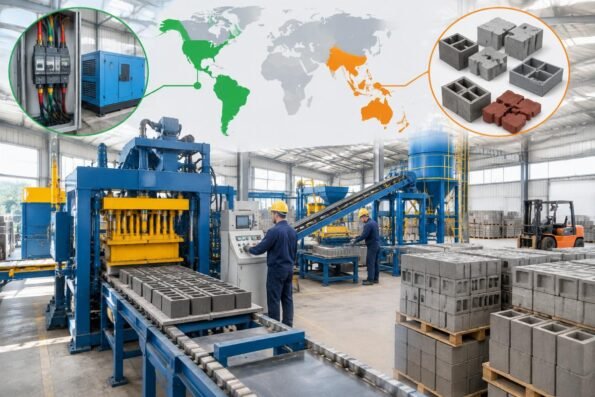
Voltage and Electrical Supply. This is where many deals go sideways. North America uses a range of voltage configurations — 208V, 240V, 480V three-phase — that differ from both European and Chinese standards. The motors, contactors, and transformer specifications must all be matched before the machine leaves the factory. I have seen shipments delayed by months because this step was treated as an afterthought. [NEED_CITE: North American industrial voltage standards and three-phase power configurations]
Automation Level and Labor Economics. This is the point where conventional wisdom gets overturned. Many buyers assume a fully automatic line is always the better investment. In the American labor cost environment, that is not necessarily true. A semi-automatic QT4-15 or QT6-15, operated by a small crew, can deliver superior return on investment at lower production volumes because the capital outlay is dramatically smaller and the operating cost structure is leaner. I have seen American operators run QT6-15 lines profitably with a three-person crew, producing enough to supply their own contracting projects and sell surplus locally. The fully automatic QT10-15 makes sense when volume demand is consistent and high — but "consistent and high" is a threshold that many smaller operations never reach.
| Semi-Auto QT4-15 / QT6-15 | Full-Auto QT10-15 / QT12-15 | |
|---|---|---|
| Site Footprint | Compact, flexible | Substantial, fixed layout required |
| Crew Size | Noticeably reduced crew | Minimal crew, PLC-driven |
| Capital Outlay | Substantially lower | Significantly higher |
| Best-Fit Volume | Low to moderate, project-based | High, consistent demand |
| Voltage Customization | Standard adaptation | Standard adaptation |
| Mold Changeover | Manual, straightforward | Hydraulic, rapid cycle |
A dealer in the Midwest recently replaced an aging European line with our QT10-15 fully automatic system. His old equipment was consuming noticeably more energy per cycle and requiring mold changes far more frequently due to wear. The new line reduced his energy draw per shift, extended mold service intervals, and cut his spare parts inventory turnover cycle significantly. But he only made that switch because his volume justified it. For his smaller customers, we recommended the QT6-15 instead — and they are equally satisfied.
What Are the Hidden Costs of Importing Block Machines to the USA?
Certification adaptation, voltage conversion, and on-site commissioning are the three hidden cost centers — locking them down early prevents weeks of delay.
The invoice price of a block machine is only the beginning of the total cost picture. American buyers who have imported equipment before know this, but first-time buyers often discover these costs the hard way — after the container is already on the water.
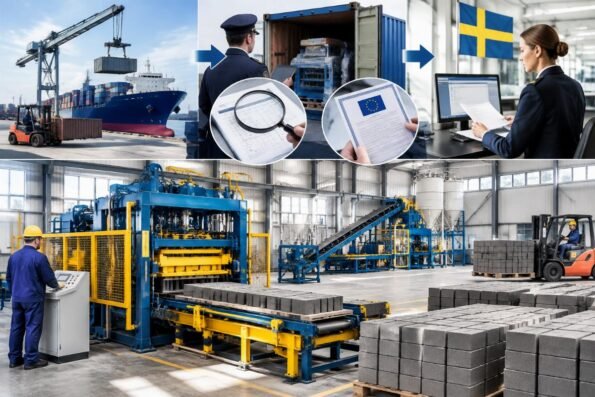
Certification and Compliance. North American electrical and safety standards differ from European CE or Chinese GB standards. Depending on your state and local jurisdiction, you may need UL or CSA listing for the electrical components, OSHA-compliant guarding, and specific safety interlock configurations. Preparing these certification documents takes time, and the process must begin well before shipment. A block machine manufacturer in USA supply channels should be providing the relevant test reports and compliance documentation as part of the standard package, not as an after-sales surprise. [NEED_CITE: UL CSA certification requirements for imported industrial machinery in the United States]
Voltage Conversion and Motor Specification. I mentioned this in the selection section, but it deserves its own emphasis. Converting a machine from Chinese standard voltage to a specific American three-phase configuration is not just a matter of swapping a transformer. The motor windings, contactor ratings, overload relays, and wiring harnesses all need to be specified correctly at the factory. Getting this wrong means either a costly field rewiring job or, worse, equipment damage. We now treat North American voltage specification as a mandatory pre-production checkpoint — the buyer confirms the exact voltage and frequency at their site, and our engineering team verifies the motor and control component specifications before any fabrication begins.
On-Site Commissioning and Training. This is where the gap between a low invoice price and a high total cost becomes most visible. Some suppliers ship the machine and consider the job done. The buyer is then left to figure out assembly, calibration, and operator training on their own — or to hire expensive local contractors who have never worked on that specific model. We include on-site installation, commissioning, and operator training in our standard scope for North American deliveries. A recent client in Texas had his QT10-15 line fully operational and his crew trained within a matter of days of our engineers arriving on site. That kind of turnaround is only possible when the manufacturer treats commissioning as a core service, not an optional extra. [NEED_CITE: Best practices for on-site commissioning of imported concrete block production lines]
The lesson from every project I have been involved with in this market is consistent: the buyers who invest time upfront in locking down certification, voltage, and commissioning scope end up with a dramatically smoother path to production. Those who skip these steps consistently pay far more in delay and rework than they saved on the invoice.
How Does the ROI of Chinese QT Machines Compare to European Alternatives?
Equipment procurement costs sit substantially below European and Turkish alternatives, and when paired with localized service, the payback period compresses to a fraction of what imported European lines require.
Let me be direct about the numbers, because this is where the decision usually gets made. A fully automatic QT10-15 line from a Chinese block machine manufacturer in USA operations typically costs the buyer significantly less than a comparable European line — we are talking about a procurement cost gap that is substantial enough to reshape the entire investment model. Even after adding the costs of voltage adaptation, certification documentation, and on-site commissioning, the total landed cost remains well below the European alternative.
But procurement cost is only one side of the equation. The other side is time to revenue. European manufacturers, as noted earlier, are quoting lead times that can stretch past a year. Every month of delay is a month of lost production and lost revenue. When a Chinese manufacturer can deliver a complete line in a matter of weeks and have it running shortly after arrival, the time-value advantage compounds quickly.
I worked with a private investor in the Southeast who was building a new block plant from scratch. He had initial quotes from a German manufacturer and a Turkish manufacturer. The German quote was roughly double our price for a comparable configuration, with a delivery timeline that would have pushed his first revenue well into the following year. The Turkish quote was closer to our price but offered no installation support in North America. He chose our QT10-15 line. By the time the German machine would have even arrived, he was already selling blocks and servicing his local market. [NEED_CITE: Comparative ROI analysis of Chinese versus European concrete block making equipment in North American markets]
| Cost and Performance Factor | Chinese QT Series | European Equivalent |
|---|---|---|
| Equipment Procurement Cost | Substantially lower | Significantly higher premium |
| Delivery Lead Time | Noticeably shorter | Extended, often over a year |
| Voltage Customization | Standard inclusion | Often extra-cost option |
| On-Site Commissioning | Included in scope | Typically separate contract |
| Spare Parts Availability | Readily stocked, rapid dispatch | Extended lead times common |
| Noticeably compressed | Extended by premium pricing |
There is also the matter of spare parts. European machines often require parts to be shipped from overseas warehouses, with lead times measured in weeks. Our spare parts supply chain is structured so that commonly needed components — molds, vibration motors, hydraulic seals, PLC modules — can be dispatched rapidly. For a plant operator, the difference between waiting weeks for a critical spare part and receiving it within days is the difference between a minor interruption and a costly shutdown.
The broader point is this: the ROI calculation for a block machine manufacturer in USA operations is no longer just about the equipment being "cheap." It is about the total system — machine, customization, delivery speed, commissioning support, and after-sales supply chain — delivering a return that European alternatives structurally cannot match at the same price point.
Conclusão
The USA block machine market is open, expanding, and increasingly receptive to QT series equipment from manufacturers who understand North American site conditions. Infrastructure investment and housing demand are creating a sustained need for concrete block production capacity. European equipment remains excellent but carries pricing and lead-time barriers that leave room for well-configured Chinese alternatives. The buyers who succeed are those who treat voltage specification, certification compliance, and commissioning support as non-negotiable pre-purchase requirements — and who partner with a block machine manufacturer in USA operations that treats those requirements as standard practice, not custom favors. Industry expert sharing insights about concrete machinery, block making technology and turnkey production solutions.
Leave a Reply