

QT10-15 Block Machine Supplier for Oman: China Factory Direct
Most buyers fixate on the machine’s quoted price, only to discover that shipping split, customs delays, and on-site commissioning cycles consume the majority of the total landing budget.
When sourcing a QT10-15 block machine supplier for Oman, the real decision framework must compare production capacity matching, ocean freight containerization strategy, voltage customization for unstable grids, and clearance compliance documentation—not just the ex-works quotation.
Growing up near Ningbo Port, I spent my early career handling shipping documents and customs declarations, staring at bills of lading and packing lists day after day. It was only after transitioning to the trade side that I understood—no matter how perfectly the paperwork is filed, if the machine arrives at port with problems, the client’s frustration lands on you personally. A few years back, I supervised the loading of a complete QT10-15 line destined for Muscat at Shanghai Port. The hydraulic station and molds were split across two separate containers. When the client opened the mold container at Salalah Port, the wooden pallet base had been soaked by seawater, and three sets of paving molds arrived covered in rust spots. With the project timeline locked, emergency air freight for replacement molds cost several times the mold value itself. Since that incident, I insist on loading hydraulic systems, electrical cabinets, and molds in the same container or adjacent positions, and verifying clearance documentation with clients weeks in advance—every character on the certificate of origin attestation must be flawless. After years in this business, what I fear most is not poor manufacturing quality, but good intentions ruined in the final kilometers. [NEED_CITE: common failure points in heavy machinery export logistics to GCC countries]
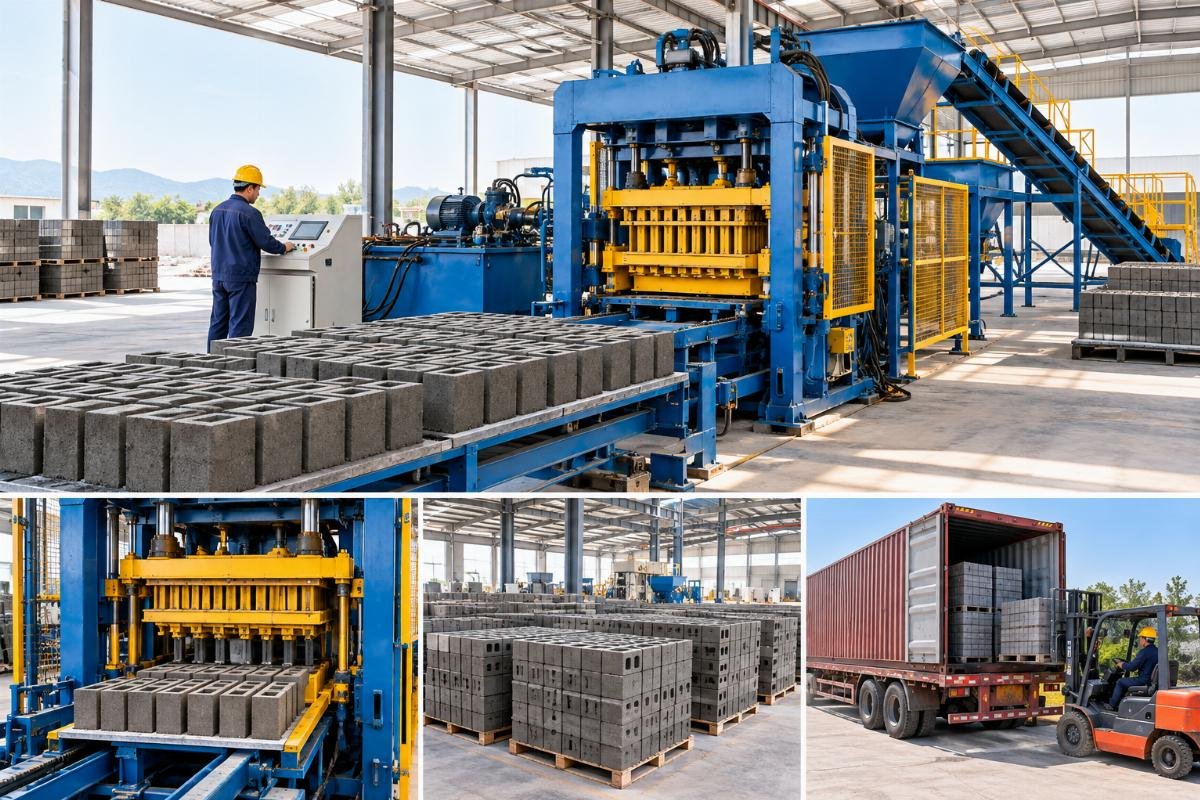
Let me walk you through the structural comparison that actually matters.
What Specs Should You Compare When Choosing a QT10-15 Supplier for Oman?
Capacity figures alone tell you nothing—voltage tolerance, mold adaptation to local aggregates, and container loading efficiency determine whether your QT10-15 block machine supplier for Oman delivers a working plant or a costly lesson.
When evaluating specifications, most buyers request a simple output comparison table. But for Oman’s operating environment, the meaningful comparison matrix looks different:
| Specification Dimension | Basic Offering | Middle-Tier Configuration | Full Customization for Oman |
|---|---|---|---|
| Voltage Adaptation Range | Fixed 380V/50Hz | ±10% tolerance | Wide-range input with stabilizer |
| Hydraulic Cooling | Standard radiator | Enhanced radiator | Oversized cooler for 50°C+ ambient |
| Electrical Cabinet IP Rating | IP54 | IP55 | IP65 with dust filters |
| Mold Material Treatment | Standard hardening | Nitride treatment | Multi-layer anti-corrosion coating |
| PLC Language Interface | English only | English/Arabic | English/Arabic with local dialect options |
| Spare Parts Package | Basic wear parts | Extended wear kit | Full two-year consumable bundle |
The voltage adaptation row deserves particular attention. Oman’s industrial power grid experiences fluctuations that would trip sensitive European-designed controllers within weeks. A QT10-15 block machine supplier for Oman who cannot demonstrate wide-range voltage tolerance—accommodating drops and spikes without shutdown—is selling you a machine designed for Stuttgart, not Sohar. [NEED_CITE: industrial power quality standards in GCC countries and equipment tolerance requirements]
Similarly, mold selection cannot follow a generic catalog. Omani aggregate sources vary significantly between coastal regions and inland quarries. The particle size distribution and moisture content of local limestone and sand directly determine mold cavity design and vibration frequency settings. A supplier who simply copies domestic Chinese recipes without testing your specific raw materials will deliver a line with unacceptably high rejection rates.
How Does Total Landing Cost Break Down for a Complete Block Line to Oman?
The machine invoice is merely the opening chapter of your total investment—freight, customs clearance, on-site commissioning duration, and local infrastructure preparation collectively determine whether your QT10-15 block machine supplier for Oman quotation represents genuine value or hidden expense.
When I began handling complete line shipments, I noticed buyers consistently underestimating non-equipment costs. A typical QT10-15 line to Muscat or Salalah requires multiple container loads: the main machine, mixer and batching system, conveyor network, pallet system, and mold inventory often split across several shipments. Each container represents not just freight cost, but port handling fees, customs clearance charges, and inland transport to your site.
Consider this cost structure framework:
| Cost Component | Typical Proportion | Common Underestimation Risk |
|---|---|---|
| Equipment FOB Price | Baseline | Often overemphasized in comparison |
| Ocean Freight & Insurance | Significant | Container split increases per-unit freight |
| Customs Clearance & Duties | Moderate | Documentation errors cause demurrage |
| On-Site Commissioning Duration | Hidden | Extended debugging consumes labor and overhead |
| Local Infrastructure Preparation | Variable | Power, water, foundation often overlooked |
| Two-Year Spare Parts Inventory | Moderate | Air freight for missing parts multiplies cost |
The commissioning duration row contains a trap many buyers fall into. A supplier who promises rapid installation but lacks experience with Oman’s specific conditions—high ambient temperature affecting hydraulic fluid viscosity, fine sand infiltrating unprotected components—will leave your technicians struggling for extended periods. Each week of delayed production represents lost revenue against your investment recovery timeline. [NEED_CITE: total cost of ownership methodology for capital equipment imports to emerging markets]
I recall a Middle East investor who chose a supplier based solely on the lowest equipment quotation. The machines arrived, but the supplier’s technicians had never commissioned a line in desert conditions. Hydraulic systems overheated, electrical components failed from sand ingress, and the project timeline stretched dramatically. The additional costs—emergency parts shipment, extended technician stays, lost production—far exceeded the initial price difference.
Why Do European/Turkish Machines Underperform in Middle East Conditions?
Brand prestige cannot compensate for engineering mismatch—equipment designed for stable European grids and temperate climates fails rapidly when deployed in Oman’s high-temperature, high-salinity, voltage-fluctuation environment, making a QT10-15 block machine supplier for Oman with regional customization experience far more valuable than a famous nameplate.
This observation comes from watching multiple projects unfold. European and Turkish manufacturers produce excellent machines for their domestic markets and nearby regions with similar infrastructure. However, when those same machines arrive in Oman, several problems emerge systematically:
Electrical control systems designed for stable 400V/50Hz supply encounter voltage swings that trigger protective shutdowns repeatedly. The machines stop production dozens of times daily, frustrating operators and reducing output dramatically. Hydraulic systems calibrated for moderate ambient temperatures overheat when facing summer temperatures exceeding fifty degrees Celsius, requiring frequent shutdowns for cooling. Sealing systems designed for clean industrial environments allow fine desert sand to infiltrate bearings and cylinders, accelerating wear substantially.
Chinese manufacturers serving emerging markets have accumulated extensive experience addressing these specific challenges. Wide-range voltage stabilizers, oversized hydraulic cooling systems, enhanced sealing packages, and dust-proof electrical cabinets become standard rather than optional. This is not about lower quality—it is about engineering priorities shaped by deployment environment. [NEED_CITE: equipment adaptation requirements for harsh climate industrial operations]
A QT10-15 block machine supplier for Oman who has delivered multiple lines across the Middle East understands these conditions intimately. They know that electrical cabinets require positive pressure systems to keep dust out, that hydraulic oil coolers must be sized for peak summer temperatures, and that vibration motors need enhanced bearing protection. This operational knowledge, accumulated through actual field deployment, cannot be replicated by simply shipping a European design to a new geography.
What Documentation and Certifications Does Oman Customs Require?
Missing or incorrect paperwork transforms a smooth arrival into an expensive port滞留 nightmare—your QT10-15 block machine supplier for Oman must provide complete, properly authenticated documentation well before the vessel departs, not after problems surface at the destination port.
Customs clearance in Oman requires specific documentation that must be prepared with precision. The commercial invoice, packing list, bill of lading, and certificate of origin form the basic package. However, the certificate of origin requires attestation by the Oman Embassy or relevant authentication authorities in the exporting country—a process that takes considerable time and cannot be rushed once the cargo has arrived.
Additionally, depending on the equipment classification, conformity certificates or inspection reports may be required. CE marking documentation, while not always mandatory for industrial machinery, demonstrates compliance with international safety standards and can facilitate smoother clearance. Some buyers also request SGS or similar third-party inspection reports conducted before shipment, providing independent verification of equipment specifications.
| Documentation Item | Preparation Timeline | Authentication Requirement | Risk of Delay |
|---|---|---|---|
| Commercial Invoice | Before shipment | May require chamber certification | Moderate |
| Packing List | Before shipment | Standard | Low |
| Bill of Lading | At shipment | Carrier issuance | Low if accurate |
| Certificate of Origin | Weeks before shipment | Embassy attestation required | High if delayed |
| CE/SGS Certificates | Before production completion | Third-party issuance | Moderate |
| Technical Manuals | With shipment | English/Arabic preferred | Low |
The certificate of origin attestation timeline deserves emphasis. This process involves submission to the relevant chamber of commerce, forwarding to the foreign ministry, and finally to the Oman Embassy—a chain that requires weeks of lead time. If your QT10-15 block machine supplier for Oman waits until after production completion to begin this process, your cargo will arrive at port before documentation is ready, generating demurrage charges that accumulate daily. [NEED_CITE: Oman customs documentation requirements for industrial machinery imports]
I have seen shipments held at port for extended periods because the certificate of origin lacked proper attestation, or because the commercial invoice contained minor discrepancies with the packing list. The demurrage charges, storage fees, and administrative costs quickly dwarf any price difference between suppliers. Proper documentation preparation is not optional—it is integral to your total project cost.
How to Validate a Supplier Before Placing an Order?
Requesting references from similar regional deployments, conducting live video factory inspections, and reviewing mold trial reports with your specific raw materials separates serious suppliers from catalog traders—these validation steps protect your investment in a QT10-15 block machine supplier for Oman far more effectively than price comparison alone.
Before committing to a supplier, several verification activities provide confidence in their capability:
First, request case studies or references from projects in Oman or neighboring GCC countries. A supplier with genuine regional experience can provide contact information for previous clients, photographs of installed lines, and performance data from actual operations. Generic marketing materials showing machines in factory settings prove nothing about field performance in your specific conditions.
Second, arrange a live video factory tour. Modern communication tools allow you to walk through production facilities, observe manufacturing processes, inspect quality control procedures, and meet the engineering team. Pay attention to whether the supplier can explain technical details about voltage adaptation, hydraulic system design for high temperatures, and electrical cabinet protection ratings. Vague answers indicate limited customization capability.
Third, if possible, send samples of your local raw materials—limestone, sand, cement sources—to the supplier for mold trial testing. Request video documentation of the trial runs, photographs of finished products, and data on cycle times and rejection rates. This proves whether the supplier can adapt their standard recipes to your specific aggregate characteristics. [NEED_CITE: supplier validation methodology for capital equipment procurement]
| Validation Activity | What It Proves | Red Flags to Watch |
|---|---|---|
| Regional Reference Checks | Field experience in similar conditions | Inability to provide verifiable contacts |
| Live Video Factory Tour | Manufacturing capability and transparency | Reluctance to show specific production areas |
| Raw Material Trial Testing | Recipe adaptation capability | Refusal to test with client materials |
| Technical Question Depth | Engineering customization capability | Generic catalog responses only |
| Certification Verification | Compliance documentation readiness | Expired or questionable certificates |
A serious QT10-15 block machine supplier for Oman welcomes these validation requests because they demonstrate confidence in their capability. Suppliers who resist providing references, avoid video tours, or refuse raw material testing typically lack the depth of experience required for successful deployment in challenging environments.
Conclusion
Selecting a QT10-15 block machine supplier for Oman requires evaluating production capacity matching, total landing cost structure, regional condition adaptation, documentation readiness, and validation transparency—not just the initial equipment quotation.
The machine price represents only the beginning of your investment. Shipping logistics, customs clearance efficiency, on-site commissioning duration, and long-term operational reliability in high-temperature, high-salinity, voltage-fluctuation conditions collectively determine your project’s success. Suppliers with proven Middle East deployment experience, customization capability for local aggregates and power conditions, and systematic documentation preparation processes deliver substantially lower total cost of ownership than competitors competing on equipment price alone.

Industry expert sharing insights about concrete machinery, block making technology and turnkey production solutions.
View all posts →
Leave a Reply