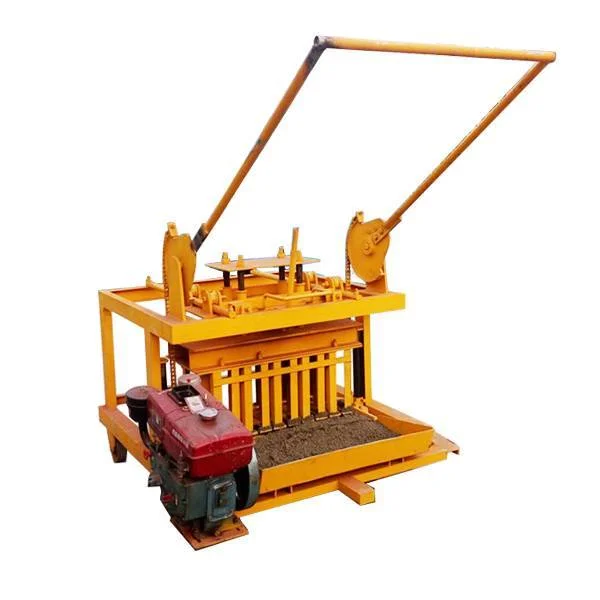
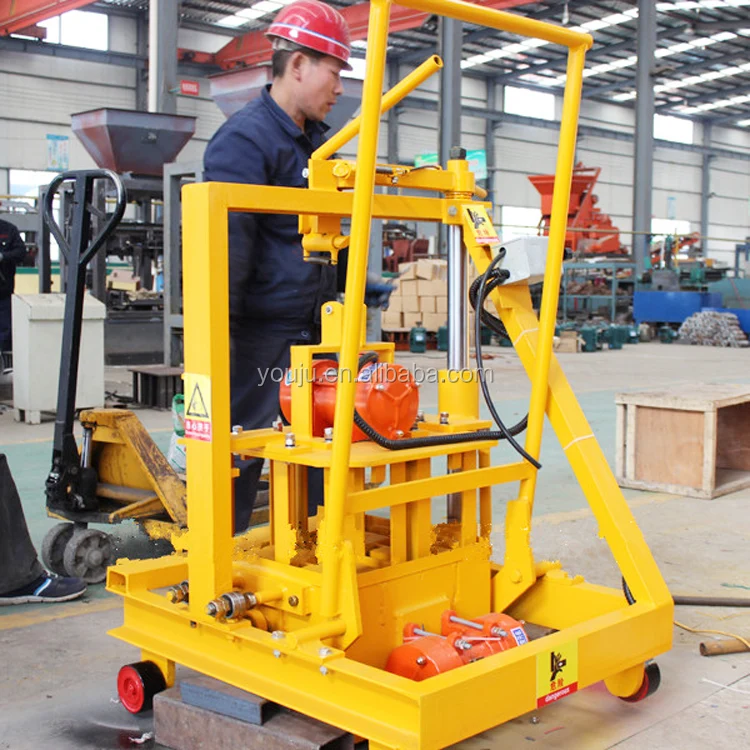
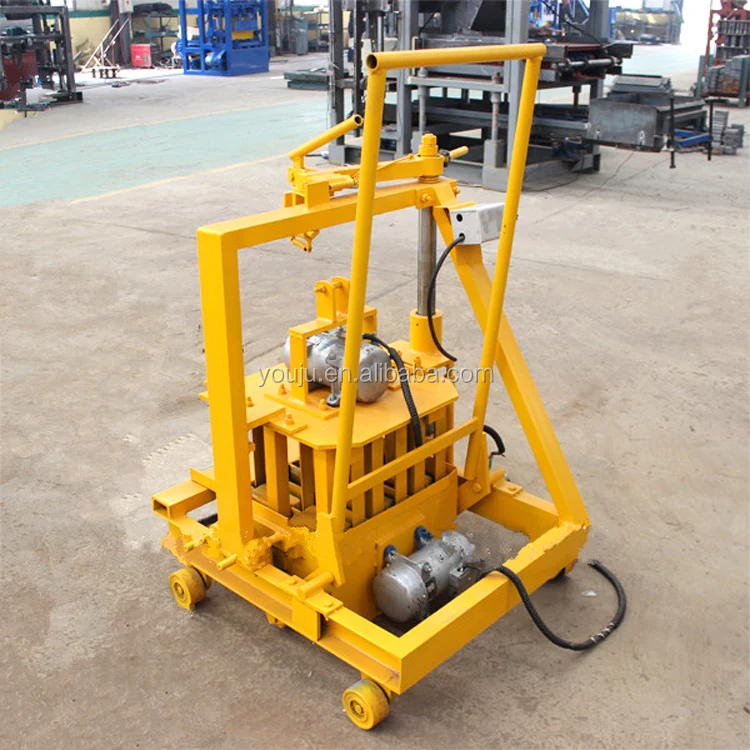
Mould and machine matched to one format list — we configure the QMJ4-45 against your actual block size, local aggregate and target output so every capacity figure on this page is tied to a specific product dimension.
Technical Specifications
| Parameter |
Value |
| Model |
QMJ4-45 |
| Product Type |
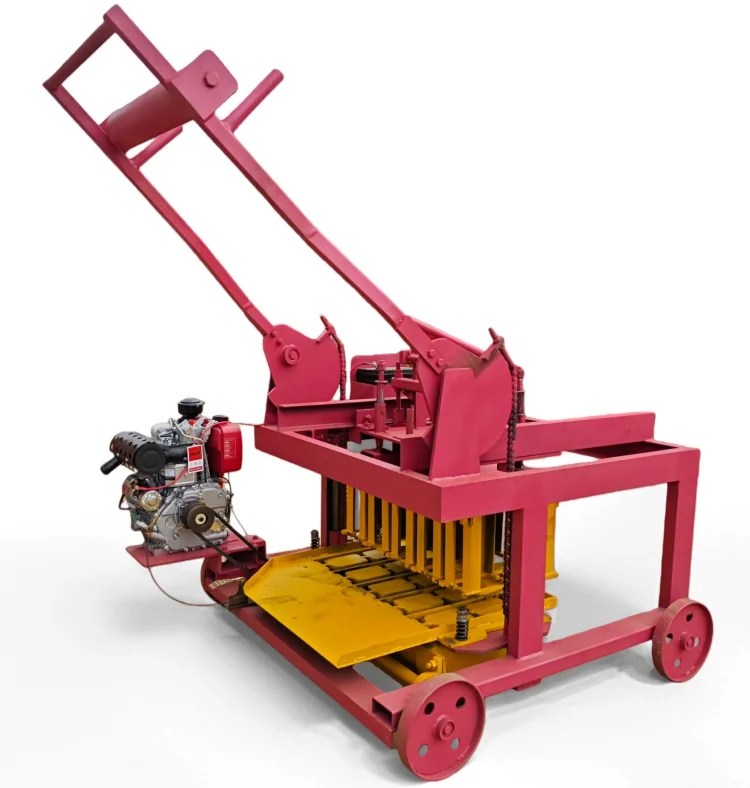
Mobile Egg-Laying Block Making Machine |
| Rated Power |
7.4 kW |
| Molding Cycle |
45 s |
| Output Capacity |
2,400 pcs / 8 h (basis: 400×200×200 mm hollow block, 4 pcs per mould) |
| Output Capacity (alt format) |
3,200 pcs / 8 h (basis: 400×150×200 mm block, 5 pcs per mould) |
| Raw Materials |
Concrete, sand, cement, fly ash, lime, gypsum |
| Net Weight |
1 T |
| Overall Dimensions (L×W×H) |
1550 × 1335 × 1580 mm |
| Pallet Requirement |
No pallets required (egg-laying type) |
| Voltage |
Configured to buyer’s local supply (value to be confirmed) |
| Control System |
Manual force control combined with jog control |
| Guide Mechanism |
Four-pole oriented with ultralong orientation bearing |
| Mould Versatility |
Road blocks, curb stones, hollow bricks and other concrete products via mould change |
| Electrical & Hydraulic Components |
Imported electrical appliances, sealing parts and hydraulic components |
| Automation Level |
Semi-automatic |
| Assembly State |
Skid-mounted mobile unit, no fixed plant required |
Application Suitability
| Application |
Material or Output |
| On-site housing project production |
Hollow blocks from crushed stone, sand and cement directly on the building site |
| Small-scale commercial block yard |
Solid blocks and road pavers from fly ash, lime and gypsum blends |
| First block plant for entrepreneurs |
400×200×200 mm hollow blocks at 2,400 pcs per 8-hour shift |
| Contractor producing curbstones locally |
Curb stones and kerb units from standard concrete mixes via mould change |
| Remote infrastructure sites |
Paving blocks using locally available sand and cement without fixed infrastructure |
Why "2,400 Blocks a Day" Means Nothing Without the Format
Every output figure we quote is tied to a specific block dimension, mould cavity count and cycle time — no format-free capacity claims.
When a mobile egg-laying block machine manufacturer quotes daily capacity without stating which block size it assumes, buyers often discover their real production falls far short once the correct mould is installed. A 400×200×200 mm hollow block at four per mould produces a different volume than a smaller format at five or six per mould, yet both numbers get rounded into the same "daily output" in many quotations [NEED_CITE: capacity calculation methods for concrete block machines]. The QMJ4-45 states 2,400 pieces per 8-hour shift specifically for the standard hollow block format, and 3,200 pieces per 8-hour shift for the 400×150×200 mm alternative. Knowing which figure applies to the product you actually sell prevents costly miscalculations in project planning and material ordering.

Where the Mobile Tier Sits in the Complete Range
The QMJ4-45 is the entry point for buyers who need production capability without committing to a fixed plant layout. It sits below semi-automatic stationary lines that add pallet systems and below fully automatic plants with stacking and cubing. For contractors producing blocks directly on a project site or entrepreneurs funding a first venture with limited capital, this mobile egg-laying block machine manufacturer tier removes the need for pallets, curing racks and a dedicated building footprint. The skid-mounted assembly means the unit can be relocated as project phases shift.
Eliminating the Pallet Cost That Stationary Lines Require
Stationary block machines need pallets for every block in the curing cycle, which multiplies into thousands of pallets for a full day’s output and a corresponding curing-area footprint. The egg-laying design of the QMJ4-45 deposits each block directly onto the ground surface, removing pallet purchase, pallet handling labour and pallet storage from the operating cost entirely [NEED_CITE: pallet cost impact on small block production economics]. For buyers operating on tight project margins or in regions where pallet supply chains are unreliable, this difference affects the total investment calculation more than the machine price itself. The trade-off is that ground flatness and surface preparation become part of the site planning.
Reading the Specs That Actually Shape Daily Output
The 45-second molding cycle governs how many blocks leave the machine per hour, but the cavity count per mould determines how many blocks each cycle produces. At four cavities for the 400×200×200 mm hollow block and five for the 400×150×200 mm format, the same cycle time yields meaningfully different daily volumes. The 7.4 kW rated power reflects the vibration motor and hydraulic pump combined; sites with limited generator capacity need to confirm headroom before adding a mixer and conveyor to the same power source. The four-pole guide mechanism with ultralong orientation bearing controls how precisely the pressure head aligns with the mould cavity on every stroke, which directly affects block density consistency across a production run. Imported sealing parts and hydraulic components reduce the likelihood of pressure loss during extended shifts in dusty site conditions.
The Cost of Skipping the Site Condition Check
Ground flatness, curing space availability and power supply stability are prerequisites that mobile machines cannot compensate for once production starts. A site with uneven compacted soil produces blocks with inconsistent base dimensions, and inadequate curing space forces production stops while earlier output gains strength. Voltage fluctuation on temporary site generators can damage the imported electrical components before the operator notices [NEED_CITE: generator voltage tolerance for construction site equipment]. These are not machine defects but planning gaps, yet they show up as machine reliability complaints. Confirming site conditions before dispatch prevents the situation where the unit arrives and cannot produce acceptable blocks on day one.
What Distinguishes This Mobile Egg-Laying Block Machine Manufacturer
We specify the machine, mould, pallet approach and output as one matched system rather than quoting the press alone. Capacity calculations state the exact block format and mould cavity count assumed, so your daily volume expectation is based on the product you will actually sell. The QMJ4-45 is configured against your local aggregate and mix design — if your sand source differs from the test material, we adjust the vibration parameters before the machine leaves the factory. Mould design covers the formats your market demands, including custom drawings when standard options do not match. Installation support extends to operator training on mould change procedures and daily maintenance routines specific to this model.
Documentation & Verification
- Line layout and capacity calculation stating the block format and mould cavity count assumed for each output figure
- Machine specification sheet with voltage, frequency and control language confirmed before production begins
- Mould drawing and format list showing every block type the QMJ4-45 can produce with your chosen moulds
- Factory test record and packing photographs provided before shipment for your review
Installation, Commissioning & Support
- Site ground preparation guidance matching the 1550 × 1335 mm machine footprint and egg-laying discharge path
- Power supply confirmation for the 7.4 kW rated load on your local voltage and frequency before dispatch
- Skid-mounted delivery state with no fixed foundation required — level compacted ground is sufficient
- First-run commissioning with molding cycle and vibration force adjusted to your confirmed aggregate and mix
- Operator training on manual force control, jog control operation and the four-pole guide inspection routine
- Wear parts list covering hydraulic seals and mould surfaces with recommended replacement intervals
What to Prepare Before Requesting a Quotation
To size the QMJ4-45 correctly for your project, share the specific block formats you need to produce, your target daily output per format, and the local aggregate sources available at your site. Include your power supply voltage and frequency, the language preference for the control panel labelling, and whether you already have a mixer and material feeding arrangement or need those specified alongside the machine. This information allows us to confirm capacity, mould configuration and electrical setup before the quotation is issued.
Frequently Asked Questions
Q: How is the QMJ4-45’s daily output calculated, and which block format does each figure assume?
A: The 2,400 pieces per 8-hour shift figure assumes a 400×200×200 mm hollow block with four cavities per mould at a 45-second cycle. The 3,200 pieces figure assumes a 400×150×200 mm block at five cavities. Both are tied to specific formats, and capacity for other block sizes must be recalculated using the same cycle time and cavity count method.
Q: Where does this mobile egg-laying tier sit compared to semi-automatic and fully automatic lines?
A: The QMJ4-45 sits at the entry of the range, designed for on-site production without a fixed plant. Semi-automatic stationary lines add pallet systems and higher output for dedicated block yards. Fully automatic lines include stacking and cubing for maximum volume. The mobile tier suits contractors and first-time plant owners who need flexibility over maximum throughput.
Q: Which block formats can one QMJ4-45 produce, and how long does a mould change take?
A: The machine handles hollow bricks, road blocks, curb stones and other concrete products through mould changes. Mould change time depends on the operator’s familiarity with the procedure — trained personnel complete the swap within a fraction of a shift, while first-time operators need the supervised training session we provide during commissioning.
Q: What site conditions does this machine need to operate without a fixed plant?
A: The QMJ4-45 requires level, compacted ground for consistent block discharge and curing. Adequate open space is needed for blocks to cure in place since no pallets are used. A stable power supply matching the confirmed voltage and the 7.4 kW load is essential, particularly when running from temporary site generators rather than grid connection.

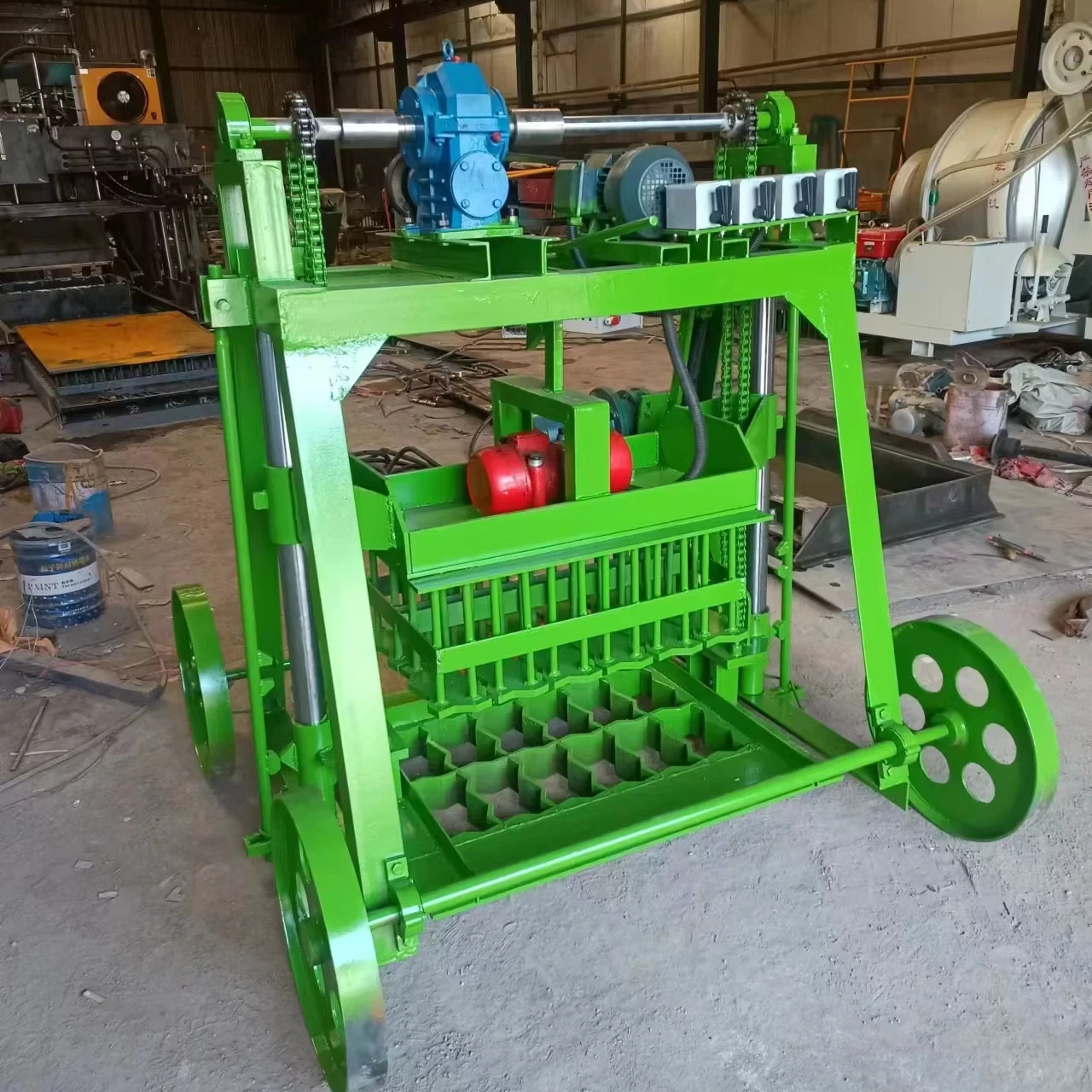
 Mobile block machine