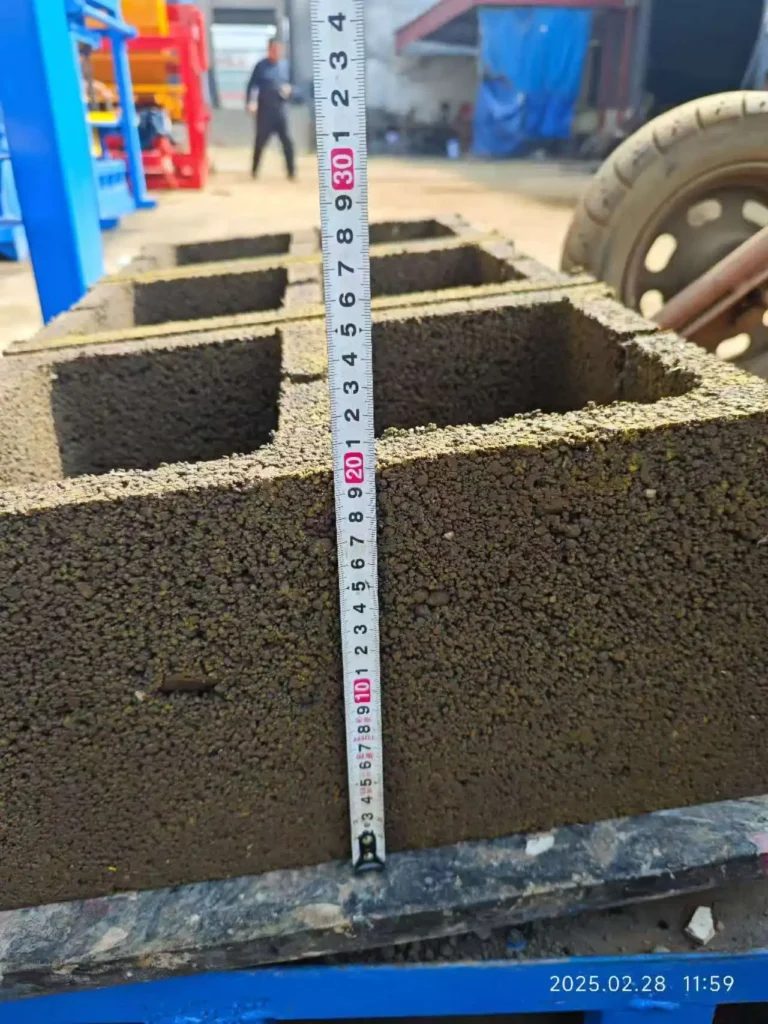
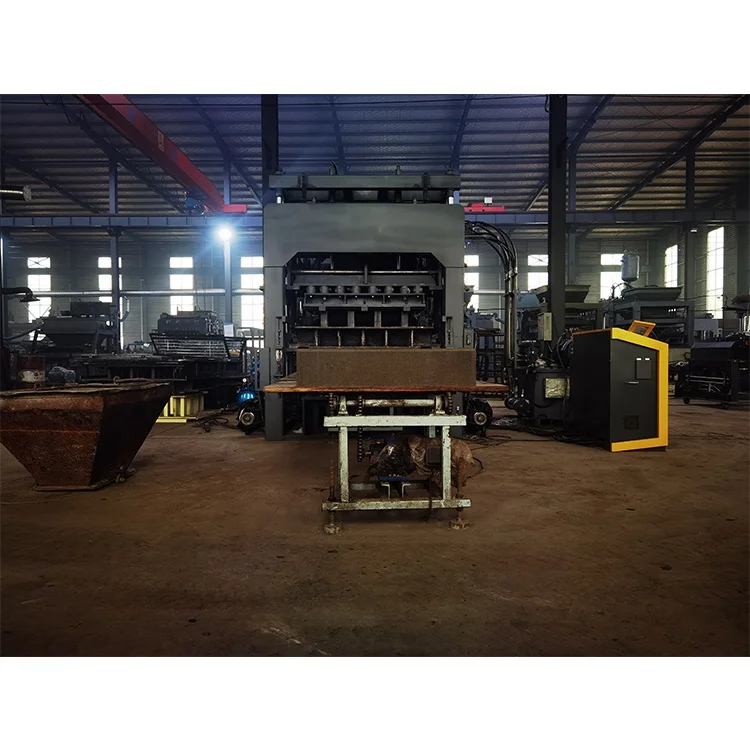
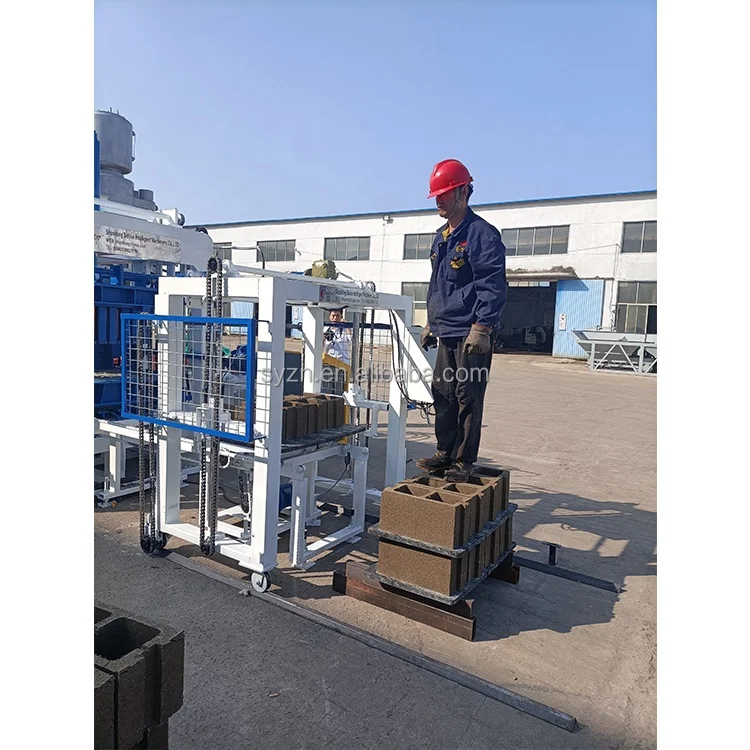
Single-Focus Machinery Engineering — The QTJ4-24 is configured around your actual mix design and local aggregate, not a catalogue default, ensuring block strength matches your market requirements.
Technical Specifications
| Parameter |
Value |
| Model |
QTJ4-24 |
| Product Type |
Semi-Automatic Cement Block Making Machine |
| Overall Dimensions (L×W×H) |
3600 x 1700 x 2560 mm |
| Pallet Size |
850 x 450 mm |
| Molding Cycle |
24–26 s (basis not stated in source — confirm block format / material / thickness) |
| Overall Power |
11.95 kW |
| Vibration Force |
45 kN |
| Total Mass |
2 T |
| Molding Method |
Mechanical |
| Vibrator Configuration |
2 × 3 kW lower vibrators + 2 × 1.5 kW upper vibrators |
| Reducer |
350-type for mold lifting |
| Control System |
PLC controlled with full-automatic spiral material distribution |
| Automation Level |
Semi-automatic |
| Voltage & Frequency |
Configurable (basis to be confirmed with target market) |
| Mould Format |
Configurable for hollow, solid, and paving formats (basis to be confirmed) |
Application Suitability
| Application |
Material or Output |
| On-site construction projects |
Hollow and solid blocks from local cement and river sand |
| Small to medium block plants |
Interlocking bricks and paving bricks from crushed stone aggregate |
| Building material distributors |
Diverse block formats using standard cement, sand, and stone mixes |
| Entrepreneurial first plants |
Reliable daily output for local market supply without high initial investment |
Why "24 Seconds" Doesn’t Tell You the Real Daily Output
A cycle time is only meaningful when tied to the specific block format and mix design you intend to produce.
When buyers look for a semi-automatic block machine for sale, they often see a single cycle time and assume it applies to every block type [NEED_CITE: block machine capacity calculation standards]. In reality, a 24–26 second cycle might apply to a standard hollow block but will differ for denser solid blocks or thinner paving formats. The QTJ4-24 mechanical system delivers consistent vibration, but the actual output depends on your aggregate size, moisture content, and the curing method you employ afterward.

Where the QTJ4-24 Fits in the Shiyue Range
The QTJ4-24 occupies the semi-automatic tier, designed for buyers who need dependable production without the capital outlay of a fully automatic line. This semi-automatic block machine for sale offers manual pallet handling but features full-automatic spiral material distribution to keep the mold cavity filled uniformly. For entrepreneurs launching a first plant or contractors producing blocks on their own project sites, this tier provides a clear entry point with room to grow.
Positioning Within Your Investment and Footprint
Buyers surveying options need to understand plant footprint and labor requirements before committing. The QTJ4-24 requires space for the press, raw material storage, a curing area sized to your pallet dimensions, and manual stacking zones. Compared to mobile egg-laying machines, this stationary unit delivers higher consistency; compared to high-capacity automatic lines, it demands more hands-on pallet handling but keeps initial investment manageable [NEED_CITE: block plant layout and investment tiers].
Vibration Force and Reducer Durability in Daily Production
The 45 kN vibration force comes from a dual-level system: two 3 kW lower vibrators and two 1.5 kW upper vibrators working in concert. This configuration compacts the mix from both directions, which is critical when working with varying aggregate sizes or higher cement ratios. The 350-type reducer handles mold lifting duties, a mechanical choice that extends service life under continuous cycling. The 11.95 kW overall power draw reflects the mechanical molding approach rather than hydraulic systems, making electrical requirements simpler for sites with limited transformer capacity.
The Cost of Ignoring Local Aggregate Compatibility
Machines configured for a standard mix that a buyer cannot source locally force costly material substitutions or compromise block strength. If your region relies on high-clay river sand or coarse crushed stone, the vibration force and cycle time must be adjusted accordingly [NEED_CITE: effect of aggregate type on block compressive strength]. A machine that ignores these variables will produce inconsistent density, leading to rejected batches and damaged reputation in your market.
Why Procurement Here Differs from Catalogue Shopping
Block machinery remains the single focus, so the QTJ4-24 is specified alongside compatible pallets, molds, and handling equipment as one matched system. Configuration decisions are made against your actual mix design and target block format rather than default settings. Mould design covers the formats your market actually sells, including custom drawings when standard options fall short. Automation level is selectable, allowing you to start semi-automatic and plan an upgrade path. Installation support includes operator training so your team understands parameter adjustment from day one.
Documentation & Verification
- Line layout showing the QTJ4-24 position relative to curing area and pallet flow
- Capacity calculation stating the exact block format and mix assumed for the 24–26 s cycle
- Machine specification sheet confirming 850 x 450 mm pallet size and 45 kN vibration force
- Voltage and PLC display language confirmation matched to your site before shipment
- Mould drawing and format list for every block type included in your order
- Wear parts list identifying replacement intervals for vibrator mounts and reducer components
Installation, Commissioning & Support
- Foundation requirements based on the 2 T total mass and 3600 x 1700 mm footprint
- Electrical supply matching the 11.95 kW overall power with dedicated circuit protection
- Assembly of the upper and lower vibrator sets and 350-type reducer on-site
- PLC control language set to operator preference before commissioning begins
- Training on mold change procedures and vibration adjustment for different block formats
- Wear parts supply plan covering reducer maintenance and vibrator bearing replacement
What We Need to Configure Your Line
To specify the QTJ4-24 correctly for your operation, provide the block formats your market demands, the local aggregate type and source, and your available curing area dimensions. Confirm your site voltage and frequency along with the preferred PLC display language. If you have existing pallets or forklifts, share their specifications so pallet sizing aligns with your current handling equipment.
Frequently Asked Questions
Q: Where does the QTJ4-24 sit compared to Shiyue’s automatic and mobile tiers?
A: The QTJ4-24 is a stationary semi-automatic machine positioned between mobile egg-laying units and fully automatic lines. It requires manual pallet handling but offers full-automatic material distribution. Buyers choose this tier when they need consistent block quality with lower initial investment than automatic stacking and cubing systems.
Q: What block formats can this machine produce and what is the realistic daily output per format?
A: The QTJ4-24 produces hollow blocks, solid blocks, interlocking bricks, and paving bricks using interchangeable molds. The stated 24–26 second cycle requires confirmation based on your specific block format and material mix. Realistic daily output depends on pallet handling speed, curing logistics, and shift length.
Q: What is the plant footprint and investment level for a semi-automatic setup?
A: The machine itself measures 3600 x 1700 x 2560 mm, but total footprint includes raw material storage, curing racks sized for 850 x 450 mm pallets, and manual stacking zones. Investment remains lower than automatic lines because stacking and pallet return systems are handled manually rather than through automated conveyors.
Q: Can I start with the QTJ4-24 and upgrade to higher automation later?
A: The PLC control system allows for future integration of automatic pallet feeding and stacking equipment. Buyers often begin with semi-automatic operation to manage initial investment, then add automation modules as production volume justifies the upgrade. The mechanical core remains the same; automation layers are added around it.
Q: What voltage, frequency and control language options are available for my market?
A: Voltage and frequency are configured to match your site supply before production. The PLC display language is confirmed during the order process to ensure operators can read error messages and parameter settings. These details are locked in before shipment to avoid commissioning delays upon arrival.

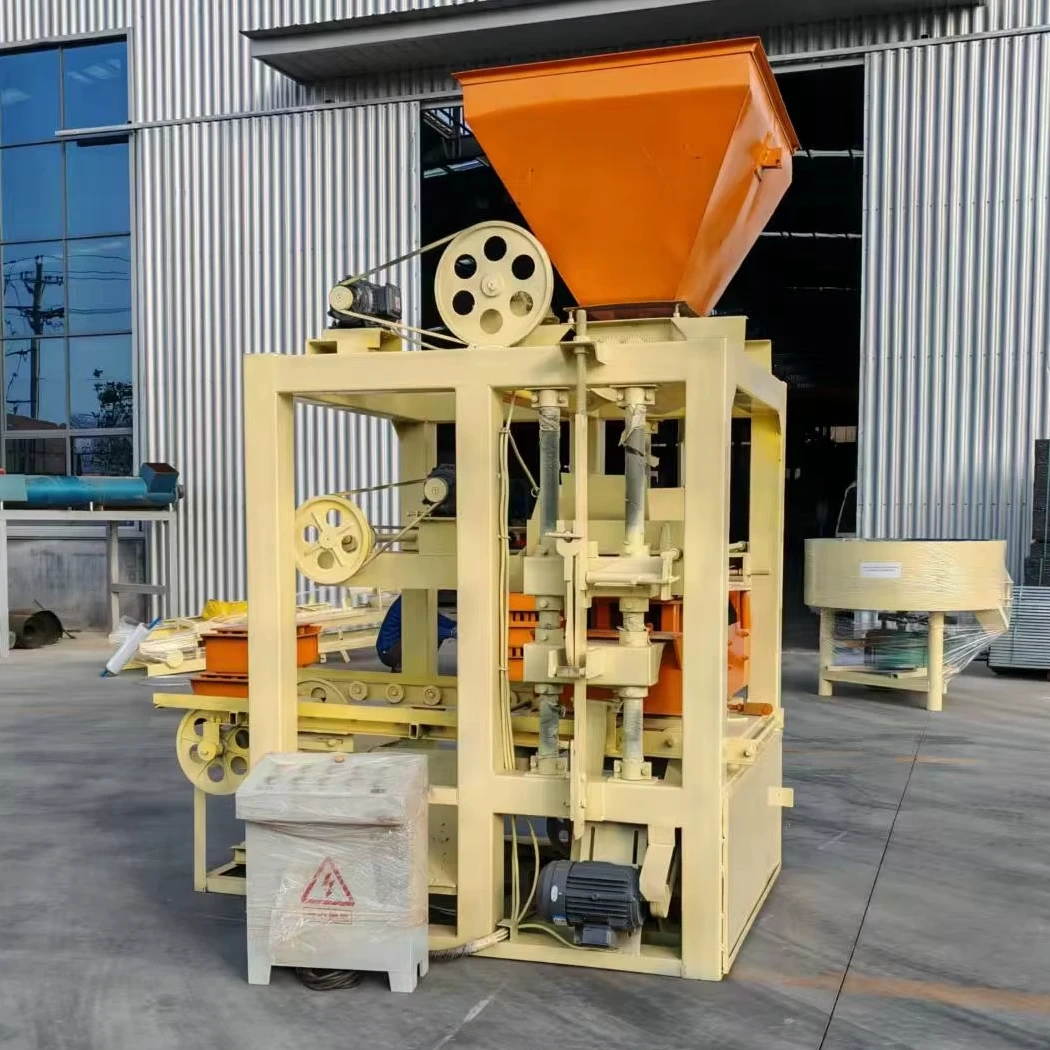
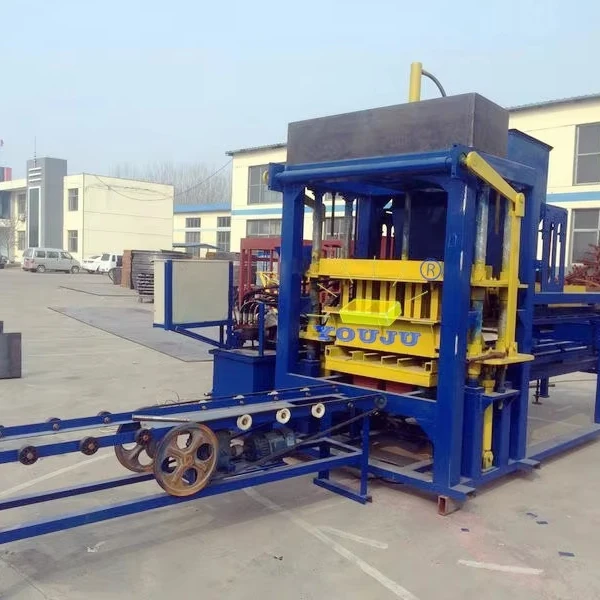 Stationary block machine