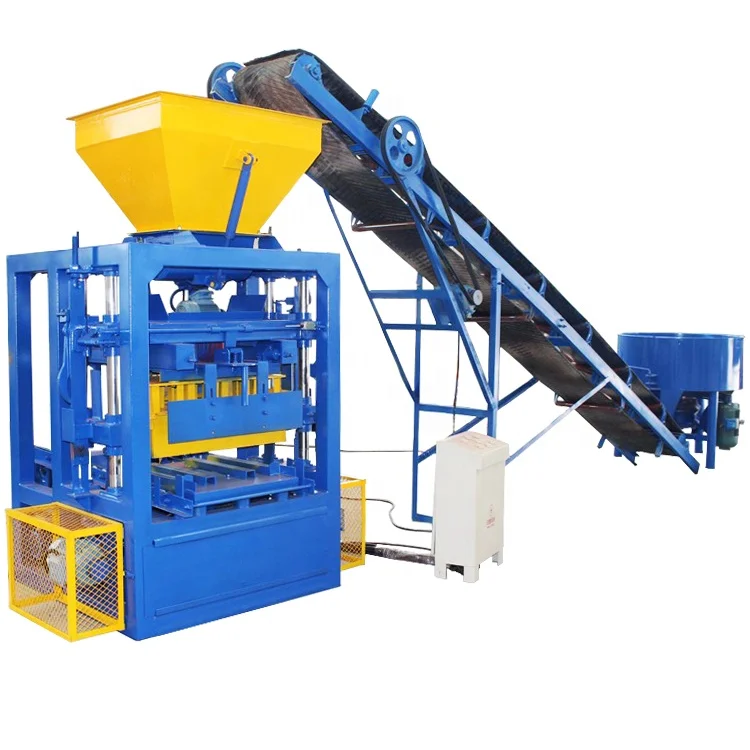
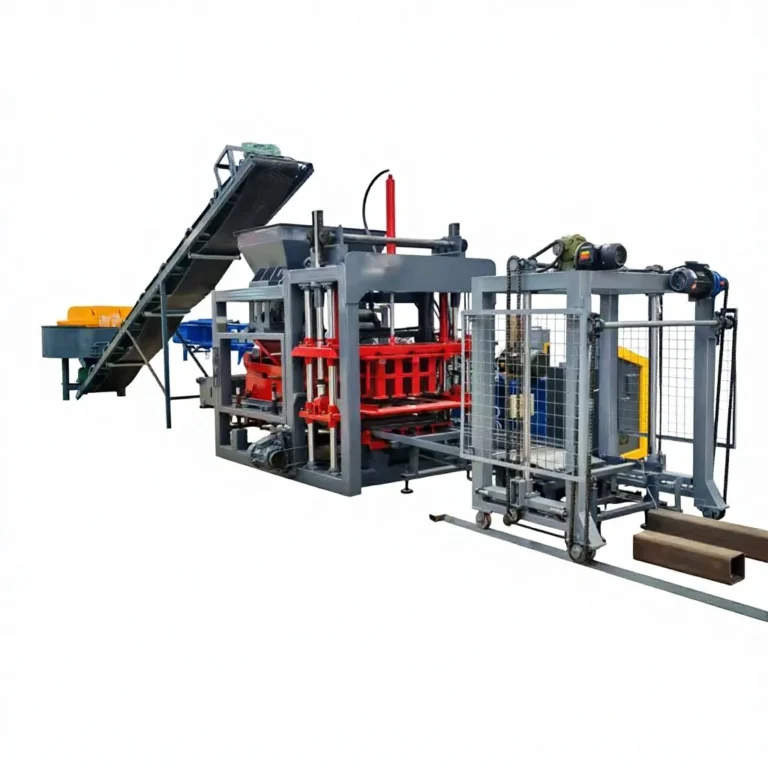
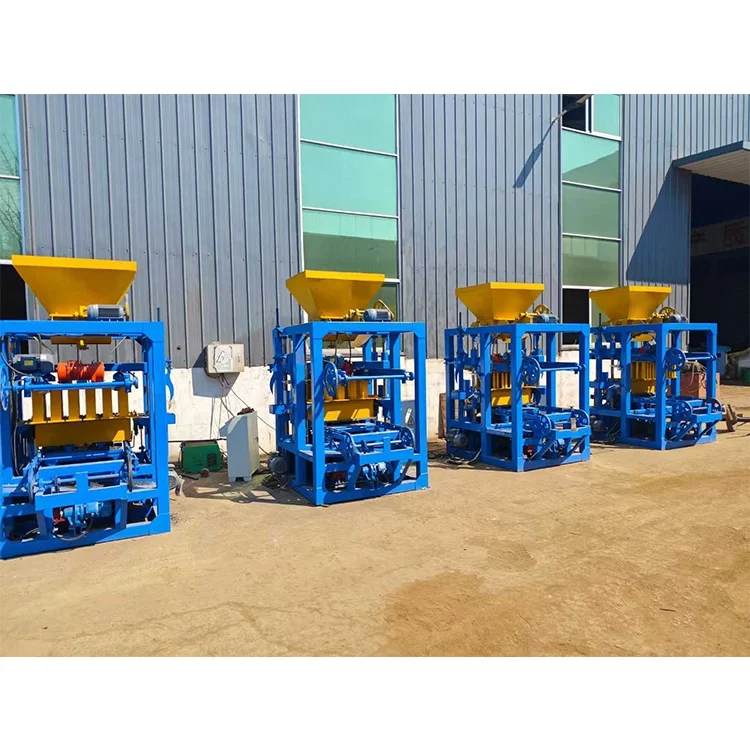
Specified as one matched system — the QTJ4-24 is configured with press, mould, pallet and handling together against your block format and local aggregate, so you know what arrives on site will actually run.
Technical Specifications
| Parameter |
Value |
| Product Type |
Concrete Block Making Machine |
| Model |
QTJ4-24 |
| Overall Dimensions (L×W×H) |
2060×1700×2650 mm |
| Rated Exiting Force |
35.5 kN |
| Main Vibration Form |
Platform Vibration |
| Vibration Frequency |
4200 r/min |
| Pallet Size |
900×450 mm |
| Molding Cycle |
24 s (basis not stated in source — confirm block format / material / thickness) |
| Overall Power |
11.95 kW |
| Total Mass |
2000 kg |
| Demolding Method |
Vibration |
| Factory Area |
260 m² |
| Applied Products |
Concrete blocks, hollow/solid blocks, pavers, interlocking blocks, curbstone, colored pavers |
| Raw Material |
Crushed stone, sand, cement, dust, fly ash, gravel, slag |
| Automation Level |
Semi-automatic |
| Stacking Method |
Manual pallet handling |
| Warranty |
1 year (whole machine, excluding spare parts) |
Application Suitability
| Application |
Material or Output |
| Hollow block production for residential wall construction |
Crushed stone, sand, cement and fly ash |
| Solid block production for load-bearing structures |
Gravel, sand, cement and slag |
| Paving block and colored paver runs for driveways and walkways |
Fine aggregate with cement and pigment |
| Interlocking brick and curbstone for municipal projects |
Coarse aggregate blended with cement |
| On-site block production for housing developments |
Locally sourced aggregate and cement |
What "24 Seconds Per Cycle" Actually Means for Your Output
The cycle number only becomes useful once it is tied to the specific block format you intend to produce.
Many buyers see a concrete block making machine for sale with a cycle time listed and assume they can divide the workday by that number to get their daily output. On a job site in Jordan, I watched a contractor plan an entire crew schedule around a quoted cycles-per-hour figure — only to discover that the figure assumed a small solid block, while the hollow blocks he actually needed to produce took considerably longer per cycle because of the deeper draw and heavier fill. The entire project timeline shifted. [NEED_CITE: realistic capacity calculation methods for block production lines] The QTJ4-24 lists a 24-second molding cycle, but that number must be validated against your target block size, wall thickness, and mix design before it can be used for planning.

Where the QTJ4-24 Sits in a Block Plant Range
The QTJ4-24 occupies the semi-automatic tier of the block machine manufacturer range, designed for buyers who need dependable pressing capacity without the investment of a fully automated line. This block making machine pairs platform vibration at 4200 r/min with a 35.5 kN rated exiting force, meaning the compaction energy is delivered through the pallet into the mould cavity from below. For a first-time plant owner or a contractor producing blocks on a development site, this configuration keeps the capital outlay contained while leaving room to add automation stations later.
Matching the Machine to Your Site Before It Ships
A concrete block making machine for sale at this tier requires the buyer to think through the supporting elements — curing space, pallet handling, and electrical supply — before the press itself is finalized. The 900×450 mm pallet must align with whatever forklift and curing racks are already on site, and the 11.95 kW total power draw must match the available supply voltage and frequency. I have seen entire commissioning schedules derailed because the motor was wound for a different voltage standard than what the local grid delivered. [NEED_CITE: voltage and frequency standards by export market] Confirming these details during the quotation stage prevents the machine from sitting idle after arrival.
How Vibration Force and Pressure Shape Block Density
The 4200 r/min platform vibration and 35.5 kN exiting force work together to compact the raw material inside the mould. Higher vibration frequency helps the mix settle into corners and thin-wall sections of the mould, while the rated exiting force determines how tightly the aggregate particles are pressed together. If the vibration force is too low for a given mix design — say, a coarse gravel blend with low fines content — the resulting block may have inconsistent density and lower compressive strength. The QTJ4-24 platform vibration system delivers compaction from below the pallet, which suits hollow and solid block formats where uniform fill across the mould cavity matters. Different local aggregates respond differently to the same vibration profile, so matching the machine settings to your specific sand, crushed stone, or fly ash blend is part of the configuration process.
The Cost of Overlooking Configuration Details
When the pallet size does not match the curing area, blocks end up stacked by hand on the floor, slowing down the entire production rhythm. When the voltage and frequency are confirmed only after the machine arrives, replacement contactors and rewound motors add weeks of downtime. A block machine manufacturer who ships a standard configuration without checking these site-specific parameters leaves the buyer to solve problems that should have been addressed before production. [NEED_CITE: common commissioning delays in block production equipment] The hidden cost is not the part itself but the idle crew, the missed delivery deadlines, and the lost confidence from the buyer’s own customers.
Why Source This QTJ4-24 Through a Matched-System Approach
The press, mould, pallet, and handling equipment are specified as one system rather than assembled from separate suppliers, which means the pallet dimensions, mould cavity depth, and vibration profile are checked against each other before the line is built. Configuration is set against the buyer’s actual mix design and target block format, not a catalogue default, so the 24-second cycle is validated for your specific product. Mould design covers hollow, solid, paving, interlocking, and curbstone formats, with custom mould engineering available to buyer drawings. The automation level is selectable — starting semi-automatic with manual pallet handling and upgrading stacking stations later — so the investment can grow with production volume. Installation support includes operator training on the specific formats the plant will run.
Documentation & Verification
- Line layout with capacity calculation stating the assumed block format for the QTJ4-24
- Machine specification sheet confirming voltage, frequency, and control language before production
- Mould drawing and format list matching your local market product requirements
- Pallet specification cross-referenced with your curing area and forklift capacity
- Factory test record on your target block format before dispatch
- CE declaration documentation where applicable to your import market
Installation, Commissioning & Support
- Foundation pad leveled within tolerance across the 2060×1700 mm footprint of the QTJ4-24
- Dedicated electrical circuit rated for 11.95 kW with confirmed voltage and frequency
- Machine dismantled for container loading and reassembled on site with alignment checks
- First-run commissioning with mould fill and vibration settings adjusted to your aggregate
- Operator training covering mould change procedure and daily maintenance routines
- Wear parts list and mould inventory provided for the formats in production
What to Prepare Before Requesting a Quotation
To configure a concrete block making machine for sale at this tier, share your target block formats with dimensions, the daily output you need per format, and the local raw materials available — including aggregate type and cement grade. Confirm the site voltage and frequency, the PLC display language your operators require, and the dimensions of your existing curing area and handling equipment. If you have an existing forklift or pallet racking system, provide those specifications so the pallet size can be matched accordingly.
Frequently Asked Questions
Q: How is the 24-second cycle time converted to realistic daily output for my specific block format?
A: The 24-second cycle is a mould cycle figure that must be validated against your target block dimensions, wall thickness, and mix design. Realistic daily output is calculated by multiplying confirmed cycles per hour by the number of blocks per pallet, then adjusting for loading, demoulding, and pallet return time. Request a capacity calculation that states the assumed block format so you can plan production accurately.
Q: What voltage, frequency, and control language options are available for my target market?
A: Voltage and frequency must be confirmed before production to match your local grid standard, whether 380V/50Hz, 440V/60Hz, or another configuration. The control panel language is set to your operator’s preference. Providing your site’s electrical specification during the quotation stage ensures the motor, contactors, and hydraulic pump rotation are all correct on arrival.
Q: Which automation level does the QTJ4-24 offer, and can I add automatic stacking later?
A: The QTJ4-24 is configured as a semi-automatic machine with manual pallet handling as standard. The line layout can be designed so that automatic pallet feeding, stacking, and cubing stations are added later without replacing the press itself. This allows you to start production at a lower investment level and increase automation as volume grows.
Q: How do I confirm the pallet size matches my existing curing racks and forklift?
A: The standard pallet size is 900×450 mm. Before finalizing the order, provide the dimensions of your curing racks and the fork width and load capacity of your forklift. This ensures the loaded pallets can be moved and stored without modification to your existing handling infrastructure.
Q: What mould formats are included, and can I order custom moulds to my own drawings?
A: The QTJ4-24 supports moulds for hollow blocks, solid blocks, pavers, interlocking bricks, and curbstone. Standard format moulds are available from the block machine manufacturer catalogue, and custom mould design is available to buyer-provided drawings. Share your target product dimensions and local market requirements so the mould cavities and draw depth are engineered accordingly.

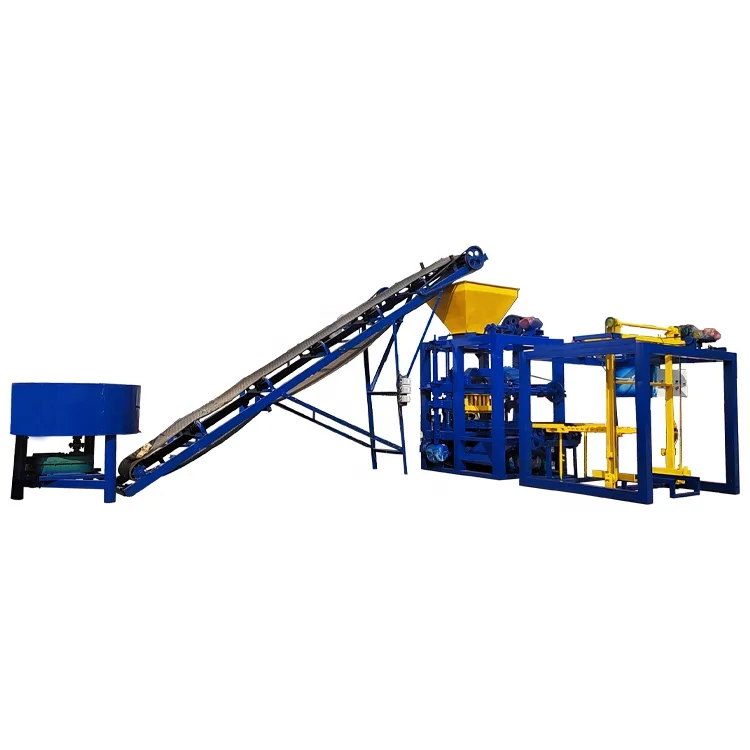
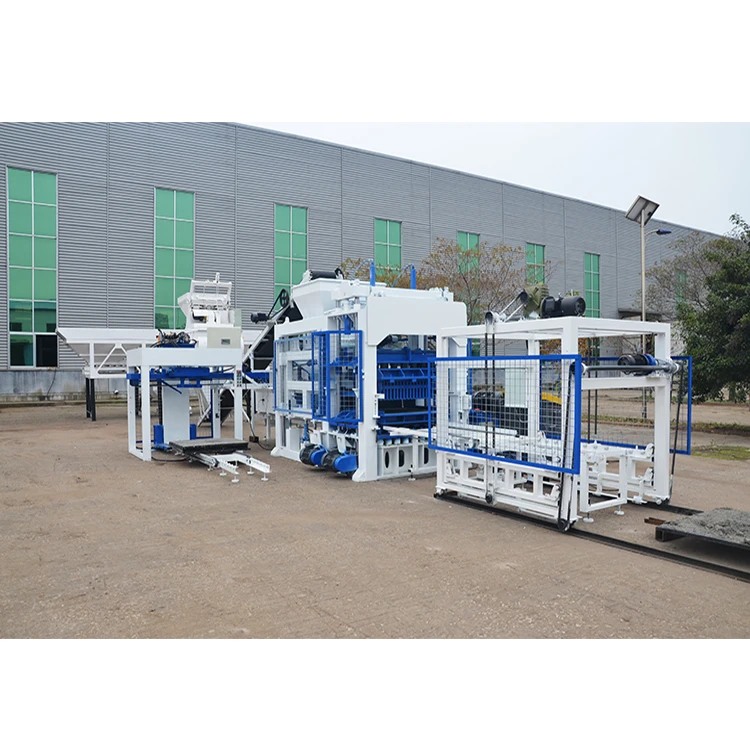 High quality block machine