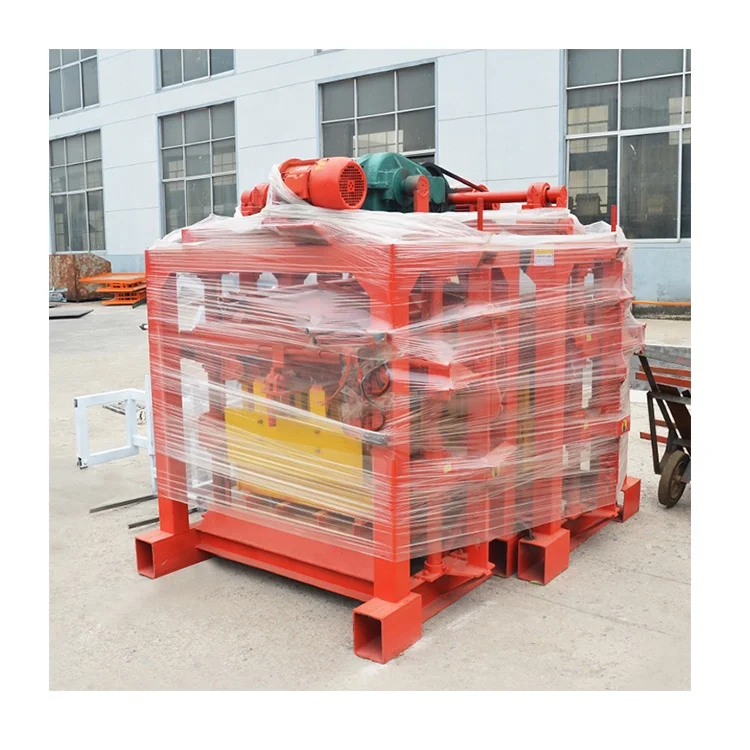
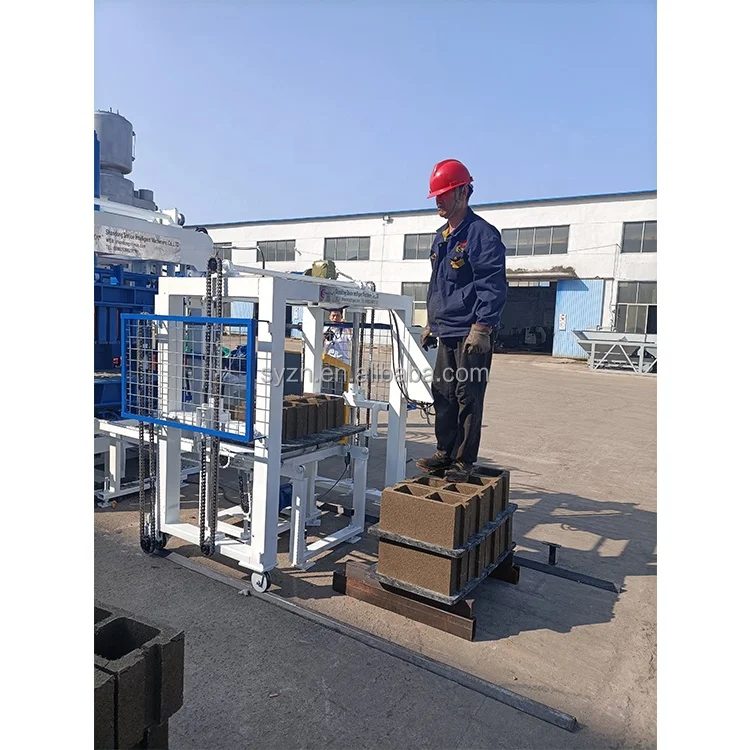
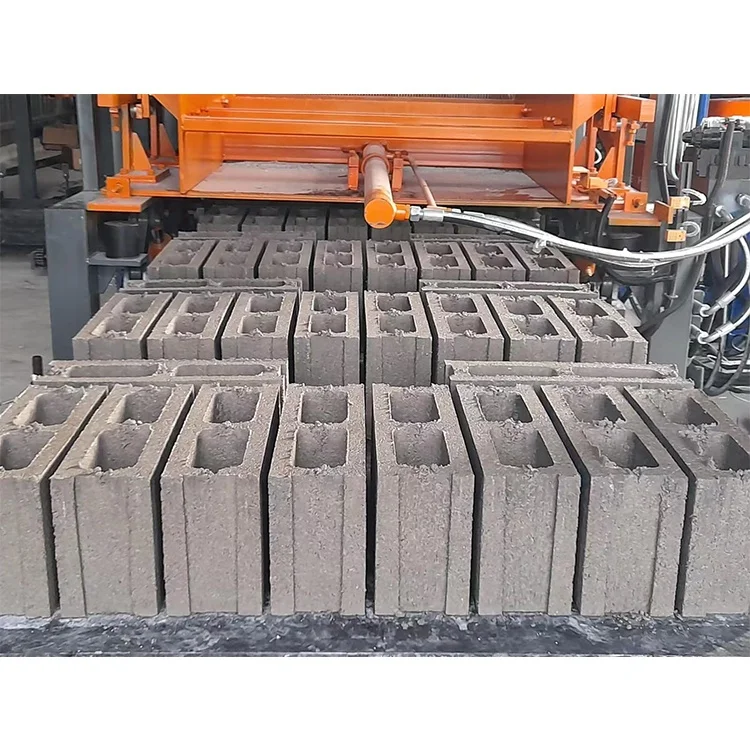
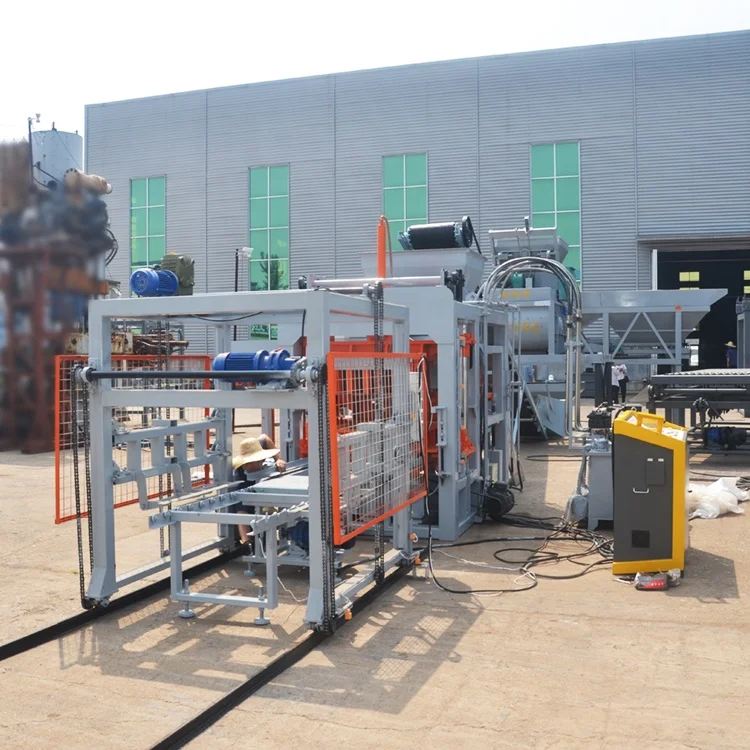
Integrated Line Configuration — The QT8-15 block machine, pallet system and hydraulic handling equipment are specified together as a matched production setup, not sourced separately.
Technical Specifications
| Parameter |
Value |
| Model |
QT8-15 |
| Product Type |
Automatic Cement Interlocking Block Making Machine |
| Host Machine Dimensions |
5870 × 2220 × 2850 mm |
| Host Machine Weight |
10,000 kg |
| Molding Area |
950 × 900 mm |
| Pallet Size |
950 × 900 × 25 mm |
| Vibration Force |
100 kN |
| Vibration Frequency |
2800–4500 times/min |
| Vibration Method |
Hydraulic + Platform Vibration |
| Host Machine Power |
47 kW |
| Molding Period |
15 seconds (basis to be confirmed per block format) |
| Control System |
Siemens PLC with proprietary control program |
| Motor |
Germany SIEMENS or CE standard equivalent |
| Travel Switch |
France Schneider / Japan Omron |
| Mould Hardness |
54–58 HRC (heat treatment + carburizing) |
| Welding |
CO₂ protection welding, CE standard materials |
| Voltage |
220 / 380 / 415 / 440V (customized to site) |
| Grouped Equipment |
PLD1200 Batching Machine, JS750 Concrete Mixer, Pallet Feeder, Brick Receiver, Hydraulic Station, Conveyor Belt, Hydraulic Trolley, SY-8 Stacker |
| Automation Level |
Automatic |
| Certification |
CE |
Application Suitability
| Application |
Material or Output |
| Hollow block production |
Crushed stone, sand, cement, water |
| Interlocking brick production |
Laterite soil blends, cement stabilizer |
| Paving brick manufacturing |
Granite dust, fine aggregate, cement |
| Solid block for load-bearing walls |
Coarse aggregate, Portland cement |
| On-site production for housing projects |
Locally sourced sand and stone dust |
What "15 Seconds per Cycle" Leaves Out in Automatic Block Making Machine Specs
Cycle time only means something when tied to a specific block format, pallet size and material recipe.
Most automatic block making machine manufacturer quotes list cycles per hour without revealing which block size was used for that calculation. A 15-second cycle on a thin paving brick is very different from the same cycle on a 200 mm hollow block. When the format changes, the vibration duration, hydraulic pressure dwell and material fill depth all shift — and so does the actual daily output [NEED_CITE: block format impact on realistic daily output calculations]. A buyer who does not ask this question before signing will find the machine running slower than expected on their primary product.

Where the QT8-15 Sits Across the Complete Block Machine Range
The SHIYUE range spans from mobile egg-laying machines for on-site contractors through semi-automatic workshop setups to high-capacity fully automatic lines. The QT8-15 occupies the upper-mid automatic tier as a proven automatic block making machine manufacturer solution for buyers who have outgrown semi-automatic output but are not yet ready for the highest-capacity presses. It requires a defined workshop of roughly 200 m² plus curing yard, a dedicated power supply, and a pallet circulation system that the semi-automatic and mobile tiers do not demand.
Comparing Investment Tiers: Automatic, Semi-Automatic and Mobile
Choosing between tiers is not simply about budget. A mobile egg-laying machine eliminates pallet costs and curing racks but limits the buyer to solid blocks and restricts format variety. A semi-automatic line reduces capital outlay but demands manual pallet handling, which caps realistic daily throughput and increases labor dependency. The QT8-15 automatic configuration includes the SY-8 stacker and hydraulic trolley, removing the heaviest manual tasks from the operator [NEED_CITE: labor configuration differences across block machine automation tiers]. The right tier depends on the buyer’s daily volume target, available curing area, and local labor conditions rather than a simple price comparison.
Vibration Force, Hydraulic Pressure and Mould Life Under Production Conditions
The 100 kN vibration force works together with the hydraulic clamping pressure to compact the concrete mix into the mould cavity. If vibration frequency stays fixed while the aggregate gradation changes, block density becomes inconsistent from batch to batch — which is why the QT8-15 allows frequency adjustment from 2800 to 4500 times per minute. The moulds are carburized to 54–58 HRC, a hardness range that resists abrasive wear from stone dust and sand over tens of thousands of cycles. Pallet size of 950 × 900 mm must match the curing racks and forklift the buyer already has on site; a mismatch here causes bottlenecks in the yard rather than at the press itself.
The Hidden Cost of Selecting the Wrong Automation Tier
A buyer who chooses a semi-automatic configuration to save capital may find that pallet handling labor and inconsistent stacking quality erode the margin on every block produced. Conversely, specifying a high-capacity automatic line for a market that only absorbs small daily volumes leaves expensive equipment sitting idle. When the pallet handling and stacking system is excluded from the quotation, the press keeps producing but blocks pile up unstacked at the discharge end [NEED_CITE: incomplete block line configuration causing manual handling bottlenecks]. These mismatches become visible only after the machine is installed and running.
Why Source the QT8-15 Through SHIYUE
Block machinery is the sole focus of the SHIYUE product range, so the QT8-15 press, pallets, moulds and SY-8 stacker are specified as one matched system. The configuration is set against the buyer’s actual mix design and local aggregate rather than pulled from a standard catalogue. Mould design covers the specific block formats that sell in the buyer’s regional market, including custom drawings when standard formats do not match local demand. Automation level is selectable, meaning a buyer can commission the QT8-15 in semi-automatic mode and add automatic stacking later as volume grows. Voltage, frequency and PLC display language are confirmed before production begins, not discovered after the container arrives.
Documentation & Verification
- Line layout drawing with capacity calculation stated per block format and pallet size
- Machine specification sheet confirming voltage, frequency and PLC display language
- Mould drawing and format list showing all block types covered by the quoted moulds
- Factory test record on the buyer’s specified block format before dispatch
- Hydraulic and electrical schematic for local maintenance reference
- Operation manual translated to the buyer’s preferred language
Installation, Commissioning & Support
- Foundation plan based on the 5870 × 2220 mm host machine footprint and 10-ton operating weight
- Dedicated power circuit sized for the 47 kW host machine plus batching and mixing loads
- Dismantling sequence for container loading documented before shipment
- On-site commissioning with vibration frequency and hydraulic pressure adjusted to local aggregate
- Operator training covering mould change, PLC fault diagnosis and daily maintenance routines
- Wear parts list with mould hardness specification for local sourcing verification
Requesting a Configuration Proposal
Buyers evaluating the QT8-15 should share their target block formats with dimensions, required daily output per format, local raw material type and gradation, available workshop footprint, and site voltage and frequency. Confirming the PLC display language and control system preferences early prevents commissioning delays. If the buyer already operates curing racks or forklifts, sharing pallet dimensions ensures the quoted pallet size integrates with existing yard equipment.
Frequently Asked Questions
Q: Where does the QT8-15 sit compared to semi-automatic and mobile block machines?
A: The QT8-15 is the upper-mid automatic tier, requiring a defined workshop and pallet circulation system. Semi-automatic machines cost less upfront but depend on manual pallet handling. Mobile egg-laying machines eliminate pallets entirely but restrict format variety. The right tier depends on daily volume targets, curing yard capacity, and whether the buyer needs multiple block formats from one press.
Q: What plant footprint and investment does each output tier require?
A: Mobile machines need only a flat concrete slab. Semi-automatic lines typically fit within a smaller workshop with a basic curing yard. The QT8-15 automatic tier requires approximately 200 m² of workshop space plus room for pallet circulation, curing racks and the SY-8 stacking area. Each tier also differs in power supply requirements, with automatic lines demanding higher connected load capacity.
Q: How is daily output calculated per block format?
A: The 15-second molding cycle listed in specifications is a baseline figure that changes depending on the block format, material fill depth and vibration duration required. A thin paving brick cycles faster than a deep hollow block. SHIYUE provides a capacity calculation that states the specific block format and pallet size assumed, so the buyer can compare quoted output against realistic production conditions.
Q: Can I start semi-automatic and upgrade later?
A: Yes. The QT8-15 configuration allows a buyer to commission the press with manual pallet handling initially and add the automatic pallet feeder, stacker and hydraulic trolley as production volume justifies the investment. The PLC control system and host machine remain unchanged — only the peripheral handling stations are added to the line.
Q: What voltage and PLC language options are confirmed before shipment?
A: Voltage is configurable across 220V, 380V, 415V and 440V systems to match the buyer’s local grid. Frequency and PLC display language are confirmed during the order process so that the Siemens control interface arrives in the operator’s working language. This prevents commissioning delays that occur when voltage or language mismatches are only discovered after the machine reaches the site.

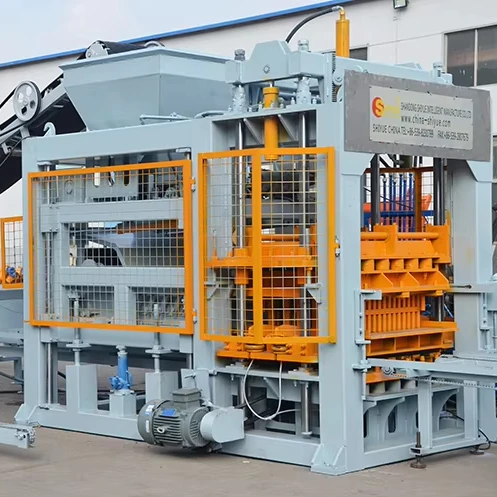
 High quality block machine