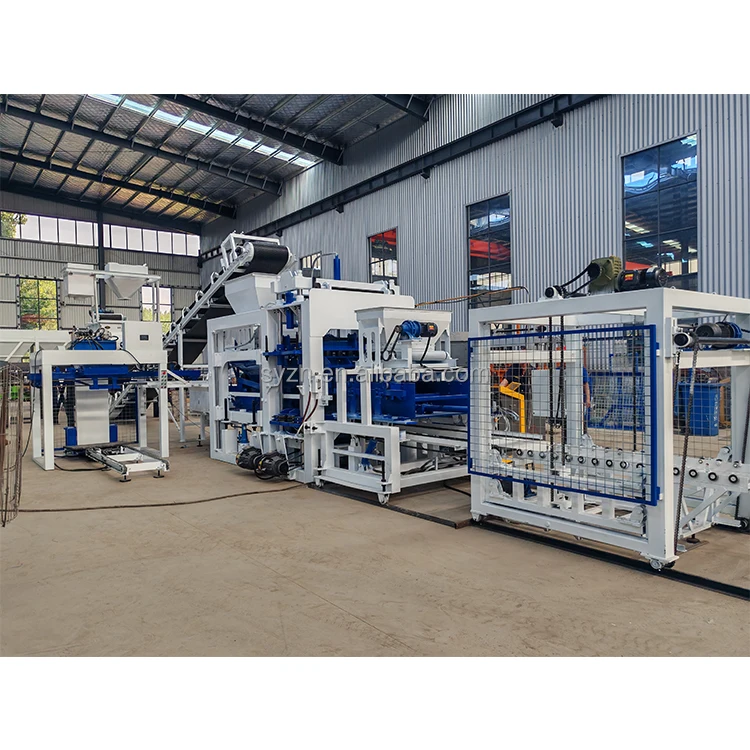
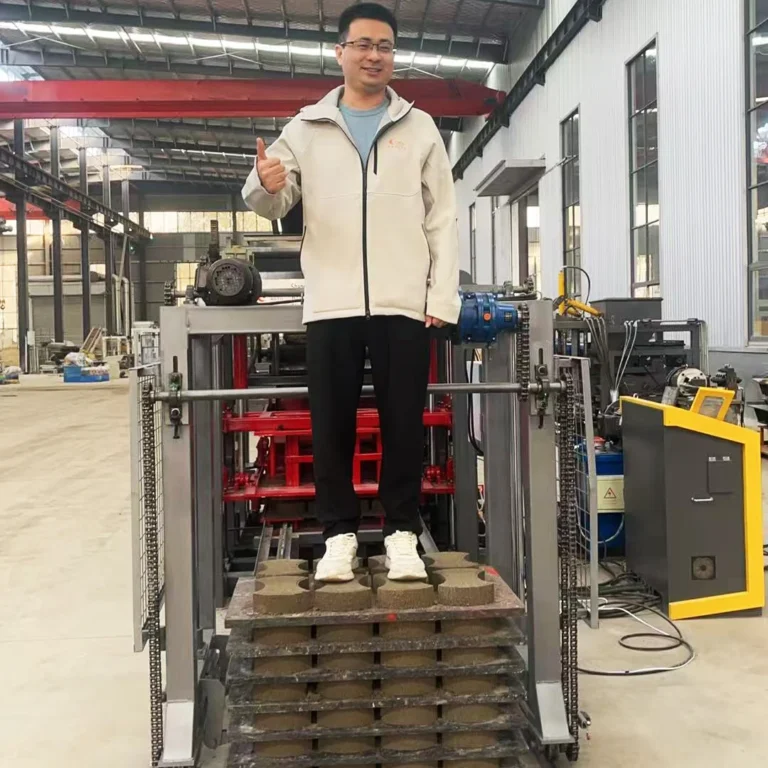
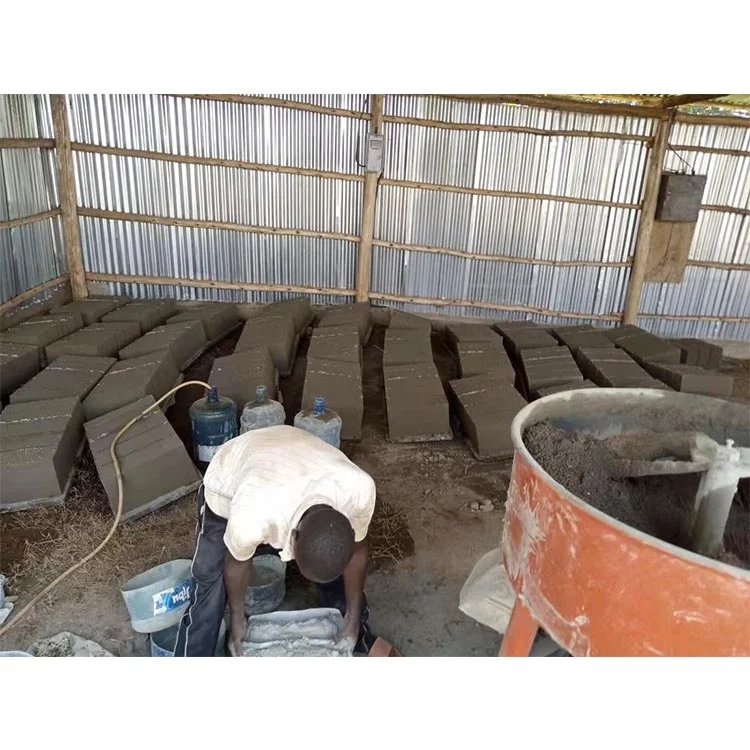
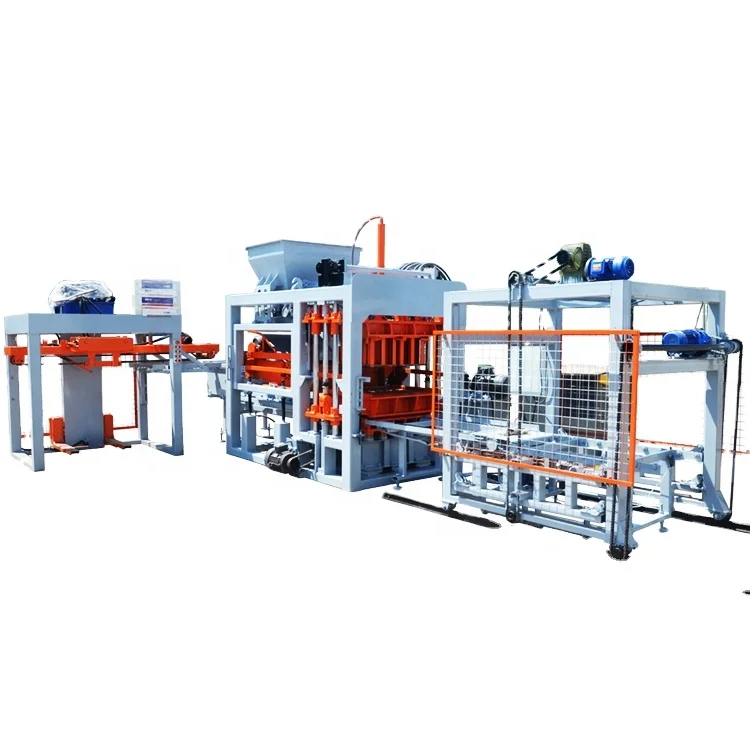
Matched System Design — the QT6-15 block making machine for sale is specified with its mould, pallet, and handling equipment as one coordinated line rather than a standalone press.
Technical Specifications
| Parameter |
Value |
| Model |
QT6-15 |
| Product Type |
Hydraulic Concrete Block Making Machine |
| Overall Dimensions (L×W×H) |
7400×1900×2660 mm |
| Total Weight |
7 T |
| Molding Cycle |
15–25 s |
| Vibration Frequency |
4600 r/min |
| Vibration Force (Exciting Power) |
40–50 kN |
| Total Power |
31.25 kW |
| Mixer Model |
JQ350 |
| Pallet Size |
850×550×25 mm |
| Control System |
PLC control system |
| Hydraulic Station |
High-pressure hydraulic system included |
| Included Equipment |
Block making machine, hydraulic station, PLC control system, pallet feeder, brick conveyor, block sweeper |
| Free Accessories |
Manual hydraulic trolley, spare parts and tools |
| Applicable Products |
Paver, solid block, hollow block, curbstone |
| Raw Materials |
Crushed stone, sand, cement, dust, fly ash |
| Output Capacity (Hollow Block 400×200×200 mm) |
1200–1680 pcs/h, 9600–13440 pcs/8 hr |
| Output Capacity (Hollow Block 400×150×200 mm) |
1800–2400 pcs/h, 14400–19200 pcs/8 hr |
| Output Capacity (Solid Brick 240×115×53 mm) |
3240 pcs/h, 16200–19440 pcs/8 hr |
| Voltage & Frequency |
To be confirmed with buyer’s local supply |
| PLC Display Language |
To be confirmed before production |
Application Suitability
| Application |
Material or Output |
| Hollow block production for building walls |
Crushed stone, sand, cement, fly ash — 400×200×200 mm and 400×150×200 mm formats |
| Solid brick manufacturing for load-bearing structures |
Cement, sand, crushed stone — 240×115×53 mm format |
| Paver production for walkways and yards |
Crushed stone, sand, cement — various mould-dependent shapes |
| Curbstone fabrication for road edges |
Cement, crushed stone, dust — heavy-section moulds |
| On-site block production for housing projects |
Locally sourced aggregates including fly ash and quarry dust |
What "1200 Pieces per Hour" Leaves Out When Quoting a QT6-15 Block Making Machine for Sale
Every output figure on this page is tied to a specific block dimension, because capacity without format is meaningless.
I have been on sites where the QT6-15 block making machine for sale was purchased based on a single headline number. Once the crew switched from hollow blocks to solid bricks, the cycle time shifted and the daily count dropped noticeably below what the buyer had planned for. The problem was not the machine — it was the quotation that never stated which block format the number assumed. That mismatch leaves contractors short on a project timeline with no way to catch up [NEED_CITE: block production capacity calculation standards by format].

Where the QT6-15 Sits in the Full Machine Range
The Shiyue lineup spans mobile egg-laying units for small on-site runs, semi-automatic presses for workshop plants, and fully automatic lines with stacking and cubing. The QT6-15 occupies the mid-to-high semi-automatic tier, delivering hydraulic pressure and PLC-controlled cycles for buyers who have outgrown manual pallet handling but do not yet need a fully automatic stacking system. This positioning makes it a practical choice for a first fixed plant or a capacity upgrade from a mobile machine.
Bridging Semi-Automatic Affordability and Hydraulic Consistency
At this tier, the press includes a high-pressure hydraulic station and a PLC control system that governs cycle timing, vibration, and mould movement. The operator still handles pallet transfer using the included manual hydraulic trolley, keeping labour requirements moderate while the machine itself maintains consistent compaction pressure cycle after cycle. For a buyer evaluating the QT6-15 block making machine for sale, this means block density stays uniform across a shift without requiring the full investment in automatic stacking and cubing equipment [NEED_CITE: semi-automatic versus fully automatic block line investment comparison].
Vibration, Pressure, and Pallet Matching Explained
The vibration system operates at 4600 r/min with an exciting power range of 40–50 kN. In concrete block production, vibration frequency and hydraulic pressure must work together to compact the mix fully before the mould lifts. Too little vibration on a stiff, low-slump mix leaves voids inside the block; too much vibration on a wet mix causes segregation and weak edges. The QT6-15’s 15–25 second molding cycle gives the hydraulic station time to apply sustained pressure while the vibration settles the aggregate. The 850×550×25 mm pallet size is part of a coordinated specification — it determines how many blocks form per cycle and must match the curing rack spacing and forklift dimensions the buyer already has on site. The included pallet feeder and brick conveyor reduce manual handling between the press and the curing area, though stacking beyond the conveyor remains a manual operation with the hydraulic trolley.
When a Mismatched Pallet Size Derails the Whole Line
A pallet that does not fit the buyer’s existing curing racks means every block must be re-stacked by hand before it enters the curing zone. I have seen crews lose an entire hour each shift just transferring blocks from non-standard pallets to racks that fit. The pallet feeder and conveyor on this line are designed around the 850×550 mm pallet — if your curing infrastructure uses a different size, the mismatch will surface on day one and cancel out the handling efficiency you expected [NEED_CITE: pallet size coordination in block plant layout].
Why Buyers Choose This Configuration
Block machinery is the single focus here, so the QT6-15 is not a generic press paired with third-party conveyors. The mould, pallet, feeder, and conveyor are specified as one system. Configuration starts with the buyer’s actual mix design and local aggregate rather than a catalogue default — if your sand has high clay content, the vibration and pressure settings are adjusted before the machine ships. Moulds are designed for the block formats the buyer’s market actually sells, including custom drawings when standard moulds do not cover the required shape. The automation level is selectable, so a buyer running the QT6-15 today can add automatic stacking or cubing modules later without replacing the press.
Documentation & Verification
- Line layout showing pallet flow from feeder through conveyor to curing rack
- Capacity calculation stating which block format each output figure assumes
- Mould drawing and format list for every block dimension in your market
- Voltage, frequency, and PLC display language confirmed in writing before production
- Factory test record on your specified mix and block format before dispatch
Installation, Commissioning & Support
- Foundation plan based on the 7400×1900 mm footprint and 7 T operating weight
- Electrical supply confirmed for your local voltage and frequency before the 31.25 kW total load is connected
- Machine arrives partially dismantled for container loading with reassembly guidance on site
- First-run commissioning with parameter tuning for your specific aggregate and block format
- Operator training covering PLC interface, mould change procedure, and daily maintenance
- Wear parts list and mould inventory provided for planning your first replacement order
What to Share Before Requesting a Quotation
To size the QT6-15 block making machine for sale correctly, provide the block formats your market demands, including exact dimensions and target daily output per format. Share a sample or analysis of your local aggregate — sand, crushed stone, fly ash, or quarry dust — so the vibration and pressure can be matched before production. Confirm your site voltage, frequency, and preferred PLC display language, along with the curing rack and forklift pallet dimensions already in use.
Frequently Asked Questions
Q: How is the output capacity of the QT6-15 verified for each block format?
A: Every capacity figure is calculated against a specific block dimension and molding cycle. For example, hollow blocks at 400×200×200 mm yield 9600–13440 pieces per 8-hour shift, while solid bricks at 240×115×53 mm yield 16200–19440 pieces per shift. We provide a written capacity calculation document that names the exact format behind each number so your daily production plan matches reality.
Q: Where does the QT6-15 sit compared to other Shiyue block machines?
A: It occupies the mid-to-high semi-automatic tier, above mobile egg-laying units and small workshop presses but below fully automatic lines with stacking and cubing. Buyers who need hydraulic pressure and PLC control without the full investment in automation find this tier practical. The upgrade path allows adding automatic handling modules later.
Q: What voltage and PLC language options are available for export markets?
A: Voltage, frequency, and PLC display language are confirmed with each buyer before production begins, not assumed from a default. This avoids commissioning delays caused by incompatible power supply or an interface the operator cannot read. Confirm your local standards early in the inquiry process.
Q: How does the included equipment compare to a fully automatic line?
A: The QT6-15 includes the press, hydraulic station, PLC system, pallet feeder, brick conveyor, and block sweeper. Pallet transfer beyond the conveyor uses the manual hydraulic trolley. A fully automatic line adds automatic stacking and cubing stations that remove manual handling entirely, but at a higher investment level.
Q: What is the upgrade path from the QT6-15 to higher automation?
A: The machine is designed within a range that supports modular upgrades. Buyers can start with the semi-automatic configuration and later add automatic stacking, cubing, or advanced pallet return systems without replacing the core press. Discuss the intended upgrade timeline during the initial inquiry so the base configuration leaves room for expansion.

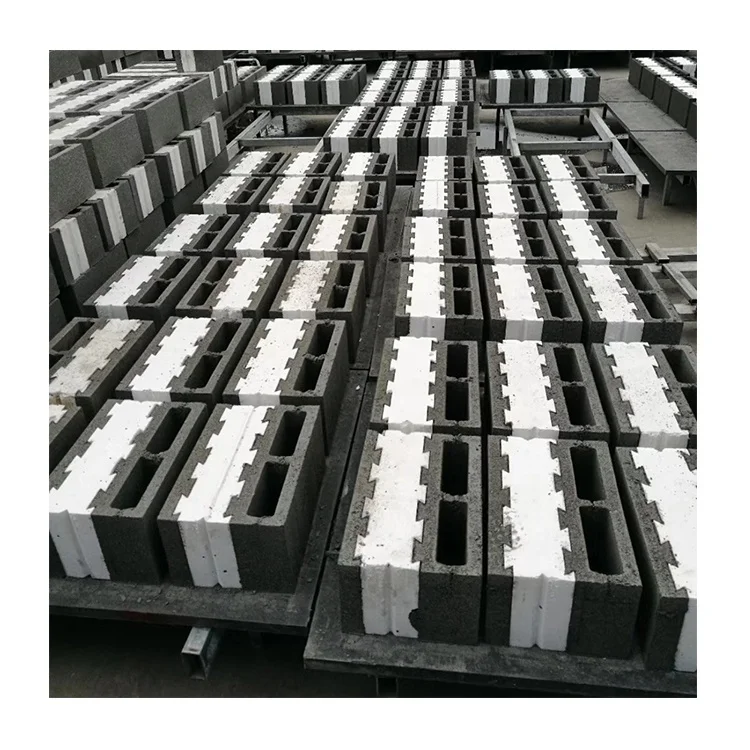
 High quality block machine