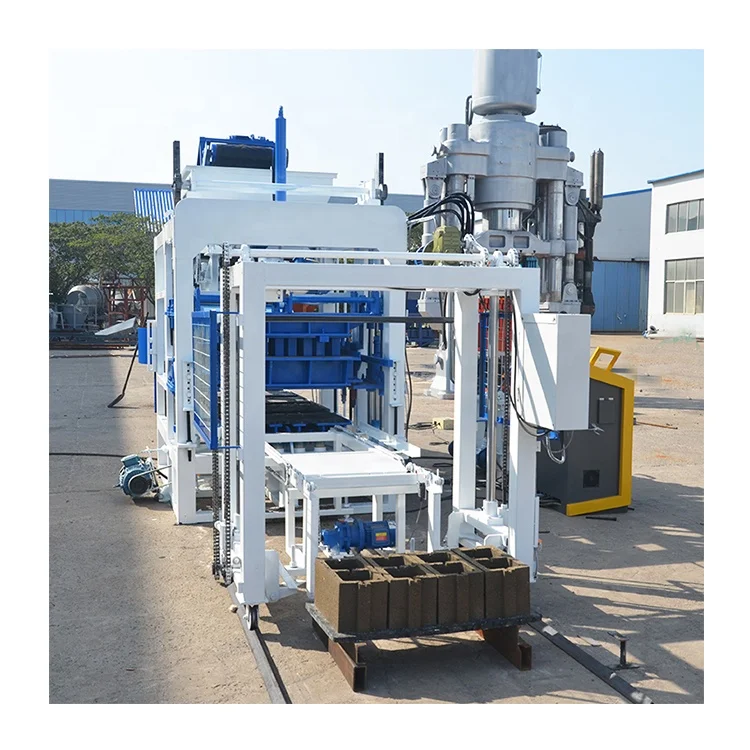
Mid-tier automatic line — the QT6-15 block making machine for sale bridges workshop-scale output and full plant automation, configurable from a basic mixer-and-stacker layout to a batching-to-cubing production line matched to your actual site footprint.
Technical Specifications
| Parameter |
Value |
| Model |
QT6-15 |
| Product Type |
Automatic Concrete Block Making Machine |
| Molding Way |
Vibration and hydraulic pressing |
| Rated Pressure |
21 MPa |
| Molding Cycle |
15s–20s (basis not stated in source — confirm block format, material, thickness) |
| Pallet Size |
900 × 700 mm |
| Main Machine Weight |
6000 kg |
| Output — Hollow Block 400×200×200 mm |
6 pcs/pallet, 1440 pcs/h, 11520 pcs/8h |
| Output — Paving Brick 200×100×60 mm |
21 pcs/pallet, 5040 pcs/h, 40320 pcs/8h |
| Output — Solid Brick 240×115×53 mm |
32 pcs/pallet, 7680 pcs/h, 61440 pcs/8h |
| Control System |
PLC (source value — verify against manufacturer catalog) |
| Voltage & Frequency |
Customizable to local standard (source value — verify against manufacturer catalog) |
| Raw Materials |
Cement, sand, fly ash, stone powder, slag |
| Automation Level |
Configurable: simple line (mixer, conveyor, stacker) or full line (cement silo, screw conveyor, batching, pallet loader, separator) |
| Standards |
CE (source value — verify against manufacturer catalog) |
| Warranty |
1 year (excluding wearing parts) |
| Assembly for Shipment |
Main machine top cylinder removed for container loading |
Application Suitability
| Application |
Material or Output |
| Hollow block production for load-bearing walls |
Cement, sand, and crushed stone aggregate at 400×200×200 mm format |
| Interlocking paver production for roads and plazas |
Stone powder and cement mix at 200×100×60 mm paving brick format |
| Solid brick production for partition walls |
Fly ash, sand, and cement at 240×115×53 mm standard brick format |
| Curbstone and kerb production for infrastructure |
Cement and coarse aggregate with custom mould configuration |
| On-site block production for housing developments |
Local aggregate and cement with semi-automatic line setup |
What "1440 Blocks per Hour" Actually Means for Your Plant
Every capacity figure here is tied to a named block format and pallet count — no cycle-rate abstraction.
The QT6-15 block making machine for sale is rated at 1440 hollow blocks per hour based on 6 pieces per pallet of 400×200×200 mm dimensions, and 5040 paving bricks per hour based on 21 pieces per pallet of 200×100×60 mm. Switching from hollow blocks to pavers on the same machine changes daily output significantly, yet many quotations quote a single cycles-per-hour number without disclosing which format it assumes [NEED_CITE: block machine capacity disclosure standards in international trade]. Buyers who discover the mismatch after commissioning lose weeks of production planning. I have walked onto sites where the daily target was set on a hollow-block assumption while the actual product mix was 70% paving bricks, and the output gap was immediate and unresolvable without adding shifts.

Where the QT6-15 Sits in the Machine Range
The QT6-15 occupies the middle tier of a broader automatic block machine lineup. Below it sit semi-automatic machines suited to smaller workshops with limited investment and manual pallet handling. Above it, higher-capacity automatic lines run larger pallets and shorter cycle times for plants targeting continuous high-volume output. The QT6-15 block making machine for sale serves buyers who need more throughput than a starter machine but are not yet ready to commit to a fully automatic line with cubing and rack handling — a position common among entrepreneurs launching a first plant and contractors producing blocks for a specific development project.
Automation Paths from Simple to Full Line
This machine platform supports multiple automation configurations. A simple line pairs the press with a mixer, conveyor belt, and basic stacker — suitable where pallet handling and curing area logistics remain manual. A full line adds a cement silo, screw conveyor, cement scale, batching machine, pallet loader, and block-and-pallet separator, reducing operator count and improving batch-to-batch consistency. Buyers can begin at the simple configuration and add stations later, which matters when capital must follow actual sales volume rather than projected capacity [NEED_CITE: phased automation investment in concrete product manufacturing].
Reading the Specs That Determine Real Output
The 21 MPa rated hydraulic pressure works together with vibration force to compact the mix into the mould cavity — insufficient pressure on a coarse aggregate mix produces low-density blocks that fail strength tests, while excessive pressure on a fine sand mix can cause surface cracking. The 900×700 mm pallet size is not arbitrary; it must align with your existing curing rack spacing and forklift tine width, because a mismatch means either rebuilding the curing area or replacing pallets after arrival. The 15s–20s molding cycle range reflects different block thicknesses and mix consistencies — a thin paving brick with high cement content cycles faster than a thick hollow block with lightweight aggregate, which is why the QT6-15 block making machine for sale carries different output ratings per format rather than a single throughput claim. The PLC control system manages vibration timing, pressure hold, and pallet indexing, and its display language must be confirmed before production so operators can read fault codes on day one.
The Cost of Skipping Configuration Verification
When pallet size is chosen without checking the buyer’s curing rack dimensions, blocks arrive at the curing area and cannot be stacked, forcing manual restacking that doubles labor on the curing floor. When voltage and frequency are assumed rather than confirmed, the machine arrives and cannot be powered until a transformer is sourced locally — a delay that typically extends commissioning by days [NEED_CITE: electrical compatibility issues in exported industrial machinery]. When the mix design assumed by the factory differs from what the buyer can actually source, vibration and pressure settings must be recalibrated from scratch, and I have seen this take four days of continuous adjustment on a project site where the local aggregate had higher clay content than expected.
Why Source This Machine Here
Block machinery is the single focus of this operation, which means the press, mould, pallet, and handling equipment are specified as one matched system rather than assembled from separate suppliers. Configuration is set against the buyer’s actual mix design and local aggregate, not a catalogue default — the QT6-15 block making machine for sale ships with hydraulic and vibration parameters adjusted to the materials you will actually use. Mould design covers the formats your market sells, with custom mould engineering available to buyer drawings. Automation level is selectable at order and expandable afterward, so investment tracks real demand. Installation includes on-site commissioning with operator training, and mould and wear parts support continues beyond the first year of operation.
Documentation & Verification
- Line layout and capacity calculation stating the block format assumed for each output figure
- Machine specification sheet with pallet size, hydraulic pressure, and vibration force matched to your mix
- Voltage, frequency, and PLC display language confirmation document before production begins
- Mould drawing and format list provided with quotation, including custom designs to buyer drawings
- Factory test record on your specified block format before dispatch
- Packing photographs and customs documentation support for export clearance
Installation, Commissioning & Support
- Foundation pad sized to the 6000 kg main machine weight with anchor bolt template provided before arrival
- Dedicated power circuit confirmed to local voltage and frequency standard before machine energization
- Top cylinder reinstalled after container unloading, with hydraulic lines pressure-tested before first cycle
- PLC parameter set calibrated to your block format, mix design, and target cycle time during commissioning
- Operator training covering mould change procedure, daily greasing points, and hydraulic oil inspection intervals
- Wear parts list and mould maintenance schedule supplied for planning replacement inventory
What to Prepare Before Inquiry
To size the right configuration around the QT6-15, share your target block formats with dimensions, the daily output you need per format, and the raw materials available locally including aggregate type and grading. Confirm your site voltage, frequency, and preferred control language. If you already have curing racks and forklifts on site, provide pallet dimensions so the system can be matched to your existing infrastructure from the start.
Frequently Asked Questions
Q: How is the QT6-15 output capacity calculated for each block format?
A: Output is calculated from the number of pieces per pallet, the molding cycle time, and an eight-hour working shift. For hollow blocks at 400×200×200 mm, the figure is 6 pieces per pallet yielding 11,520 per shift. For paving bricks at 200×100×60 mm, it is 21 per pallet yielding 40,320 per shift. Actual throughput depends on your mix design and line automation level.
Q: Where does the QT6-15 sit compared to semi-automatic and higher-tier machines?
A: It occupies the mid-tier, above semi-automatic machines that use manual pallet handling and below high-capacity lines with larger pallets and faster cycles. The QT6-15 block making machine for sale suits buyers who need reliable mid-volume output and want the option to start with a simpler line and add automation stations as production demand grows.
Q: Can I start semi-automatic and upgrade to full automation later?
A: Yes. The QT6-15 platform supports a simple line with mixer, conveyor, and stacker at the entry level. Additional stations — cement silo, batching machine, pallet loader, block-and-pallet separator — can be added later to reach full automatic operation without replacing the press itself.
Q: How is pallet size selected to match my curing area?
A: The standard 900×700 mm pallet is checked against your curing rack slot width and forklift tine spacing before order confirmation. A mismatch here means blocks cannot be racked or moved efficiently, so this verification happens during the proposal stage, not after shipment.
Q: What electrical and control details are confirmed before production?
A: Voltage, frequency, and PLC display language are documented and confirmed before the machine enters production. This prevents the common delay where a machine arrives on site and cannot be powered or operated in a language the local team understands until additional equipment is sourced.

 Semi automatic block