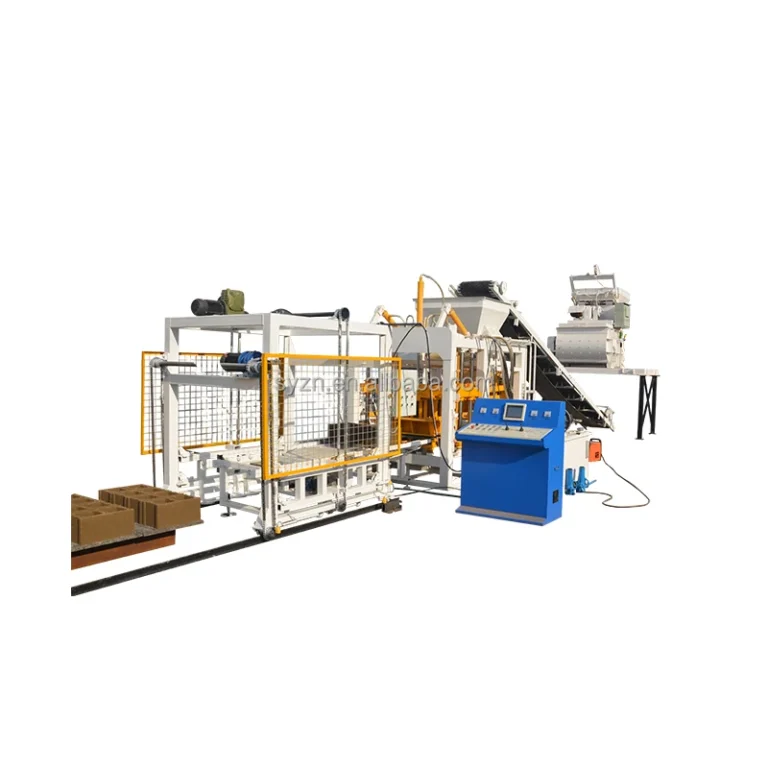
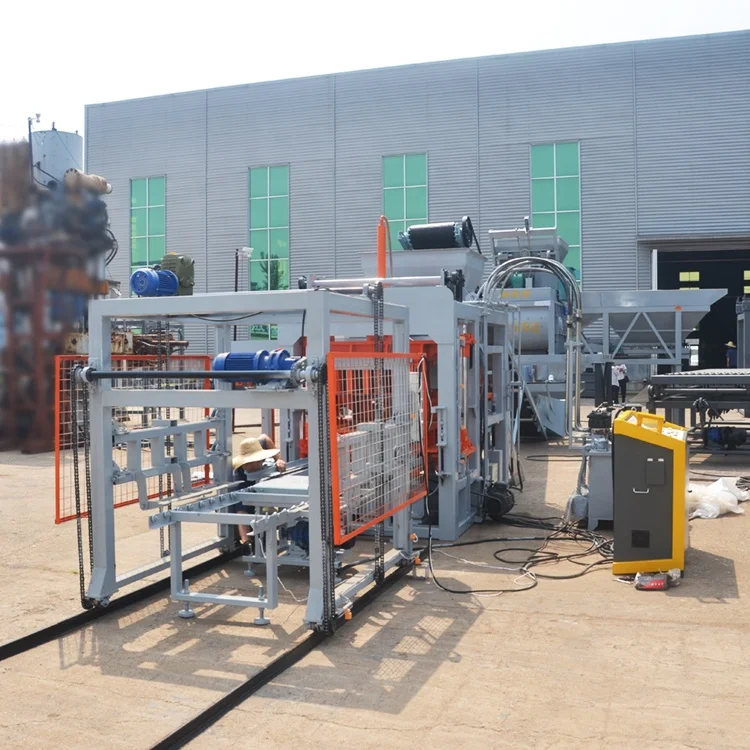
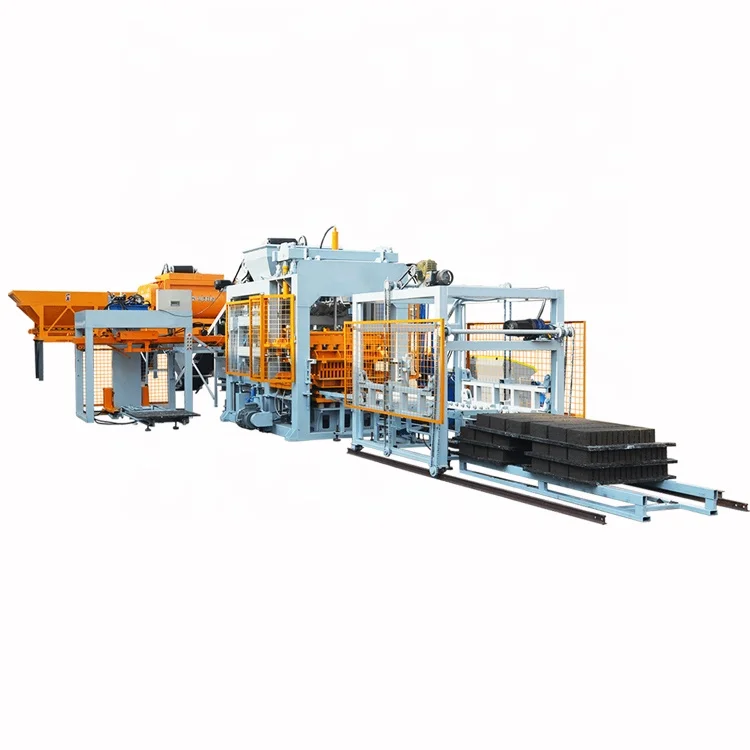
Matched system configuration — the QT5-15 block making machine, mould, pallet and handling equipment are specified as one integrated line rather than assembled from separate suppliers.
Technical Specifications
| Parameter |
Value |
| Model |
QT5-15 |
| Product Type |
Automatic Hydraulic Block Making Machine |
| Overall Dimensions (L×W×H) |
7100×1600×2610 mm |
| Molding Cycle |
15 s |
| Vibration Frequency |
0-60 Hz |
| Exciting Power (Vibration Force) |
40 kN |
| Total Power |
33.5 kW |
| Mixer Model |
JS500 |
| Pallet Size |
1100×550 mm |
| Total Weight |
5 T |
| Control System |
PLC control system |
| Hydraulic Station |
Included |
| Automation Level |
Fully automatic |
| Included Equipment |
Block making machine, hydraulic station, PLC control system, pallet feeder, brick conveyor, block sweeper |
| Output Capacity (400×200×200 mm hollow block) |
450 pcs/h, 3600 pcs/8hr |
| Output Capacity (400×150×200 mm hollow block) |
540 pcs/h, 4320 pcs/8hr |
| Output Capacity (400×100×200 mm solid brick) |
720 pcs/h, 5760 pcs/8hr |
| Applied Products |
Paver, solid block, hollow block, curbstone |
| Raw Materials |
Crushed stone, sand, cement, dust, fly ash |
| Certification |
CE |
Application Suitability
| Application |
Material or Output |
| Hollow block production for residential and commercial walls |
Crushed stone, sand, cement, fly ash in 400×200×200 mm and 400×150×200 mm formats |
| Solid brick manufacturing for load-bearing structures |
Sand, cement, and stone dust in 400×100×200 mm format |
| Paver and curbstone production for roads and landscaping |
Crushed stone and cement mixes in surface and kerb formats |
| On-site block production for housing projects |
Local aggregate and cement adapted to site-available materials |
Why the QT5-15 Automatic Block Making Machine Manufacturer You Choose Changes Your Actual Output
A capacity figure means nothing unless you know which block format it was measured on.
I have watched buyers sign off on a block machine quotation based on a headline cycle rate, only to discover on the first production week that the number assumed a small solid brick while their daily orders were almost entirely hollow blocks. The QT5-15 automatic block making machine manufacturer you work with should give you a line layout document that states the assumed format next to every capacity number — 450 pieces per hour for 400×200×200 mm hollow blocks, not a generic "up to 720" that quietly shifts the goalposts. [NEED_CITE: industry practice of quoting block machine capacity on a single reference format] When the format assumption is missing, your real daily tonnage can fall well short of the business plan you showed your bank.

Where the QT5-15 Sits in the Automatic Range
The QT5-15 occupies the mid-tier position in the fully automatic block machine lineup. It delivers a 15-second molding cycle across hollow block, solid brick, and paver formats, which places it above small workshop machines but below the high-capacity lines designed for continuous three-shift operation. For a buyer establishing a first block plant or a contractor adding new formats to an existing product range, this tier balances investment level against daily output without over-committing to a footprint that the curing yard cannot absorb.
Full Range Coverage From One Machine Platform
A single QT5-15 platform covers the block formats that most regional markets actually order: hollow blocks in two wall thicknesses, solid bricks, pavers, and curbstones. The machine accepts mould changes so a buyer can run hollow blocks in the morning and switch to pavers when the order book demands it. This matters because the alternative — buying a dedicated machine for each format — only makes sense once daily volume justifies dedicated lines. [NEED_CITE: typical format changeover time on mid-tier hydraulic block presses] The QT5-15 automatic block making machine manufacturer you select should confirm the full mould format list and changeover procedure before production starts.
Reading the Numbers Behind Vibration, Pressure, and Cycle Time
The 40 kN vibration force and the included hydraulic station work together to compact the mix into a dense, uniform block. Vibration alone settles the aggregate; hydraulic pressure applied through the mould head finishes the compaction from above. If vibration force is high but hydraulic pressure is weak, the bottom of the block is dense and the top is friable. The 0-60 Hz adjustable vibration frequency lets the operator tune the shake to the specific mix — a fly-ash-heavy blend needs a different frequency window than a crushed-stone mix. The 15-second molding cycle holds across all three listed formats because the hydraulic station response and PLC-sequenced pallet feed keep each station synchronized. The JS500 mixer capacity is matched to the press throughput so that the hopper never runs empty mid-cycle, which would force the PLC to pause and break the rhythm. Pallet size at 1100×550 mm determines the block layout per mould and must align with the curing racks and forklift tines already on site.
What Happens When Pallet Size and Voltage Are an Afterthought
A pallet dimension chosen without checking the curing area means blocks are stacked by hand on the floor because the racks do not fit the pallet footprint. I have seen a buyer lose the entire curing cycle of a day because his forklift tines were wider than the pallet runners. On the electrical side, arriving at site to discover the PLC display is in a language the operator cannot read, or the voltage does not match the local grid, delays commissioning by weeks while transformers or control boards are shipped. [NEED_CITE: common commissioning delays caused by unconfirmed voltage and frequency] These are not machine defects — they are specification gaps that a thorough QT5-15 automatic block making machine manufacturer catches before the machine leaves the factory.
Why Source This Range From a Dedicated Block Machinery Supplier
Block machinery is the single focus here, so the QT5-15 press, JS500 mixer, pallet feeder, brick conveyor, and block sweeper are specified as one matched system. Machine configuration is set against your actual mix design and local aggregate, not a catalogue default. Mould design covers the formats your market sells, with custom drawings accepted for non-standard shapes. The automation level is selectable — a buyer can start with the standard pallet feeder and brick conveyor, then add automatic stacking later as output volume grows. Installation support includes operator training on the PLC control system so that the crew can run the QT5-15 independently from the first week.
Documentation & Verification
- Line layout and capacity calculation stating the block format assumed for each output figure
- Machine specification sheet confirming pallet size, vibration force, and hydraulic pressure ratings
- Mould drawing and format list showing all available block types and changeover procedure
- Voltage, frequency, and PLC display language confirmed in writing before production
- Factory test record on your target block format before dispatch
- CE declaration and operation manual with wear parts and mould list included
Installation, Commissioning & Support
- Foundation pad sized to 7100×1600 mm footprint with anchor bolt plan provided before machine arrival
- Dedicated electrical circuit rated for 33.5 kW total power with voltage and frequency confirmed to local grid
- Machine shipped as main press, hydraulic station, and PLC cabinet — reassembled and leveled on site
- First-run commissioning includes PLC parameter tuning to your mix design and target block density
- Operator training covers mould change procedure, vibration frequency adjustment, and daily maintenance checklist
- Wear parts and mould spares list provided so first replacements are on hand before production ramps up
What to Prepare Before Requesting a Quotation
Share your target block formats, the daily output you need for each one, and the raw materials available locally — especially the type and grading of aggregate. Confirm your site voltage and frequency, the language you need on the PLC display, and the pallet size that fits your existing curing racks and forklift. If you are replacing an existing machine, note the current pallet dimensions and any downstream handling equipment that the new line must connect to.
Frequently Asked Questions
Q: How is the 450–720 pcs/h capacity range calculated and which block format does each figure assume?
A: Each figure is measured on a specific mould format at the standard 15-second cycle. Hollow blocks at 400×200×200 mm yield 450 pieces per hour, 400×150×200 mm hollow blocks yield 540, and 400×100×200 mm solid bricks yield 720. These assume continuous operation with the JS500 mixer feeding without interruption.
Q: What automation level does the QT5-15 include and where does it sit between semi-automatic and high-capacity lines?
A: The QT5-15 is fully automatic with PLC-controlled pallet feeding, press cycling, and block sweeping via the brick conveyor. It sits in the mid-tier automatic range — above semi-automatic machines that require manual pallet handling, but below high-capacity lines that add automatic stacking and cubing systems.
Q: Which pallet size is specified and does it match standard curing racks and forklifts in my region?
A: The standard pallet is 1100×550 mm. Before confirming your order, compare this dimension against your curing rack slot width and your forklift tine spacing. If your existing infrastructure uses a different size, the pallet specification can be adjusted during the configuration stage.
Q: What voltage and frequency configurations are available for my target market?
A: The electrical system is configured to your local voltage and frequency before production. This includes the main motor circuit, hydraulic station pump, and PLC panel supply. Confirm your grid specification early so the correct components are sourced and the PLC display language is set before shipment.
Q: How do I verify the machine configuration matches my local raw material and aggregate availability?
A: Provide a sample description of your aggregate type, grading, and any supplementary materials like fly ash. The vibration frequency range of 0-60 Hz and the hydraulic pressure are then set to suit that specific mix. A factory test on your target block format is run before dispatch to confirm block density and surface finish.

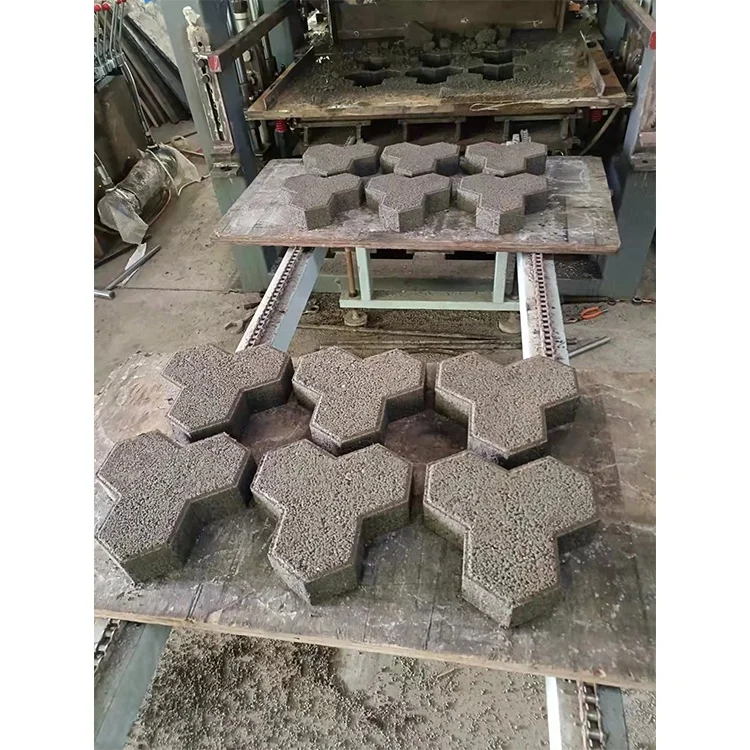
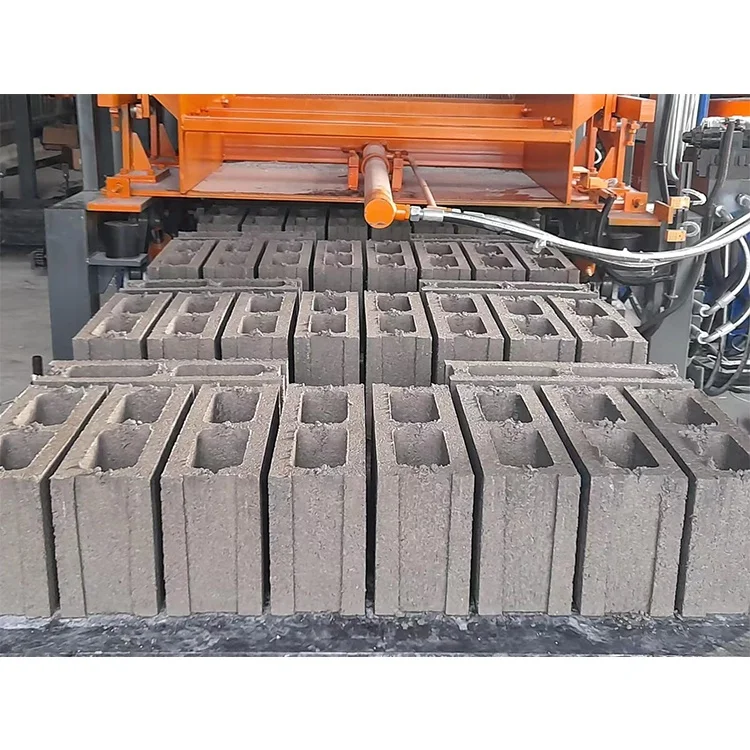 High quality block machine