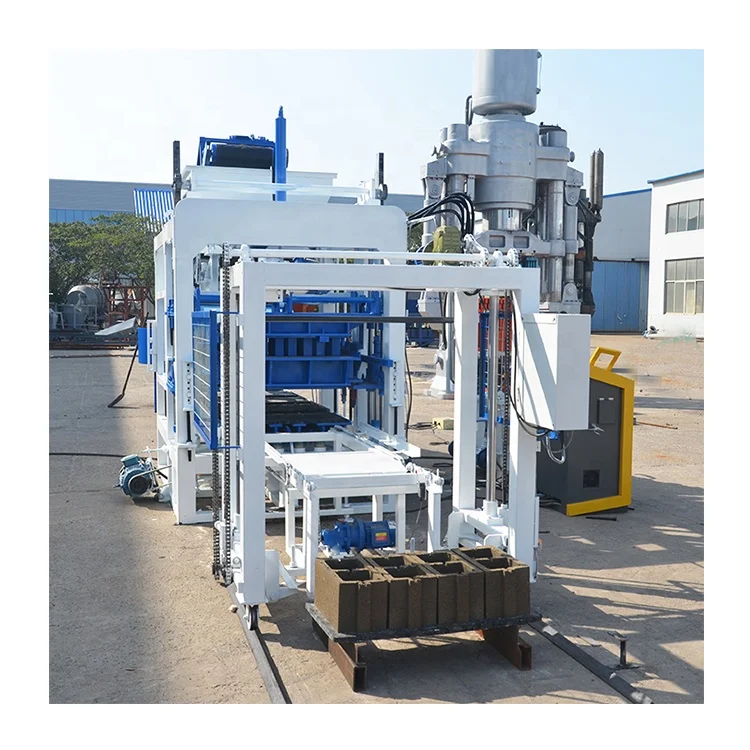
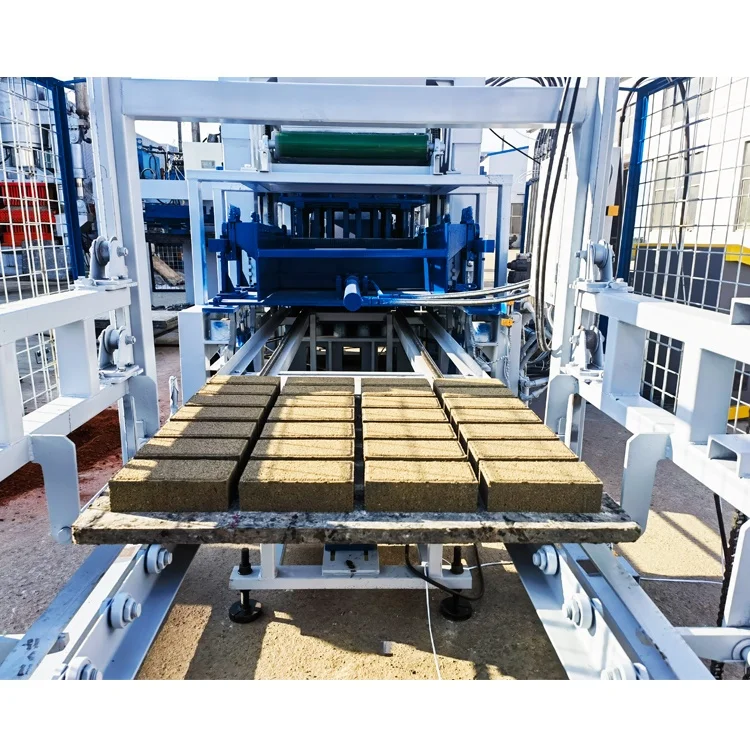
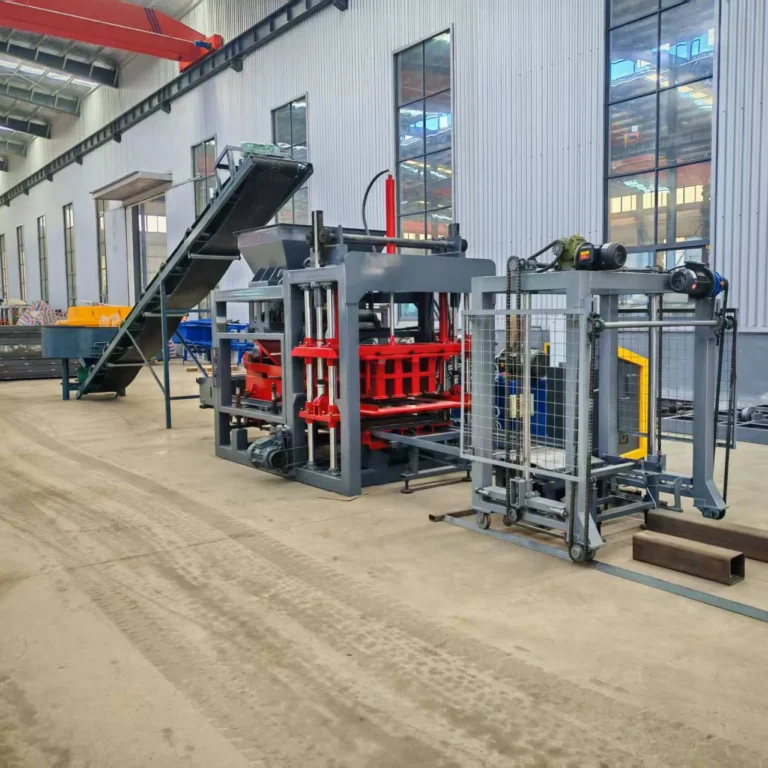
Integrated Line Logic — QT4-15A configured as one matched press, mould, pallet and handling package rather than a standalone unit.
Technical Specifications
| Parameter |
Value |
| Model |
QT4-15A |
| Product Type |
Fully Automatic Concrete Block Making Machine |
| Overall Dimensions (L×W×H) |
4100×1600×2600mm |
| Rated Pressure |
16–21 MPa |
| Vibration Form |
Platform Vibration |
| Vibration Frequency |
4200 r/min |
| Vibration Force |
55 KN |
| Pallet Size |
880×550 mm |
| Molding Cycle |
25–30 s (basis not stated in source — confirm block format and mix) |
| Overall Power |
18.45 kW |
| Total Mass |
4 T |
| Demolding Method |
Hydraulic |
| Factory Area Required |
300 m² |
| Control System |
PLC (brand/language options to be confirmed) |
| Automation Level |
Fully automatic |
| Applied Products |
Hollow blocks, solid blocks, pavers, interlocking blocks, curbstone, colored pavers |
| Raw Material Compatibility |
Crushed stone, sand, cement, dust, fly ash, gravel, slag |
| Container Loading |
1×40HQ (basic equipment) |
| Warranty |
1 year |
Application Suitability
| Application |
Material or Output |
| Hollow block production for residential wall systems |
Crushed stone, sand, and cement blends with fly ash substitution |
| Solid paver manufacturing for pedestrian and light-traffic areas |
Fine aggregate mixes with pigment for colored surface layers |
| Interlocking brick runs for landscape and retaining structures |
Gravel and slag blends adjusted for interlock geometry |
| Kerbstone and curb units for site infrastructure |
Coarse aggregate concrete with high compaction requirement |
| On-site production for medium-scale housing contractors |
Local aggregate sourced within project radius |
Why the Block Format Assumption Decides Your Actual Daily Yield
A cycle time is only meaningful when tied to a specific block format and mix design.
Buyers often see a number like "25–30 seconds" and multiply it across a shift, only to discover that the hollow block they actually sell requires a longer press cycle than the standard test block. The vibration force and hydraulic pressure needed to achieve target strength differ between a 400×200×200mm hollow block and a thin paving unit. When the format is not stated, the capacity figure is essentially a placeholder [NEED_CITE: block format assumptions in capacity quotations]. I have watched contractors base an entire project timeline on a cycle number that was measured on a completely different product, then scramble when daily output fell short on the format their market actually buys.

Placing the QT4-15A in the Machine Range Hierarchy
The QT4-15A sits in the mid-tier of our automatic lineup, bridging workshop-scale semi-automatic machines and the high-capacity automatic lines designed for continuous three-shift operation. For a buyer surveying options, this model addresses the gap between needing more than manual pallet handling but not yet justifying the footprint and investment of a full stacking and cubing system. The 300 m² factory area requirement gives a realistic baseline for site planning before any commitment is made. A first-time plant owner can see where this QT4-15A block machine manufacturer offering fits relative to both smaller and larger tiers in the range.
How the Stations Connect Around the Press
The press itself is only one station in the line. Raw material feeding, mixing, pallet circulation, and post-press handling must all match the press cycle so the machine is never left waiting for a pallet or a batch. With the QT4-15A, the 880×550mm pallet dimension governs how many pallets are in circulation at any moment and what curing rack spacing is needed downstream. If the mixer discharge rate does not align with the 25–30 second molding window, the press sits idle [NEED_CITE: line synchronization and press idle time in block production]. This is why the QT4-15A block machine manufacturer scope covers the entire material flow, not just the press specifications.
What the Hydraulic and Vibration Numbers Mean on the Floor
The 16–21 MPa rated pressure range works together with the 55 KN vibration force at 4200 r/min to compact the concrete mix into the mould cavity. Platform vibration transmits energy through the pallet into the material, which suits the 880×550mm pallet format and the range of block heights this machine handles. Higher vibration frequency improves surface finish on pavers and interlocking bricks, while the hydraulic pressure controls overall density and demolding integrity. When a buyer’s local aggregate is angular volcanic crushed stone rather than smooth river gravel, the pressure and vibration balance must be re-evaluated to maintain block strength. The 18.45 kW total power draw reflects the combined demand of the hydraulic pump, vibration motor, and PLC-controlled feed system running together.
The Hidden Cost of Specifying in Isolation
When a machine is quoted without confirming pallet size against the buyer’s existing curing area and forklift capacity, pallets arrive that cannot be moved or stored efficiently. When voltage and PLC display language are not confirmed before shipment, commissioning stalls while a technician waits for a translated interface or a step-down transformer [NEED_CITE: commissioning delays from unconfirmed electrical specifications]. These are not equipment failures — they are specification gaps that turn into weeks of lost production. A buyer who selected the QT4-15A based on press capacity alone, without matching the downstream pallet handling and curing logistics, ends up stacking wet blocks by hand.
Why Buyers Source the Full Range Here
Block machinery is our single focus, so the QT4-15A is specified alongside its moulds, pallets, and handling equipment as one integrated system rather than assembled from separate suppliers. Configuration starts from the buyer’s actual mix design and target block format, not a catalogue default. Mould options cover hollow, solid, paver, interlocking, and kerbstone formats, with custom mould design available to buyer drawings. The automation level on the QT4-15A can be adjusted so a buyer starts with semi-automatic pallet handling and upgrades to full stacking later. Factory testing is performed before dispatch, with settings recorded for the buyer’s confirmed material sample.
Documentation & Verification
- Line layout showing QT4-15A footprint within 300 m² plant with pallet flow paths marked
- Capacity calculation per block format with cycle time assumptions stated for each
- Hydraulic and electrical schematic matching confirmed voltage and frequency
- Mould drawing and format list for every included cavity type
- Factory test record using buyer’s submitted raw material sample
- Packing photographs and container loading plan for 40HQ shipment
Installation, Commissioning & Support
- 300 m² floor area with level concrete slab to support 4T machine mass and vibration loads
- Dedicated power circuit matching confirmed voltage and 18.45 kW total draw
- Machine arrives dismantled for 40HQ loading with reassembly guided on site
- PLC parameter tuning for buyer’s local aggregate and confirmed mix proportions
- Operator training covering mould change procedure and daily maintenance checkpoints
- Wear parts list and hydraulic seal kit identified for first replacement cycle
What to Prepare Before Requesting a Proposal
Share the specific block formats your market sells along with target daily output so the capacity calculation can be built around real products rather than a test standard. Provide a sample or description of your local aggregate and any cement or fly ash sources you plan to use. Confirm your site’s available floor area, existing curing rack dimensions, forklift capacity, and local voltage and frequency so the QT4-15A block machine manufacturer configuration arrives ready to run.
Frequently Asked Questions
Q: How is capacity calculated and what block format does the cycle time assume?
A: The 25–30 second molding cycle is a reference range that varies depending on block format, material mix, and required compaction level. We calculate capacity per specific format — a hollow block cycle differs from a paver cycle. The quotation includes a written capacity table stating the assumed format, mix, and shift length for each output figure so there is no gap between quoted and realistic daily production.
Q: Where does the QT4-15A sit between semi-automatic and high-capacity tiers?
A: This model occupies the mid-tier of the full automatic range, suited for buyers who need more throughput than a workshop-scale machine but whose site footprint and investment budget do not yet support a high-capacity line with full cubing. The 300 m² factory requirement and 4T machine mass give practical boundaries for comparing this tier against larger or smaller options in the QT4-15A block machine manufacturer lineup.
Q: Can I start with semi-automatic pallet handling and upgrade later?
A: Yes. The automation level is selectable, and the press platform, mould interface, and PLC architecture on the QT4-15A are designed to accept upstream and downstream automation additions. A buyer can begin with manual pallet transfer and add automatic stacking or curing rack handling as production volume grows, without replacing the core press.
Q: What pallet size options exist and how do they relate to my curing area?
A: The standard pallet dimension is 880×550mm, which determines curing rack spacing, forklift tine width, and storage density. If your existing curing racks or forklift are sized differently, the pallet specification must be discussed before the line is configured so that finished blocks can move from press to curing to dispatch without manual re-handling.
Q: Which block formats can one machine produce and how long does a mould change take?
A: The QT4-15A supports hollow, solid, paver, interlocking, kerbstone, and colored paver formats through mould changes. Mould change duration depends on the specific changeover system fitted and operator familiarity. We include the format list and changeover procedure in the documentation so buyers can plan production scheduling around realistic changeover windows.

![QTJ4-35 Block Making Machine for Hollow Block – Manufacturer 记录ID 80035 数字之和:8+0+0+3+5=16 第一层:shiyueblockmachine.com → FULL MACHINE RANGE → 全品类目录类角色 → Manufacturer / Factory Supply / Full Range 第三层:16 % 3 = 1 → Factory Supply 第二层:16 % 6 = 4 → [品类词] with [核心配置] – [站点修饰词] Block Making Machine with Belt Conveyor – Factory Supply](https://shiyueblockmachine.com/wp-content/uploads/2026/04/H226555bf51f44687a8dd9cee247a6ab2c.webp) High quality block machine
High quality block machine