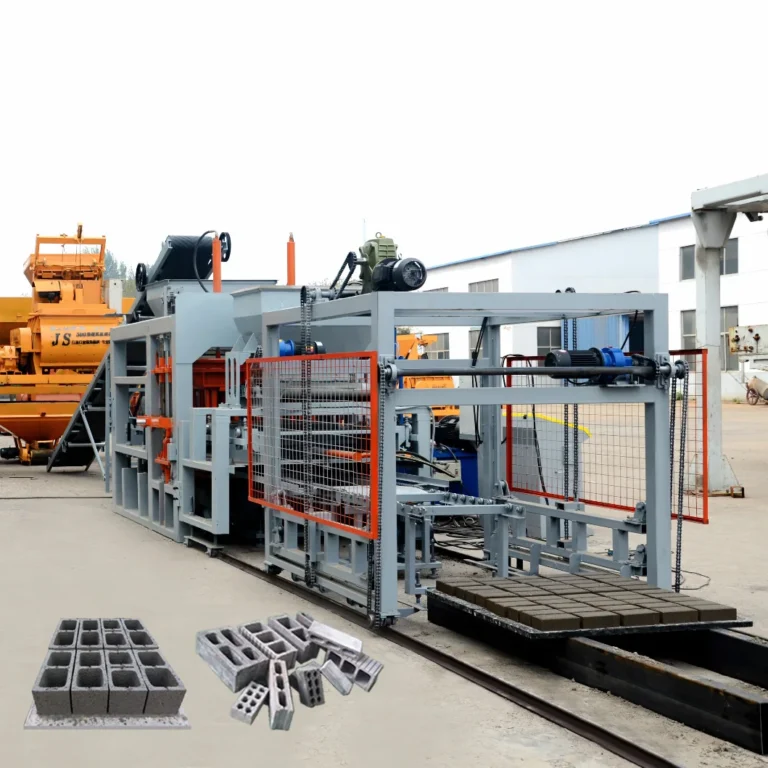
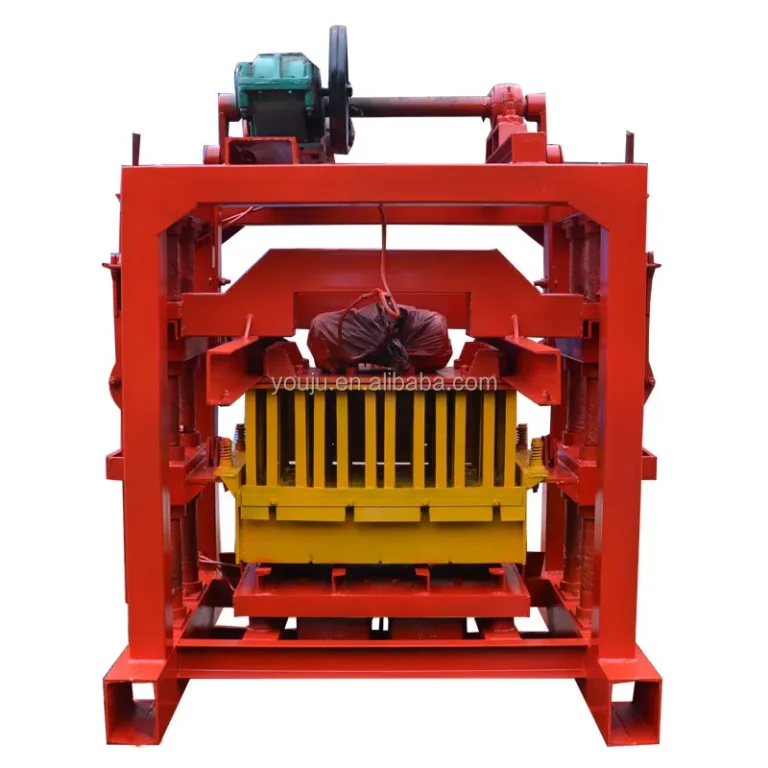
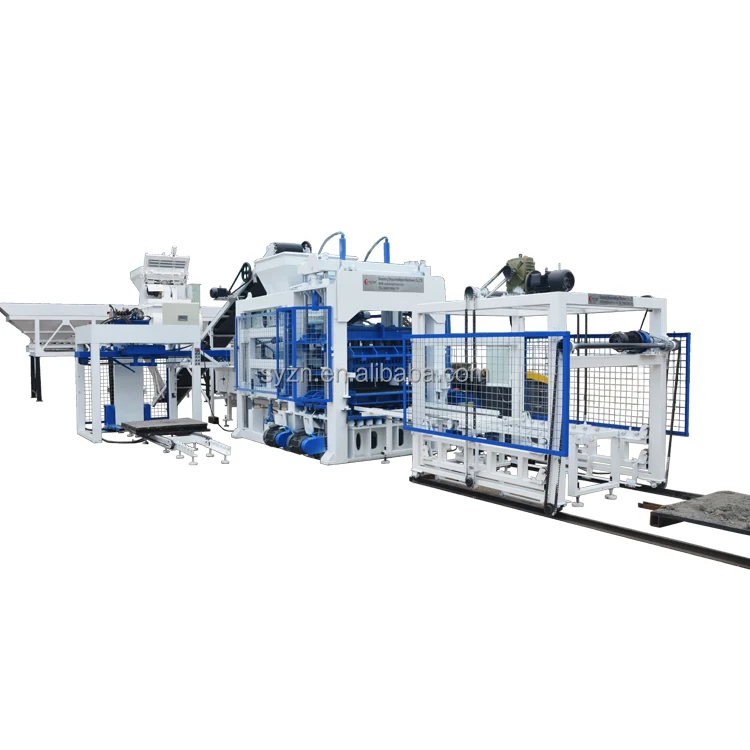
Single-focus block machinery engineering — the QT18-25 stationary block machine is configured as one matched system of press, mould, and handling rather than assembled from separate suppliers.
Technical Specifications
| Parameter |
Value |
| Model |
QT18-25 |
| Product Type |
Fully Automatic Pallet-free Block Making Machine |
| Category |
Stationary block machine |
| Brick Height Range |
50-300mm |
| Stacking Height |
0-1200mm |
| Main Vibration Form |
Platform Vibration |
| Vibration Frequency |
2800~4500 r/min |
| Vibration Power |
60 kW |
| Hydraulic System Power |
59 kW |
| Driving Method |
Hydraulic |
| Demolding Method |
Vibration and Hydraulic |
| Pallet Size |
1350×1350×120mm |
| Molding Cycle |
15-25 s (basis not stated in source — confirm block format / material / thickness) |
| General Water Consumption |
8T/Day |
| Factory Area Required |
2000m² |
| Raw Materials |
Crushed stone, sand, cement, dust, fly ash, gravel, slag |
| Control System |
PLC with person-machine conversation interface |
| Automation Level |
Fully automatic, pallet-free |
| Applied Products |
Concrete blocks, hollow/solid blocks, pavers, interlocking blocks, curbstone, colored pavers |
Application Suitability
| Application |
Material or Output |
| Hollow block production plants |
Crushed stone and cement mixes for structural walling blocks |
| Solid block manufacturing |
Sand, fly ash and gravel blends for load-bearing masonry |
| Paving block and colored paver runs |
Fine aggregate and pigment mixes for interlocking pavement formats |
| Interlocking brick production |
Local aggregate and cement for mortar-less wall systems |
| Kerbstone and curb production |
High-density concrete mixes for roadside and drainage profiles |
What "15-25 Seconds per Cycle" Actually Means for Your Output
A molding cycle figure without a named block format is a capacity estimate, not a guarantee.
When evaluating any fully automatic block making machine manufacturer, the first question should always be which specific block size and mix design the quoted cycle time assumes. A 15-second cycle on a small solid paver differs fundamentally from a 25-second cycle on a large hollow block, yet both can appear under the same headline number [NEED_CITE: block machine cycle time standards and format dependency]. The QT18-25 pallet-free system carries a stated range of 15-25 seconds, but real daily throughput depends on the format you intend to produce, the curing characteristics of your local aggregate, and the stacking height your site can accommodate. Buyers who skip this clarification often find their actual shift output falling noticeably short of the brochure promise.

Where the QT18-25 Sits in the Full Shiyue Range
The Shiyue lineup spans mobile egg-laying machines for on-site work, semi-automatic presses for smaller plants, and fully automatic stationary lines for higher-tier output. The QT18-25 occupies the high-capacity stationary tier with pallet-free operation, meaning blocks are stacked directly after moulding without pallet investment or pallet-return conveyors. For a buyer comparing tiers, this model suits operations ready to commit to a fixed plant footprint around 2000 square metres and move beyond manual pallet handling.
Automation Level and Plant Footprint at This Tier
Pallet-free fully automatic operation removes an entire layer of handling labour and pallet replacement cost from the production loop. The PLC-controlled cycle covers moulding through to direct stacking up to 1200mm, so the operator role shifts from physical handling to monitoring mix consistency and output quality [NEED_CITE: PLC control language confirmation for export block machinery]. This automation tier demands a dedicated curing area and a forklift or side-shifter matched to the stacking dimensions rather than to standard pallet sizes.
Platform Vibration and Hydraulic Pressure as a Matched Pair
The QT18-25 pairs a 60 kW platform vibration system operating across 2800-4500 r/min with a 59 kW hydraulic circuit for driving and demolding. In block pressing, vibration frequency determines how densely the mix settles into the mould cavity, while hydraulic pressure controls the compaction force applied from above. A mix with coarse crushed stone needs higher vibration amplitude and lower frequency to settle, whereas a fly-ash-rich mix compacts better under sustained hydraulic pressure with moderate vibration. Setting these two forces incorrectly for your local raw material produces blocks with inconsistent density and strength, a common commissioning issue that delays plant start-up.
The Cost of Skipping the Pallet and Stacking Audit
A pallet-free machine eliminates pallet purchase and handling, but only if the downstream curing area and transport equipment are designed for the stack dimensions the machine produces. Buyers who order the press without confirming how cured stacks will be moved from the curing zone to dispatch often end up breaking stacks apart manually, negating the automation investment [NEED_CITE: pallet-free block stacking and curing area logistics]. Voltage and PLC display language also need confirming before the machine leaves the factory; a control panel in the wrong language can stall commissioning entirely while replacement software is sourced remotely.
Why Source This Stationary Tier from Shiyue
Block machinery is Shiyue’s single focus, so the QT18-25 press, moulds, and stacking system are specified together as one matched line rather than assembled from separate vendors. Configuration is set against your actual mix design and local aggregate, not pulled from a catalogue default. Mould design covers the formats your market actually sells, with custom drawings available for non-standard profiles. Automation level is selectable across the range, so a buyer can start on a semi-automatic tier and transition to this pallet-free class when volume justifies it. Installation support includes on-site commissioning and operator training tied to the specific formats running on your machine.
Documentation & Verification
- Line layout drawing showing QT18-25 footprint and stacking zone within the 2000m² plant area
- Capacity calculation sheet stating the exact block format assumed for each output figure
- Vibration frequency and hydraulic pressure settings matched to your confirmed mix design
- Voltage, frequency, and PLC display language confirmation signed off before production begins
- Factory test record demonstrating cycle time and block density on your target format before dispatch
Installation, Commissioning & Support
- Plant foundation plan sized for the QT18-25 vibration load and 2000m² factory area requirement
- Power supply specification covering the combined 60 kW vibration and 59 kW hydraulic circuit loads
- Machine dismantling and container loading plan for shipment to your port of entry
- On-site commissioning with PLC interface language verified before first production run
- Operator training covering mould change procedure and stacking height adjustment from 0-1200mm
- Wear parts list for hydraulic seals and vibration components with recommended replacement intervals
What to Include in Your Inquiry
To receive an accurate QT18-25 configuration, share your target block formats with dimensions, the daily output you need per format, and the raw materials available locally including aggregate gradation. Confirm your site voltage and frequency supply along with the preferred PLC display language for your operators. If you have an existing curing area or forklift fleet, provide those dimensions so the stacking configuration can be matched to your current handling equipment.
Frequently Asked Questions
Q: Where does the QT18-25 sit compared to semi-automatic and mobile machines in the Shiyue range?
A: The QT18-25 is positioned at the high-capacity stationary tier with full pallet-free automation. Semi-automatic models suit smaller plants with lower investment, while mobile egg-laying machines serve on-site production without a fixed plant. The QT18-25 is the choice for buyers ready to commit to a permanent facility and eliminate pallet handling from the production loop.
Q: What plant footprint and investment level does this tier require?
A: The QT18-25 requires approximately 2000 square metres of factory area including press zone, raw material feeding, and stacking area. This tier represents a higher capital outlay than semi-automatic models but removes pallet purchase and pallet-return conveyor costs. Investment comparison across tiers should factor in the total line configuration, not the press price alone.
Q: How is daily output calculated per block format on this machine?
A: Output depends on the specific block format, mix design, and confirmed cycle time within the 15-25 second range. A capacity calculation must state which block size each figure assumes, because a small paver cycles faster than a large hollow block. Request a format-by-format output sheet rather than accepting a single headline number.
Q: Can I start with a lower tier and upgrade to this automation level later?
A: The Shiyue range allows buyers to begin on semi-automatic equipment and transition to fully automatic pallet-free operation as volume grows. The upgrade path involves replacing the press and adding automated stacking, so planning the plant layout for future expansion at the initial stage reduces later disruption.
Q: What block formats can one QT18-25 produce with mould changes?
A: The machine produces concrete blocks, hollow blocks, solid blocks, pavers, interlocking blocks, kerbstones, and colored pavers through mould changes. Custom mould design is available to buyer drawings for non-standard profiles. Mould change time should be confirmed during commissioning so format flexibility matches your production schedule.

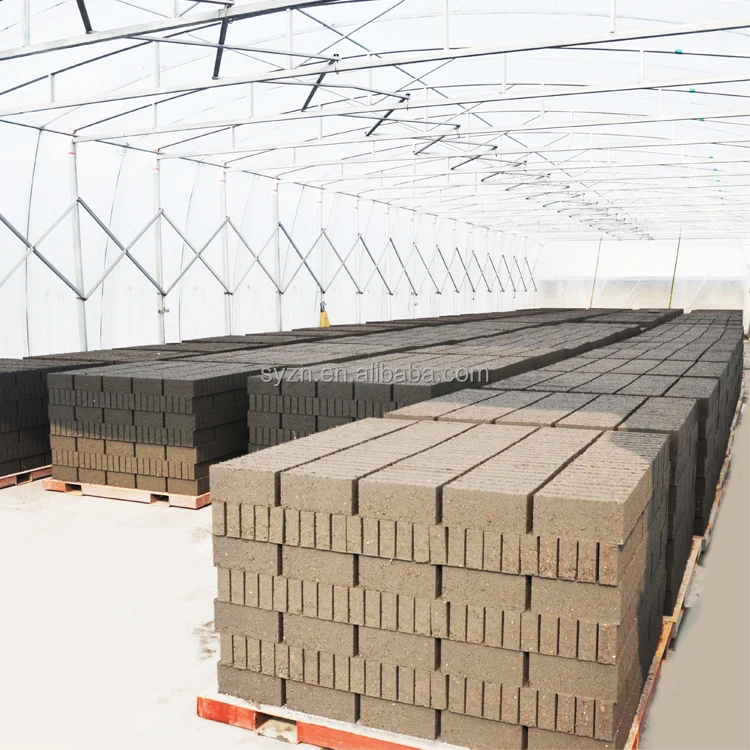
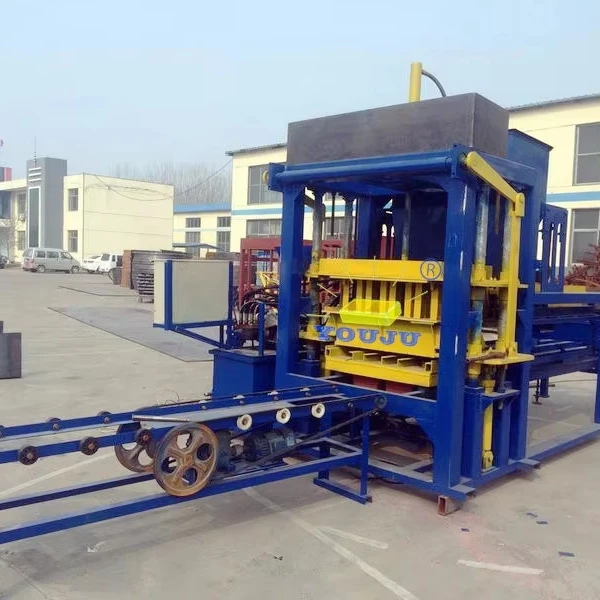 Stationary block machine