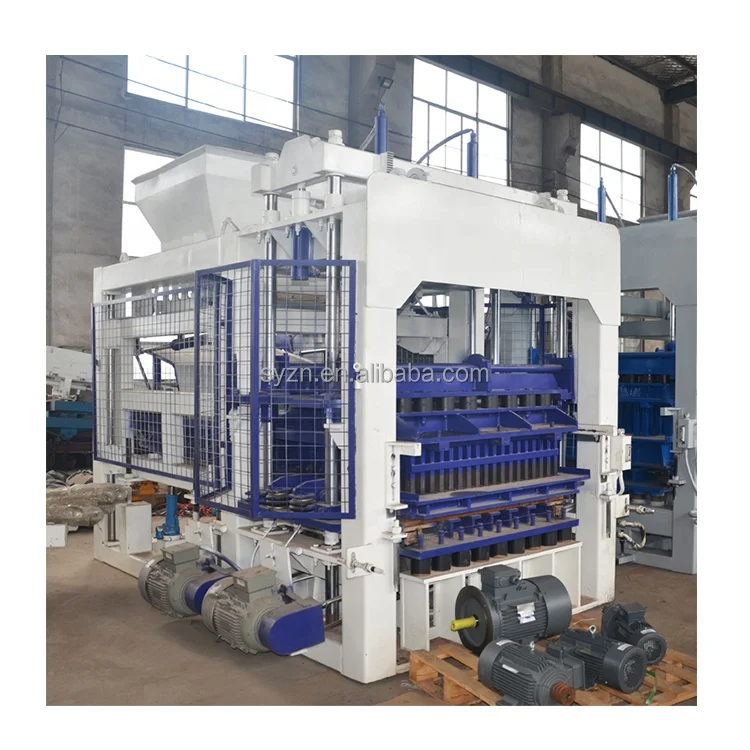
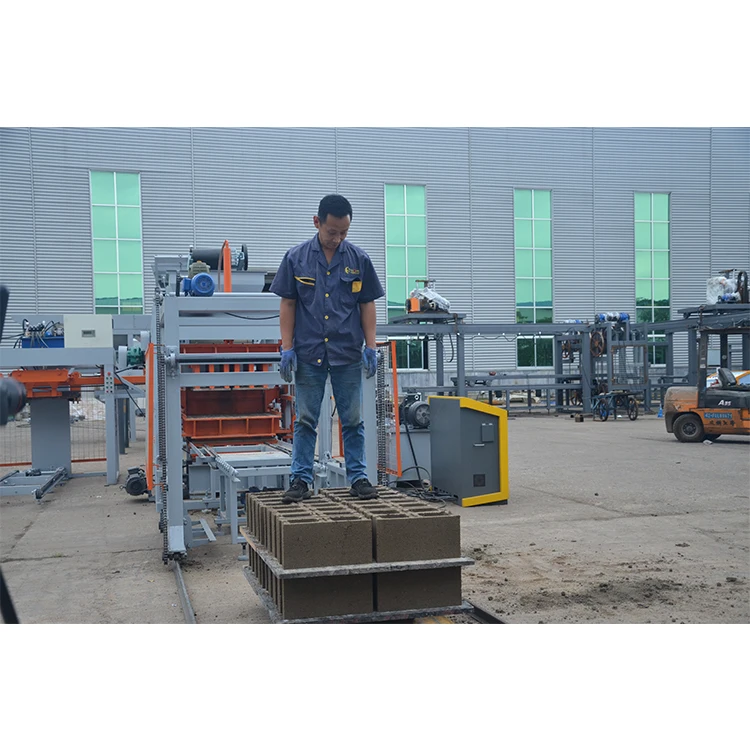
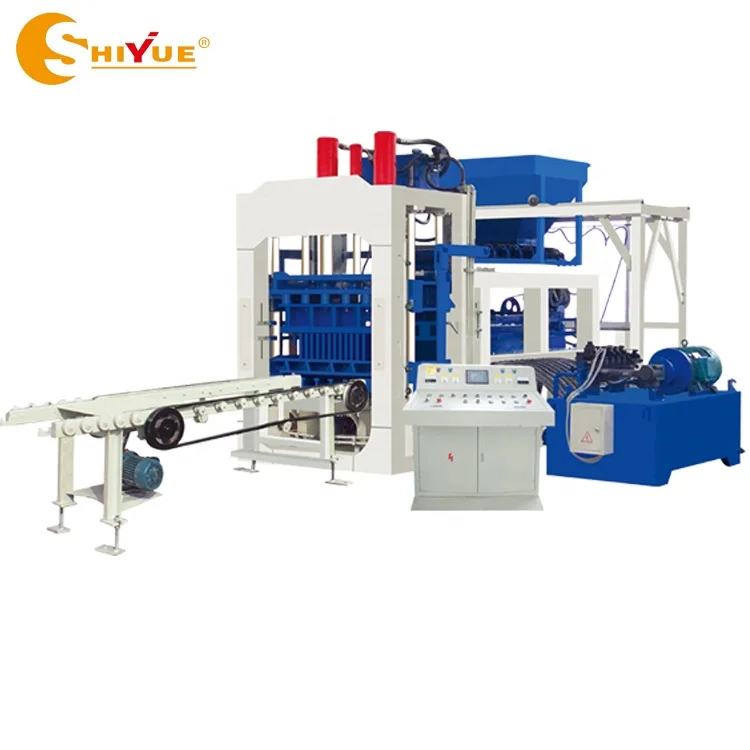
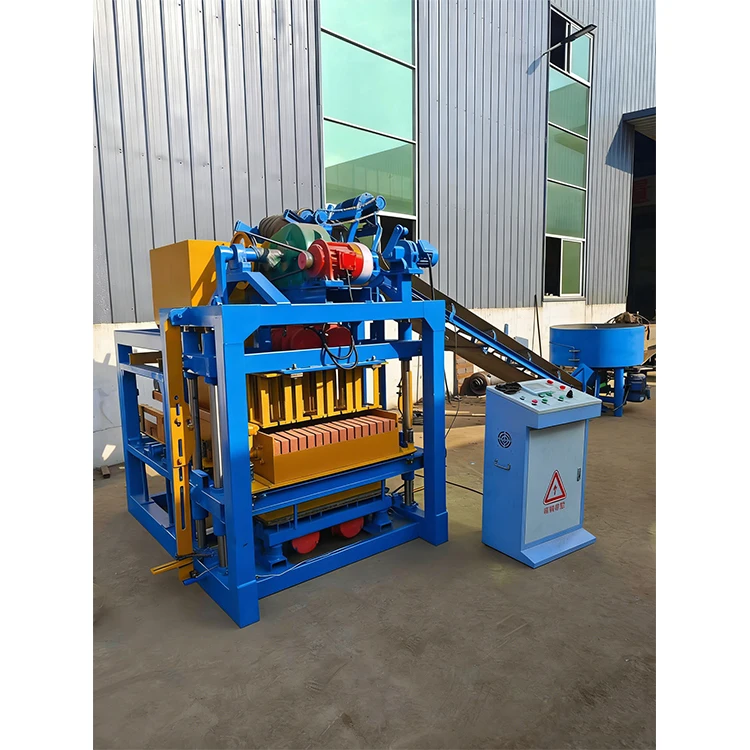
Matched System Specification — the QT12-15 block machine, mould, pallet and handling stations are engineered as a single production line rather than sourced from separate suppliers, so cycle times align from raw material feeding through to stacking.
Technical Specifications
| Parameter |
Value |
| Model |
QT12-15 |
| Product Type |
Automatic Concrete Block Making Machine |
| Control System |
PLC with human-machine interface (HMI) |
| Vibration System |
Dual vibration sources, frequency conversion braking, synchronous vertical vibration |
| Hydraulic System |
Computer-controlled flow pressure |
| Feeding System |
Semi-closed screen reticular rotational forced feeding unit |
| Loading Unit |
Special hydraulic loading unit for mass automatic production |
| Molding Cycle (Hollow block 400x200x200mm) |
15-20 seconds |
| Output Capacity (Hollow block 400x200x200mm) |
2160-2880 pcs/h, 17280-23040 pcs/8hr (based on 12 pcs/mould) |
| Molding Cycle (Hollow block 400x150x200mm) |
15-20 seconds |
| Output Capacity (Hollow block 400x150x200mm) |
2520-3360 pcs/h, 20160-26880 pcs/8hr (based on 14 pcs/mould) |
| Molding Cycle (Solid brick 240x115x53mm) |
15-20 seconds |
| Output Capacity (Solid brick 240x115x53mm) |
9360-12480 pcs/h, 74880-99840 pcs/8hr (based on 52 pcs/mould) |
| Molding Cycle (Rectangular paver 200x100x60mm) |
20-25 seconds |
| Output Capacity (Rectangular paver 200x100x60mm) |
5040-6300 pcs/h, 40320-50400 pcs/8hr (based on 35 pcs/mould) |
| Molding Cycle (Zigzag brick 225×112.5x60mm) |
20-25 seconds |
| Output Capacity (Zigzag brick 225×112.5x60mm) |
3888-4860 pcs/h, 31104-38880 pcs/8hr (based on 27 pcs/mould) |
| Automation Level |
Automatic with hydraulic loading unit |
| Key Features |
Dual-source synchronous vertical vibration, semi-closed forced feeding, PLC-controlled HMI |
Application Suitability
| Application |
Material or Output |
| Large-scale hollow block production |
Crushed stone, sand, and cement mixes for hourdis and porous blocks |
| Solid brick manufacturing |
Dense aggregate and cement for structural masonry units |
| Rectangular paving brick output |
Fine aggregate blends for heavy-duty infrastructure surfaces |
| Zigzag interlocking paver production |
Graded sand and cement for high-load pavement applications |
Why "Cycles Per Hour" Misleads Buyers of the Automatic Block Machine Range
Every capacity figure must be tied to a specific block format, mould cavity count, and cycle time.
When reviewing the automatic block machine range, I have seen buyers sign contracts based on a single peak cycles-per-hour number, only to find the daily pallet output falls short because the quotation assumed a block format they never intended to produce. A press running 400×200×200mm hollow blocks with 12 cavities delivers a different daily volume than one running 240×115×53mm solid bricks with 52 cavities, even if the cycle time appears identical on paper. [NEED_CITE: realistic block output calculation methods by format]

Where the QT12-15 Sits in the Automatic Block Machine Range
This high-output tier is designed for stationary plants where daily production volume justifies the investment in a fully automated press and supporting line. Buyers evaluating the automatic block machine range typically land here when their target output exceeds what mid-tier models can sustain over an eight-hour shift, or when the block formats they sell require a larger pallet and more mould cavities per cycle.
Comparing Tiers Before Committing Capital
The step up from a mid-range automatic model is not just about cycle speed; it involves a larger pallet, higher vibration force, and a hydraulic system sized for continuous mass production. A plant owner must weigh the additional floor space, curing area, and forklift capacity against the volume gain. [NEED_CITE: block plant footprint scaling by output tier]
Vibration, Pressure, and the Feeding System
The QT12-15 uses dual-source synchronous vertical vibration with frequency conversion braking, which controls how the vibration energy is delivered and stopped. This matters because a clean stop prevents the block surface from cracking as the mould lifts. The computer-controlled hydraulic flow pressure works in tandem with vibration to compact the mix; if hydraulic pressure is too low relative to the vibration force, blocks emerge with uneven density. The semi-closed screen reticular forced feeding unit distributes material across the mould cavity before the press closes, which is critical when running mixes with varying aggregate sizes. Pallet size must match both the mould footprint and the buyer’s existing curing racks, a detail that often surfaces only after the machine arrives on site.
The Cost of a Mismatched Line Configuration
When the pallet size specified for a high-output press does not align with the curing racks already in the buyer’s yard, every pallet must be manually re-stacked before curing, which erases the labour savings the automation was supposed to deliver. Similarly, if the voltage and frequency are not confirmed before production, the PLC and hydraulic pumps may arrive incompatible with the local grid, delaying commissioning by weeks. [NEED_CITE: voltage and frequency standards by export market]
Why Buyers Source This Tier Here
The QT12-15 is configured against the buyer’s actual mix design and local aggregate, not a catalogue default, so the vibration and hydraulic parameters are set for the material that will actually run through the press. Machine, mould, pallet, and handling equipment are specified as one matched system, meaning the pallet feeder cycle time is timed to the press cycle, and the stacking station is rated for the peak output. Mould design covers the formats the buyer’s market actually sells, with custom drawings available for non-standard sizes. The automation level is selectable, allowing a buyer to start with semi-automatic pallet handling and add full stacking later on the same platform.
Documentation & Verification
- Line layout and capacity calculation stating the block format assumed for every output figure
- Machine specification sheet confirming voltage, frequency, PLC display language, and pallet size
- Mould drawing and format list showing standard and custom tooling options
- Factory test record and packing photographs before shipment
Installation, Commissioning & Support
- Foundation plan sized for the QT12-15 vibration load and hydraulic unit weight
- Dedicated power circuit confirmed for the machine’s rated voltage and frequency before arrival
- PLC display language and HMI dialogue set to the operator’s working language
- On-site commissioning includes mould change rehearsal and cycle time verification per block format
- Operator training covers vibration frequency adjustment and hydraulic pressure tuning for local aggregate
What to Include in Your Inquiry
To size the QT12-15 correctly within the automatic block machine range, provide the target block formats, required daily output per format, and the local raw material source including aggregate grading and cement type. Specify the available curing area dimensions, existing forklift capacity, and local voltage and frequency so the supporting equipment can be matched before the quotation is issued.
Frequently Asked Questions
Q: How do I determine which tier of automatic block machine matches my daily output target?
A: Start with the block format you sell most and the daily volume required. Each tier in the automatic block machine range is rated with output figures tied to specific block sizes and mould cavity counts. Compare those figures against your target, then factor in the curing area and pallet handling capacity needed to sustain that output over a full shift.
Q: What block formats does the QT12-15 cover, and which need custom moulds?
A: Standard moulds cover 400×200×200mm and 400×150×200mm hollow blocks, 240×115×53mm solid bricks, 200×100×60mm rectangular pavers, and 225×112.5×60mm zigzag bricks. Formats outside these dimensions require custom mould design to buyer drawings, which is included in the line configuration proposal.
Q: How is capacity calculated, and what does each figure assume?
A: Each output figure is calculated from the mould cavity count, the cycle time range for that specific block format, and an eight-hour shift. For example, the hollow block figure assumes 12 cavities and a 15-20 second cycle. No single peak number is quoted without its format and cavity premise.
Q: Can I start semi-automatic and upgrade to full automation on the same QT12-15 platform?
A: The platform supports selectable automation levels. A buyer can begin with manual or semi-automatic pallet handling and stacking, then add automatic pallet feeding, stacking, and cubing stations later without replacing the press itself.

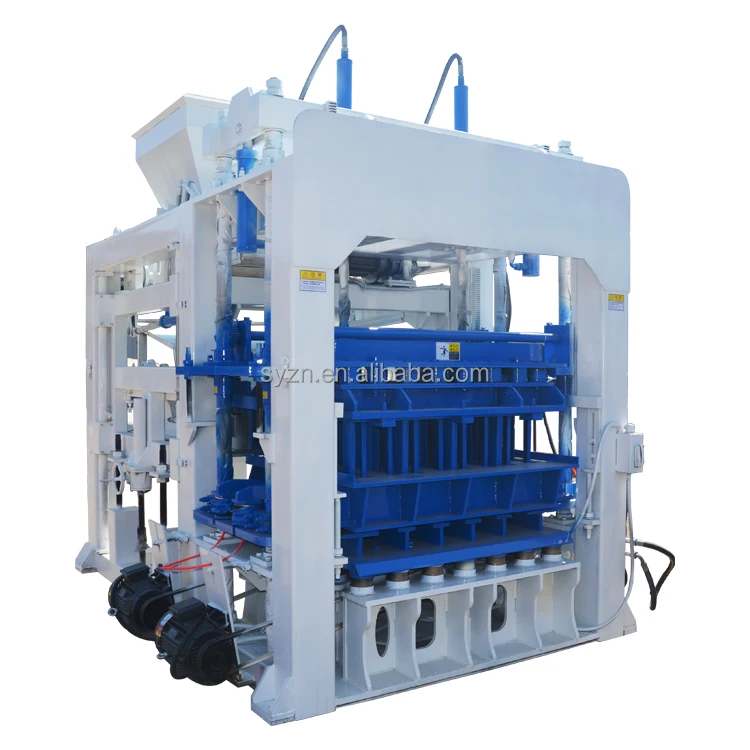
 Automatic block machine