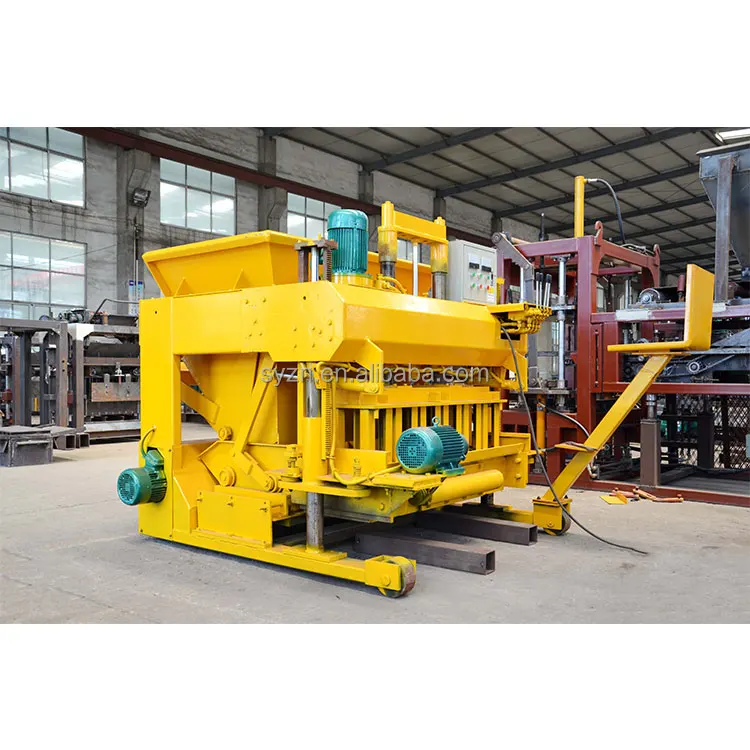
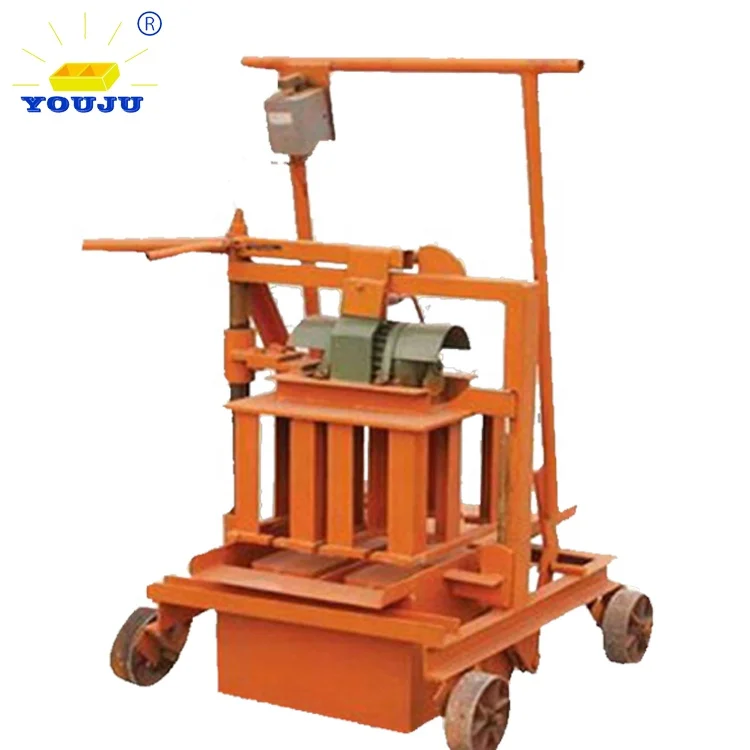
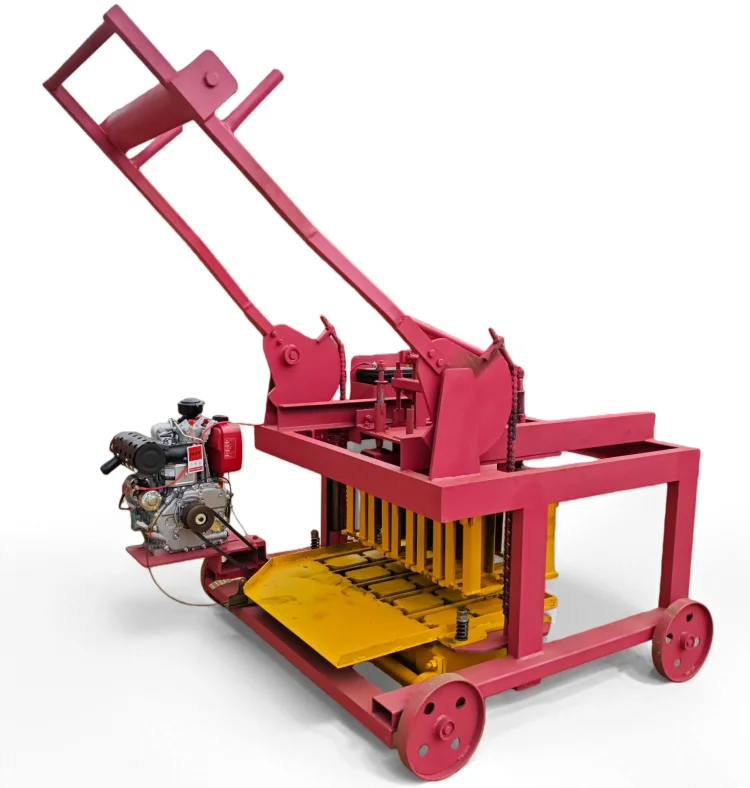
Single-Focus Block Machinery — the QMR4-45 diesel mobile block machine is specified as one matched system covering press, mixer and trolley rather than assembled from separate suppliers.
Technical Specifications
| Parameter |
Value |
| Model |
QMR4-45 |
| Product Type |
Mobile Concrete Block Making Machine |
| Power Source |
Diesel (Electric option available) |
| Rated Power |
8 hp |
| Molding Cycle |
45 s (basis not stated in source — confirm block format / material / thickness) |
| Molding Form |
Vibration and Pressure |
| Vibration Force |
60 kN |
| Total Weight |
800 kg |
| Overall Dimensions (L×W×H) |
2420 × 1320 × 1650 mm |
| Automation Level |
Manual / mobile egg-laying, palletless operation |
| Pallet Size |
N/A (palletless operation) |
| Mould Format Options |
Hollow block, solid block, paver brick, fly ash brick |
| Stacking Method |
Manual, blocks laid directly on ground |
| Basic Equipment Included |
JZC350 Diesel Concrete Mixer or JQ350 Diesel Mixer with Electric Generating Unit; Trolley |
| Assembly State |
Fully assembled, mobile unit |
Application Suitability
| Application |
Material or Output |
| On-site hollow block production |
Crushed stone, river sand and cement at project sites without fixed plant |
| Paving brick manufacturing for small contractors |
Local aggregate and cement for interlocking or rectangular pavers |
| Remote or off-grid block making |
Diesel-powered operation where grid electricity is unavailable |
| First block plant for entrepreneurs |
Low-capital entry into solid block and fly ash brick production |
| Infrastructure project supply |
On-site production eliminating transport of purchased blocks |
What "45 Seconds per Cycle" Actually Means on Site
Cycle time only translates to daily output once you fix the block format, mix design and curing pace.
Quoted cycle figures on mobile machines rarely name the block size they were measured on. A 45-second cycle on a small solid block is a very different daily tonnage from the same cycle on a 400 mm hollow block. I have stood beside a QMR4-45 in West Africa where the operator was producing hollow blocks at nearly half the rate the brochure implied, simply because the quoted cycle had been measured on a smaller format. Once we confirmed the target block size and recalculated, the daily plan matched reality. A diesel mobile block making machine for sale is only as honest as the capacity sheet behind it. [NEED_CITE: block format assumptions in machine capacity quotations]

Where the Mobile Tier Sits in the Range
The QMR4-45 occupies the entry-mobile position in the Shiyue block machine range. It is designed for buyers who need to produce blocks at the point of use — a housing site, a road project, a rural compound — without investing in fixed foundations, a curing shed, or a pallet inventory. The egg-laying design means the machine moves forward after each cycle, leaving blocks on the ground to cure in place. This eliminates the entire pallet-handling loop: no pallet purchase, no pallet return conveyor, no forklift shuttling racks to a curing area. For a contractor whose project stretches across a large site, that simplicity is the main reason to choose mobile over stationary.
Diesel Power and the Off-Grid Reality
Many project sites in sub-Saharan Africa, parts of Southeast Asia and Latin America simply do not have reliable three-phase power. The QMR4-45 ships with a diesel engine as standard, paired with a JZC350 or JQ350 diesel mixer, so the entire batching and pressing loop runs independently of the grid. An electric generating unit is available as part of the package when local voltage permits, giving buyers a path to switch fuel sources later if grid power arrives. The key decision at inquiry stage is not just diesel versus electric but whether the optional generating unit matches the local voltage and frequency — a detail that causes commissioning delays when overlooked. [NEED_CITE: voltage and frequency standards by export market]
Reading the Numbers That Matter
The 60 kN vibration force is matched to the compact mould box of the QMR4-45. Vibration force and hydraulic or mechanical pressure together determine the density of the green block as it leaves the mould. On a palletless machine, that density must be high enough for the block to hold its shape the instant it is set on the ground — there is no pallet to support it during the first minutes of curing. The 800 kg total weight keeps the machine portable by pickup or small flatbed, yet heavy enough that frame mass contributes to vibration damping during the press cycle. The 2420 × 1320 × 1650 mm footprint means the unit fits inside a standard 20-foot container for shipment, and once on site it can be repositioned along a curing lane without heavy lifting equipment. Mould change involves swapping the mould box and adjusting the feed tray; the exact changeover time depends on the format and should be confirmed before committing to multiple mould orders.
When Palletless Becomes a Constraint
Palletless operation saves capital upfront, but it also fixes your curing layout to whatever flat ground the machine can traverse. If the project site has uneven terrain, soft soil after rain, or limited flat area, the blocks may cure on a surface that causes breakage at the base. I have seen contractors lose a noticeable share of their daily output to ground-contact damage in the first week before they leveled and compacted a proper curing lane. The other hidden cost is manual stacking: every block is picked up and moved by hand once it has gained enough strength, which sets a practical ceiling on daily volume that no cycle-time calculation can overcome. [NEED_CITE: manual handling limits on egg-laying block production]
Why Buyers Source This Machine Here
Block machinery is the single focus at Shiyue, so the QMR4-45 is supplied as a matched system — press, mixer and trolley specified together rather than sourced from three separate vendors. The configuration is set against the buyer’s actual mix design and local aggregate, not a generic catalogue default. Moulds are designed for the block dimensions the buyer’s market actually sells, and custom drawings are available when standard formats do not match. Automation is selectable across the range, so a buyer who starts with the QMR4-45 today can move to a semi-automatic stationary line later without switching suppliers. Installation support and operator training are included, with wear parts and mould replacement available from the same source.
Documentation & Verification
- Line layout and capacity calculation stating the block format assumed for the 45-second cycle
- Mould drawing and format list confirming dimensions before production
- Machine specification sheet covering diesel engine rating and mixer model
- Voltage and control language confirmation for the optional electric generating unit
- Factory test record on the buyer’s target block format before dispatch
- Packing photographs and customs documentation support for container loading
Installation, Commissioning & Support
- Level and compact a curing lane of sufficient length to receive blocks from the 2420 mm long machine footprint
- Confirm diesel fuel supply and storage for the 8 hp engine and JZC350 mixer before commissioning day
- Machine ships fully assembled; position on site with a pickup or small flatbed, no crane required
- First production run verifies vibration force and mix proportion against the buyer’s local aggregate
- Mould change procedure trained on-site so operators can swap formats without external technician visits
- Wear parts list provided with the machine covering vibration springs and mould liner replacements
Before You Send an Inquiry
To size the QMR4-45 correctly, tell us the block formats your market sells — dimensions, wall thickness for hollow blocks, and any interlocking profile requirements. Share your local raw materials, especially the sand or aggregate source and whether fly ash is available nearby. If you are considering the electric generating unit option, confirm your site voltage and frequency so we can match the unit before build.
Frequently Asked Questions
Q: Does the 45-second cycle time apply equally to hollow blocks and paving bricks?
A: No. The cycle time depends on block format, material fill depth and the vibration duration needed for adequate compaction. A thin paver may complete a cycle faster than a deep hollow block. Request a capacity calculation that names the specific format you intend to produce so the daily output figure reflects your actual product, not a generic average.
Q: What mould sizes are available for the QMR4-45?
A: The machine supports hollow block, solid block, paver brick and fly ash brick moulds. Specific cavity dimensions and block counts per cycle are configured to your market requirements. Ask for the mould drawing and format list during the inquiry stage so you can confirm the machine produces the exact block dimensions your customers expect before the order is placed.
Q: Can I switch from diesel to electric power later?
A: Yes. The QMR4-45 is available with an electric option, and the transition involves replacing the diesel engine with an electric motor of equivalent rating and confirming your site voltage and frequency. The mixer may also need a matching electric motor swap. Plan the conversion during a scheduled downtime window to avoid disrupting ongoing production commitments.
Q: How do I manage curing without pallets?
A: Blocks are laid directly on leveled, compacted ground and left in place until they gain handling strength. You need a curing lane long enough to accommodate a full day’s output and a water source for moist curing. Plan lane layout before the machine arrives so operators are not improvising ground preparation during the first production week.
Q: When should I consider moving from this mobile machine to a semi-automatic line?
A: The shift makes sense when daily volume targets exceed what manual stacking and ground curing can support, or when block consistency demands pallet-based curing and controlled stacking. The QMR4-45 remains useful for satellite sites even after a main plant is established. Discuss your growth trajectory during the initial inquiry so the machine choice leaves room for a logical next step.

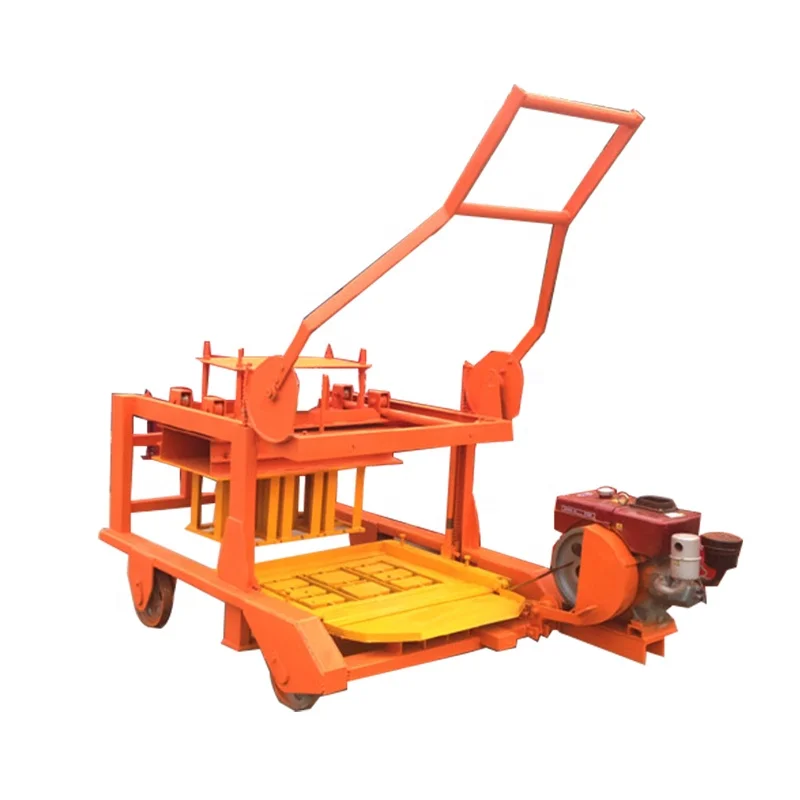
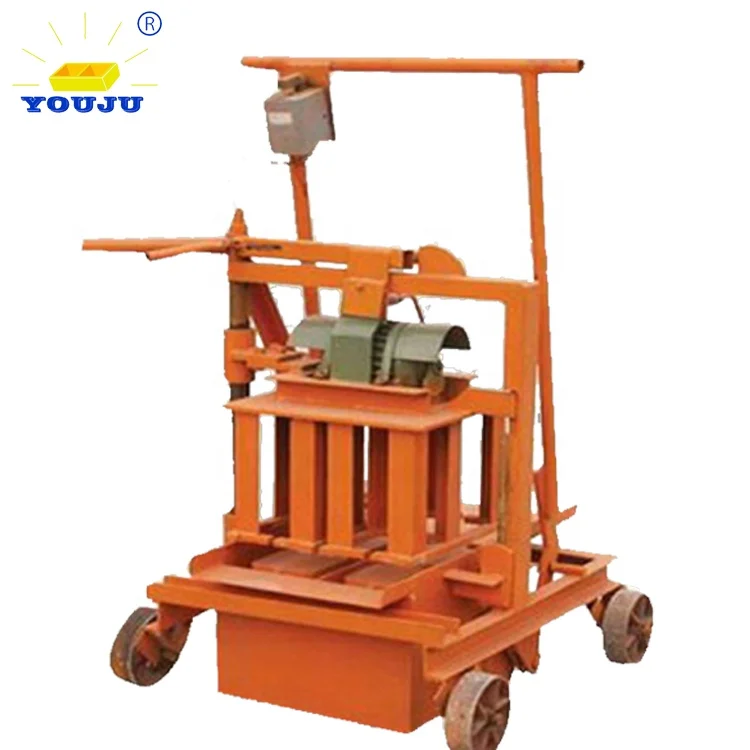 Mobile block machine