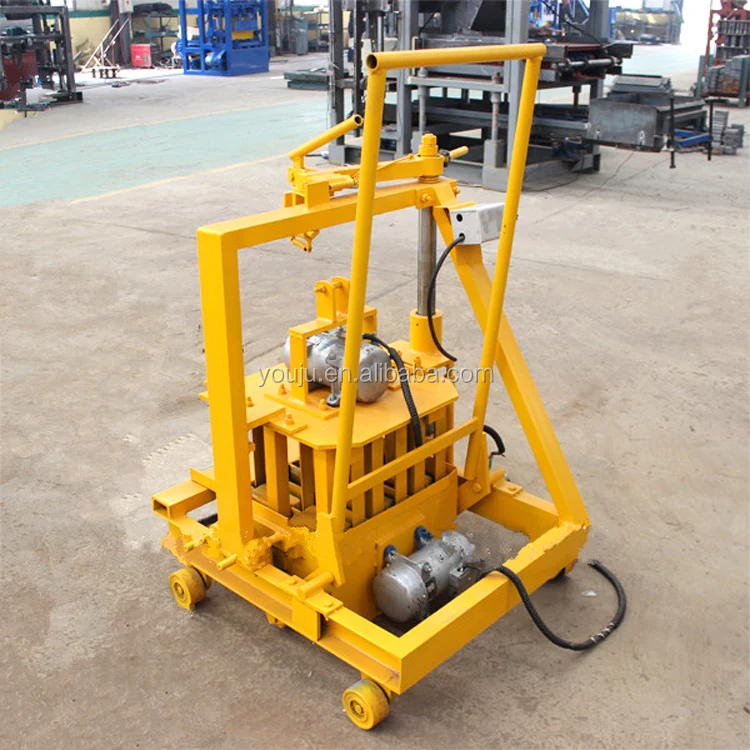
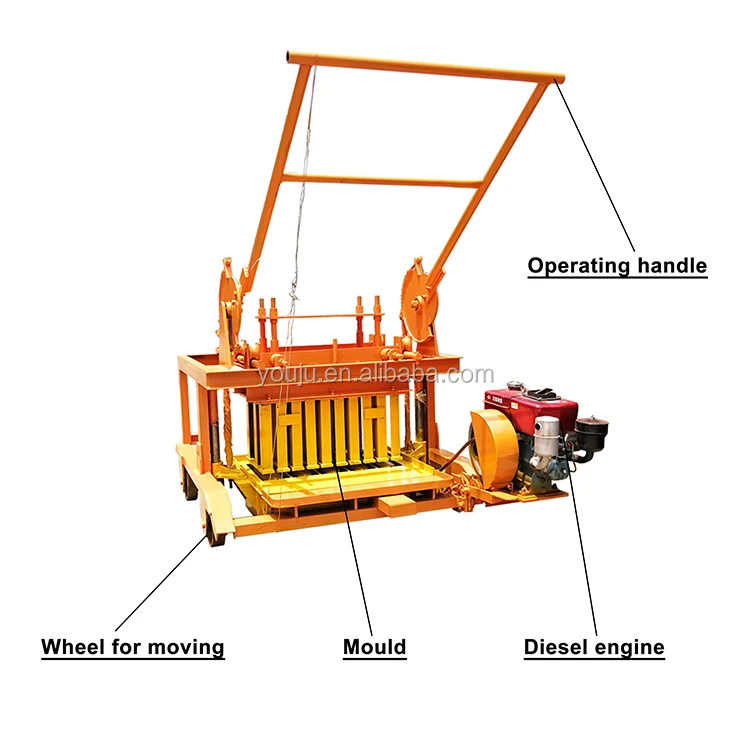
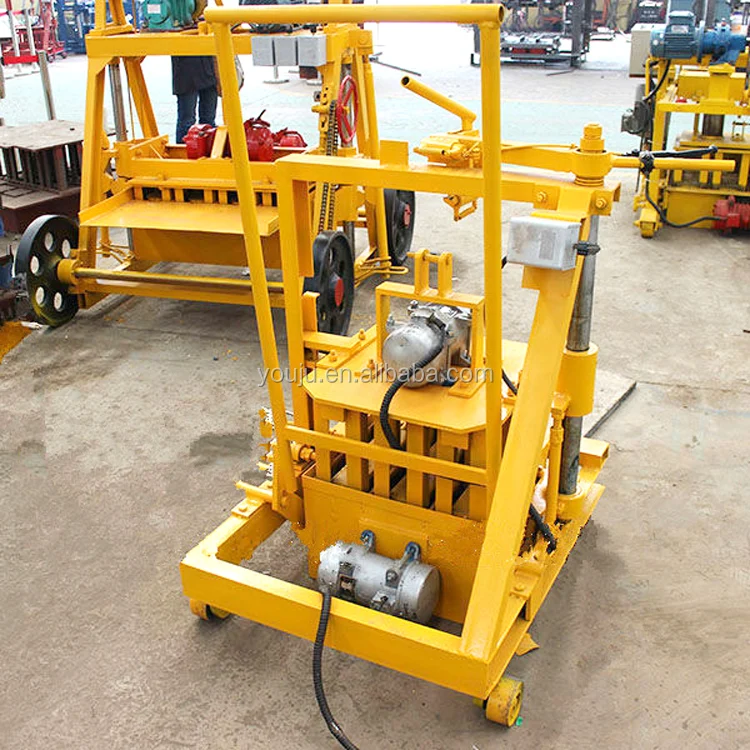
Pallet-less egg-laying design — the QMR4-45 produces hollow, solid, and paver blocks directly on the ground, eliminating pallet costs and curing-rack infrastructure from your first day of operation.
Technical Specifications
| Parameter |
Value |
| Model |
QMR4-45 |
| Product Type |
Mobile Diesel/Electric Block Making Machine |
| Power Source |
Diesel (Electric optional) |
| Rated Power |
8 hp |
| Molding Cycle |
45 s (basis to be confirmed by block format) |
| Molding Form |
Vibration and Pressure |
| Vibration Force |
60 kN |
| Pallet Size |
Not applicable — pallet-less egg-laying design |
| Overall Dimensions (L×W×H) |
2420 × 1320 × 1650 mm |
| Net Weight |
800 kg |
| Automation Level |
Manual mobile operation |
| Assembly State |
Mobile unit, no fixed plant required |
| Basic Equipment Included |
JZC350 or JQ350 Diesel Concrete Mixer; Trolley |
Application Suitability
| Application |
Material or Output |
| Hollow block production on construction sites |
Crushed stone, sand, and cement mixes |
| Solid brick manufacturing for small plants |
Fly ash, sand, and cement blends |
| Paver brick output for local yards |
Granite dust, fine aggregate, and cement |
| On-site block production without a fixed plant |
Locally sourced aggregate and cement |
Why "45 Seconds per Cycle" Needs a Format Attached
A cycle time only means something when you know which block is being pressed.
I have watched buyers sign off on a mobile block machine because the spec sheet said 45 seconds, then arrive on site to find that figure assumed a small solid brick — not the 200 mm hollow block their market actually buys. The QMR4-45 mobile block machine manufacturer documentation lists 45 s as the molding cycle, but the real daily output shifts noticeably depending on whether you are running pavers, solid bricks, or hollow blocks. Without that format stated up front, capacity planning becomes guesswork. [NEED_CITE: block format assumptions in cycle time quotations]

Where the QMR4-45 Sits in the Range
The QMR4-45 occupies the entry tier of the SHIYUE lineup, aimed at buyers who need production capability without committing to a fixed batching plant. It sits below the semi-automatic stationary presses and well below the fully automatic lines with pallet feeders and stackers. For a contractor pouring a housing development or an entrepreneur testing a local block market, this mobile block machine keeps capital outlay low while still covering hollow, solid, and paver formats through mould swaps.
What Diesel Power Changes on Site
An 8 hp diesel engine means the QMR4-45 runs independently of grid reliability — a practical advantage on remote project sites or regions where three-phase supply is unavailable. The electric option exists for buyers who have stable power and prefer lower fuel costs over the long run. Either way, the machine travels with its mixer and trolley, so you are not sourcing ancillary equipment separately. [NEED_CITE: diesel versus electric operating cost considerations for mobile block presses]
Reading the Numbers That Matter
The 60 kN vibration force works together with mechanical pressure to compact the mix inside the mould box. In egg-laying machines, vibration is the primary densification mechanism because there is no hydraulic ram pushing from above — so that 60 kN figure directly influences block strength and surface finish. The 45-second cycle governs how many moulds you can fill per shift, but actual throughput also depends on how fast your crew can reposition the machine and feed the mixer. At 800 kg net weight, the unit is light enough to tow between sites on a flatbed yet heavy enough to resist walking during vibration.
When the Wrong Mixer Bottlenecks the Press
Pairing the QMR4-45 with an undersized or poorly maintained mixer means the press sits idle waiting for concrete. The included JZC350 or JQ350 diesel mixer is sized to keep pace with a single mobile unit, but if your crew adds a second machine later, that mixer becomes the constraint. Buyers who overlook this end up with a press capable of more cycles than the batch supply can support, leaving output far below what the spec sheet implies. [NEED_CITE: mixer-to-press throughput matching in mobile block production]
Why Buyers Source From a Single-Focus Supplier
Block machinery is the only product category here, which means the QMR4-45, its moulds, and the supporting mixer are specified as one system rather than assembled from unrelated vendors. Mould drawings are prepared against the block formats your market actually sells, not pulled from a generic catalogue. The diesel engine, vibration motor, and mould box are tested together at the factory before crating. Configuration conversations start with your local aggregate sample and target block format, so the machine arrives matched to what you will actually produce.
Documentation & Verification
- Factory test record run on your specified block format before dispatch
- Mould drawing and format list for every block type included in your order
- Machine specification sheet confirming vibration force and power rating
- Operation and maintenance manual covering diesel engine and mould change procedures
Installation, Commissioning & Support
- No foundation required — the QMR4-45 operates on level compacted ground at your site
- Diesel engine arrives pre-assembled; electric option requires confirmed voltage and frequency before wiring
- Mould box and vibration motor inspected and tested as a single unit at factory
- First-run parameter adjustment based on your aggregate sample and target block strength
- Wear parts list provided with recommended replacement intervals for vibration springs and mould liners
What to Share Before Requesting a Quote
To size the QMR4-45 correctly, send your target block formats with dimensions, the aggregate types available locally, and whether your site has grid electricity or requires diesel-only operation. If you already own a mixer or curing area, mention those so the line layout accounts for existing equipment. A small sample of your aggregate — even a kilogram — lets the factory confirm that the vibration force and mix design will produce the block strength your market expects.
Frequently Asked Questions
Q: What is the real daily output of the QMR4-45, and which block format does the cycle time assume?
A: The 45-second cycle is a base figure that varies with block format. A small solid brick completes faster than a large hollow block because mould fill and compaction differ. Always ask for a capacity calculation that names the exact block dimensions and mix used, so you can plan shifts and curing space accurately.
Q: Diesel vs. electric power — how do I choose for my site?
A: Diesel suits remote sites without reliable three-phase electricity and lets you move between locations freely. Electric reduces per-block fuel cost where grid power is stable and affordable. Confirm your site voltage and frequency before ordering the electric option so the motor and wiring match local supply.
Q: Which block formats can one QMR4-45 produce, and how long does a mould change take?
A: The machine covers hollow blocks, solid bricks, pavers, and fly ash bricks through mould swaps. Mould change time is not published as a fixed figure because it depends on crew familiarity and bolt configuration. Request the mould drawing and format list for each block type you plan to produce.
Q: Where does the QMR4-45 sit compared to semi-automatic and automatic tiers?
A: It is the entry tier — pallet-less, manually operated, and designed for on-site or low-investment production. Semi-automatic and automatic tiers add pallet handling, PLC control, and stacking systems for higher daily volumes. Buyers often start with the QMR4-45 to test a market before scaling to a stationary line.
Q: What additional equipment do I need beyond the mixer and trolley?
A: The QMR4-45 ships with its diesel mixer and trolley, so you can produce blocks immediately on level ground. You will need a water supply for mixing, a curing area where blocks can dry undisturbed, and basic hand tools for mould changes. No pallets, curing racks, or fixed foundations are required.

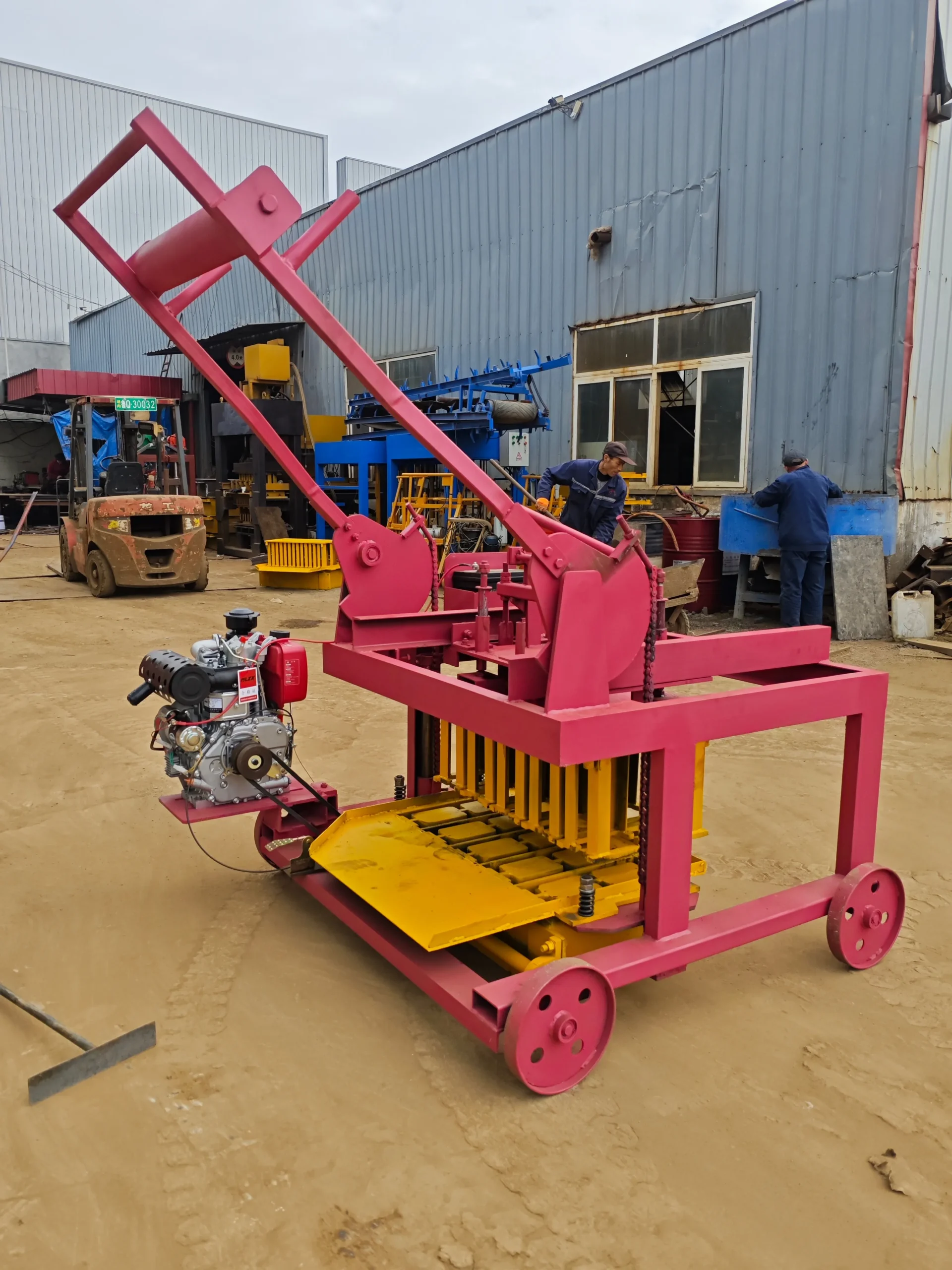
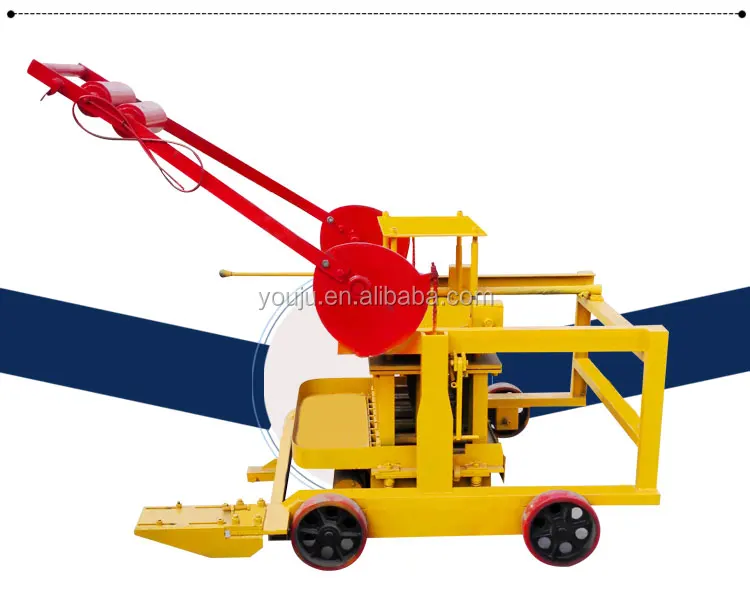 Mobile block machine