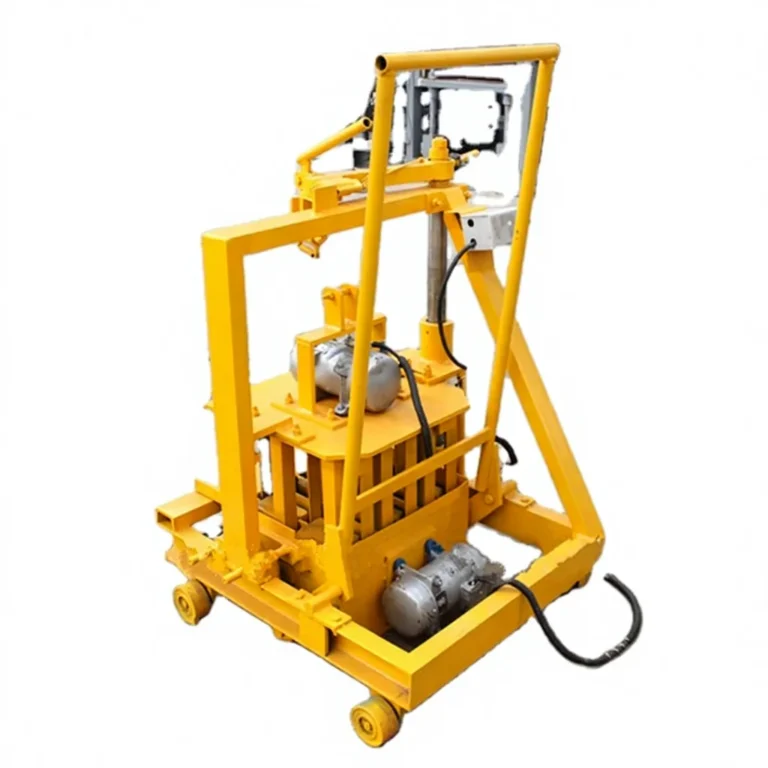
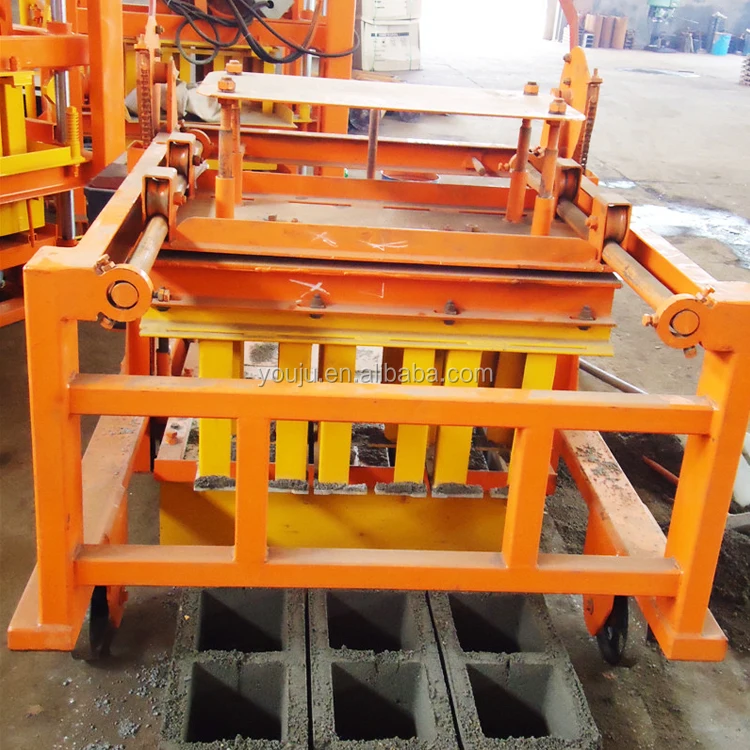
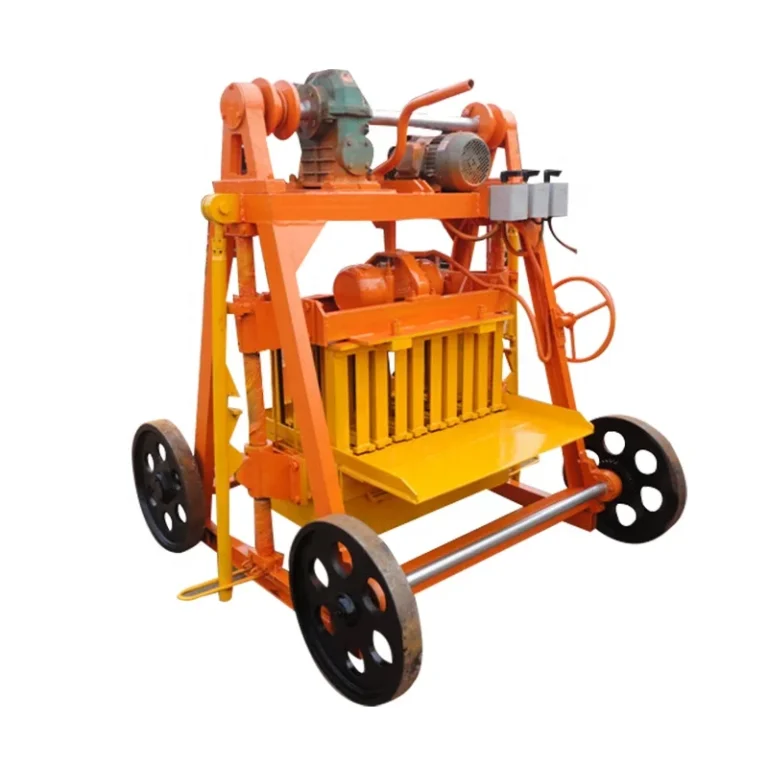
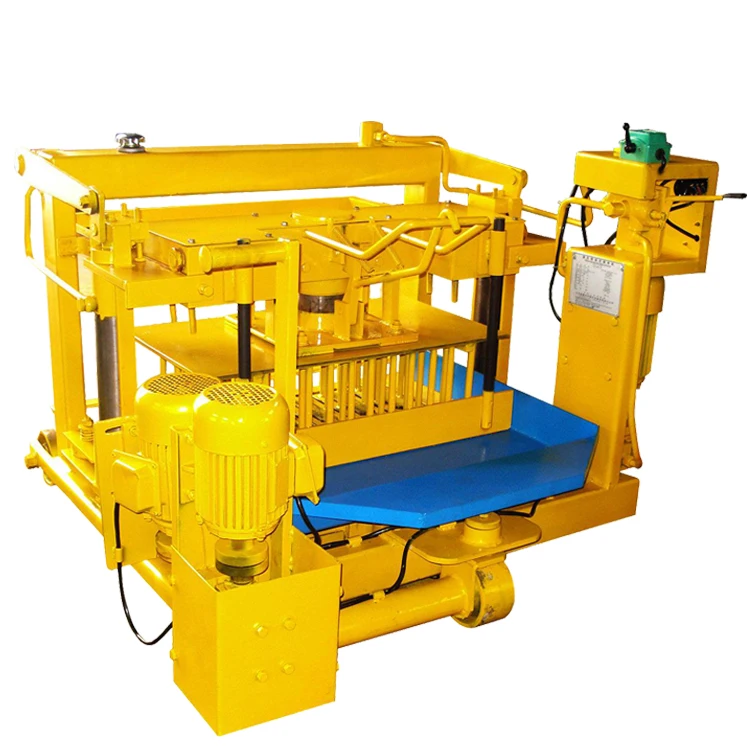
Engine-Driven Mobility — the QMJ4-45 produces hollow blocks directly on any cement ground without pallets or grid power, keeping your first plant footprint to the space you can pour concrete on today.
Technical Specifications
| Parameter |
Value |
| Model |
QMJ4-45 |
| Product Type |
Mobile Egg Laying Block Making Machine |
| Molding Capacity |
4 pcs/mould (400×200×200mm hollow block) |
| Vibration Frequency |
2400 r/min |
| Daily Output (400×200×200mm) |
3000 pcs per 8-hour shift (4 pcs/mould, 40-45s cycle) |
| Daily Output (400×150×200mm) |
3500 pcs per 8-hour shift (5 pcs/mould, 40-45s cycle) |
| Daily Output (400×120×200mm) |
4500 pcs per 8-hour shift (6 pcs/mould, 40-45s cycle) |
| Molding Cycle |
40-45 s |
| Vibration Method |
Mould vibration (twice-vibration core) |
| Demold Method |
Manual |
| Turning Method |
Manual |
| Total Power |
6 kW |
| Power Source |
Diesel / Petrol engine |
| Pallet Requirement |
None (egg-laying type) |
| Automation Level |
Manual / egg-laying (mobile) |
| Mould Format Options |
400×200×200mm / 400×150×200mm / 400×120×200mm hollow block |
| Voltage & Frequency |
Not applicable (engine-driven) |
| Warranty |
One year for the whole machine |
Application Suitability
| Application |
Material or Output |
| On-site hollow block production |
Crushed stone, river sand, cement — no fixed plant required |
| Remote construction sites |
Diesel or petrol engine operation where grid power is unavailable |
| Small-scale block making for contractors |
400×200×200mm to 400×120×200mm hollow blocks on existing cement ground |
| First plant for entrepreneurs |
Low-capital entry with no pallet inventory or curing rack investment |
| Housing project block supply |
Local production at the build site, eliminating block transport costs |
What "3000 Blocks a Day" Actually Means on Your Site
Daily output depends entirely on which hollow block size your market buys and how your local aggregate behaves under vibration.
Most mobile block machine quotations state a single capacity figure without naming the block format behind it. A buyer expecting 4500 pieces per day may receive a machine moulded for 400×200×200mm blocks, where the realistic figure sits closer to 3000 per eight-hour shift. The difference is not a defect — it is geometry. Larger blocks fill the mould in fewer pieces per cycle. When I send a configuration proposal, each output tier is stated against a named block format and cycle time so the math is visible before the order is placed. Local aggregate grading and moisture also shift the cycle: a sandy mix with high fines may need a few extra seconds of vibration to reach target density [NEED_CITE: effect of aggregate grading on concrete block compaction time].

Where the QMJ4-45 Sits in a Block Machine Range
The mobile egg-laying tier is the starting point for buyers who need blocks on a project site without investing in a fixed plant, pallets, or curing racks. This mobile block machine manufacturer positions the QMJ4-45 below semi-automatic and fully automatic lines in both capital outlay and daily volume. A semi-automatic line adds pallet handling and a mixer; an automatic line adds stacking and cubing. The QMJ4-45 strips all of that away and leaves you with an engine, a vibrating mould, and the ground beneath your feet.
Eliminating Pallets Changes Your Curing Layout
Egg-laying machines deposit each block directly onto the floor and move forward, leaving a row of wet blocks behind. This removes the entire pallet loop — no pallet purchase, no pallet return conveyor, no rack storage. The trade-off is floor space: an eight-hour shift of 400×200×200mm blocks covers a considerable area of flat, level cement ground. The curing zone must be planned before the first block is laid [NEED_CITE: floor area planning for egg-laying block production sites]. Once cured, blocks are collected manually or with a small loader.
Vibration Frequency, Mould Count, and Real Cycle Time
The 2400 r/min vibration frequency drives compaction through the mould walls rather than through a hydraulic ram pressing from above. Twice-vibration molding means the core and outer shell vibrate together, which improves density uniformity across the block cross-section. The 40–45 second cycle covers feed, vibration, demold, and the machine stepping forward. Mould count per cycle — four, five, or six pieces — is set by the block width you choose. A 120mm-wide wall block fits six per mould, while a 200mm block fits four. The 6 kW total power is modest and within the reach of a small diesel engine, which is why this unit runs without grid electricity.
When the Wrong Ground Surface Doubles Your Breakage Rate
Egg-laying machines are unforgiving about floor condition. Uneven or soft ground causes blocks to settle on one side before initial set, producing dimensional variation and corner damage during collection. A buyer who skips the cement screed preparation step will see breakage climb noticeably in the first weeks. This cost never appears in the machine quotation — it shows up as lost saleable output and rework labour [NEED_CITE: floor preparation standards for mobile block laying operations].
Why Source This Mobile Block Machine Manufacturer Directly
Configuration starts with the block format your market actually buys, not a catalogue default — the QMJ4-45 ships with moulds matched to your confirmed sizes. The engine type and fuel specification are agreed before production so the unit starts on arrival. Mould drawings and a format list are provided so you can verify dimensions before the machine leaves the factory. Capacity calculations state the assumed block format for every output figure in the proposal. The one-year whole-machine warranty covers structural and mechanical components from the date of commissioning.
Documentation & Verification
- Line layout showing block laying path and curing area sized to your confirmed daily output
- Machine specification sheet with vibration frequency, engine type, and total power confirmed
- Mould drawing and format list covering all selected hollow block sizes
- Factory test record on your chosen block format before dispatch
- Operation and maintenance manual with one-year warranty terms
- Packing photographs for container loading verification
Installation, Commissioning & Support
- Flat, level cement ground required — the QMJ4-45 lays blocks directly without pallets
- Diesel or petrol engine fuel specification confirmed before shipment to match local supply
- Machine arrives assembled; mould change requires manual bolt removal and alignment
- First-run commissioning includes vibration tuning to your local aggregate and mix design
- Operator training covers mould swap procedure, cycle timing, and daily greasing points
- Wear parts list included with recommended spare mould and vibration motor brush stock
What to Send With Your Inquiry
Tell us the hollow block sizes your local market sells and the daily volume you need to hit. Share a sample of your available sand or aggregate so we can assess grading and confirm the vibration setting. If your site has grid electricity as a backup option, state the local voltage and frequency so we can note it for future line expansion.
Frequently Asked Questions
Q: How is daily output calculated and what block format is each figure based on?
A: Each output figure is tied to a specific mould. The QMJ4-45 produces 3000 pieces per eight-hour shift at 400×200×200mm (4 pcs/mould), 3500 at 400×150×200mm (5 pcs/mould), and 4500 at 400×120×200mm (6 pcs/mould), all at a 40–45 second cycle. No single headline number is quoted without its format.
Q: Where does the QMJ4-45 sit compared to semi-automatic and automatic tiers?
A: It is the entry-level mobile tier — engine-driven, no pallets, no fixed plant. Semi-automatic adds a mixer and pallet handling for higher volume. Automatic adds stacking and cubing for continuous production. The QMJ4-45 suits first plants and on-site contractor use where capital and space are limited.
Q: What site conditions are needed for egg-laying block production?
A: You need flat, cured cement ground large enough to hold a full shift of wet blocks in rows. The area must be level to prevent block tilt before initial set. A water source for curing and a shaded or covered zone helps in hot climates. The machine itself requires only the floor space of its own footprint plus working clearance.
Q: Can I move from this mobile unit to a semi-automatic line later?
A: Yes. The QMJ4-45 covers your initial production while you build market volume. When demand justifies a fixed plant, a semi-automatic line with pallet handling and a mixer can be added. The mould knowledge and block format data from the mobile stage carry over into the new line configuration.
Q: What power options exist if my site later gets grid electricity?
A: The QMJ4-45 is engine-driven and does not use grid power. If your site later gains reliable electricity, a motor-driven mobile or semi-automatic model can be specified to the local voltage and frequency. We confirm electrical standards during the inquiry stage so future equipment matches your supply [NEED_CITE: voltage and frequency standards by export market].

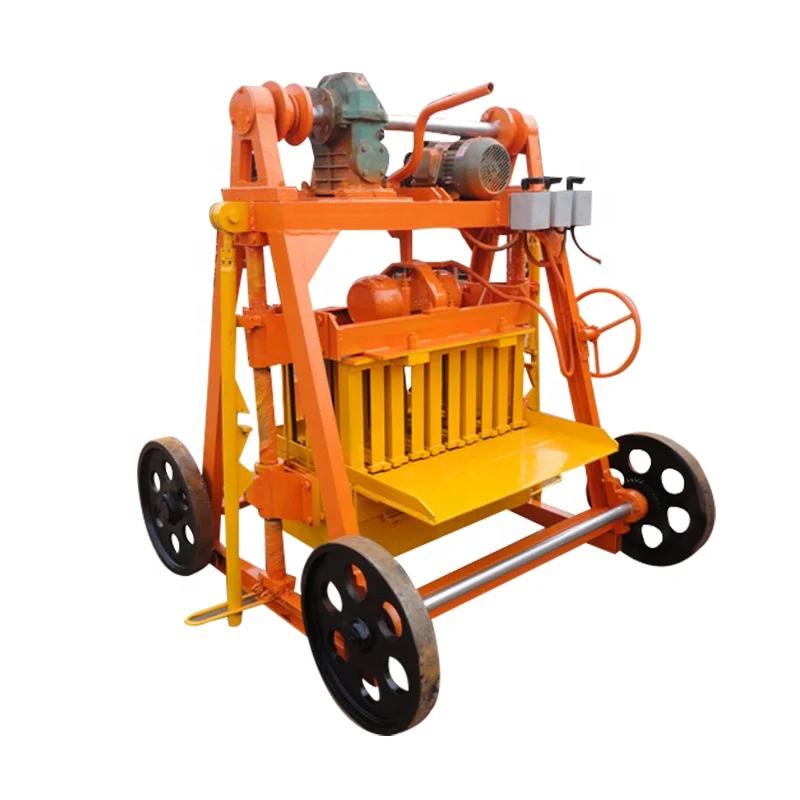
 Mobile block machine