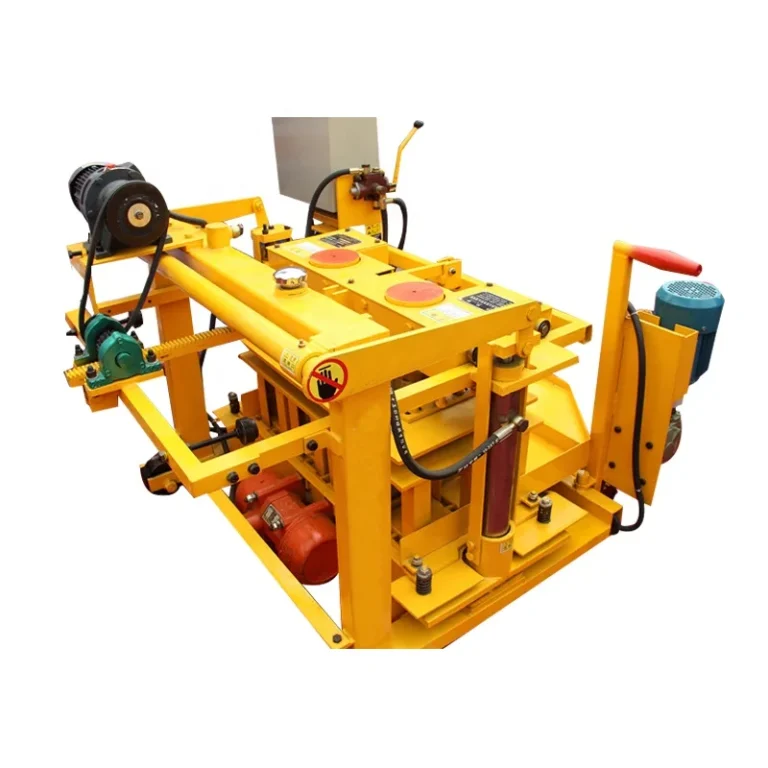
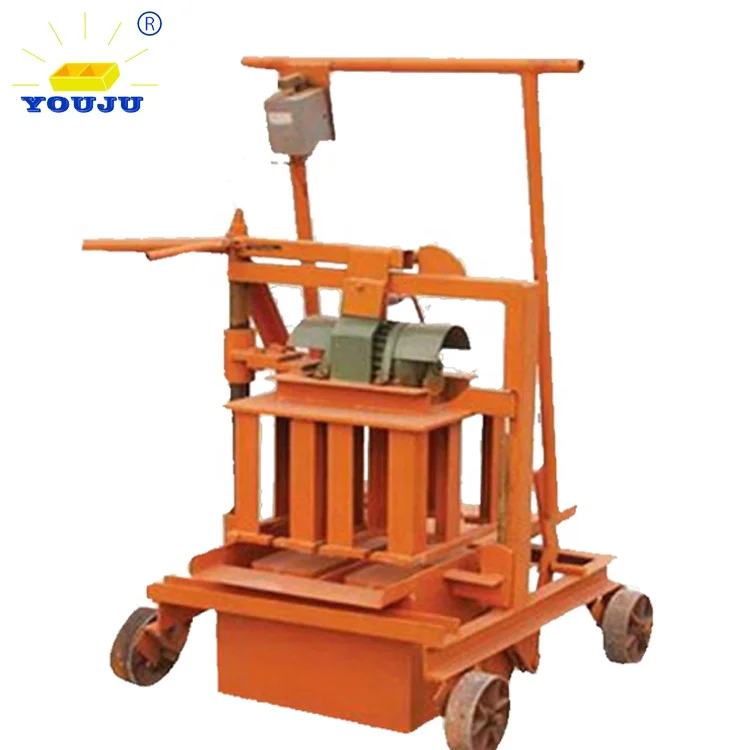
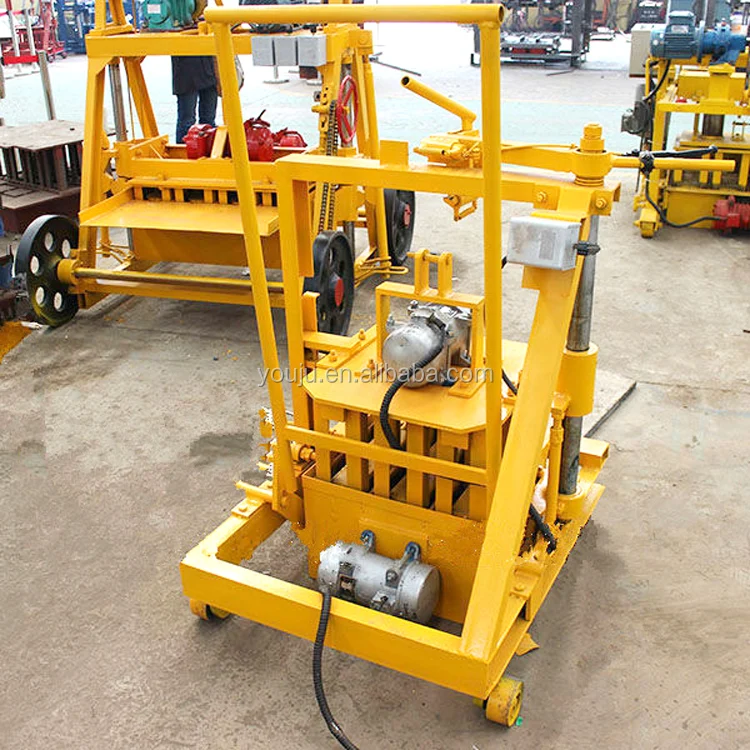
Matched System Approach — the QMJ2-45 is specified with its mould, power source and site footprint as one working unit, not quoted as a bare press with hidden add-ons.
Technical Specifications
| Parameter |
Value |
| Model |
QMJ2-45 |
| Product Type |
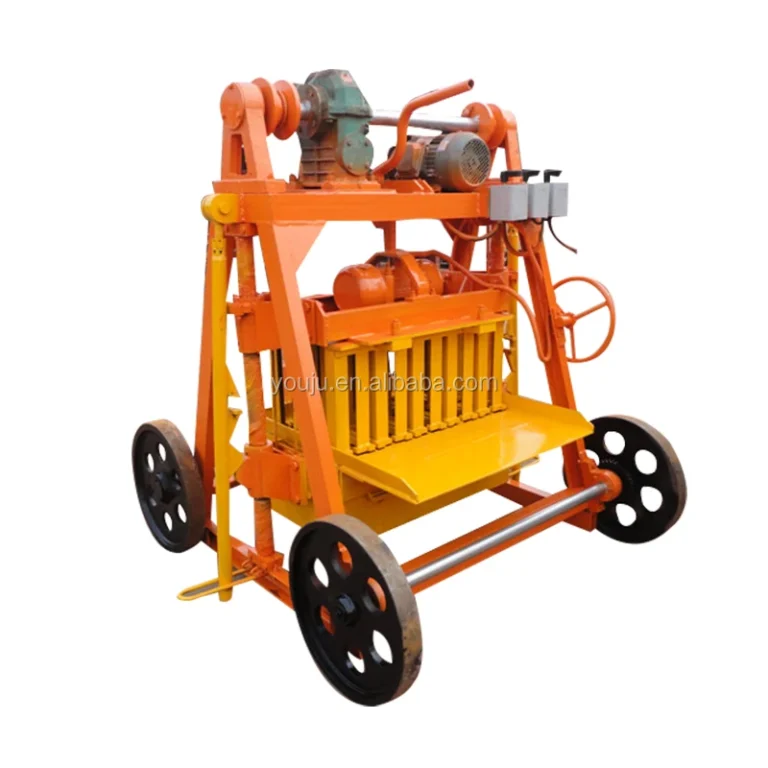
Mobile Block Making Machine |
| Machine Type |
Mobile egg-laying block making machine |
| Automation Level |
Manual / semi-manual operation |
| Pallet Requirement |
Not required (egg-laying design) |
| Power Source |
Electric motor |
| Labor Requirement |
1 to 3 workers |
| Mould Change |
Supported; different hollow brick formats via mould swap |
| Output Capacity (400×200×200mm) |
160 pcs/h, 1,280 pcs/8hr (basis: 2 pcs per mould, 25–30s cycle) |
| Output Capacity (400×150×200mm) |
240 pcs/h (basis: 3 pcs per mould, 25–30s cycle — 8hr figure inconsistent with hourly rate; source value, verify against manufacturer catalog) |
| Output Capacity (400×100×200mm) |
320 pcs/h, 2,560 pcs/8hr (basis: 4 pcs per mould, 25–30s cycle) |
| Molding Cycle |
25–30 seconds |
| Hydraulic Pressure |
Not applicable — manual/electric mechanical press |
| Pallet Size |
Not applicable (pallet-free design) |
| Standards |
ISO 9001:2000, CE (verify certification body and validity) |
Application Suitability
| Application |
Material or Output |
| On-site hollow block production for housing projects |
Crushed stone, sand, cement and water mix |
| Small-scale hollow brick manufacturing |
Local aggregate with cement binder, limited yard space |
| First-time block plant setup with minimal capital |
Standard concrete mix for 400×200×200, 400×150×200, 400×100×200mm formats |
| Remote or off-grid construction sites |
Electric-powered production where pallet logistics are impractical |
| Satellite or overflow production for existing plants |
Supplementary hollow brick output without fixed plant infrastructure |
What "25–30 Second Cycle" Actually Means for Your Daily Count
The cycle time only matters when tied to the block format you actually sell.
A mobile block making machine manufacturer quoting a single cycle figure across all formats leaves the buyer guessing which block size was used for the measurement. On the QMJ2-45, the 25–30 second molding cycle produces two 400×200×200mm blocks per press, but four 400×100×200mm blocks in the same window — so the hourly rate swings from 160 to 320 pieces depending entirely on your product mix. I have seen buyers order based on the larger number and then discover their market only demands the thicker wall format. [NEED_CITE: block format assumptions in capacity quotations from equipment suppliers]

Where This Tier Sits in the Full Range
The QMJ2-45 occupies the entry-mobile position in the block machine lineup. Buyers who need a fixed plant with pallet circulation, automatic stacking and curing racks will move up to semi-automatic or fully automatic tiers. This machine serves those whose priority is getting blocks produced on-site without committing to conveyor infrastructure, pallet inventory, or a dedicated curing chamber. The QMJ2-45 mobile block making machine lays blocks directly onto the ground and moves forward, which fundamentally changes how you plan your curing area and material feed path compared to a stationary press.
Pallet-Free Operation Changes the Site Layout
Eliminating pallets removes an entire logistics loop — no pallet purchase, no pallet return conveyor, no pallet cleaning station, no pallet storage rack. For a first-time producer or a contractor running blocks at a remote housing development, this simplification is significant. The trade-off is that your ground surface becomes part of the production system. The egg-laying design demands a level, hardened floor where freshly formed blocks can cure in place without disturbance. [NEED_CITE: ground preparation standards for mobile egg-laying block production] Material staging must sit adjacent to the machine path, and workers manually feed the hopper as the unit advances along the production line.
Reading the Specs That Matter for Mobile Production
The electric motor drive means the QMJ2-45 has no diesel engine constraints — it moves freely on site without fuel logistics, but it does require a stable power supply at the correct voltage and frequency for your region. The manual and semi-manual operation level keeps labor at one to three workers, with the crew handling material feeding and machine advancement. Mould change capability covers three standard hollow brick dimensions, and the physical swap is a mechanical process requiring basic tools rather than hydraulic disconnection. The absence of hydraulic pressure in this design means compaction relies on vibration and mechanical pressing, which influences the mix consistency you need — too wet and the block slumps after the mould lifts; too dry and the vibration force cannot consolidate it properly. [NEED_CITE: mix design considerations for vibration-only block compaction] The 25–30 second cycle assumes a crew that has already developed a rhythm in material feeding and machine positioning.
The Cost of Skipping Site Preparation
Buyers who treat a mobile machine as a "just plug it in" purchase often encounter problems that have nothing to do with the press itself. An uneven ground surface causes freshly formed blocks to crack or lean before the concrete sets. Inadequate curing space forces the crew to move blocks too early, damaging edges and corners. A power supply with incorrect voltage or insufficient amperage leads to motor overheating and inconsistent vibration. Material placed too far from the production path slows the feed cycle, and the quoted output becomes unreachable because the crew spends more time walking than pressing. [NEED_CITE: common site preparation failures in mobile block production]
Why Source the QMJ2-45 Mobile Block Machine for Sale Through This Range
Block machinery is the sole focus here, so the QMJ2-45 is not quoted as a standalone press — the mould options, power configuration and operating footprint are addressed together before the order is placed. Configuration starts with your actual mix design and local aggregate rather than a catalogue default, which matters because volcanic ash, river sand and crushed limestone each demand different moisture and vibration settings. Mould design covers the hollow brick formats your market actually buys, with custom drawings available when standard sizes do not match local building codes. Automation level is selectable across the range, so a buyer starting with this mobile unit has a documented upgrade path toward semi-automatic pallet-based production. Installation support includes operator training on site, covering material feed technique, mould change procedure and daily maintenance specific to this egg-laying design.
Documentation & Verification
- Machine specification sheet with QMJ2-45 power rating and dimensional data
- Mould drawing and format list covering all three hollow brick sizes
- Voltage and frequency confirmation record matched to your site supply
- Factory test record showing actual cycle times per block format before dispatch
- Operation and maintenance manual with mould change procedure and daily checkpoints
- Wear parts list with mould replacement intervals and ordering codes
Installation, Commissioning & Support
- Hardened, level ground surface required across the full production and curing path for the egg-laying design
- Electrical supply must match confirmed voltage and frequency with a dedicated circuit for the motor rating
- Machine arrives assembled with mould installed; spare mould formats shipped separately and fitted on site
- First-run commissioning covers material feed consistency, cycle rhythm and block dimensional accuracy per format
- Operator training addresses manual feeding technique, mould swap procedure and vibration timing
- Wear parts and replacement moulds listed with lead times for ongoing production continuity
What to Share Before Requesting a Quotation
Provide the hollow brick format or formats your market demands, along with the daily output target for each size. Share your local raw material type — whether crushed stone, river sand, volcanic ash or another aggregate — so the mix design can inform the machine configuration. Confirm your site voltage and frequency, the available curing area dimensions, and whether you plan to add formats later that would require additional moulds. [NEED_CITE: pre-inquiry information checklist for mobile block machine buyers]
Frequently Asked Questions
Q: How is the capacity per hour calculated, and which block format does each figure assume?
A: Each output figure ties to a specific hollow brick dimension. The 160 pieces per hour rate assumes the 400×200×200mm format with two blocks per mould and a 25–30 second cycle. The 320 pieces per hour rate assumes the 400×100×200mm format with four blocks per mould in the same cycle window. Always compare against the format you actually intend to sell.
Q: What voltage and frequency options are available for my country’s grid?
A: Voltage and frequency are not stated as fixed values in the standard specification. These must be confirmed against your site supply before production begins. Share your local grid standard during the inquiry stage so the motor and wiring are configured correctly before the QMJ2-45 mobile block making machine ships.
Q: Can the QMJ2-45 be upgraded later to a semi-automatic line with pallet handling?
A: The mobile egg-laying design operates on a fundamentally different principle from pallet-based systems. Rather than upgrading this specific unit, the typical path is adding a semi-automatic stationary machine to your operation as volume grows, keeping the QMJ2-45 for satellite or overflow production on remote sites.
Q: How long does a mould change take, and are custom mould sizes available?
A: Mould change on this mobile unit is a mechanical process using basic hand tools rather than hydraulic disconnection. Custom mould sizes are available based on buyer drawings when standard formats do not match local building requirements. Confirm additional format needs during the initial inquiry to align lead times.
Q: What does the site need in terms of ground preparation, curing space and raw material staging?
A: The egg-laying design requires a hardened, level concrete floor spanning the production path and curing area. Raw material must be staged within manual reach of the hopper to maintain cycle rhythm. Curing space depends on your daily output target and the time blocks need before handling.

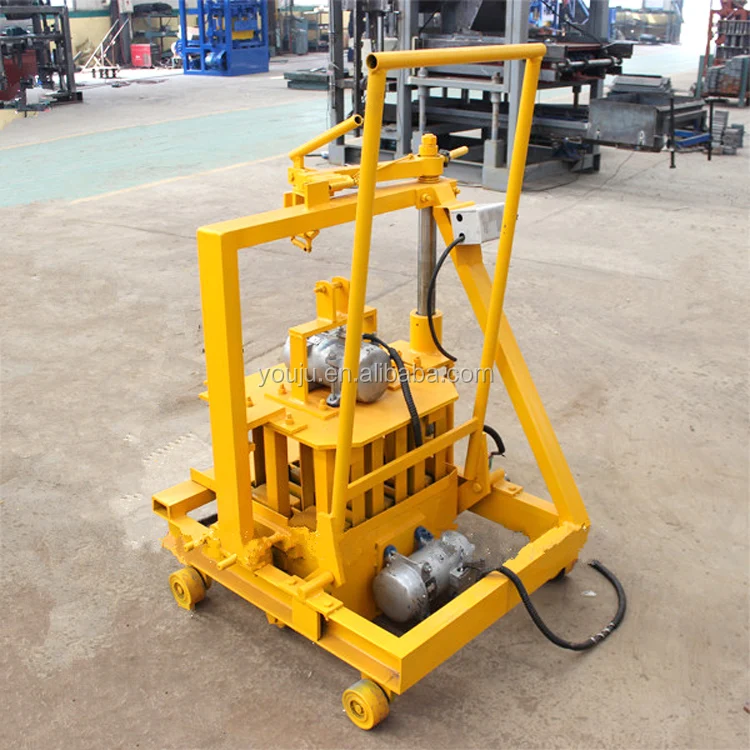
 Mobile block machine