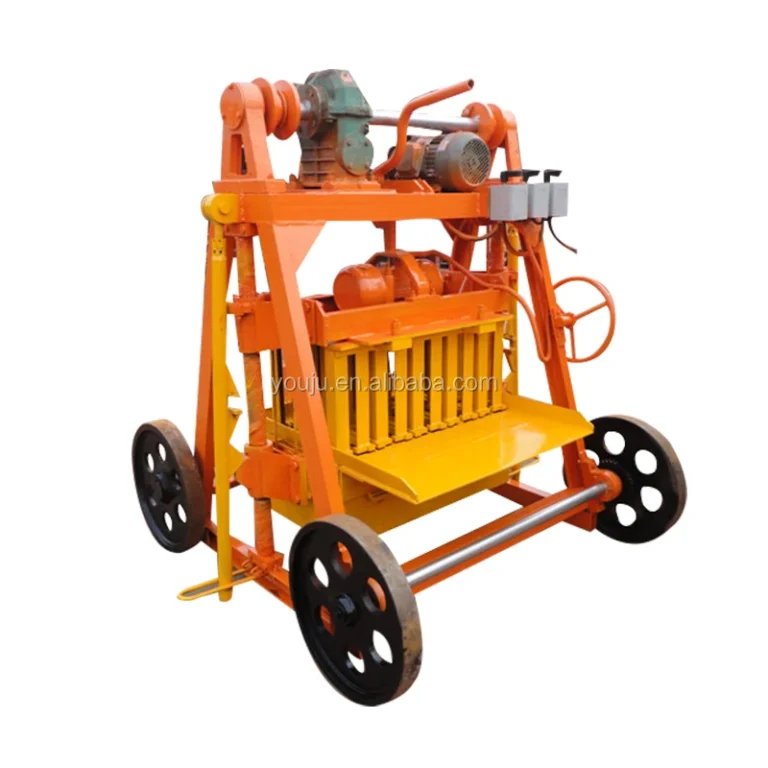
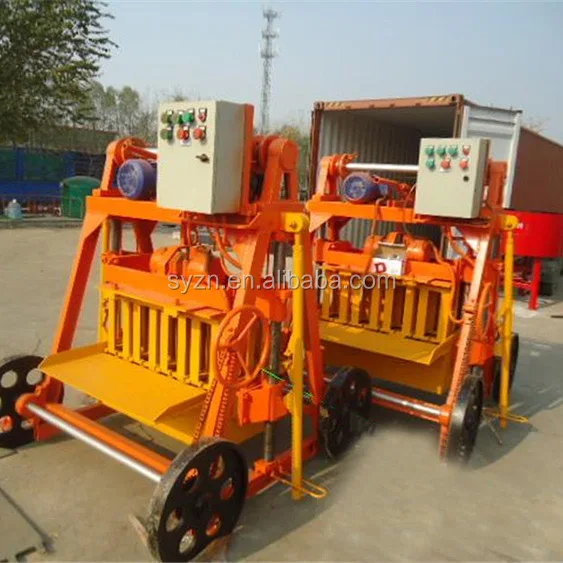
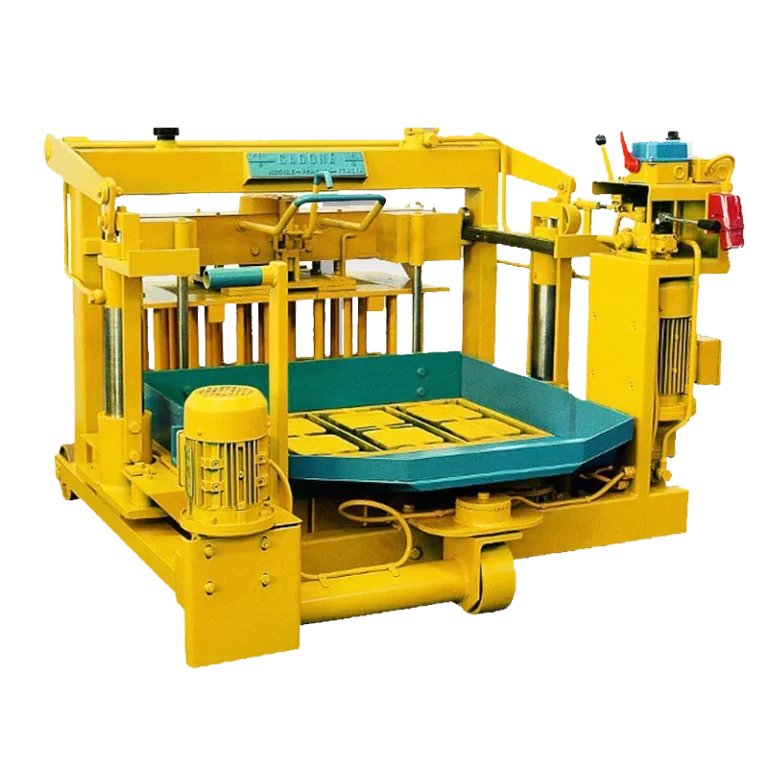
Configuration Set Against Actual Mix — Every QMJ2-45 leaving our Linyi workshop is tested against the buyer’s actual aggregate sample, not a catalogue default, ensuring block strength matches local material reality.
Technical Specifications
| Parameter |
Value |
| Model |
QMJ2-45 |
| Product Type |
Mobile Concrete Block Making Machine |
| Machine Type |
Manual mobile (egg-laying) block machine |
| Automation Level |
Manual operation |
| Pallet Requirement |
No pallets required |
| Labour Requirement |
1 to 3 workers |
| Mould Change |
Interchangeable moulds for different hollow brick formats |
| 400×200×200 mm Hollow Brick |
2 pcs/mould, 25–30 s cycle, 160 pcs/h, 1280 pcs/8 hr |
| 400×150×200 mm Hollow Brick |
3 pcs/mould, 25–30 s cycle, 240 pcs/h (basis to be confirmed) |
| 400×100×200 mm Hollow Brick |
4 pcs/mould, 25–30 s cycle, 320 pcs/h, 2560 pcs/8 hr |
| Power Source |
No diesel engine or external power required (basis not stated in source — confirm if electric motor option exists) |
| Control System |
Manual (no PLC) |
| Mobility |
Free-moving on-site, no fixed plant required |
Application Suitability
| Application |
Material or Output |
| On-site hollow block production |
Local aggregate, cement, sand and water mixed on the construction site |
| Small-scale block plants |
Hollow bricks in 400×200×200, 400×150×200 and 400×100×200 mm formats |
| Remote or off-grid project sites |
Production without mains electricity or diesel generator dependency |
| First-time block entrepreneurs |
Low-investment entry with format flexibility across three mould sizes |
| Housing project contractors |
Hollow blocks produced directly on the building site without pallet handling |
What "Pieces per Hour" Actually Means for Mobile Block Production
Every capacity figure on this page is tied to a specific hollow brick size and cycle time, not a single headline number.
Most mobile block machine quotations state an hourly output without revealing which block format that number assumes. A buyer expecting the highest quoted figure often discovers their actual format — typically the larger hollow block their market demands — produces considerably less across a working shift. I have watched contractors plan entire project timelines around a capacity number that only applied to the smallest format in the mould catalogue. The QMJ2-45 output is therefore listed per format above, so your daily planning starts from the brick your site actually sells [NEED_CITE: block format assumptions in mobile machine capacity quotations].

Where the QMJ2-45 Sits Across the SHIYUE Mobile Range
The QMJ2-45 is the entry tier of our mobile block making machine for sale range, built for buyers who need to produce hollow bricks on-site without investing in pallets, curing racks or a fixed plant. It operates as an egg-laying machine, depositing blocks directly onto the ground surface and moving forward after each cycle. This keeps the initial capital requirement low and the site footprint minimal, which matters when you are working inside a compound or beside an active building zone.
When an Egg-Laying Design Removes the Biggest Line Bottlenecks
A fixed block plant requires pallets, a pallet return system, curing rack handling and a forklift to move stacked product. Each of those stations introduces cost and a potential point of failure. The QMJ2-45 eliminates that entire downstream chain by laying blocks directly on the ground, which means no pallet inventory to maintain, no curing rack to build and no forklift operator to hire. For a contractor producing blocks beside a housing project or an entrepreneur starting a first plant with limited space, this simplification removes the most common commissioning delays [NEED_CITE: pallet and curing system requirements in block plant setup].
Reading the Specs That Determine Your Daily Output
The cycle time of 25–30 seconds per mould governs how many blocks one operator team can produce in a shift, but the real variable is the format you run most often. Mould interchangeability across three hollow brick sizes means you can switch production to match a site order, though the change itself takes time that must be factored into a day with multiple format runs. Labour requirement of one to three workers keeps the operating cost predictable, but the manual nature of the operation means output consistency depends on how disciplined the feeding and positioning rhythm becomes. No pallet requirement is the defining engineering decision here: the machine’s weight distribution, vibration transmission and mould release are all calibrated for ground-laying, so the surface condition of your production area directly affects block dimensional accuracy.
The Cost of Overlooking Ground Conditions and Mix Compatibility
An egg-laying machine deposits blocks onto whatever surface is beneath it. Uneven ground produces uneven blocks, and a surface that absorbs moisture too quickly can weaken the bottom face before curing begins. I once travelled to a West African site where volcanic aggregate replaced the river sand we had tested with — the bricks crumbled on arrival because vibration frequency and pressure were set for a completely different mix. The machine was fine; the configuration was wrong for that buyer’s material [NEED_CITE: aggregate variation effects on block strength consistency].
Why Sourcing This Machine from a Single-Focus Manufacturer Matters
Block machinery is the only product line at our Linyi facility, so the QMJ2-45 is specified as a matched system of machine, mould and ground-laying parameters rather than assembled from unrelated components. Mould design is done in-house for the hollow brick formats your market actually buys, with custom drawings available if your region requires a non-standard size. We set the machine configuration against a sample of your local aggregate before it ships, not against a default catalogue mix. Automation level is selectable across our range, so you can start with the QMJ2-45 and step up to a semi-automatic or fully automatic model as your market grows. Installation support and operator training are included so your crew understands the rhythm that keeps cycle times consistent.
Documentation & Verification
- Line layout and capacity calculation stating which hollow brick format each output figure assumes
- Mould drawing and format list confirming the three hollow brick sizes included with shipment
- Factory test record run on your submitted aggregate sample before dispatch
- Operation and maintenance manual covering manual mould change procedures and ground surface preparation
- Wear parts and mould list for planning your first replacement order
Installation, Commissioning & Support
- Level, compacted ground surface required across the production area for consistent block dimensions from the QMJ2-45
- Confirm whether electric motor option is needed if your site has power, or plan for fully manual operation
- Mould installation and first-cycle calibration performed on your actual aggregate mix before handover
- Operator training on feeding rhythm, cycle timing and mould change sequence for one-to-three-worker teams
- Wear parts supply plan covering mould liners and vibration components for your first replacement cycle
What We Need to Configure Your Machine Correctly
Tell us which hollow brick format your market sells most, your daily target output in that specific size, and the type of aggregate available at your site. Send a sample of your local sand or crushed stone so we can test the mix before the machine leaves our workshop. Confirm whether your site has access to mains power or requires fully manual operation, and describe the ground surface where blocks will be laid.
Frequently Asked Questions
Q: How is the quoted hourly capacity calculated, and which block format does it assume?
A: Each output figure on the QMJ2-45 specification sheet is tied to a specific hollow brick dimension and its corresponding mould cavity count. The 400×200×200 mm format produces 160 pieces per hour at a 25–30 second cycle, while smaller formats yield more per cycle. We quote per format so your daily planning reflects the block you actually sell.
Q: Where does the QMJ2-45 sit in the SHIYUE mobile machine range, and when should a buyer step up?
A: It is the entry tier for buyers producing hollow blocks on-site without pallets or a fixed plant. When daily demand outpaces what a manual egg-laying cycle can deliver, or when your market requires solid or paving blocks alongside hollow formats, stepping to a larger mobile or semi-automatic model becomes the practical next stage.
Q: What site conditions does an egg-laying mobile block machine require?
A: The production surface must be level and compacted so deposited blocks maintain dimensional accuracy. Adequate curing space around the laying path is needed, and ambient temperature affects setting time. A covered area is recommended in regions with heavy rain during the initial curing hours.
Q: Which mould formats are included, and how long does a mould change take?
A: The QMJ2-45 ships with interchangeable moulds for 400×200×200, 400×150×200 and 400×100×200 mm hollow bricks. Mould change is manual and requires the operator team to stop production for the swap, so planning format runs in batches minimises lost time across a shift.
Q: What documentation and operator training ship with the machine?
A: You receive a capacity calculation by format, mould drawings, a factory test record on your aggregate sample, and an operation manual. Our team trains your workers on feeding rhythm, cycle timing and mould change procedures during commissioning at your site.

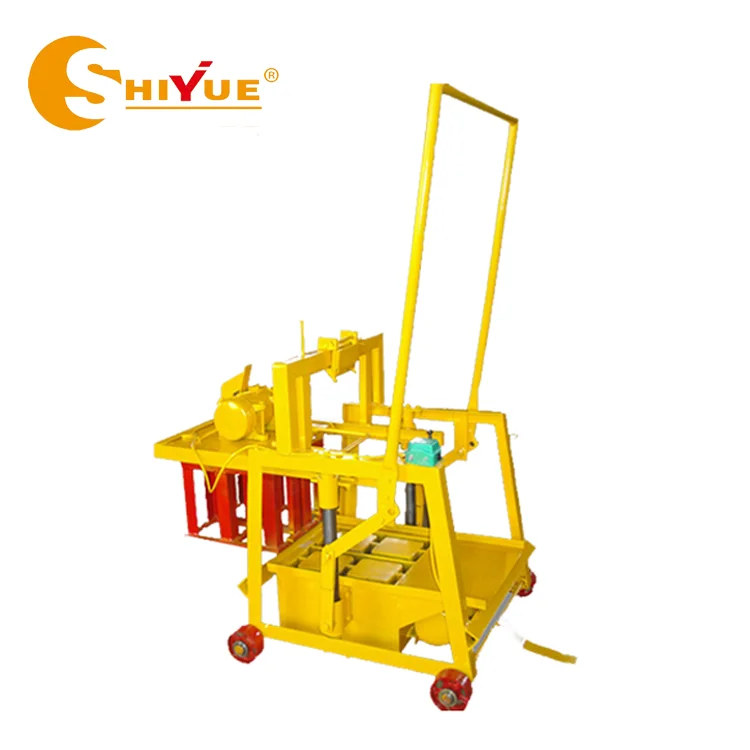
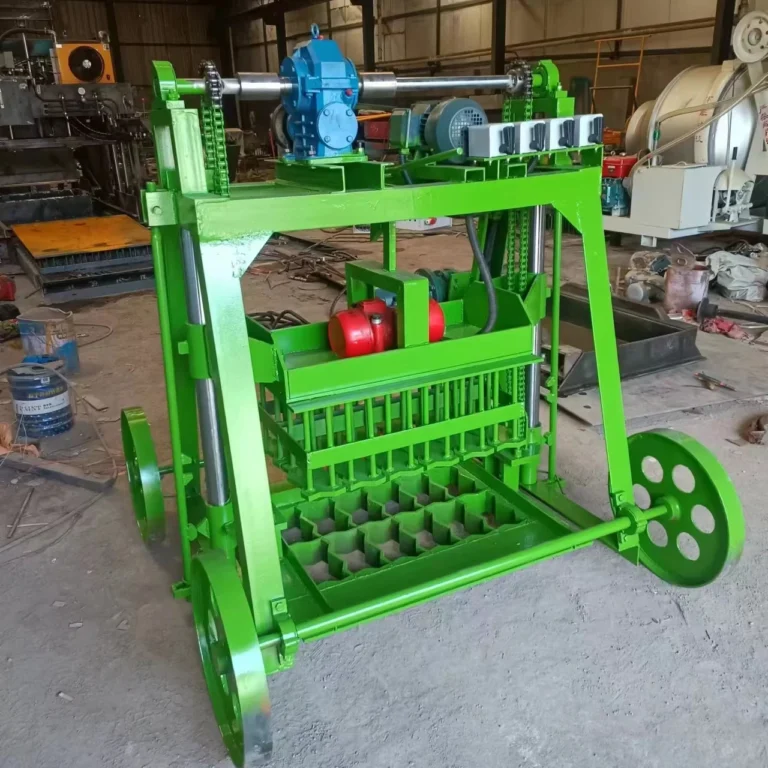 Mobile block machine