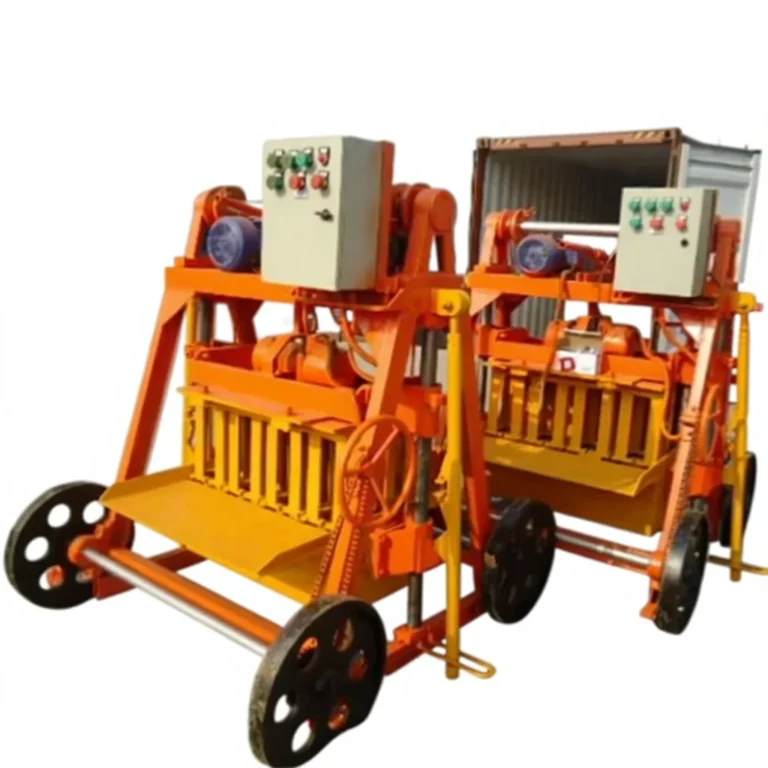
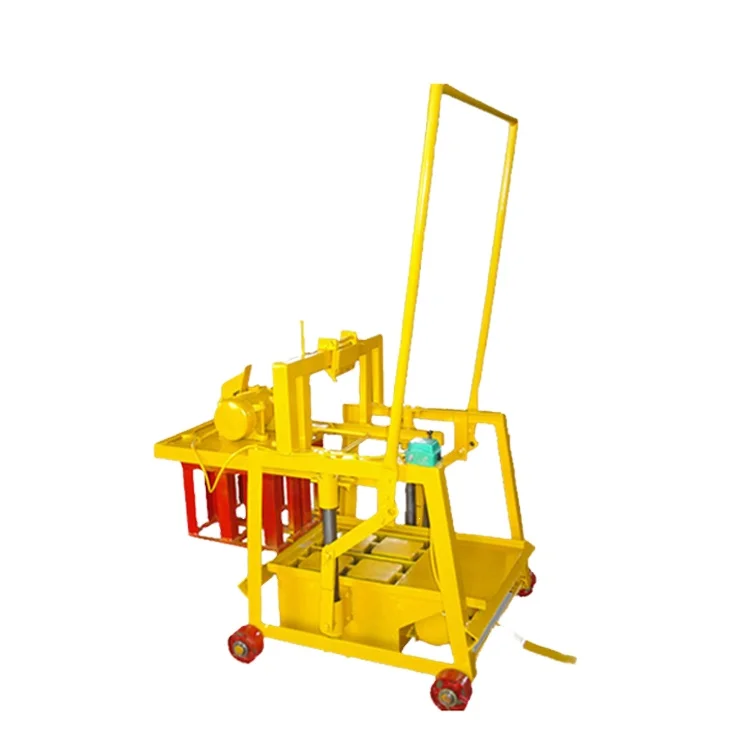
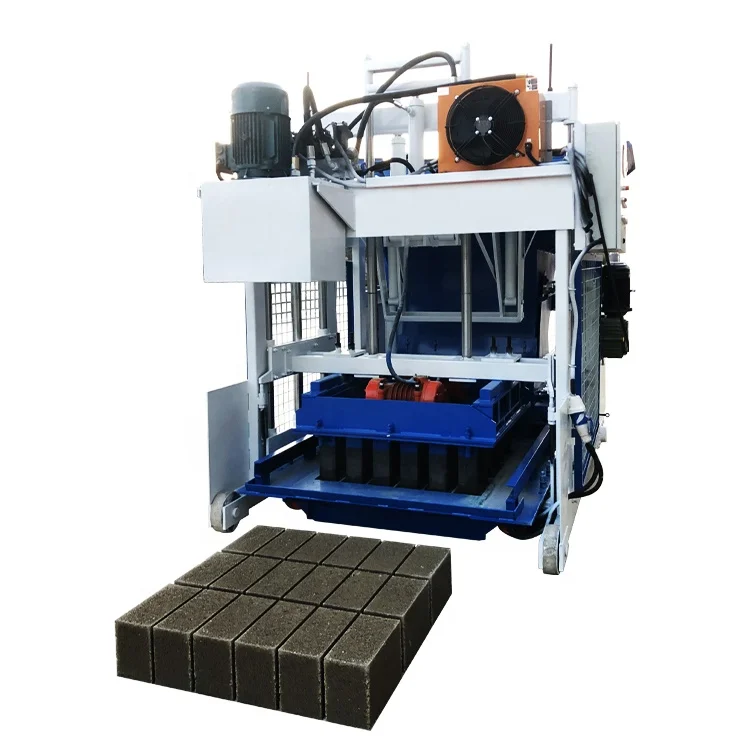
Pallet-Free Production Footprint — the QMJ2-45 eliminates curing-area pallet logistics entirely by laying blocks directly on the ground, which removes a major hidden cost for contractors working on remote or confined project sites where pallet storage and return loops are impractical.
Technical Specifications
| Parameter |
Value |
| Model |
QMJ2-45 |
| Product Type |
Mobile Block Making Machine |
| Operation Mode |
Manual egg-laying |
| Mould Format |
Hollow brick (multiple sizes via mould change) |
| Cycle Time |
25–30 seconds per mould |
| Output Capacity (400×200×200 mm) |
2 pcs/mould, approx. 160 pcs/hour, 1280 pcs per 8-hour shift |
| Output Capacity (400×150×200 mm) |
3 pcs/mould, approx. 240 pcs/hour (basis not stated in source for higher figures) |
| Output Capacity (400×100×200 mm) |
4 pcs/mould, approx. 320 pcs/hour, 2560 pcs per 8-hour shift |
| Pallet Requirement |
None (egg-laying design) |
| Power Source |
Engine (diesel or petrol, confirm type before order) |
| Labor Requirement |
1 to 3 workers |
| Control System |
Manual operation |
| Mould Change |
Supported across listed hollow brick formats |
| Standards |
ISO 9001:2000, CE |
Application Suitability
| Application |
Material or Output |
| On-site hollow block production |
Crushed stone, sand, cement, water mix laid directly on compacted ground |
| Small-scale block plant startup |
Low-volume hollow brick output with minimal capital and no fixed infrastructure |
| Remote housing project supply |
Engine-powered operation independent of local electrical grid availability |
| Building material distributor add-on |
Supplementary on-site block supply complementing existing yard inventory |
What "Pieces per Hour" Actually Means on a Site Without Pallets
Output figures only hold up when the block format and cycle time are stated together.
Many mobile block making machine for sale quotations list a single cycle speed without specifying which mould is installed, leaving buyers to discover on-site that their target hollow block format runs slower than the headline number suggested. I have seen contractors in mountainous regions of Peru plan a full week of wall construction around a quoted hourly rate, only to find that the 400×200×200 mm format they actually needed produced roughly half the pieces the brochure implied. [NEED_CITE: capacity verification by block format before shipment] The QMJ2-45 output is therefore always quoted per specific mould, so the daily planning number you take to your site foreman matches what the machine actually delivers over an eight-hour shift.

Where the QMJ2-45 Sits in the Mobile Range
This unit occupies the entry tier of the mobile block machine lineup. It is designed for buyers who need to produce hollow bricks directly at a project site or in a small yard without investing in a stationary press, pallet circulation system, or curing rack infrastructure. The egg-laying principle means the machine moves forward after each cycle, depositing the freshly pressed block onto the ground surface behind it. For a first-time block plant entrepreneur or a contractor producing for a single housing development, this removes the largest capital line items — pallets, stacking equipment, and covered curing space — from the initial budget.
Engine Power and the Grid Independence Question
The QMJ2-45 is engine-powered, which positions it for sites where three-phase electricity is either unavailable or unreliable. This matters in rural development projects and infrastructure camps where connecting a stationary block line to the grid would require a separate transformer installation. [NEED_CITE: power supply constraints on remote construction sites] The engine configuration also means the machine can be relocated across a large site as the building footprint expands, something a fixed electric press cannot do without dismantling and rewiring. Buyers should confirm whether the supplied engine is diesel or petrol and verify fuel consumption per operating hour against local fuel costs before committing to a production schedule.
Reading the Specs That Matter for Hollow Block Density
On a manual egg-laying machine, block strength comes from the combination of vibration force applied during the cycle and the mix design the operator feeds into the mould. The 25–30 second cycle time listed for the QMJ2-45 represents the full press-and-release sequence; shortening it compromises compaction and produces blocks that crack during handling. Mould change across the three supported formats — 400×200×200 mm, 400×150×200 mm, and 400×100×200 mm — allows a single machine to serve different wall thickness requirements on the same project. The absence of pallets means the ground surface itself becomes the curing bed, so surface preparation and leveling directly affect block dimensional consistency.
The Cost of Skipping the Spare Parts Conversation
I once shipped a small mobile unit to a job site in the Peruvian highlands and did not walk the buyer through a detailed wear parts list before dispatch. When the mould lining showed wear after several weeks of continuous production, the site had no replacement on hand, and a sea freight resupply took nearly a month. The entire masonry crew stood idle waiting for that single component. [NEED_CITE: spare parts availability impact on remote project timelines] That experience changed how I approach every mobile block making machine for sale dispatch: the spare parts list is now reviewed item by item with the buyer before the crate is sealed, so the first replacement cycle never catches the site unprepared.
Why Buyers Source This Tier from Shandong Shiyue
Shandong Shiyue Intelligent Machinery focuses exclusively on block machinery, which means the QMJ2-45 is specified as part of a matched system — machine, mould, and ground-curing workflow — rather than assembled from unrelated component suppliers. Configuration is set against your actual local aggregate and target block format, not pulled from a catalogue default. Mould design covers the hollow brick sizes your market actually sells, and custom drawings are available when standard formats do not match local building codes. The automation path is open: a buyer can start with this manual egg-laying tier and move to semi-automatic or fully automatic mobile units as volume grows, without replacing the entire production concept.
Documentation & Verification
- Line layout showing egg-laying travel path and ground curing area dimensions
- Machine specification sheet confirming engine type, cycle time, and vibration characteristics
- Mould drawing and format list for each supported hollow brick size with change procedure
- Factory test record demonstrating actual cycle time and output per format before dispatch
- Voltage and control confirmation document (not applicable for engine-powered units, noted for record)
- Operation and maintenance manual covering daily greasing points and mould alignment checks
Installation, Commissioning & Support
- Ground surface must be compacted and level to support egg-laying block release without breakage
- Engine type and fuel specification confirmed before shipment to match local supply availability
- Machine arrives assembled; mould installed and tested at factory before crating
- First-day commissioning includes cycle timing verification against each ordered hollow brick format
- Operator training covers mix consistency, mould filling technique, and manual release timing
- Wear parts list reviewed and packed with shipment to cover the first replacement cycle on-site
- Daily maintenance schedule provided, focusing on vibration mechanism greasing and mould bolt checks
What to Include in Your Inquiry
To configure the QMJ2-45 correctly for your project, share the specific hollow brick dimensions your local market requires, the daily output volume you need to sustain, and the type of aggregate available at your site. Confirm whether your location has reliable diesel supply or if a petrol engine is preferred. Let us know the ground conditions where the machine will operate so we can advise on surface preparation. [NEED_CITE: aggregate and mix design influence on block strength and cycle time]
Frequently Asked Questions
Q: How is daily output verified per block format before the machine ships?
A: Each QMJ2-45 undergoes a factory test running the exact mould format you have ordered. The test record documents the actual cycle time and pieces produced over a measured period, so the daily planning figure you receive is based on your specific hollow brick size, not a generic catalogue number.
Q: What engine type does the QMJ2-45 use, and how long can it run per fuel tank?
A: The machine is available with either a diesel or petrol engine depending on buyer preference and local fuel availability. Fuel tank capacity and consumption rate per operating hour are confirmed during the quotation stage so you can plan daily refueling against your shift length.
Q: How long does a mould change take on-site between hollow brick formats?
A: Mould change on the QMJ2-45 involves unbolting the current mould and securing the replacement. With two workers and basic hand tools, the swap is typically completed within a single shift break, allowing format flexibility without losing an entire production day.
Q: What ground conditions are required for egg-laying block production without pallets?
A: The surface must be compacted, level, and free of loose debris so that freshly pressed blocks release cleanly and cure without tilting or cracking. A concrete floor is ideal, but well-compacted hard earth can also serve as a curing bed for this mobile block making machine for sale.
Q: Where does the QMJ2-45 sit compared to semi-automatic mobile machines in the range?
A: The QMJ2-45 is the manual, engine-powered entry point requiring one to three workers and no pallets. Semi-automatic mobile units in the range add pallet feeding and higher vibration force, increasing output and reducing labor per block, but requiring a larger initial investment and pallet inventory.

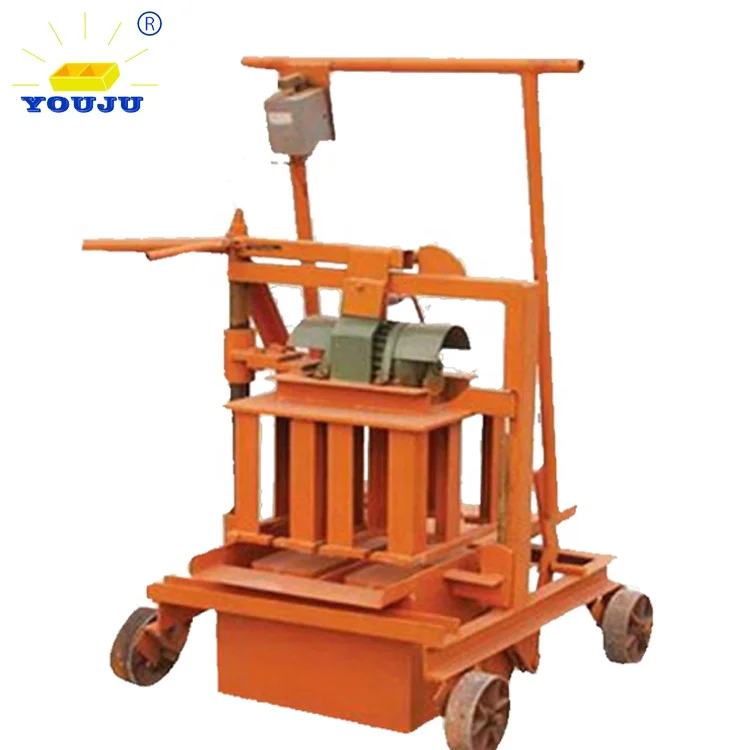
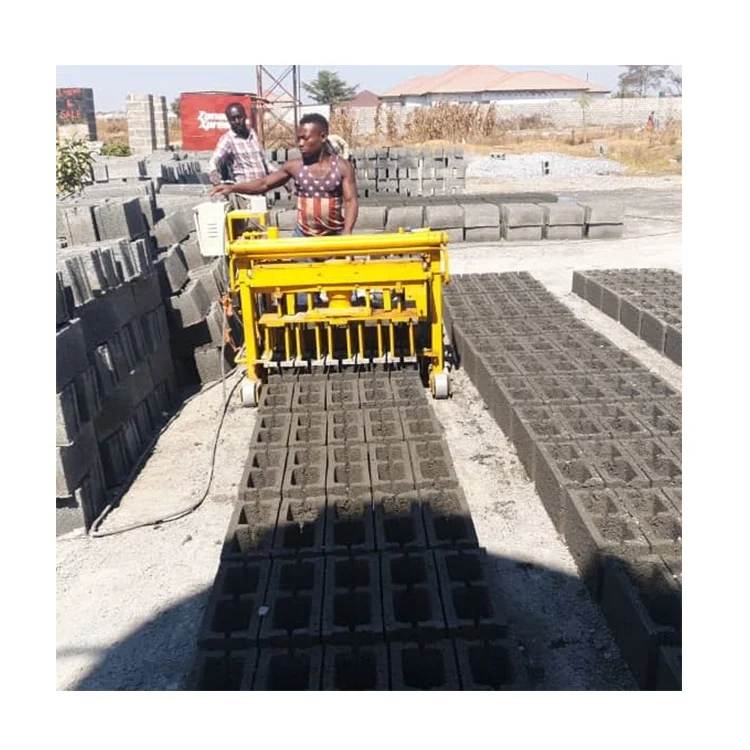 Mobile block machine