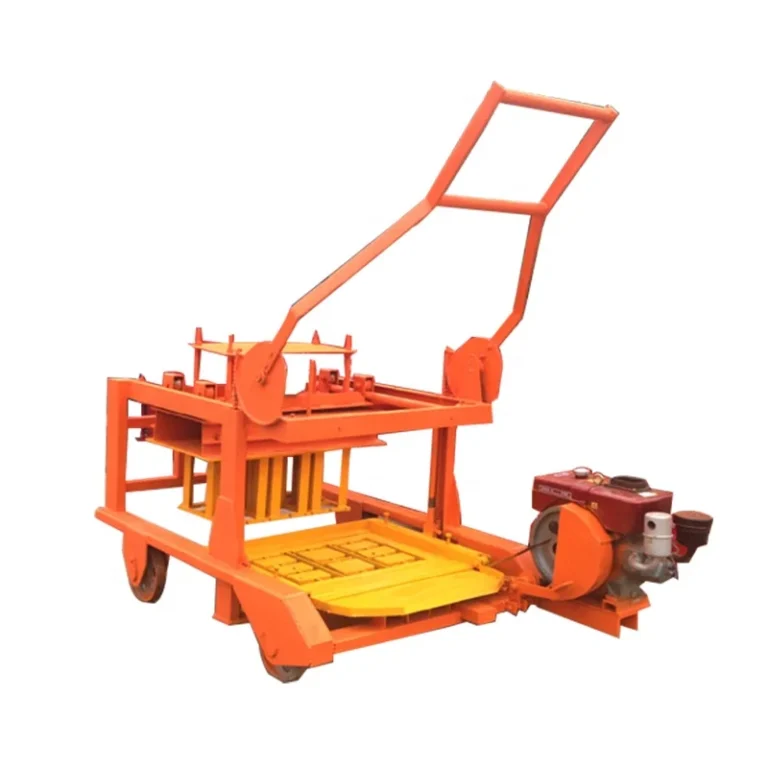
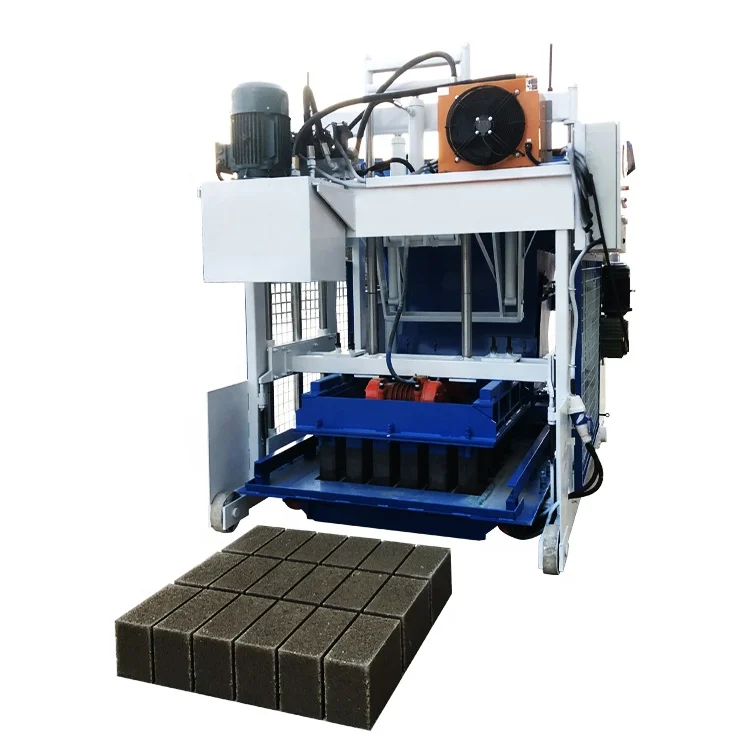
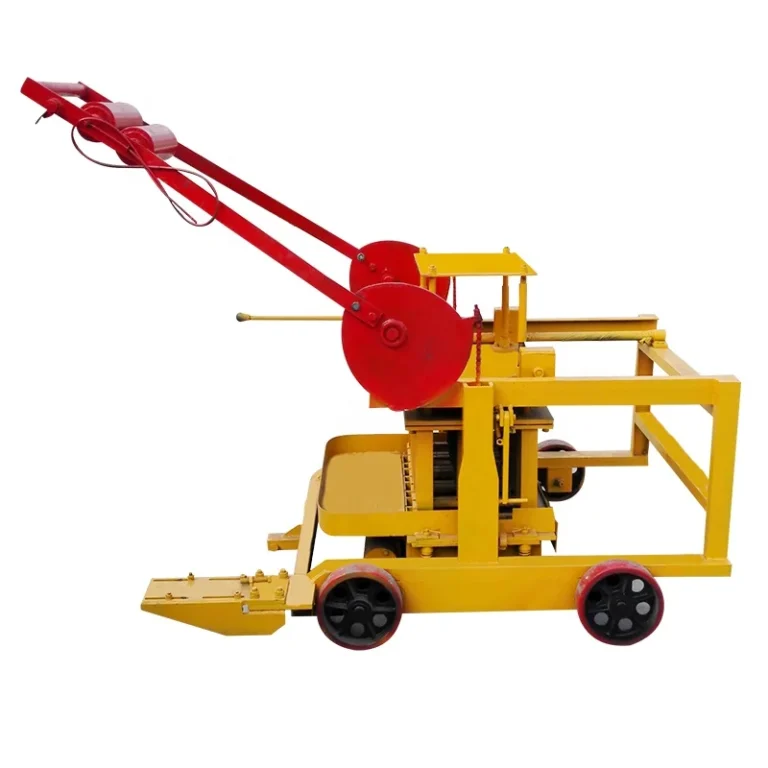
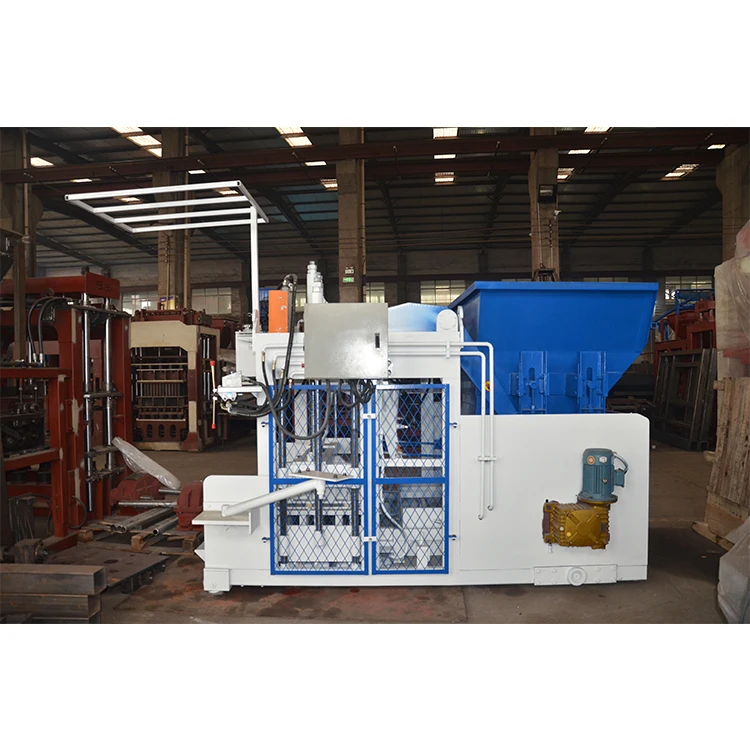
Single-focus machinery scope — machine, mould, pallet and handling are specified as one matched system around the QMR4-45 mobile block machine, not assembled from separate suppliers.
Technical Specifications
| Parameter |
Value |
| Model |
QMR4-45 |
| Product Type |
Mobile Block Making Machine |
| Overall Dimensions (L×W×H) |
1100 × 950 × 2100 mm |
| Net Weight |
810 kg |
| Molding Cycle |
30–45 s |
| Power Source |
Diesel / Petrol Engine / Electric (selectable) |
| Output Capacity |
2560 pcs/day (basis not stated in source — confirm block format / material / thickness) |
| Pallet Requirement |
No pallet required (egg-laying on ground) |
| Mould Compatibility |
Paver brick, hollow block, concrete block, solid brick, fly ash brick |
| Basic Equipment Included |
JZC350 Diesel Concrete Mixer or JQ350 Diesel Concrete Mixer with Electric Generating Unit; Trolley |
| Warranty |
1 Year |
Application Suitability
| Application |
Material or Output |
| On-site housing project block production |
Hollow and solid concrete blocks laid directly on prepared ground |
| Remote or off-grid construction sites |
Diesel-powered operation independent of grid electricity |
| Small-scale paver and kerb production |
Interlocking pavers and solid bricks from local aggregate and cement |
| First-time block plant entrepreneurs |
Low-infrastructure entry into concrete product manufacturing |
| Fly ash brick production near thermal plants |
Fly ash, lime and gypsum blends formed without fixed plant investment |
What "2560 Pieces per Day" Actually Means for Your Site
Daily output figures only become meaningful once the block format, local aggregate and curing conditions are defined.
Catalogues often quote a single daily capacity without stating which block size or mix that number assumes. A mobile block machine manufacturer quoting 2560 pieces per day might be referring to small solid bricks, not the 200 mm hollow blocks your market demands. When you switch formats, the cycle time, mould volume and curing space all change. I have seen contractors arrive at remote sites in West Africa expecting to hit catalogue numbers on hollow blocks, only to find the daily tally closer to a fraction of the quoted figure because the capacity was based on a completely different format [NEED_CITE: block format assumptions in mobile machine capacity claims].

Positioning the QMR4-45 Within the Full Machine Range
The QMR4-45 sits at the entry tier of the Shiyue range. It is a mobile, egg-laying platform designed for buyers who need to produce blocks directly on a job site without building a fixed production plant. Unlike semi-automatic lines that require pallets, curing racks and stacking stations, this machine lays each block on the ground and moves forward on its trolley. That makes it suitable where infrastructure is minimal and the project footprint is large. Buyers evaluating a mobile block machine manufacturer for the first time often start here before deciding whether to scale up to a pallet-based system.
Power Source Selection for Off-Grid and Unstable-Grid Sites
The triple power-source option — diesel, petrol or electric — is the defining feature of this tier. On sites where grid supply is unreliable or absent entirely, a diesel engine keeps production running without waiting for a generator set to be sourced locally. I have spent weeks on sites in South Asia where the electric variant would have sat idle for days due to load-shedding schedules [NEED_CITE: grid reliability impact on construction equipment uptime in South Asia]. The diesel option pairs with a JZC350 mixer, so the entire batching and forming loop stays independent of external power.
Reading the Specs That Actually Shape Your Output
The 30–45 second molding cycle governs how many blocks a single machine can form per shift, but that range depends on the operator’s feeding speed and the mix consistency reaching the hopper. A drier mix with well-graded aggregate compacts faster and holds shape immediately after the mould lifts — essential for an egg-laying machine with no pallet to support the block during curing. The 810 kg net weight provides enough mass to resist vibration walk-off on uneven ground, though the subgrade still needs compaction before production begins. Mould compatibility spans hollow, solid, paver and fly ash formats, but each swap requires manual mould change and recalibration of the vibration duration to match the new cavity volume.
The Cost of Overlooking Ground and Curing Conditions
A mobile no-pallet machine places every block directly on the earth. If the ground is soft, uneven or poorly drained, blocks deform under their own weight before the cement sets. I have visited sites where an entire day’s production was scrapped because rain the previous night left the curing area waterlogged, and no one had planned a gravel bed or drainage slope [NEED_CITE: ground preparation requirements for egg-laying block machines]. The machine itself performed correctly; the site preparation did not match the production method.
Why Source This Tier From a Specialist Supplier
Block machinery as a single focus means the QMR4-45, its moulds and the matching mixer are specified as one system rather than pulled from unrelated catalogues. The configuration is set against the buyer’s actual mix design and target block format, not a generic default. Custom mould design is available when the local market sells a shape that standard mould libraries do not cover. The automation path is open — a buyer can begin with this mobile tier and move to a semi-automatic pallet line later without changing suppliers. Installation support and operator training are included so that the first production run happens under guidance, not trial and error.
Documentation & Verification
- Machine specification sheet confirming selected power-source variant and matching mixer scope
- Mould drawing and format list showing included and optional block shapes
- Line layout sketch with capacity calculation stating the block format assumed
- Factory test record on the buyer’s specified mix and target block format before dispatch
- Voltage and control language confirmation for electric variants, engine spec for diesel or petrol variants
Installation, Commissioning & Support
- Compacted gravel subgrade required across the full curing area to support ground-laid blocks at 1100 × 950 mm machine footprint
- Dedicated diesel fuel storage or confirmed electric supply circuit matching the selected QMR4-45 power-source variant
- Machine arrives assembled on trolley; mixer requires on-site coupling to the generating unit or engine
- First-day commissioning covers vibration duration tuning for the buyer’s local aggregate and target block format
- Operator training addresses mould change procedure, mix consistency checks and daily lubrication of vibration components
- Wear parts list covering vibration springs, mould liners and hopper gates with recommended reorder intervals
Preparing Your Inquiry
To receive a configuration that matches your actual site, share the block formats your market sells, the local aggregate type and cement availability, and whether grid power is stable enough for the electric variant or diesel is required. Include the approximate curing area dimensions so that daily output can be calculated against a realistic curing cycle rather than a catalogue assumption.
Frequently Asked Questions
Q: How is daily output verified, and which block format does the quoted capacity assume?
A: The 2560 pcs/day figure requires confirmation against a specific block format, mix design and shift length. A mobile block machine manufacturer should provide a capacity calculation that names the exact block size and molding cycle used. Without that breakdown, the number is a reference only and should not be treated as a guaranteed production target.
Q: Diesel, petrol or electric — how do I choose the right power source for my site?
A: Choose diesel when grid power is absent or unreliable and you need the mixer and machine on a single fuel source. Petrol suits smaller sites with fuel access but shorter duty cycles. Electric is the lowest operating cost option where a stable supply at the correct voltage and frequency is confirmed before shipment.
Q: Where does the QMR4-45 sit compared to semi-automatic and automatic machines in the range?
A: It is the entry tier — mobile, no pallet, ground-laying. Semi-automatic machines add pallets, a fixed press station and partial stacking automation for higher format consistency. Automatic lines add batching, pallet circulation and cubing for continuous high-volume output. The QMR4-45 suits project-based production; the upper tiers suit permanent plants.
Q: Which moulds are included in the base machine, and which require a separate order?
A: The base package includes one mould matching the buyer’s selected primary format from the compatible range — hollow, solid, paver, concrete or fly ash brick. Additional moulds for other formats are ordered separately, each with its own drawing approval and cycle-time recalculation before production.
Q: What site preparation does a mobile no-pallet machine require?
A: The curing area must be compacted, level and well-drained because blocks are laid directly on the ground. A gravel bed with a slight drainage slope is typical. The machine needs clear trolley paths between the mixing point and the curing area, with no overhead obstructions across the 2100 mm machine height.

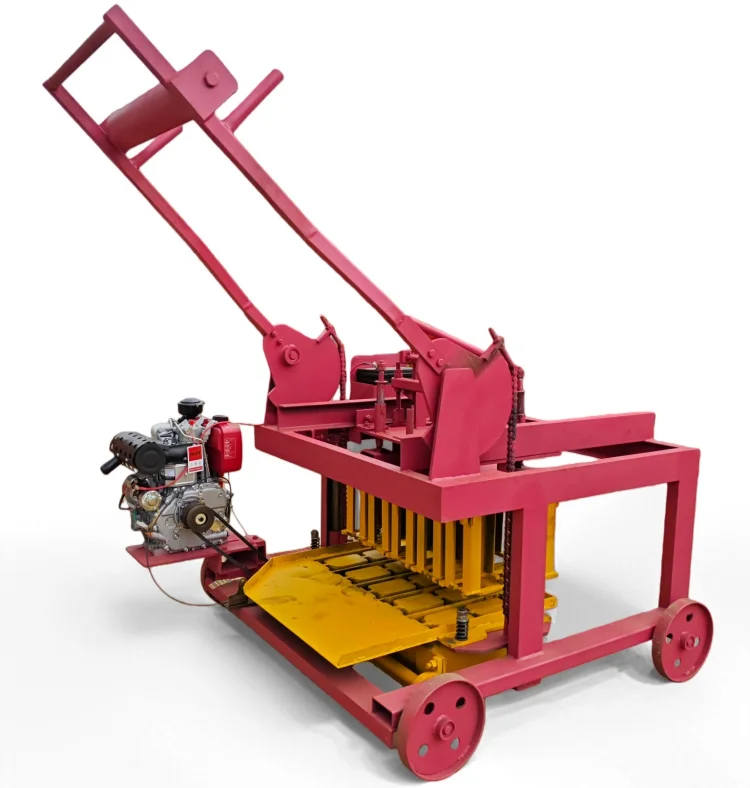
 Mobile block machine