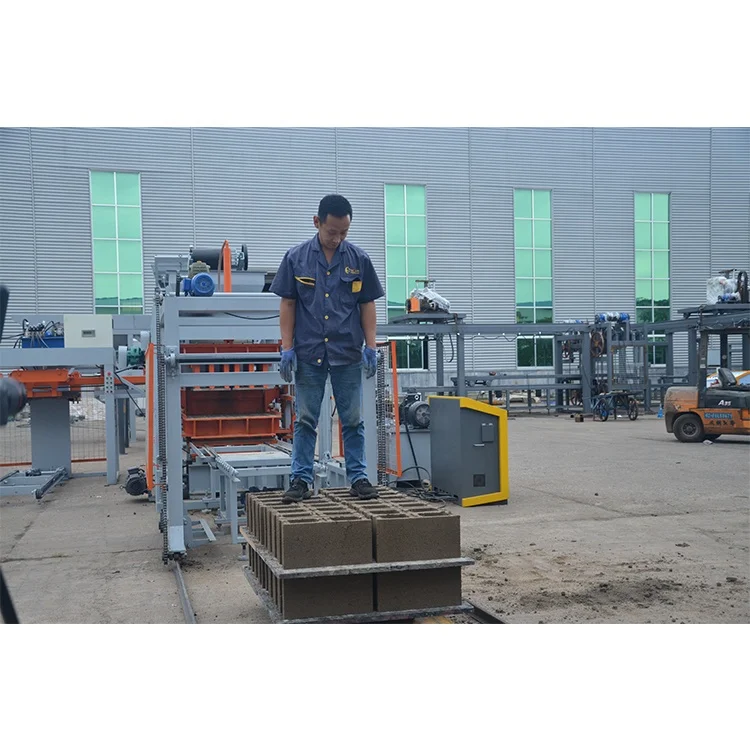
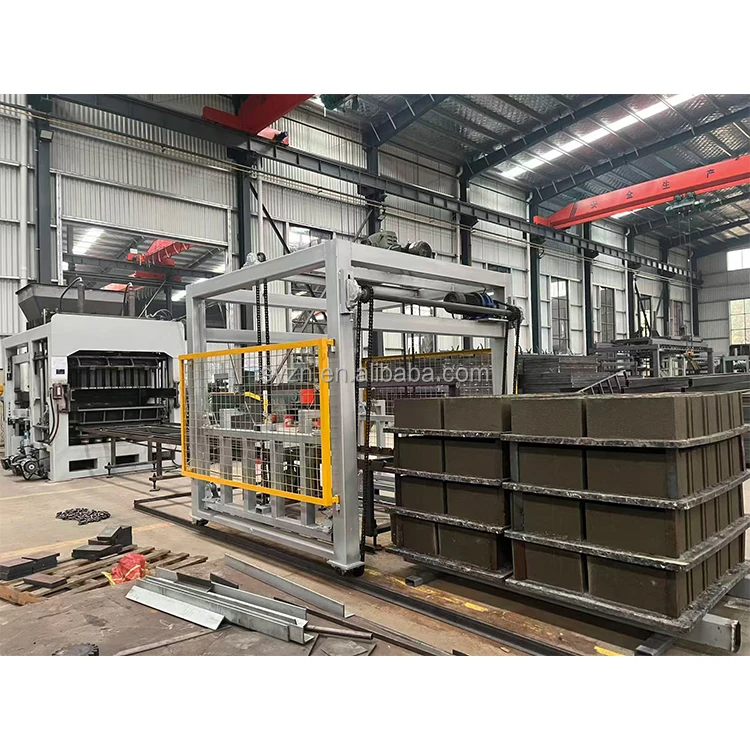
Hydraulic-Vibration Matching — The QT4-18 pairs a high-pressure hydraulic station with 40–50 kN vibration force, tuned together against the buyer’s actual mix and aggregate rather than set to a catalogue default.
Technical Specifications
| Parameter |
Value |
| Product Type |
Automatic Hydraulic Concrete Block Making Machine |
| Model |
QT4-18 |
| Overall Dimensions (L×W×H) |
3900 × 1600 × 2300 mm |
| Molding Cycle |
15–25 s (basis not stated in source — confirm block format, material and thickness) |
| Vibration Force |
40–50 kN |
| Rated Power |
24 kW |
| Hydraulic Station |
High-pressure hydraulic system included |
| Control System |
PLC control system |
| Pallet Size |
850 × 550 × 25 mm |
| Mixer Model |
JQ350 |
| Net Weight |
3 T |
| Applied Products |
Hollow block, solid brick, paver, curbstone |
| Raw Materials |
Crushed stone, sand, cement, stone dust, fly ash |
| Included Auxiliary Equipment |
Pallet feeder, brick conveyor, block sweeper |
| Free Accessories |
Manual hydraulic trolley, spare parts and tools |
| Output — Hollow Block 400×200×200 mm |
1200–1680 pcs/h; 9600–13440 pcs per 8-hour shift |
| Output — Hollow Block 400×150×200 mm |
1800–2400 pcs/h; 14400–19200 pcs per 8-hour shift |
| Output — Solid Brick 240×115×53 mm |
3240 pcs/h; 16200–19440 pcs per 8-hour shift |
| Mould Change |
Supported — multiple formats via mould swap |
| Automation Level |
Full automatic |
| Container Loading |
Nude packing in 20GP; approx. 500 pcs pallets loaded |
Application Suitability
| Application |
Material or Output |
| Hollow block production for residential and commercial walls |
Crushed stone, sand, cement, fly ash mixes on 850×550 mm pallets |
| Solid brick manufacturing for load-bearing and partition masonry |
Standard 240×115×53 mm format, high-density hydraulic pressing |
| Paver and curbstone production for roads and landscaping |
Interlocking and rectangular formats via mould change |
| On-site block production for housing project contractors |
Full automatic cycle reducing manual pallet handling at remote sites |
| First block plant setup for entrepreneurs entering the market |
Mid-tier automatic line with integrated pallet feeder and brick conveyor |
What "1200 Pieces per Hour" Actually Means for the QT4-18 automatic block making machine manufacturer
Capacity figures only matter when the block format behind them is stated up front.
Most quotations list a single cycle speed and leave the buyer to discover — after commissioning — that the number assumed a thin paver, not the 200 mm hollow block the local market demands. With the QT4-18, every output row in the table above names the exact block size, so you can calculate realistic daily volume against your own product mix. A plant selling mostly 400×150×200 mm hollow blocks will see noticeably higher shift output than one running 200 mm wall blocks, even on the same machine. Skipping this conversation before purchase is the single largest cause of capacity disappointment in this equipment class [NEED_CITE: buyer expectations versus stated cycle times in block machinery tenders].

Positioning the QT4-18 Within the Shiyue Full Machine Range
The Shiyue lineup spans mobile egg-laying units at the entry point, semi-automatic presses for smaller workshops, and fully automatic lines like the QT4-18 for buyers ready to eliminate manual pallet handling. This model sits at the mid-tier automatic position — a complete step up from semi-automatic operation without the footprint and capital outlay of a high-capacity plant. Buyers moving from a mobile machine will find the integrated pallet feeder and block sweeper remove two of the most labour-heavy stations. For those already running a semi-automatic press, the QT4-18 automatic block making machine manufacturer configuration introduces PLC-controlled cycling that keeps mould close, vibration, and hydraulic pressure timed without operator judgement on every stroke.
When the Full Range Matters More Than a Single Press
A block plant is a sequence of stations — material feeding, mixing, pressing, pallet handling, stacking, curing — and the press only sets the pace if every other station keeps up. In the Shiyue range, the QT4-18 is specified alongside its matching JQ350 mixer, pallet feeder and brick conveyor so that material arrives and pallets cycle without the press idling between strokes. Choosing a press without confirming the supporting equipment is how plants end up with a machine capable of 1680 hollow blocks per hour but a curing area that can only absorb half that volume. The full-range approach lets a buyer see the line layout before committing, including where pallets exit, how blocks travel to the curing yard, and which forklift the 850×550 mm pallet size requires [NEED_CITE: pallet size and curing area compatibility in block plant planning guides].
Reading the Specs That Shape Daily Production
Vibration force and hydraulic pressure together determine whether a block leaves the mould at consistent density or cracks at the edges. The QT4-18 delivers 40–50 kN of vibration paired with a high-pressure hydraulic station — enough to compact crushed stone and fly ash mixes into hollow blocks that meet common compressive strength requirements for load-bearing walls. The 15–25 second moulding cycle range reflects the spread between a thin paver and a tall 200 mm hollow block; thicker products need longer vibration to fully settle the mix before the mould lifts. Pallet dimensions at 850×550×25 mm are fixed, so the buyer must confirm their curing racks and handling forklift match before the order is placed. A mismatch here means buying new pallets or re-racking the entire curing yard after the machine arrives. The 24 kW rated power covers the press, hydraulic pump and auxiliary motors, which should be verified against the site’s available three-phase supply and transformer headroom.
The Cost of Skipping the Configuration Conversation
Ordering a block machine by model number alone — without discussing local aggregate, target block formats and available voltage — creates problems that surface only after the container is opened. A machine wired for 380V/50Hz landing in a 440V/60Hz market will not start, and reconfiguring the motor and PLC on site delays commissioning by weeks. Choosing a pallet size without checking the buyer’s existing curing racks forces a capital spend on new pallets and rack modifications. And specifying a mould for a block format the local market does not buy leaves the buyer paying for flexibility they will never use, while the format they actually need is not in the initial mould set. Each of these oversights traces back to a missing question during the inquiry stage [NEED_CITE: post-delivery commissioning delays in exported concrete machinery].
Why Source This QT4-18 automatic block making machine manufacturer Configuration From Shiyue
Block machinery is the only product line here, so the press, mould, pallet and handling equipment are specified as one matched system rather than assembled from separate suppliers. Configuration starts from the buyer’s actual mix design and local aggregate — not a catalogue default — which keeps vibration and hydraulic pressure matched to the material that will actually run through the hopper. Mould design covers the formats the buyer’s market sells, with custom drawings available when a local standard does not match the catalogue. Automation level is selectable within the range, so a buyer can begin at full automatic on the QT4-18 and plan a future step up to higher-tier lines as volume grows. Installation support includes operator training at the plant, and wear parts plus mould replacements remain available from the same source that built the machine.
Documentation & Verification
- Line layout drawing with capacity calculation per block format for the QT4-18
- Machine specification sheet stating hydraulic pressure and vibration force ratings
- Mould drawing and format list showing every block type included in the order
- Pallet specification confirming 850×550×25 mm dimensions and material grade
- Voltage, frequency and PLC display language written confirmation before production
- Factory test record on buyer’s target block format before container loading
Installation, Commissioning & Support
- Foundation plan based on 3900×1600 mm footprint and 3 T operating weight
- Three-phase power supply verified against the 24 kW rated power draw
- Machine shipped nude in a 20GP container with approx. 500 pallets loaded alongside
- PLC display language and control parameters set before first production run
- Operator training covering mould change, pallet feeder and block sweeper sequences
- Wear parts list and hydraulic seal kit supplied with initial spare parts package
Before You Send an Inquiry
To size the QT4-18 correctly within the Shiyue range, share the block formats your market buys most, the daily volume you need per format, and the raw materials available locally — including a sample of your aggregate if possible. Confirm the three-phase voltage and frequency at your site, the PLC language your operators will need, and whether you already have curing racks and a forklift so the 850×550 mm pallet can be cross-checked before the order is finalized.
Frequently Asked Questions
Q: How is the output capacity of the QT4-18 verified and what block format does each figure assume?
A: Every output number published for the QT4-18 is tied to a specific block size — 400×200×200 mm hollow, 400×150×200 mm hollow, or 240×115×53 mm solid brick. The factory test runs the buyer’s chosen format before dispatch, producing a record that confirms actual cycle time against the quoted range.
Q: Where does the QT4-18 sit in the Shiyue range and when should a buyer move to a higher tier?
A: The QT4-18 occupies the mid-tier automatic position, above semi-automatic and mobile models. Buyers whose daily volume targets exceed the QT4-18 shift output on their primary block format, or who need dual-format simultaneous production, should look at higher-tier automatic lines in the range.
Q: What voltage, frequency and PLC language options can be confirmed before production?
A: Voltage and frequency are confirmed during the quotation stage to match the buyer’s local grid. The PLC display language is set before the control panel is wired, so operators see instructions in their working language from the first production run — not after commissioning delays.
Q: What plant footprint and supporting equipment does the QT4-18 need for a complete setup?
A: The press itself measures 3900×1600×2300 mm, but the complete line includes the JQ350 mixer, pallet feeder, brick conveyor and curing area sized to the 850×550 mm pallet. A line layout drawing shows every station so the buyer can verify floor space and material flow before ordering.
Q: How is the mould change configured and what format flexibility does this tier offer?
A: The QT4-18 supports mould swaps across hollow block, solid brick, paver and curbstone formats within this tier. The mould change system is manual with the included tools, and the buyer receives a format list and mould drawings so every planned product can be verified against local market demand before the initial mould set is built.

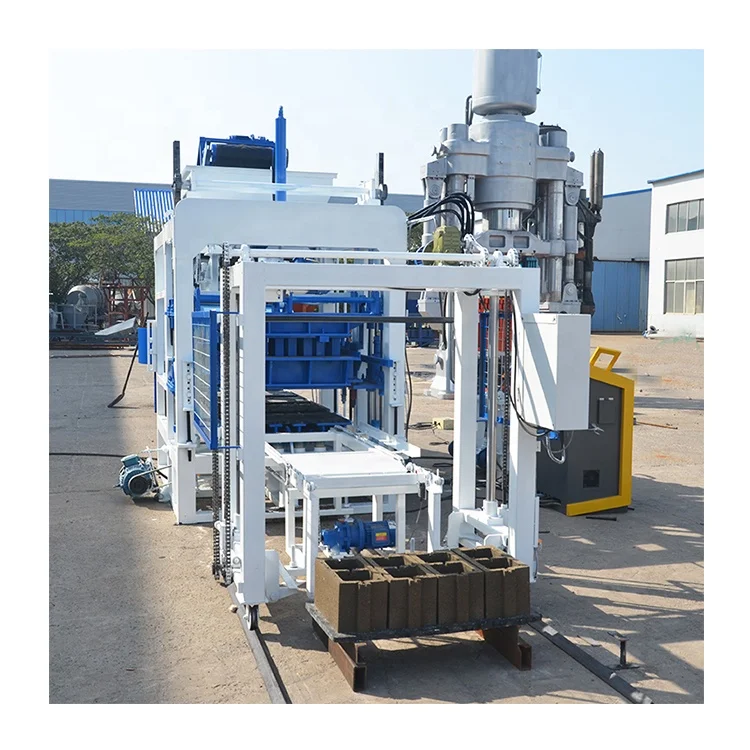
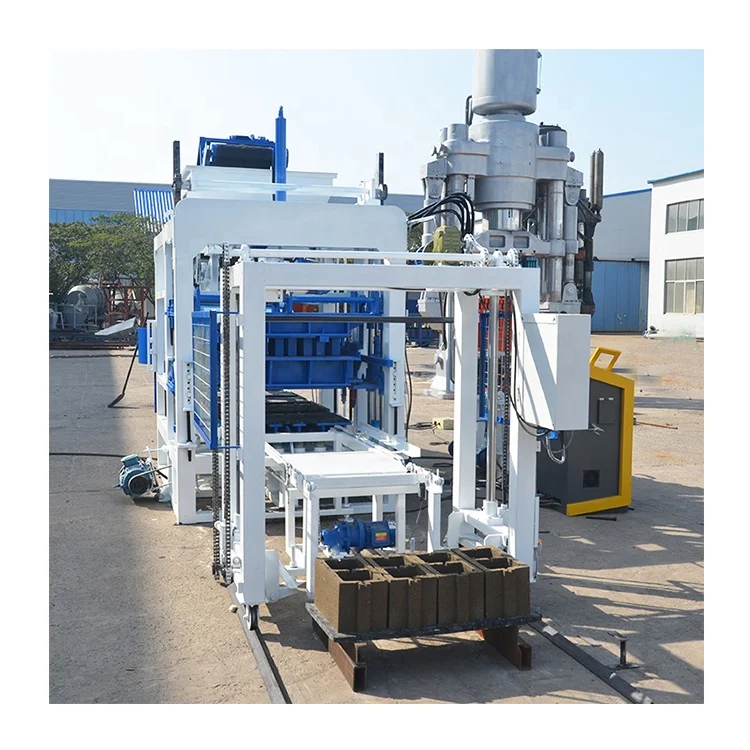 High quality block machine