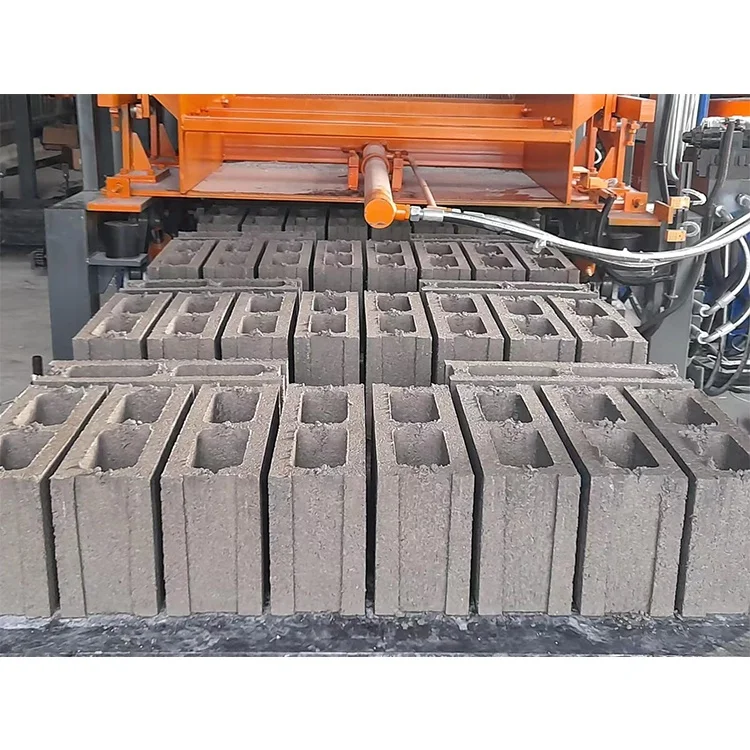
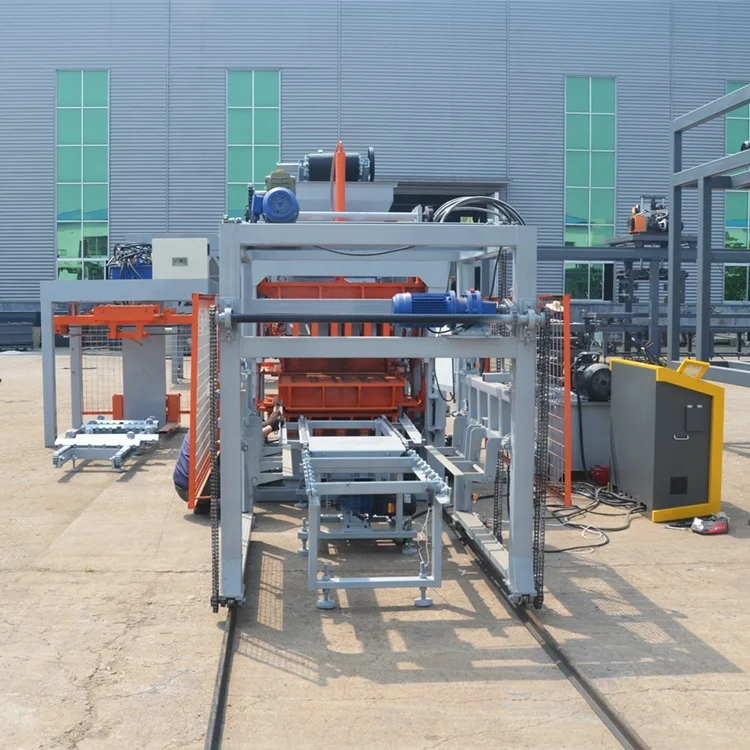
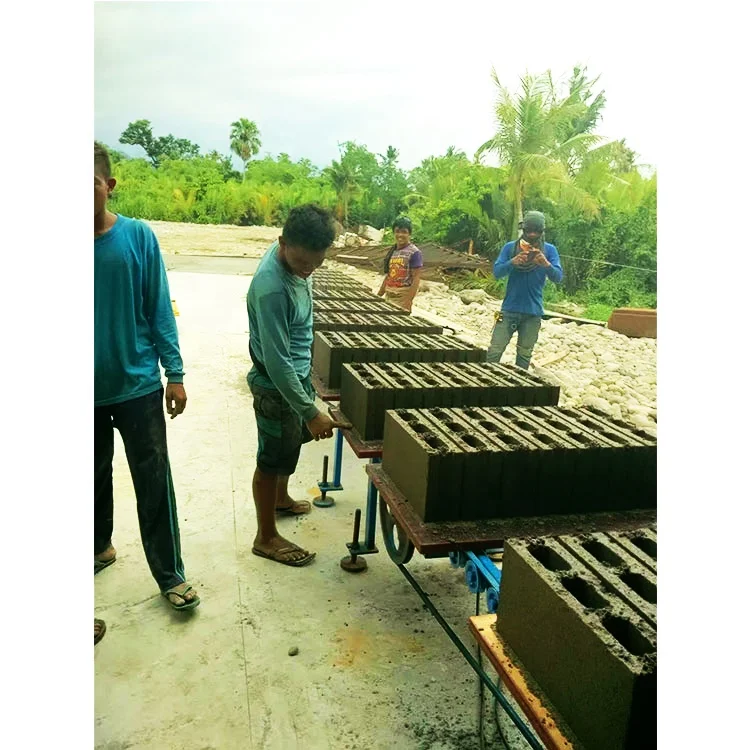
Single-Focus System Integration — the QTJ4-40 is supplied with pallets, moulds, and handling matched to the press cycle rather than assembled from separate vendors.
Technical Specifications
| Parameter |
Value |
| Model |
QTJ4-40 |
| Product Type |
Semi-Automatic Cement Block Making Machine |
| Rated Power |
9.5 kW |
| Molding Cycle |
40 s |
| Theoretical Productivity (400×200×200 mm hollow, 4 pcs/mould) |
360 pcs/h, 2800 pcs/day |
| Theoretical Productivity (400×150×200 mm hollow, 5 pcs/mould) |
450 pcs/h, 3600 pcs/day |
| Theoretical Productivity (225×112.5×60 mm solid brick, 9 pcs/mould) |
800 pcs/h, 6400 pcs/day |
| Output Capacity |
2000-2500 pcs / 8 hours (basis not stated in source) |
| Vibration Method |
Bed mould vertical vibration + upper mould compression vibration |
| Control System |
Semi-automatic with top die push-pull and automatic scraper |
| Pallet Size |
850 × 450 mm |
| Overall Dimensions (L×W×H) |
1350 × 1460 × 1800 mm |
| Machine Weight |
1 T |
| Voltage |
Configurable to buyer’s local voltage and frequency |
| Assembly State |
New condition, single-worker operable |
Application Suitability
| Application |
Material or Output |
| Small-scale hollow block production |
Concrete with sand, cement, and fly ash |
| On-site solid brick production for contractors |
Crushed stone, cement, lime, and gypsum |
| Paving brick runs for municipal projects |
Aggregate blends with cement binder |
| First-plant entrepreneur production |
Locally sourced sand and cement mixes |
What "2800 Blocks Per Day" Actually Means for the QTJ4-40 Block Machine Manufacturer
Every output figure must name the block format it assumes — or it means nothing.
I once watched an African customer take delivery of a small block press rated at a number that looked impressive on the quotation. His local sand carried high clay content, the vibration force was not matched to his mix, and actual daily output fell to roughly half the catalogue number. With the QTJ4-40 block machine manufacturer configuration, we state capacity per format: 360 pieces per hour on 400×200×200 mm hollow blocks, 450 on 400×150×200 mm hollow, and 800 on solid bricks. Those numbers assume a 40-second cycle and a mix design that actually suits your aggregate. [NEED_CITE: aggregate grading standards for concrete block production]

Where the QTJ4-40 Sits in the Machine Range
The QTJ4-40 occupies the entry-to-mid tier of the Shiyue range, sitting between the smallest manual egg-laying machines and the fully automatic stacking lines. Buyers who need a first machine with limited capital typically land here. The semi-automatic design means one worker handles the pallet transfer while the top die push-pull and automatic scraper reduce manual steps. For a buyer surveying options, this model answers whether a semi-automatic press covers daily volume needs before committing to a higher-tier automatic line.
Footprint and Foundation Reality at This Tier
A machine weighing 1 T with overall dimensions of 1350 × 1460 × 1800 mm fits inside a modest workshop bay. The foundation does not require a reinforced pit — a level concrete slab bearing the static and dynamic load is typically sufficient. The 850 × 450 mm pallet size determines your curing rack layout and the forklift capacity you need on site. Buyers sometimes overlook that the curing area must hold several days of pallet inventory, so the total plant footprint extends well beyond the press itself. [NEED_CITE: concrete curing duration by climate zone]
How Vibration and Pressure Shape Block Density
The dual vibration system — bed mould vertical vibration combined with upper mould compression vibration — addresses a common failure mode in small presses where blocks crack or crumble at the edges. Vertical vibration settles the aggregate downward while upper compression closes voids near the top face. With a rated power of 9.5 kW driving both the vibration and the hydraulic scraper, the QTJ4-40 block machine manufacturer balances energy input against the 40-second cycle to reach target density. Pallet size and mould cavity count are matched so the operator feeds and retrieves at a steady rhythm rather than waiting on the press or chasing pallets.
The Cost of Skipping Voltage Confirmation Before Shipment
Arriving at a job site to discover the control panel displays a language the operator cannot read, or that the motor is wired for 380V when the local supply is 440V, turns a commissioning week into a month. Voltage, frequency, and control language must be confirmed in writing before production starts. I have seen small-plant operators forced to rewire entire distribution boards because the voltage question was left to an assumption on the quotation. With configurable voltage settings, the QTJ4-40 can match local supply standards, but only if the buyer provides exact values early in the sales process. [NEED_CITE: voltage and frequency standards by export market]
Why Sourcing the Press and Line Together Matters
The QTJ4-40 block machine manufacturer approach treats the press, mould, pallet, and handling equipment as one system rather than separate purchases. Mould design covers the formats the buyer’s market actually sells, including custom drawings when standard cavities do not match. Pallet material and size are chosen with the curing area and existing forklift in mind. Automation level is selectable — a buyer can start with semi-automatic pallet handling and plan an upgrade path later. Installation includes operator training on the specific mix design and block format the plant will run. Documentation arrives with the machine: line layout with capacity stated per format, factory test records, mould drawings, and a wear parts list so replacements are available when first needed.
Documentation & Verification
- Line layout with capacity calculation stating the block format assumed for each figure
- Machine specification sheet covering power, cycle time, and pallet dimensions
- Mould drawing and format list confirming cavity count per block type
- Voltage and control language confirmation document signed before production
- Factory test record showing cycle time and output on buyer’s specified format
- Operation and maintenance manual with wear parts and mould replacement intervals
Installation, Commissioning & Support
- Level concrete slab foundation sufficient for 1 T static load and vibration forces
- Dedicated power circuit sized for 9.5 kW rated draw at confirmed local voltage
- Machine arrives assembled; pallet racks and curing area prepared before arrival
- First-day commissioning includes cycle timing and block density checks per format
- Operator trained on semi-automatic pallet feed and top die push-pull sequence
- Wear parts list and mould inventory reviewed before production starts
What We Need From You to Configure the Right Setup
To move past a catalogue quotation, we need to know your target block format and daily volume requirement, the sand and aggregate available locally with any known clay or moisture content, and your existing site conditions including curing area dimensions. Confirm your local voltage, frequency, and preferred control panel language. If you already have forklifts or curing racks on site, share their specifications so pallet sizing aligns with what you own.
Frequently Asked Questions
Q: How is the QTJ4-40 daily capacity calculated, and which block format does each figure assume?
A: Capacity is calculated from the 40-second molding cycle multiplied by cavity count per mould. The 360 pcs/h figure assumes 400×200×200 mm hollow blocks at 4 per mould, 450 pcs/h assumes 400×150×200 mm at 5 per mould, and 800 pcs/h assumes solid bricks at 9 per mould. Daily figures assume continuous 8-hour operation with pallet handling at cycle pace.
Q: Where does the QTJ4-40 sit compared to the fully automatic tiers in the Shiyue range?
A: The QTJ4-40 is semi-automatic with one-worker operation, positioned below fully automatic lines that include pallet feeding, stacking, and cubing. Buyers choosing this model accept manual pallet transfer in exchange for lower investment and a smaller footprint, with the option to add automation stations later.
Q: What voltage and control language options are available for my market?
A: Voltage is configured to the buyer’s local supply before production — common ranges include 220V, 380V, and 440V at 50 or 60 Hz. Control panel labeling and documentation language are confirmed during the quotation stage so operators can read displays and manuals on arrival.
Q: Can I start with the QTJ4-40 now and add automation later?
A: The semi-automatic configuration is designed to accept add-on stations. Automatic pallet feeders, stacking units, and cubing systems can be integrated into the line as production volume grows, provided the original layout reserved space for downstream equipment and the pallet size remains consistent.
Q: What plant footprint does the QTJ4-40 require, including curing area?
A: The press itself fits within 1350 × 1460 mm floor space plus operator clearance. The curing area must hold multiple days of 850 × 450 mm pallets, which typically requires several times the press footprint. Total site area depends on daily output target and local curing duration requirements.

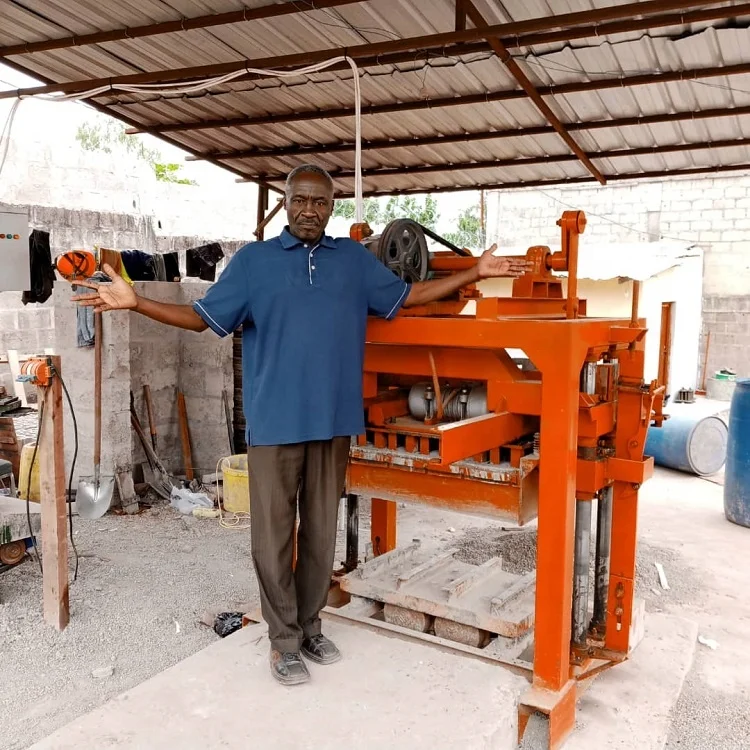
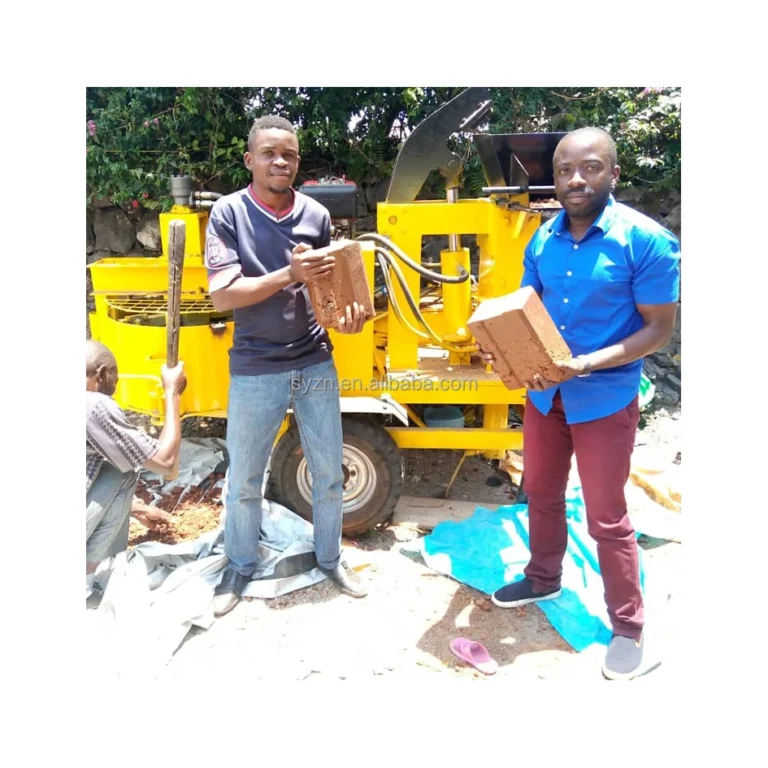 High quality block machine