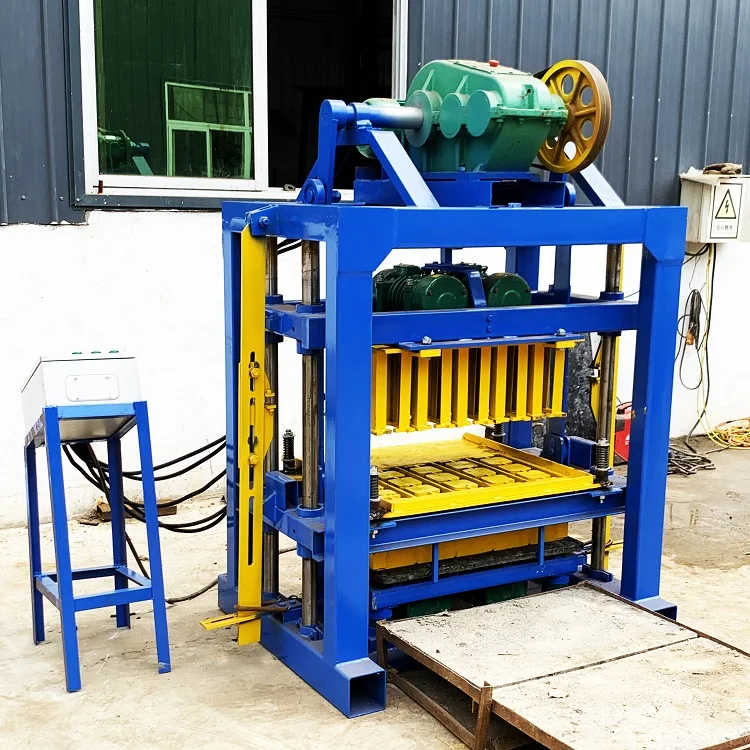
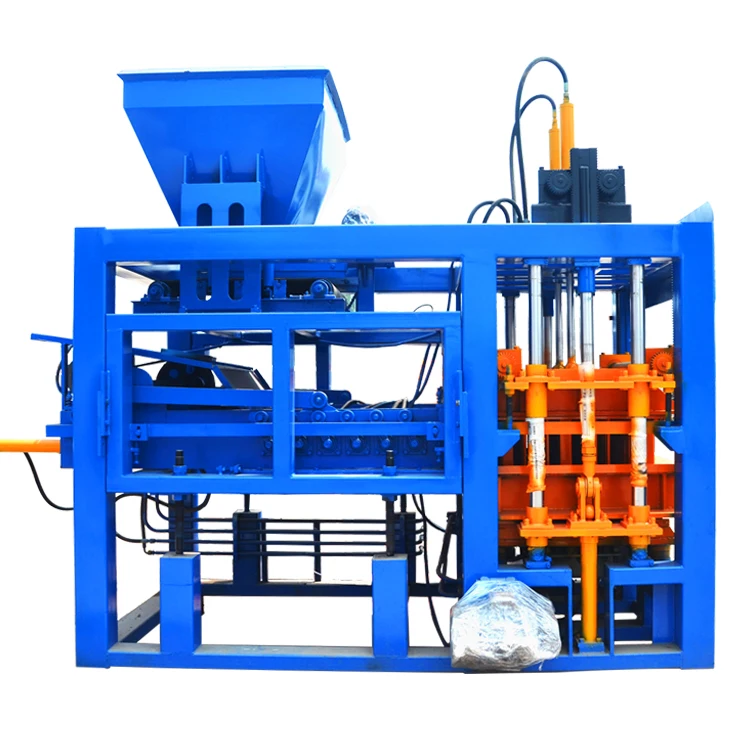
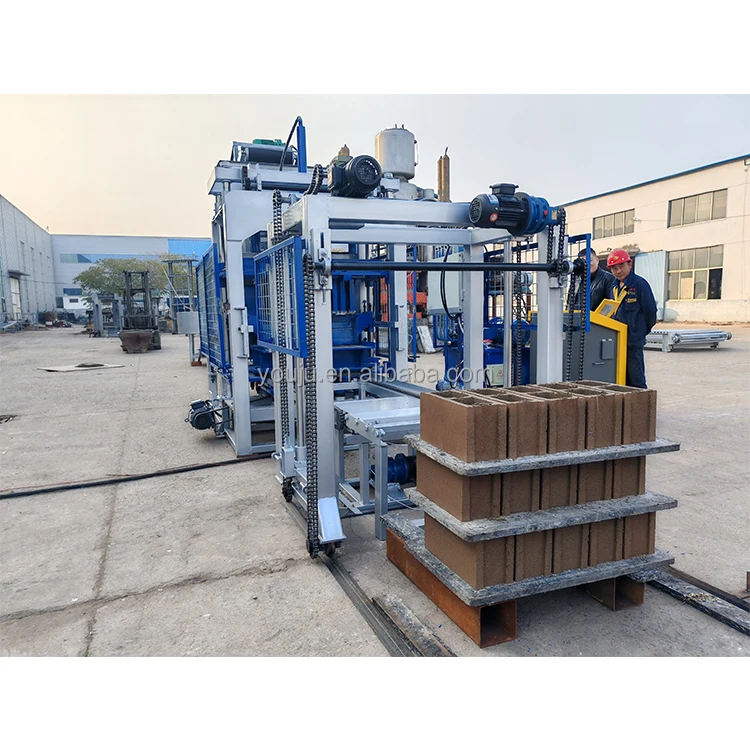
Integrated System Design — machine, mold, pallet, and handling are specified as one matched system rather than assembled from separate suppliers, so the QTJ4-24 arrives configured for your actual mix and target block format.
Technical Specifications
| Parameter |
Value |
| Model |
QTJ4-24 |
| Product Type |
Stationary Block Making Machine |
| Overall Dimensions (L×W×H) |
3600 × 1700 × 2560 mm |
| Pallet Size |
850 × 450 mm |
| Molding Cycle |
24–26 s |
| Vibration Force |
45 kN |
| Vibration Configuration |
2 × 3 kW lower vibrators + 2 × 1.5 kW upper vibrators |
| Overall Power |
11.95 kW |
| Molding Method |
Mechanical (gear driven) |
| Reducer (Mold Lifting) |
350-type |
| Material Distribution |
Full-automatic spiral |
| Control System |
PLC controlled |
| Total Mass |
2 T |
| Raw Materials |
Cement, sand, stone |
| Block Formats Supported |
Hollow block, solid block, paving brick (basis not stated in source — confirm block format / material / thickness) |
| Output Capacity per Format |
basis to be confirmed |
| Voltage & Frequency |
not stated in source — confirm target market standard |
| Warranty |
1 year for whole machine (excluding spare parts) |
Application Suitability
| Application |
Material or Output |
| Hollow block production for residential and commercial walls |
Cement, sand, crushed stone mixes |
| Solid block manufacturing for load-bearing structures |
Dense aggregate and cement blends |
| Paving brick production for walkways and light-traffic areas |
Fine aggregate and cement mixes |
| On-site contractor block production for housing developments |
Locally sourced sand and stone |
| First-plant entrepreneur block manufacturing |
Standard cement and aggregate combinations |
What "24-Second Cycle" Leaves Out About Your Actual Daily Output
The molding cycle means nothing without knowing which block format you intend to produce.
I once watched a buyer in West Africa unpack a stationary block machine for sale that was quoted at a fixed cycles-per-hour rate. The machine ran flawlessly, but the hollow blocks they needed were 200 mm tall, not the 150 mm standard the factory test used. The filling time increased, the vibration had to run longer for proper compaction, and the realistic daily output dropped to roughly half what the quotation implied. The QTJ4-24 has a published 24–26 second molding cycle, but that figure assumes a specific block format, wall thickness, and material density. [NEED_CITE: block machine capacity calculation standards by block format and mix design] When you request a quotation, the capacity breakdown must state which block size each number is based on — otherwise you are comparing machines on a metric that does not exist in your plant.

Where the QTJ4-24 Sits in the Range
The QTJ4-24 occupies the middle ground between manual egg-laying machines and high-capacity hydraulic automatic lines. It is a mechanical-vibration press with a full-automatic spiral feeder, meaning material distribution into the mold cavity is handled without operator intervention while pallet feeding and stacking remain manual operations. This makes it a practical stationary block machine for sale for buyers who have outgrown mobile machines but are not yet ready to invest in full automation. The gear-driven molding method keeps maintenance simpler than hydraulic systems, and the overall power draw of 11.95 kW allows installation at sites where electrical infrastructure is limited.
Matching Automation to Your Labor and Output Plan
A semi-automatic configuration reduces your capital outlay and keeps operator skill requirements manageable, which matters when you are training a first shift crew. The PLC control system governs the spiral feeder timing and vibration cycle, removing guesswork from the two steps most sensitive to inconsistency. If your production plan calls for higher throughput later, the machine family allows progression to automatic pallet handling and stacking systems. Starting with the QTJ4-24 means you can validate your market, refine your mix design against local aggregate, and expand automation only when daily demand justifies the investment. [NEED_CITE: block plant automation upgrade paths for semi-automatic presses]
Reading the Specs That Actually Shape Your Production Day
The 45 kN vibration force is generated by a combined upper and lower vibrator arrangement — two 3 kW units below the mold and two 1.5 kW units above it. This dual-direction vibration compacts the mix from both faces of the block, which matters when your local aggregate includes irregular crushed stone that resists settling under single-direction force. The 350-type reducer handles the mold lifting mechanism; a lighter-duty reducer would wear faster under the repeated shock loads of a 2-ton press cycling every 24 seconds. The 850 × 450 mm pallet size determines your curing rack layout and forklift compatibility — if your existing curing area is built around a different pallet dimension, you need to know this before the machine ships. The full-automatic spiral feeder ensures each mold cavity receives a consistent material charge, which directly affects block weight uniformity and dimensional tolerance across a production run.
The Hidden Cost of Skipping the Voltage Conversation
A stationary block machine for sale configured for the wrong voltage and frequency will not start on arrival, and the delay is measured in weeks, not days. The QTJ4-24 ships with a PLC control system and vibration motors that must match your local electrical standard. I have seen plants sit idle while a replacement transformer was sourced locally because the machine arrived wired for 380V/50Hz when the site ran on 440V/60Hz. Voltage and frequency must be confirmed before production begins, and the PLC display language should match your operator team’s working language — these are not afterthoughts, they are commissioning prerequisites. [NEED_CITE: industrial machinery voltage and frequency compatibility by export market]
Why Source This Machine Here
Block machinery is the single focus of this operation, which means the QTJ4-24 is not a generic press pulled from a catalog — it is specified as part of a system that includes the mold, pallet, and handling equipment matched to your plant. The configuration is set against your actual mix design and local aggregate, not a default recipe that may not reflect materials available in your region. Mold design covers the formats your market sells, and custom mold drawings can be produced from your specifications. The automation level is selectable, so the semi-automatic QTJ4-24 can serve as your entry point with a clear path to higher automation within the same machine family. Installation and commissioning support includes operator training on your specific block formats.
Documentation & Verification
- Line layout and capacity calculation stating which block format each output figure assumes
- Machine specification sheet confirming vibration force, pallet size, and cycle time per format
- Voltage and control language confirmation matched to your site before production starts
- Mold drawing and format list showing which block formats the quoted machine produces on delivery
- Factory test record demonstrating cycle performance with your specified material mix
- Operation and maintenance manual covering reducer lubrication and vibrator servicing intervals
Installation, Commissioning & Support
- Foundation pad sized to the 3600 × 1700 mm footprint with vibration isolation for the 2-ton operating mass
- Dedicated electrical circuit rated for the 11.95 kW overall power draw with correct voltage and frequency wiring
- Machine arrives fully assembled with pallet and mold installed; site preparation limited to utility connections
- First-run commissioning includes cycle timing verification against your target block format and mix design
- Operator training covers PLC control navigation, spiral feeder calibration, and mold changeover procedure
- Wear parts list and mold inventory provided at delivery for planned first-replacement ordering
What We Need to Configure Your Machine
Before we prepare a quotation for the QTJ4-24, we need to understand which block formats you intend to produce and the daily volume your market requires. Share your local raw material sources — the type of sand and stone available to you — so we can align the vibration profile and cycle timing to your actual mix. Let us know your site’s voltage and frequency standard, the language your operators will work in, and the pallet dimensions your curing area and forklift are already set up to handle.
Frequently Asked Questions
Q: How is the QTJ4-24’s daily output calculated, and which block format does that figure assume?
A: Daily output depends on the block format, wall thickness, and mix density you intend to produce. The 24–26 second molding cycle is a baseline; actual cycle time shifts based on material characteristics and the specific mold installed. We provide a capacity calculation that states the exact block format and mix assumption behind every output figure before you place an order.
Q: Where does the QTJ4-24 sit in the range compared to fully automatic stationary machines?
A: The QTJ4-24 is a semi-automatic mechanical press with PLC-controlled material distribution and vibration cycling, while pallet handling and stacking remain manual. It sits between entry-level mobile machines and high-capacity fully automatic hydraulic lines, making it suitable for buyers who need consistent output without the capital commitment of a complete automated plant.
Q: What pallet size does the QTJ4-24 require, and does it match my existing curing setup?
A: The machine uses an 850 × 450 mm pallet. If your curing racks and forklift are already configured for a different dimension, this must be addressed before production begins. We confirm pallet specifications against your existing site equipment during the proposal stage so there are no surprises at commissioning.
Q: Can I start with the QTJ4-24 and upgrade to higher automation later?
A: Yes. The QTJ4-24 belongs to a machine family that supports progression to automatic pallet feeding, stacking, and cubing. Starting semi-automatic allows you to establish your production process and market before investing in full automation, and the upgrade path stays within the same system architecture.
Q: What voltage, frequency, and PLC display language options are available?
A: These are confirmed during the quotation process based on your site’s electrical infrastructure and operator requirements. Voltage, frequency, and PLC display language must be locked in before production starts to avoid commissioning delays after the machine arrives at your plant.

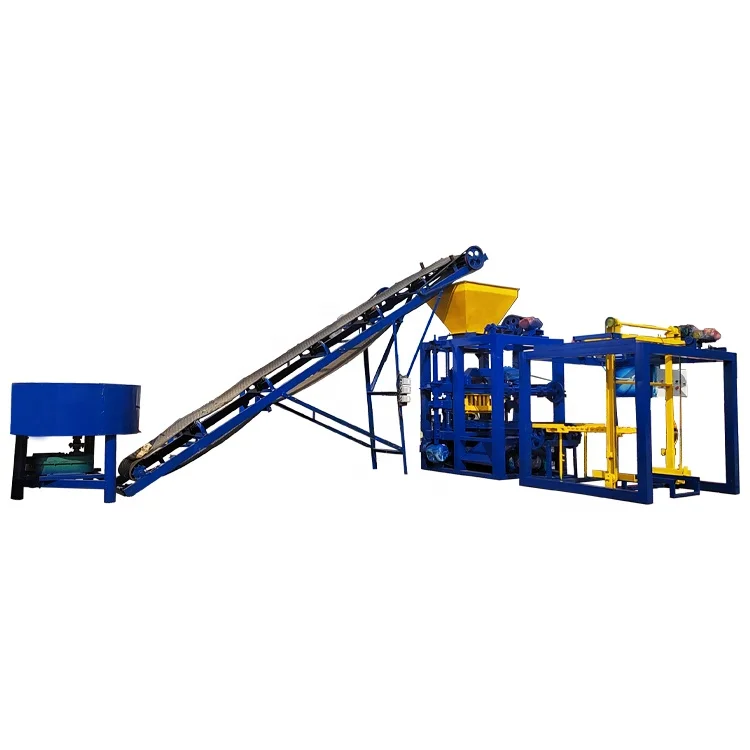
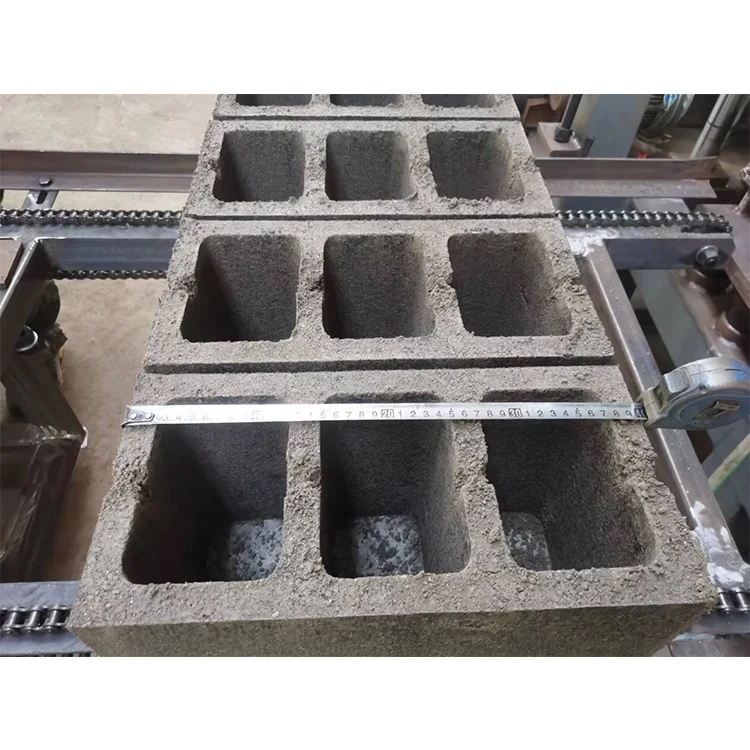 Stationary block machine