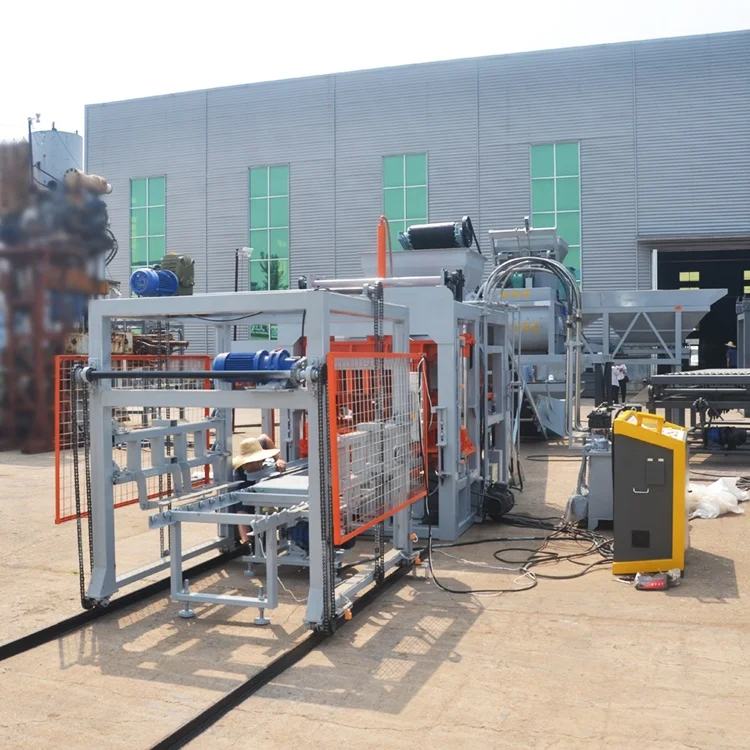
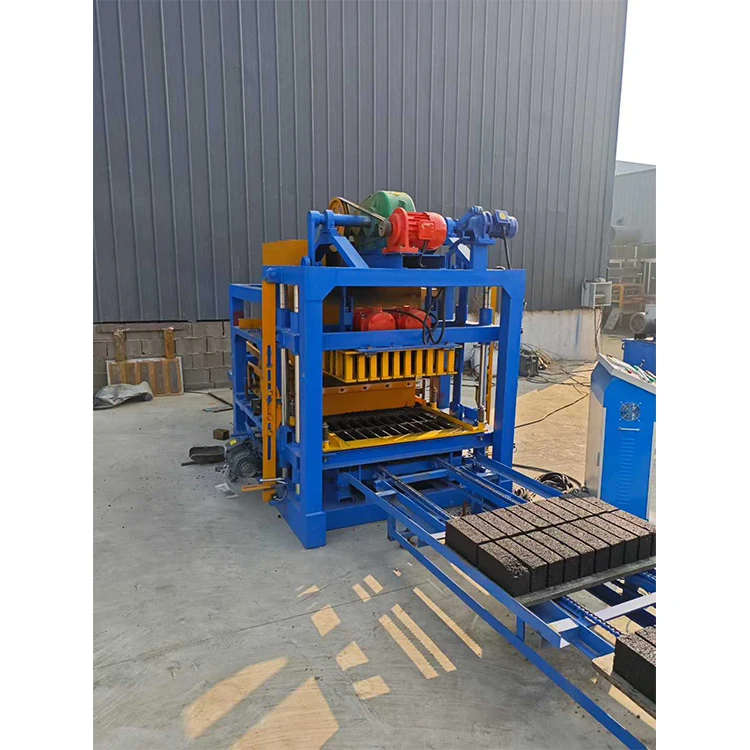
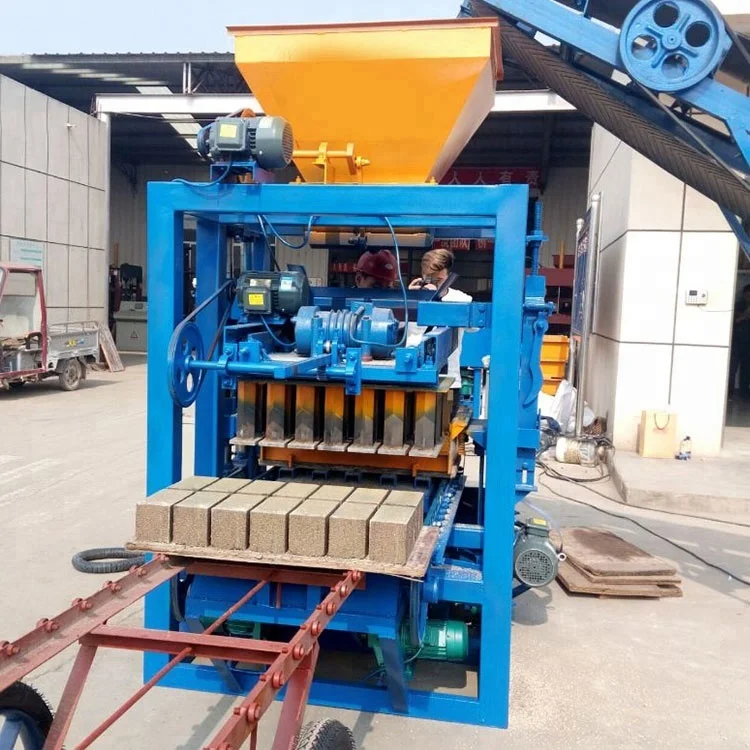
Matched System Sizing — The QT8-15 is specified as one matched system of press, mould, pallet and handling, configured against your actual mix design rather than a catalogue default.
Technical Specifications
| Parameter |
Value |
| Model |
QT8-15 |
| Product Type |
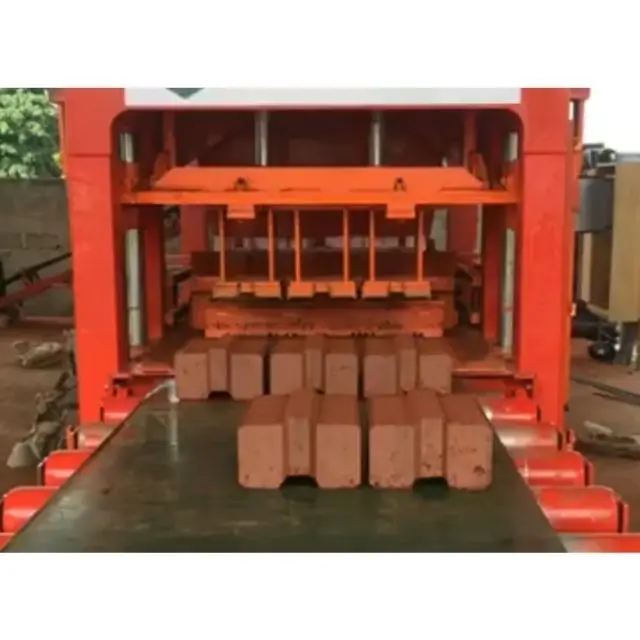
Hydraulic Concrete Block Making Machine |
| Overall Dimensions (L×W×H) |
8300 × 1860 × 3000 mm |
| Rated Pressure |
21 MPa |
| Main Vibration Form |
Platform Vibration |
| Vibration Frequency |
2800–4500 r/min |
| Vibration Force |
45 kN |
| Pallet Size |
950 × 900 mm |
| Molding Cycle |
15–20 s (basis not stated in source — confirm block format / material / thickness) |
| Overall Power |
55.5 kW |
| Total Mass |
8 T |
| Demolding Method |
Hydraulic |
| Factory Area Required |
300 m² |
| Applied Products |
Hollow/solid blocks, pavers, interlocking blocks, curbstone, colored pavers |
| Raw Materials |
Crushed stone, sand, cement, fly ash, gravel, slag, dust |
| Control System |
Available with PLC or MCC control (brand and language to be confirmed) |
| Voltage & Frequency |
Configurable to buyer’s local supply (to be confirmed before production) |
| Warranty |
1 year on whole machine, excluding spare parts |
Application Suitability
| Application |
Material or Output |
| Block production plants replacing an aging press |
Hollow and solid blocks from crushed stone, sand and cement |
| Housing project contractors producing on-site |
Kerbstones and hollow blocks using locally sourced aggregate and fly ash |
| Building material distributors expanding formats |
Pavers, interlocking bricks and colored pavers on one machine platform |
What a Molding Cycle Range Actually Means for Your Shift Output
The 15–20 second cycle only becomes a real number once the block format and mould are locked in.
When a buyer reads "15–20 seconds" on a spec sheet for a hydraulic block making machine manufacturer, the instinct is to divide a shift by the shortest figure and call that the daily target. I have watched this play out badly: a plant owner in West Africa ran a QT8-15 with a standard hollow block mould and expected the 15-second end of the range, but the local sand had a high clay content that required a longer vibration hold to reach full compaction. The real cycle settled around 22 seconds, and the daily count fell short by several hundred blocks. That gap compounds across a month. [NEED_CITE: effect of aggregate clay content on vibration dwell time in hydraulic block presses]

Where the QT8-15 Sits on the Shiyue Range
The Shiyue lineup runs from small semi-automatic workshop machines up to high-capacity fully automatic lines. The QT8-15 occupies the mid-to-high automatic tier. It suits buyers who have outgrown a manual or egg-laying machine and need consistent output across multiple formats, but who do not yet justify the footprint and investment of the largest flagship press. If you are still proving your market with one or two block types, a smaller semi-automatic model may be the right starting point, with an upgrade path available later.
How the Full Range Connects Beyond the Press
A hydraulic block making machine manufacturer does not just ship a press. The QT8-15 must connect upstream to raw material feeding and mixing, and downstream to pallet feeding, stacking and curing rack handling. If the mixer cannot deliver a fresh batch before the press finishes its current cycle, the press waits and the quoted output is theoretical. Matching every station so the press is never starved and never blocked is the real engineering work. [NEED_CITE: line balancing principles in concrete block production]
Pressure, Vibration and Pallet Size — Reading the Core Specs
The 21 MPa rated hydraulic pressure and 45 kN platform vibration force are the two numbers that together determine how densely the concrete is compacted inside the mould. Pressure alone compresses; vibration alone settles fine particles. When both are correctly matched to the buyer’s mix design — say a fly-ash-heavy blend versus a pure crushed-stone mix — the resulting block reaches the required compressive strength without excessive cement usage. The vibration frequency range of 2800 to 4500 r/min gives the operator room to tune for different formats: lower frequency for large hollow blocks that need deep penetration, higher frequency for thin pavers where surface finish matters. The 950 × 900 mm pallet size is the physical link between the press and the curing yard. If your existing forklifts and curing racks were built around a different pallet dimension, every pallet becomes a handling problem from day one. Confirming pallet size against the buyer’s actual yard layout is a step that must happen before the machine enters production.
The Cost of Skipping Configuration Details
When voltage and frequency are not confirmed before production, the machine can arrive with a motor wound for the wrong supply. Commissioning stalls while a replacement motor ships across borders. I have seen a three-week delay on a QT-class press because the PLC display arrived in a language the local operators could not read, and every parameter adjustment required a translator on the floor. These are not engineering failures; they are communication gaps that a proper pre-production checklist eliminates. [NEED_CITE: common causes of commissioning delay in exported industrial machinery]
Why Source the QT8-15 Through This Range
Block machinery is the single focus here, so the QT8-15 is not assembled from separate suppliers — press, mould, pallet and handling equipment are specified as one matched system. Every configuration is set against the buyer’s actual mix design and target block format, not pulled from a catalogue default. Mould design covers the formats the buyer’s market actually sells, with custom drawings available. The automation level is selectable, meaning a buyer can start with semi-automatic pallet handling and add full stacking and cubing as volume grows. Installation support includes on-site commissioning and operator training so the crew knows the machine before the engineer leaves.
Documentation & Verification
- Line layout and capacity calculation stating the block format assumed for each output figure
- Machine specification sheet confirming voltage, frequency and PLC display language before production
- Mould drawing and format list covering every block type in the buyer’s catalogue
- Pallet specification matched to the buyer’s existing curing racks and forklift fleet
- Factory test record and packing photographs provided before container loading
- Hydraulic and electrical schematic for local maintenance teams
Installation, Commissioning & Support
- 300 m² factory area requirement confirmed against the buyer’s available floor and headroom before dispatch
- 55.5 kW total power draw communicated so the buyer arranges the correct dedicated circuit and transformer
- Machine dismantled into container-load sections with reassembly sequence documented in the manual
- On-site vibration frequency and hydraulic pressure tuned to the buyer’s local aggregate during first run
- Operator training covers mould change procedure, PLC navigation and daily maintenance checkpoints
- Wear parts and mould list provided so the first replacement order can be placed before stock runs out
What to Prepare Before Requesting a Quotation
Share the specific block formats you intend to produce, including dimensions and target compressive strength, along with your local raw material source and any available aggregate test data. Confirm your site’s voltage, frequency and the control language your operators need. If you have an existing curing yard and forklift fleet, send the pallet dimensions and rack spacing so the QT8-15 can be matched to your current handling setup from the start.
Frequently Asked Questions
Q: How is QT8-15 daily output calculated per block format, and what cycle time applies to my target product?
A: The 15–20 second molding cycle is a range that shifts depending on block format, wall thickness and mix composition. A large hollow block typically needs a longer vibration hold than a thin paver. We calculate daily output only after locking in the exact mould and running a test cycle with your material, so the figure you plan against reflects real production, not a catalogue maximum.
Q: Where does the QT8-15 sit on the Shiyue range — should I look at a smaller semi-automatic or a larger automatic line instead?
A: The QT8-15 is the mid-to-high automatic tier. It fits buyers producing multiple formats at steady volume who are not yet ready for the largest flagship line. If you are starting with one product and limited capital, a smaller semi-automatic model may be more appropriate, and the range allows you to step up later as demand grows.
Q: What voltage, frequency and PLC language will the machine ship with for my country?
A: These are confirmed with you before production begins. The motor winding, control panel and PLC display language are all set to match your local electrical supply and operator requirements. Shipping a machine without this confirmation is one of the most common causes of delayed commissioning.
Q: How much factory floor and curing yard do I need for the QT8-15 plus its pallet handling and stacking stations?
A: The press itself requires a 300 m² factory area, but the total footprint depends on pallet handling, curing racks and stacking stations downstream. We provide a line layout showing every station so you can verify space requirements against your actual building before the machine ships.
Q: Can I start with the QT8-15 semi-automatic now and upgrade to full automatic stacking and cubing later?
A: Yes. The automation level is selectable, and the machine platform supports adding automatic pallet feeding, stacking and cubing as your volume justifies the investment. Planning the upgrade path early means the electrical and mechanical interfaces can be prepared during the initial build.

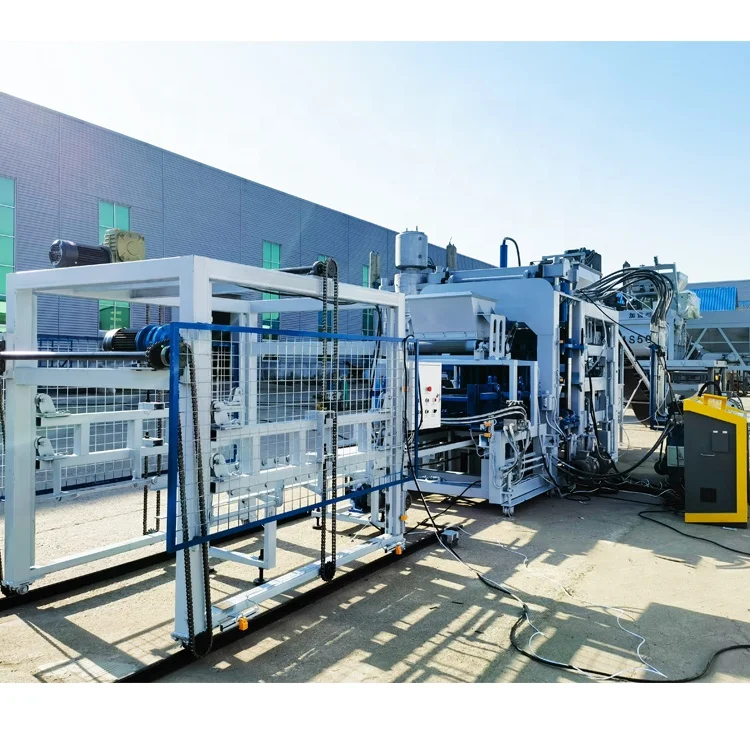
 Automatic block machine