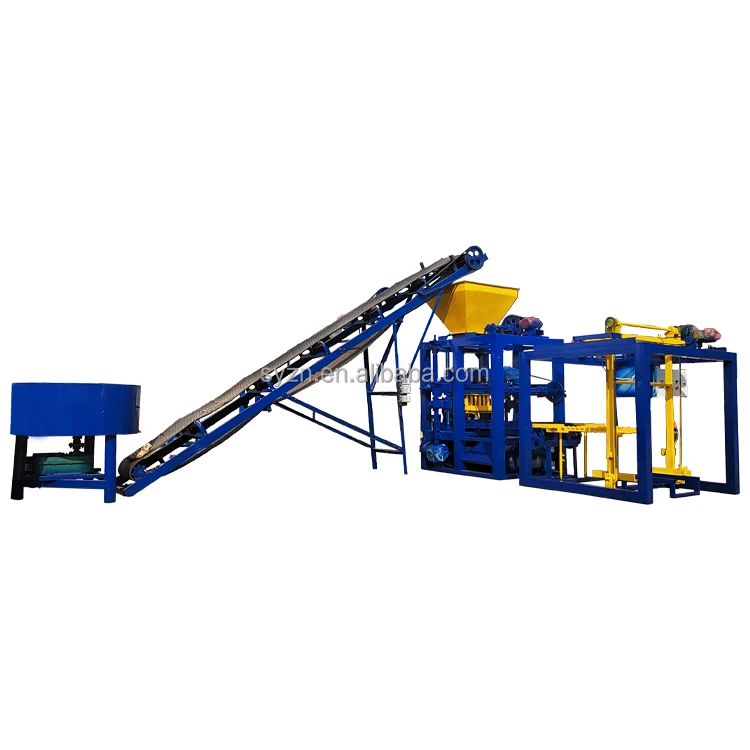
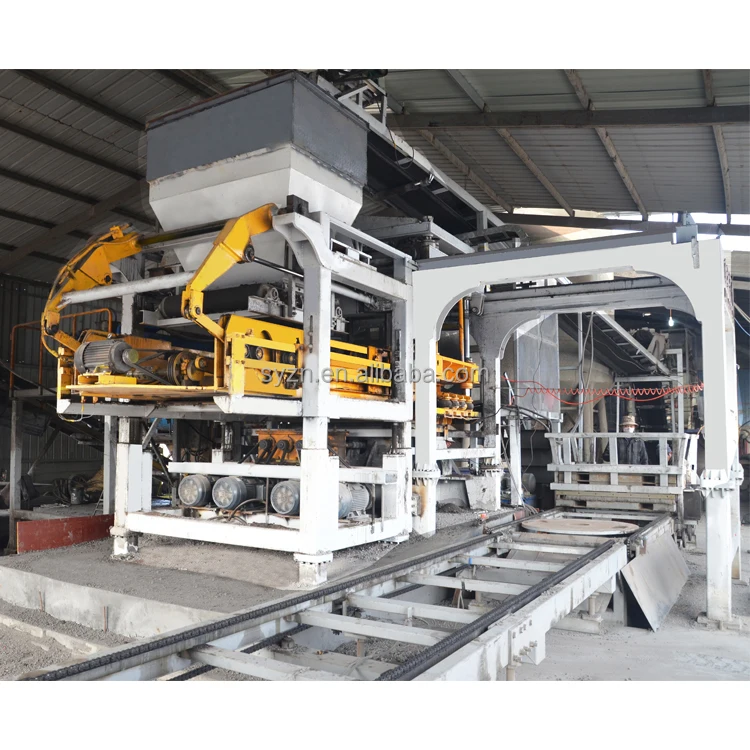
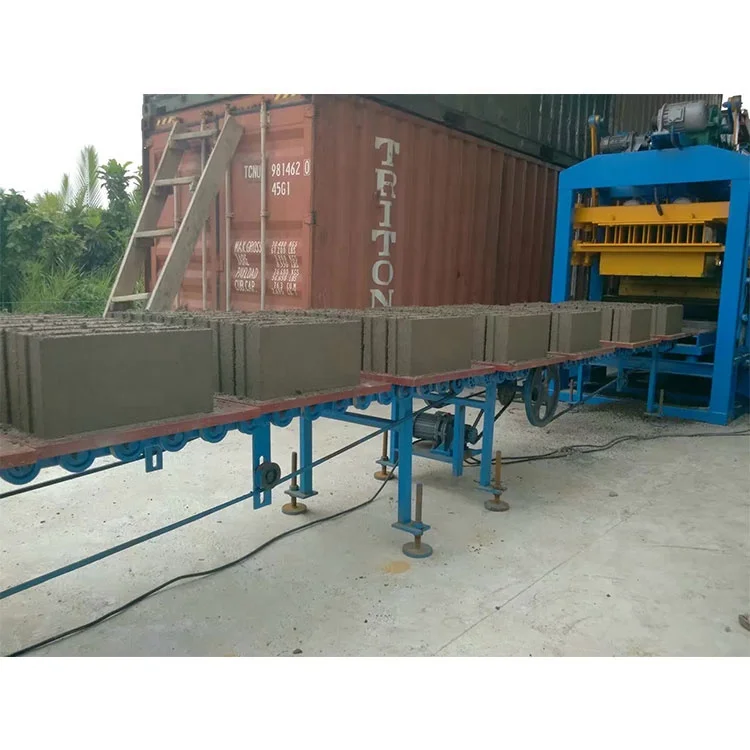
Full-Range Positioning — The QT5-15 sits at the mid-tier of our stationary block machine lineup, bridging workshop-scale semi-automatic setups and high-capacity production lines, so buyers can map their exact investment level before committing.
Technical Specifications
| Parameter |
Value |
| Model |
QT5-15 |
| Product Type |
Fully Automatic Concrete Block Making Machine |
| Overall Dimensions (L×W×H) |
7400×1950×2800 mm |
| Rated Hydraulic Pressure |
21 MPa |
| Main Vibration Form |
Platform Vibration |
| Vibration Frequency Range |
2800–4500 r/min |
| Pallet Size |
1100×550 mm |
| Molding Cycle |
15–25 s (varies by format) |
| Overall Power |
26.5 kW |
| Demolding Method |
Hydraulic |
| Control System |
PLC Control System |
| Automation Level |
Fully Automatic |
| Output (400×200×200 mm hollow block) |
1800 pcs/h (5 pcs/mold, 16–20 s cycle) |
| Output (400×150×200 mm hollow block) |
1300 pcs/h (6 pcs/mold, 15–20 s cycle) |
| Output (225×112.5×60 mm S paver) |
3700 pcs/h (16 pcs/mold, 15–17 s cycle) |
| Raw Materials |
Crushed stone, sand, cement, fly ash, gravel, slag, dust |
| Applied Products |
Hollow/solid blocks, pavers, interlocking blocks, curbstone, colored pavers |
| CE Declaration |
Available where applicable |
Application Suitability
| Application |
Material or Output |
| Hollow block production for residential construction |
Crushed stone and cement mixes at 400×200×200 mm or 400×150×200 mm formats |
| Interlocking paver manufacturing for municipal projects |
Sand, cement, and aggregate blends for 225×112.5×60 mm S pavers |
| Solid block runs for load-bearing walls |
Gravel and fly ash mixes with higher hydraulic pressure settings |
| Curbstone production for road and highway contractors |
Coarse aggregate blends requiring extended vibration cycles |
| On-site block production for housing developments |
Locally sourced sand and stone with portable pallet configurations |
What "1,800 Pieces per Hour" Actually Means for Your Plant
Every capacity figure on this page names the exact block size, mould cavity count, and cycle time behind it — no hourly rate is quoted without its assumptions.
I have watched buyers receive a block machine rated at an impressive hourly output, only to discover on commissioning day that the number assumed a small solid brick they never intended to sell. Their real product — a 200 mm hollow block — cut actual daily throughput well below what the pro-forma invoice promised. The QT5-15 fully automatic block making machine lists output per format so that your financial model matches what the press actually delivers on your curing racks [NEED_CITE: common block plant capacity calculation errors reported by equipment importers].

Placing the QT5-15 Within the Full Stationary Range
The QT5-15 block machine manufacturer lineup positions this model between entry-level semi-automatic presses and the higher-output QT8 and QT10 tiers. For a first-time plant owner, it offers fully automatic PLC control without the floor space and capital outlay of a high-capacity line. Buyers who already run a semi-automatic machine can step up to the QT5-15 to gain automatic pallet feeding and stacking while keeping the footprint compact enough for an existing workshop bay.
Where the Mid-Tier Fits a Growing Block Business
If your daily target sits between what a small workshop press produces and what a full automatic cubing line demands, the QT5-15 occupies that middle ground. The pallet size of 1100×550 mm keeps curing rack dimensions manageable, and the 26.5 kW total power draw stays within a standard industrial supply panel. Contractors running multiple housing phases often choose this tier because it covers hollow blocks, pavers, and curbstones through mould changes rather than requiring separate machines [NEED_CITE: block plant scaling strategies for mid-volume contractors].
Reading the Specs That Shape Your Daily Output
Hydraulic pressure at 21 MPa and platform vibration adjustable from 2800 to 4500 r/min work together to determine block density and green strength. Higher frequency suits thin-wall hollow blocks where rapid compaction prevents collapse, while lower frequency paired with sustained pressure builds density in solid blocks and curbstones. The 15–25 second molding cycle range reflects this format dependency — a 16–20 second cycle for 400×200×200 mm hollow blocks versus 15–17 seconds for S pavers where the mould cavity is shallower. Pallet size at 1100×550 mm must align with your existing forklift tine width and curing rack spacing; ordering a pallet dimension without checking your rack inventory leads to pallets that stack unevenly or require a new forklift purchase.
The Cost of Skipping Voltage and Language Confirmation
A PLC panel that displays cycle parameters in a language the operator cannot read turns commissioning into a standstill. I once saw a fully automatic line sit idle because the HMI defaulted to a language the local electrician did not recognize, and the translation file had to be shipped on a USB drive from another province. Voltage mismatches cause similar delays: a 380 V / 50 Hz motor on a 440 V / 60 Hz supply overheats within the first shift, damaging the vibration motor winding before the buyer realizes the error [NEED_CITE: electrical standard mismatches in exported industrial machinery]. These issues are entirely preventable when voltage, frequency, and PLC display language are locked in before production starts.
Why Buyers Source the QT5-15 Through Shiyue
Block machinery is the single product focus here, so the QT5-15 is specified as one matched system — press, mould, pallet, and handling equipment — rather than assembled from unrelated suppliers. Configuration is set against your local aggregate and target block format, not pulled from a catalogue default. Custom mould design is available to buyer drawings, letting you produce the exact formats your market moves fastest. Automation level is selectable; you can begin with semi-automatic pallet handling and upgrade to full stacking later. Factory test records and packing photographs are shared before shipment so you see the machine running your block format before it leaves the floor.
Documentation & Verification
- Line layout drawing showing the QT5-15 footprint with capacity calculated per block format
- Machine specification sheet confirming voltage, frequency, and PLC display language before production
- Mould drawing and format list detailing cavity count and cycle time for each product
- Hydraulic and electrical schematic matching the as-built QT5-15 configuration
- Factory test record on your specified block format before dispatch
- Packing photographs and CE declaration documentation where applicable
Installation, Commissioning & Support
- Foundation plan sized to the QT5-15 overall dimensions of 7400×1950×2800 mm with anchor bolt layout
- Dedicated power circuit rated for 26.5 kW at the confirmed voltage and frequency
- Machine dismantled into press frame, hydraulic station, and control cabinet for container loading
- On-site PLC parameter tuning to match your local aggregate density and mix moisture
- Operator training covering mould change procedure and cycle time adjustment per format
- Wear parts list identifying hydraulic seals and vibration motor brushes with replacement intervals
Starting Your QT5-15 Inquiry
To size the QT5-15 to your project, share the block formats you plan to sell along with your target daily output and the raw materials available locally. Confirm your site voltage, frequency, and preferred PLC display language so the control cabinet is built to match. If you already have curing racks or forklifts on site, provide their dimensions so the pallet specification aligns with your existing handling equipment.
Frequently Asked Questions
Q: How is the hourly capacity calculated, and which block format does each figure assume?
A: Each capacity figure states the block dimensions, mould cavity count, and cycle time range. For example, 1,800 pieces per hour applies to 400×200×200 mm hollow blocks at five cavities per mould and a 16–20 second cycle. Different formats produce different hourly rates because cavity count and cycle length change.
Q: Where does the QT5-15 sit in the range — when should a buyer step up to a higher tier?
A: The QT5-15 occupies the mid-tier, suited to buyers who need fully automatic operation without the footprint of a high-capacity line. If your daily target exceeds what this tier delivers on your primary format, stepping to a larger press with bigger pallets and more cavities per cycle becomes the logical next move.
Q: What voltage, frequency, and PLC language options are available, and when must they be confirmed?
A: Voltage and frequency are configured to your site supply before production begins. The PLC display language is confirmed at the same stage so operators can read cycle parameters and alarm messages on day one. These details are locked in before the machine enters assembly.
Q: How is the machine, mould, pallet, and handling equipment specified as one matched system?
A: The press, mould cavity layout, pallet dimensions, and stacking equipment are selected together so that cycle times, curing rack spacing, and forklift compatibility all align. This prevents situations where one component arrives mismatched to the rest of the line.
Q: What plant footprint does the QT5-15 require at different automation levels?
A: The press itself measures 7400×1950×2800 mm. Adding automatic pallet feeding and stacking extends the line length, while a semi-automatic setup with manual pallet handling reduces it. A detailed layout drawing is provided during the proposal stage showing exact clearances for maintenance access and pallet circulation.

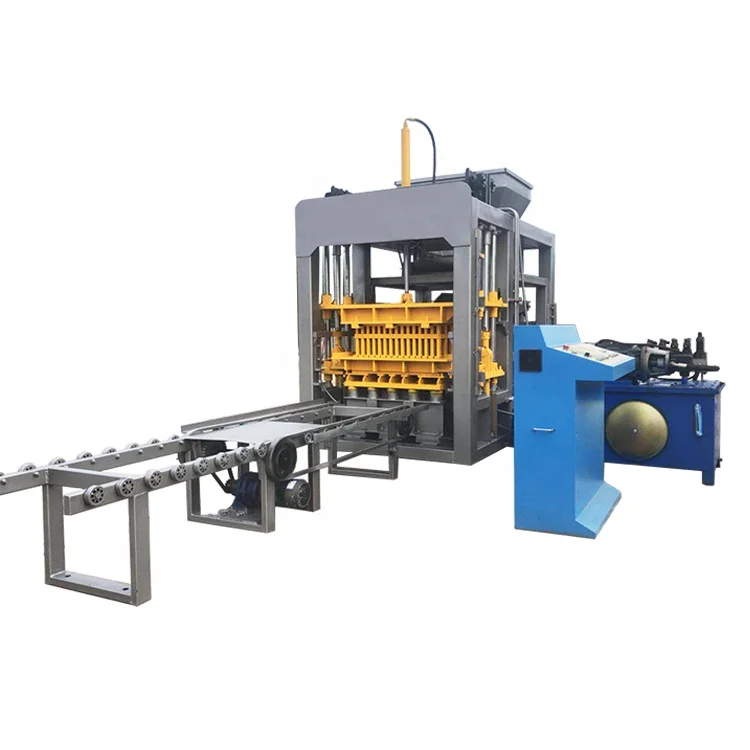
 Stationary block machine