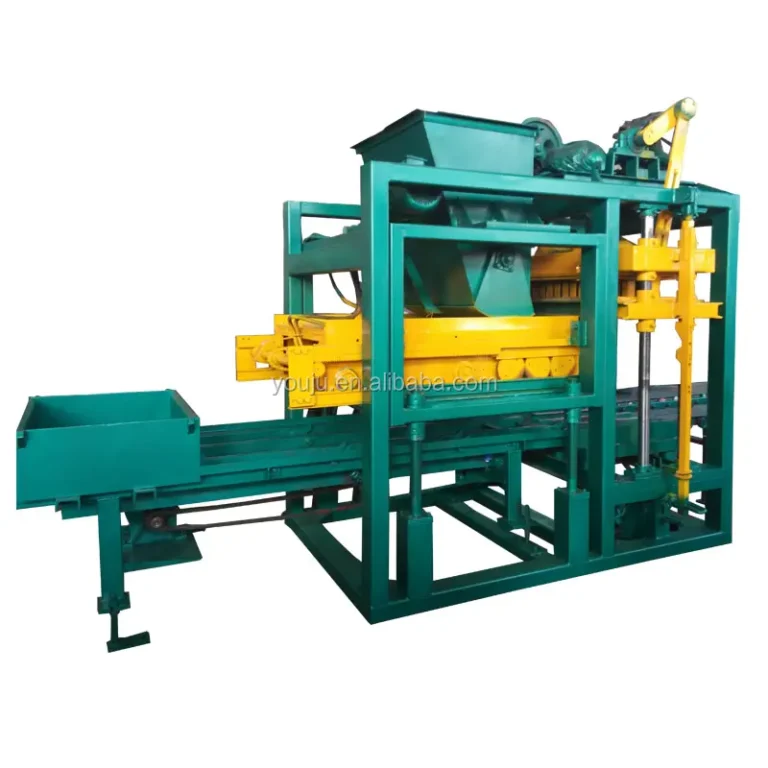
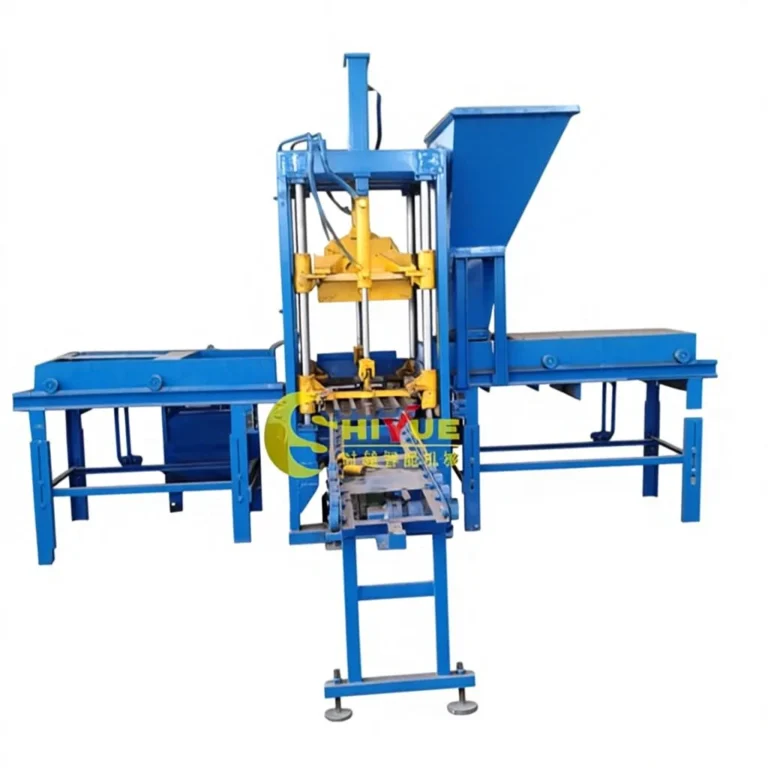
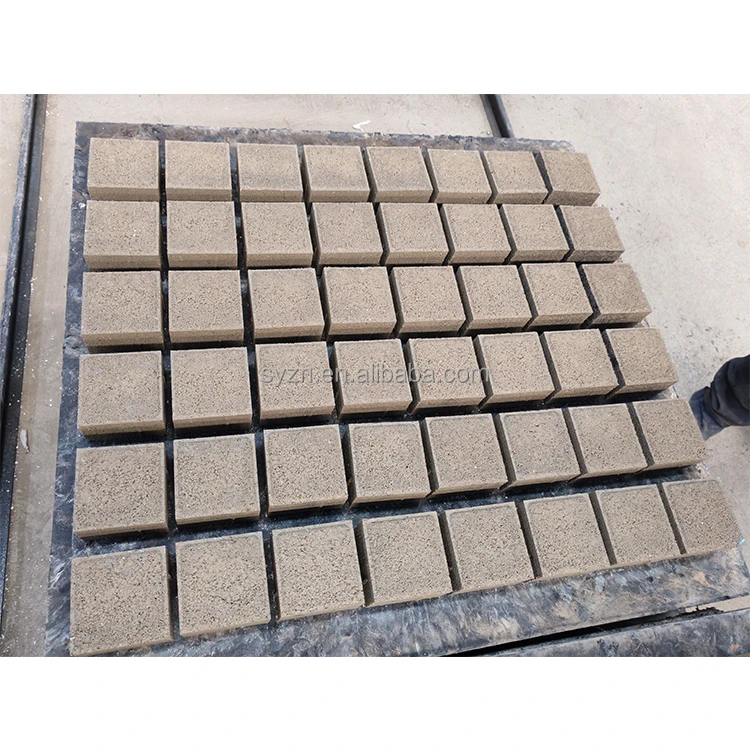
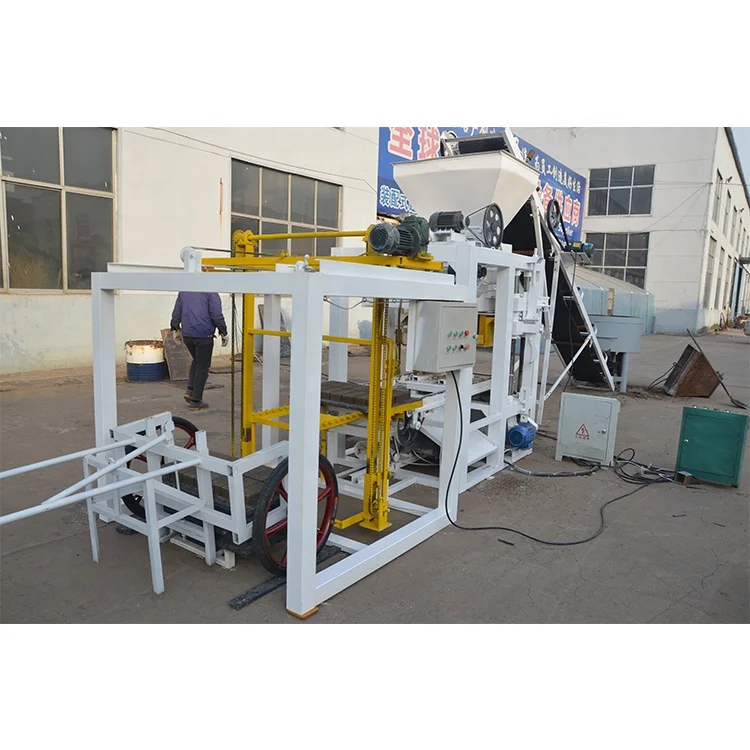
Mid-tier placement — the QT5-15 bridges SHIYUE’s stationary automatic block machine range between workshop-scale semi-automatic setups and high-capacity fully automatic lines, letting buyers locate their exact production tier before committing to a plant layout.
Technical Specifications
| Parameter |
Value |
| Model |
QT5-15 |
| Product Type |
Stationary Automatic Hydraulic Concrete Block Making Machine |
| Overall Dimensions (L×W×H) |
7400×1950×2800 mm |
| Rated Hydraulic Pressure |
21 MPa |
| Main Vibration Form |
Platform Vibration |
| Vibration Frequency |
2800–4500 r/min |
| Pallet Size |
1100×550 mm |
| Molding Cycle |
15–25 s (basis to be confirmed per block format) |
| Overall Power |
26.5 kW |
| Demolding Method |
Hydraulic |
| Output — Hollow Brick 400×200×200 mm |
5 pcs/mold, 16–20 s cycle, 1800 pcs/h |
| Output — Hollow Block 400×150×200 mm |
6 pcs/mold, 15–20 s cycle, 1300 pcs/h |
| Output — S Paver 225×112.5×60 mm |
16 pcs/mold, 15–17 s cycle, 3700 pcs/h |
| Applied Products |
Concrete blocks, hollow/solid blocks, pavers, interlocking blocks, curbstone, colored pavers |
| Raw Materials |
Crushed stone, sand, cement, dust, fly ash, gravel, slag |
| Control System |
PLC (source value — verify against manufacturer catalog) |
| Voltage & Frequency |
Not stated in source — confirm before order |
| Automation Level |
Automatic (source value — verify against manufacturer catalog) |
| Warranty |
1 year (source value — verify against manufacturer catalog) |
Application Suitability
| Application |
Material or Output |
| Hollow block production for residential and commercial walls |
Crushed stone, sand, cement, fly ash blends |
| Solid block manufacturing for load-bearing structures |
Gravel, sand, cement mixes |
| Interlocking paver production for driveways and walkways |
Colored concrete with fine aggregate |
| Curbstone forming for road and infrastructure projects |
High-strength concrete with coarse aggregate |
| On-site block production for housing developments |
Locally sourced sand, slag, and cement |
What "1800 Blocks per Hour" Actually Means for Your Plant
Every capacity figure on this page is tied to a specific block format, mould cavity count, and cycle time — not a single headline number.
I have watched buyers sign contracts based on a peak hourly number, then arrive at their new plant to discover the hollow blocks they actually sell run at a different cavity count and longer cycle. The gap between a quoted capacity and a real daily output can swallow an entire shift. [NEED_CITE: block format assumptions in capacity quotations]. With the QT5-15, we state that 1800 pcs/h applies only to 400×200×200 mm hollow bricks at 5 pcs per mould and a 16–20 second cycle, while the same automatic concrete block making machine manufacturer rates the unit at 1300 pcs/h for 400×150×200 mm hollow blocks at 6 pcs per mould.
Positioning the QT5-15 Within the Full Stationary Range
The QT5-15 occupies the middle tier of SHIYUE’s stationary block machine lineup, sitting above semi-automatic workshop models and below high-capacity automatic lines designed for continuous two-shift operation. Buyers evaluating their first stationary plant typically compare this tier against smaller machines with lower pallet sizes and manual pallet handling, weighing the step-up in floor space, power draw at 26.5 kW, and supporting equipment requirements.
For existing plant operators considering a second line, the QT5-15 offers a format range — from hollow blocks through pavers and curbstones — that can diversify output without the infrastructure investment a top-tier line demands. The 1100×550 mm pallet size sits at a midpoint in the range, meaning curing area and forklift compatibility must be confirmed before the order is finalized.
Matching Automation Level to Your Workforce and Budget
The automatic concrete block making machine manufacturer configures the QT5-15 across a spectrum from semi-automatic pallet handling through to fully automatic stacking and cubing, so buyers are not forced into an all-or-nothing decision. A contractor producing blocks on a housing project site may start with manual pallet transfer and add automatic stacking later as volume justifies the investment. [NEED_CITE: automation upgrade paths in stationary block plants].
The PLC control system governs cycle timing, vibration frequency between 2800–4500 r/min, and hydraulic demolding sequence. Buyers must confirm the PLC display language and the voltage and frequency for the destination country before production begins — a step that, when skipped, has delayed commissioning by weeks on arrival.
Reading the Specs That Matter on the Shop Floor
The 21 MPa rated hydraulic pressure and platform vibration system work together to compact the concrete mix into the mould. Pressure alone does not determine block density; the adjustable vibration frequency must be tuned to the buyer’s specific aggregate gradation and moisture content. I once spent three days on-site adjusting vibration parameters because the local sand had a higher clay content than the test samples, and block strength dropped below the target until we found the right frequency setting.
The 1100×550 mm pallet size directly governs how many blocks cure per rack and whether the buyer’s existing forklift can handle loaded pallets. A mismatch here means either buying a new forklift or re-racking every pallet by hand. The hydraulic demolding method releases blocks cleanly from the mould, reducing edge chipping and extending mould life compared to mechanical knock-out systems. The overall power draw of 26.5 kW determines the electrical supply specification and dedicated circuit requirements at the plant.

The Cost of Skipping the Configuration Conversation
When a buyer orders a block machine configured for a mix design they cannot source locally, the result is either a costly material substitution or weeks of on-site trial and error to find a workable recipe. [NEED_CITE: raw material compatibility in concrete block production]. Mould change time is another specification that rarely appears in quotations but determines whether the format flexibility you paid for is real or theoretical — if a mould swap takes most of a shift, producing multiple block formats in one day becomes impossible.
Pallet handling, stacking, and curing equipment left out of the quotation means the press keeps cycling but finished blocks pile up on the floor waiting for manual labor. The QT5-15’s output tiers are meaningful only when the downstream stations can keep pace.
Why Buyers Source the QT5-15 Through This Range
Block machinery is our single focus, which means the QT5-15 machine, its moulds, pallets, and handling equipment are specified as one matched system rather than assembled from separate suppliers who may not coordinate cycle times. We configure each machine against the buyer’s actual mix design, local aggregate source, and target block format — not a catalogue default that assumes materials you cannot obtain.
Mould design covers every format your market sells, including custom drawings when standard cavity layouts do not match local block dimensions. The automation level is selectable, so a first-time plant owner can begin semi-automatic and add automatic stacking or cubing as production volume grows. Installation support includes on-site commissioning and operator training so your crew can run the machine independently from the first week. [NEED_CITE: commissioning and training scope for stationary block machines].
Documentation & Verification
- Line layout and capacity calculation stating the exact block format behind each output figure
- Machine specification sheet confirming voltage, frequency, and PLC display language for your market
- Mould drawing and format list showing all compatible moulds with cavity counts
- Hydraulic and electrical schematic for local maintenance teams
- Factory test record and packing photographs before dispatch
Installation, Commissioning & Support
- Foundation must accommodate the 7400×1950 mm footprint with level tolerances for platform vibration stability
- Dedicated electrical circuit sized for 26.5 kW overall power at confirmed voltage and frequency
- Hydraulic system filled and bled on-site with pressure verified to 21 MPa before first cycle
- PLC display language and control parameters set during commissioning to match operator preference
- Mould change procedure trained on-site with your production crew using actual block formats
- Wear parts and mould list provided with recommended replacement intervals for hydraulic seals and vibration components
What We Need Before Quoting Your QT5-15
To configure the QT5-15 accurately, we need your target block formats and the daily output you expect for each, along with samples or test results from your local aggregate and sand source. Provide your available voltage, frequency, and preferred PLC display language so the control system is built for your market. Share your curing area dimensions and the forklift you already own so we can confirm pallet size compatibility.
Frequently Asked Questions
Q: How is the QT5-15 capacity calculated, and which block format does each figure assume?
A: Each capacity figure is tied to a specific block format, mould cavity count, and cycle time. For example, 1800 pcs/h applies to 400×200×200 mm hollow bricks at 5 pcs per mould and a 16–20 second cycle. Different formats yield different hourly outputs, so we provide a full capacity table rather than a single headline number.
Q: Where does the QT5-15 sit in the SHIYUE range compared to other stationary models?
A: The QT5-15 occupies the mid-tier of our stationary automatic block machine range, positioned between smaller semi-automatic workshop machines and high-capacity fully automatic lines. It suits buyers who need more output than a starter model but are not yet ready for the infrastructure investment a top-tier line requires.
Q: What plant footprint and supporting equipment does the QT5-15 require?
A: The machine itself measures 7400×1950×2800 mm, but total plant footprint depends on automation level, pallet return system, and curing rack layout. Supporting equipment includes raw material feeding, mixing, pallet feeding, and stacking — all configurable from semi-automatic to fully automatic depending on your labor and budget.
Q: Can I start with a semi-automatic configuration and upgrade later?
A: Yes. The QT5-15 is designed so automation components like automatic pallet feeding, stacking, and cubing can be added after initial installation. This allows first-time plant owners to manage investment in stages as production volume grows.
Q: How do I confirm voltage, frequency, and control language before production begins?
A: We request your site’s voltage and frequency specification along with your preferred PLC display language during the inquiry stage. These details are locked into the production order so the electrical system and control interface match your local standards upon arrival.

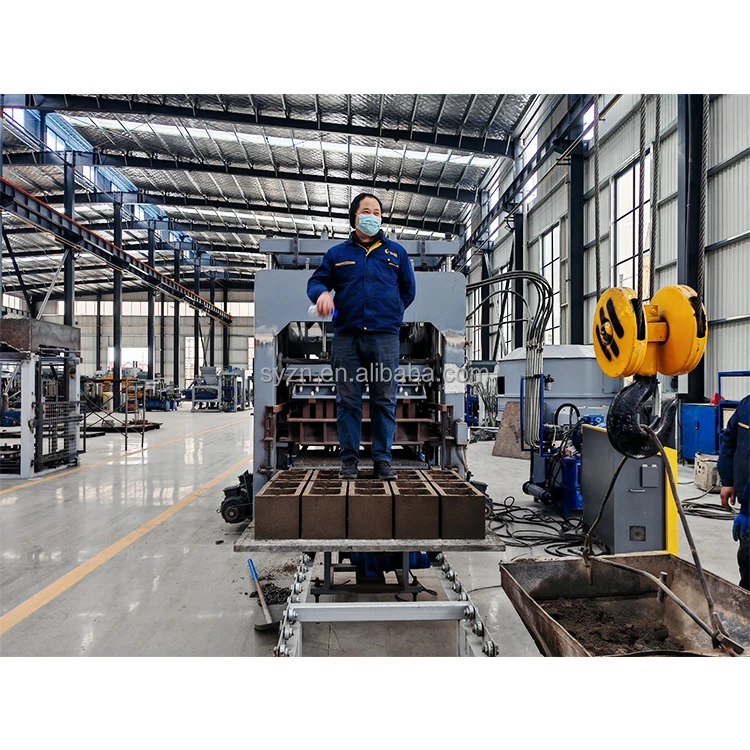
 Stationary block machine