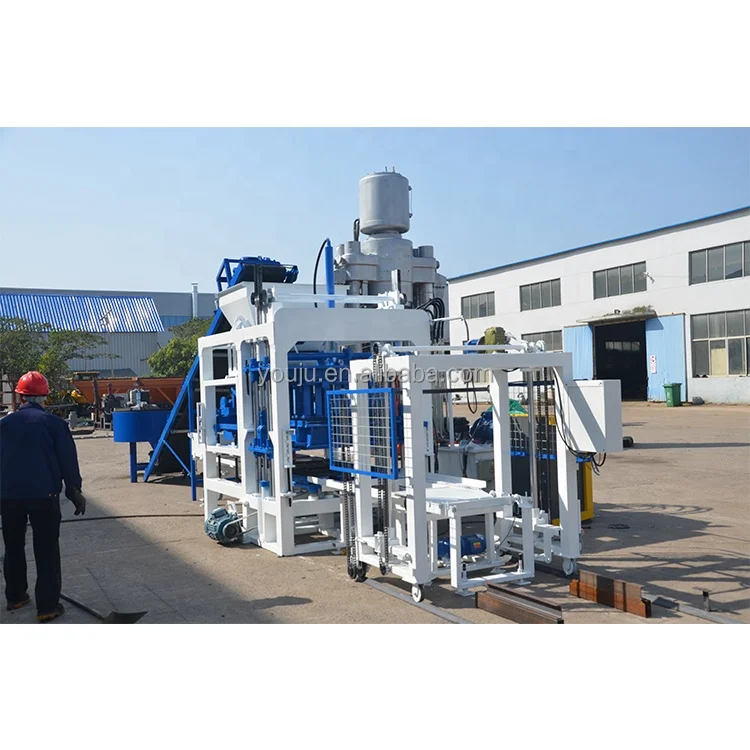
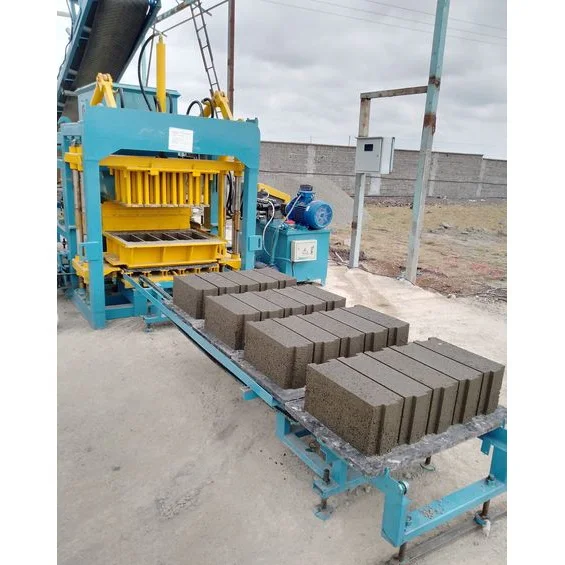
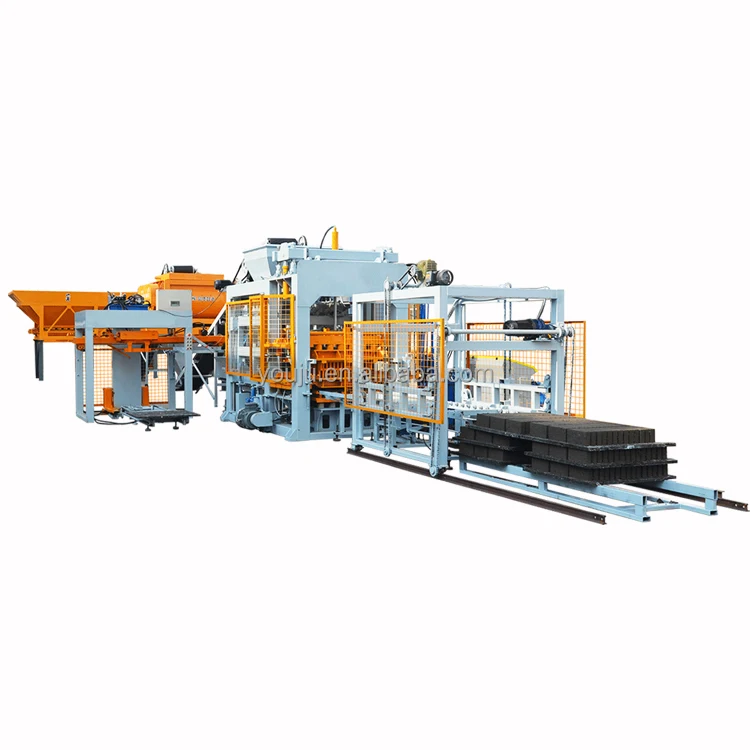
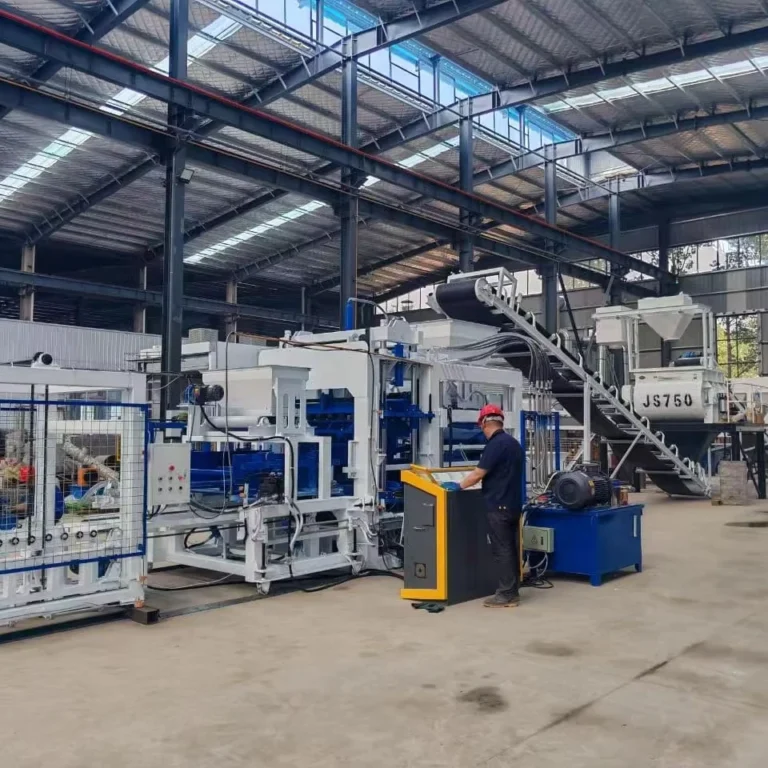
Mid-tier automatic line — the QT4-20 sits between entry-level semi-automatic presses and high-capacity plants, configured here with pallet, mould, and handling as one matched system rather than separate purchases.
Technical Specifications
| Parameter |
Value |
| Model |
QT4-20 |
| Product Type |
Automatic Concrete Block Making Machine |
| Overall Dimensions (L×W×H) |
7100×1600×2610 mm |
| Rated Pressure |
21 MPa |
| Main Vibration Form |
Platform Vibration |
| Vibration Frequency |
2800–4500 r/min |
| Vibration Force |
60 kN |
| Pallet Size |
1020×570 mm |
| Molding Cycle |
15–25 s (basis not stated in source — confirm block format and material) |
| Overall Power |
27.5 kW |
| Total Mass |
5.8 T |
| Demolding Method |
Hydraulic |
| General Water Consumption |
8 T/Day |
| Factory Area Required |
500 m² |
| Control System |
PLC with person-machine conversation interface |
| Automation Level |
Automatic production line |
| Voltage & Frequency |
Configurable (to be confirmed before production) |
| PLC Display Language |
Configurable (to be confirmed before production) |
Application Suitability
| Application |
Material or Output |
| Hollow block production for residential and commercial walls |
Crushed stone, sand, cement, fly ash |
| Solid block manufacturing for load-bearing structures |
Gravel, sand, cement, slag |
| Paving block and colored paver runs for walkways and yards |
Fine aggregate, cement, pigment |
| Interlocking block and kerbstone for road and landscape projects |
Crushed stone, dust, cement |
What "15-Second Cycle" Actually Means for Your Daily Output
A molding cycle figure only matters when tied to the exact block format, wall thickness, and mix you plan to run.
Every automatic block machine manufacturer quotes a cycle time, yet that number shifts depending on whether you are pressing a thin paver or a deep-cavity hollow block. On the QT4-20, the 15–25 second range applies across formats, but where your product lands inside that window depends on your local aggregate grading and moisture content. I have watched a Middle East buyer lose an entire shift chasing a cycle time that assumed a sand mix he could not source locally [NEED_CITE: aggregate grading influence on vibration compaction time]. Confirming the format-specific cycle before signing the purchase order prevents that mismatch.

Where the QT4-20 Fits Across the Full Machine Range
Buyers surveying options for a first or replacement machine often need to place themselves on the spectrum before narrowing down. The QT4-20 occupies the mid-tier of our automatic block machine range, delivering PLC-controlled production with hydraulic demolding and platform vibration — a step above semi-automatic models that still rely on manual pallet handling, yet below the high-capacity lines designed for multi-shift continuous output. Investment level and plant footprint scale accordingly, and this model requires roughly 500 m² of factory area.
Matching Investment Tier to Your Actual Production Target
Choosing between tiers is not about picking the largest machine you can afford; it is about matching the automatic block machine manufacturer configuration to the daily volume your market absorbs. A contractor producing blocks on-site for a single housing project may find the QT4-20 delivers more capacity than needed, while a distributor supplying multiple block formats to a regional market may use this model as a starting point and add a second line later. The automation level is selectable, meaning a buyer can begin with semi-automatic pallet handling and upgrade to full stacking and cubing as demand grows [NEED_CITE: phased automation adoption in block plants].
Reading the Specs That Determine Real Block Quality
The rated pressure of 21 MPa and vibration force of 60 kN work together to compact the mix into a dense, consistent block. Pressure alone does not guarantee strength; without sufficient vibration, the aggregate particles do not settle into a tight matrix, leaving voids that weaken the finished product. The platform vibration system on the QT4-20 operates across 2800–4500 r/min, allowing the operator to adjust frequency based on whether the mix contains fine fly ash or coarse crushed stone. Higher frequencies suit finer materials where particle rearrangement requires rapid oscillation, while lower frequencies move heavier aggregate more effectively. The 1020×570 mm pallet size determines how many blocks are pressed per cycle and must align with the curing racks and forklift dimensions already on site.
The Cost of Skipping Pallet and Handling Specification
Leaving pallet material, curing rack layout, and stacking method to chance creates bottlenecks that have nothing to do with the press itself. A buyer who selects a pallet size without checking forklift tine spacing will spend weeks reorganizing the yard. Another who omits automatic stacking from the quotation ends up assigning two workers to hand-stack output every shift, erasing the labour advantage of buying an automatic line in the first place [NEED_CITE: manual versus automatic stacking labour allocation]. These are not machine defects; they are specification gaps that surface only after installation.
Why Buyers Specify Their Line Here
Block machinery is our single focus, so the QT4-20 arrives with its mould, pallet, and handling equipment specified as one matched system rather than assembled from separate suppliers. Configuration is set against your actual mix design and local aggregate, not a catalogue default. Mould design covers the formats your market sells, including custom drawings when standard options do not fit. Automation level is selectable, letting you start at the investment tier that makes sense today and expand later. Installation support includes on-site commissioning with operator training so the first production run meets spec.
Documentation & Verification
- Line layout and capacity calculation stating the block format assumed for each output figure
- Machine specification sheet with voltage, frequency, and PLC language confirmed before production
- Mould drawing and format list with cycle time noted per block type
- Factory test record and packing photographs provided before shipment
- Hydraulic and electrical schematic for local maintenance teams
Installation, Commissioning & Support
- Foundation plan matched to the QT4-20’s 7100×1600 mm footprint and 5.8 T operating mass
- Dedicated power circuit sized for 27.5 kW total draw at confirmed voltage and frequency
- Machine dismantled for container loading and reassembled on-site with alignment checks
- First-run parameter setting covering vibration frequency, hydraulic pressure, and feed timing
- Operator training on PLC interface, mould change procedure, and daily maintenance schedule
- Wear parts list with hydraulic seals and mould liners identified for first reorder
Preparing a Useful Inquiry
Tell us which block formats your market demands, the daily volume you need for each, and the raw materials available locally — including aggregate type and maximum particle size. Share your site’s voltage, frequency, and preferred PLC display language so the electrical package is built correctly from the start. If you already have curing racks or forklifts on site, send their dimensions so the pallet and handling specification aligns with your existing layout.
Frequently Asked Questions
Q: How is the QT4-20 output capacity calculated, and which block format does each figure assume?
A: Output depends on the block format, wall thickness, and mix design running on the machine. The 15–25 second molding cycle covers a range of formats, but the exact position within that window shifts with material and cavity depth. We provide a capacity calculation document that states the assumed format for every output figure, so you can compare against your actual production target before ordering.
Q: Where does the QT4-20 sit in the full range compared to semi-automatic and higher-tier models?
A: This model is the mid-tier automatic block machine in the range. It offers PLC-controlled hydraulic demolding and platform vibration above semi-automatic presses, yet sits below high-capacity lines built for multi-shift continuous output. Buyers choose this tier when daily volume and format variety justify automation without the footprint and investment of a top-tier plant.
Q: What voltage, frequency, and PLC language options are available, and when must they be confirmed?
A: Voltage and frequency are configurable to match your local grid standard, and the PLC display language is set during production. All three must be confirmed before manufacturing begins, because changing them after the electrical panel is assembled causes commissioning delays on site.
Q: How are the mould, pallet, and handling equipment specified as one system?
A: Rather than sourcing each component separately, we match the mould format, pallet dimensions, and handling equipment to the QT4-20 press and to each other. Pallet size is checked against your curing racks and forklift, and mould design reflects the block formats your market sells. This prevents mismatched components that slow production after installation.
Q: What plant footprint does the QT4-20 require, and how does this compare to other tiers?
A: The QT4-20 needs approximately 500 m² of factory area, which covers the press, raw material feed, pallet return, and stacking zone. Semi-automatic models in the range require less space but more manual labour, while higher-tier automatic lines need a larger footprint to accommodate continuous pallet circulation and automatic cubing systems [NEED_CITE: typical block plant layout dimensions by automation tier].

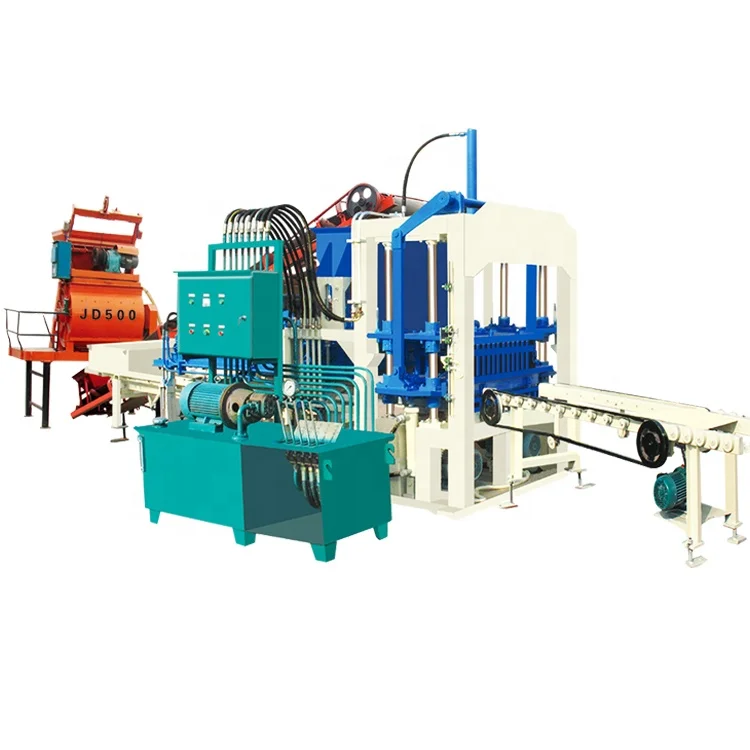
 Automatic block machine