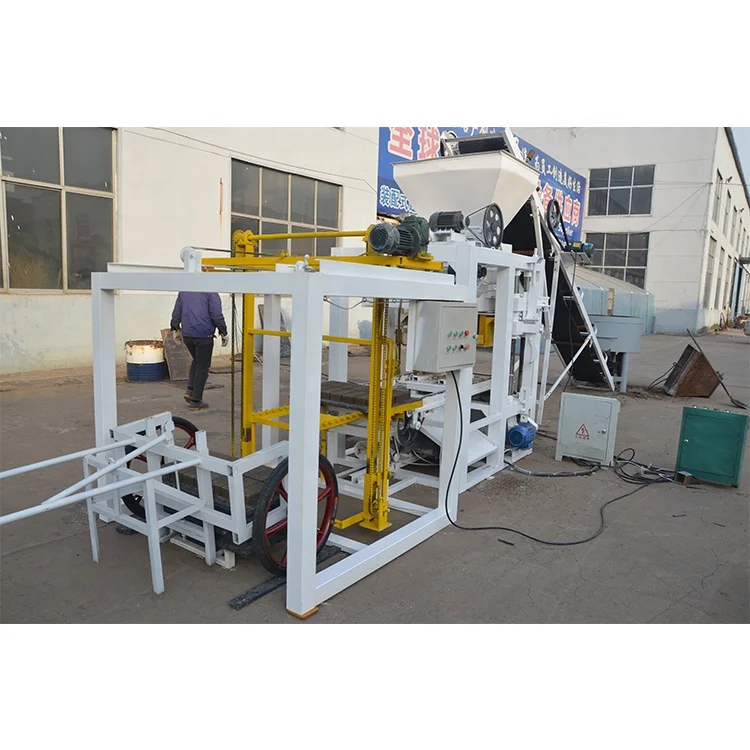
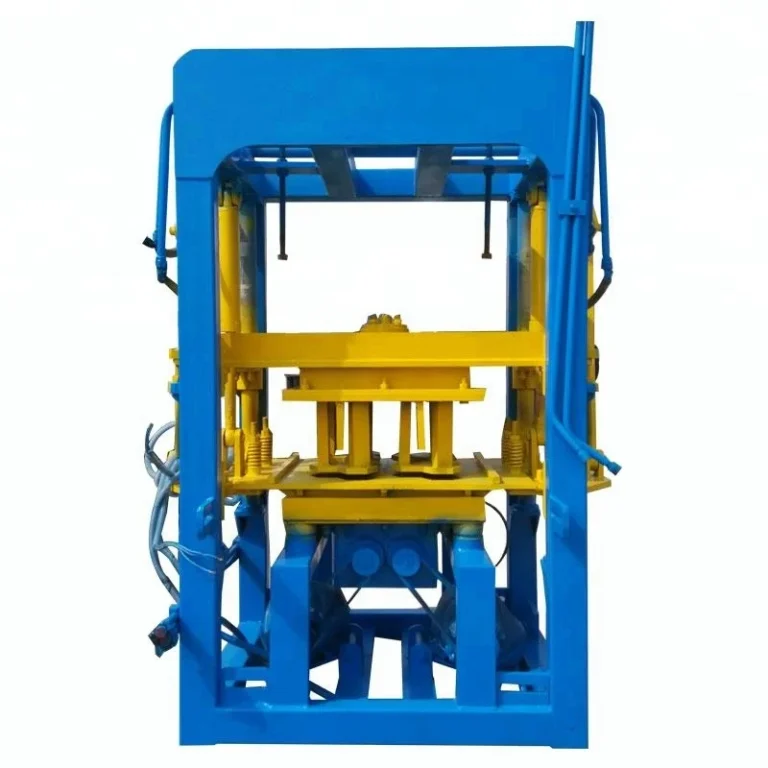
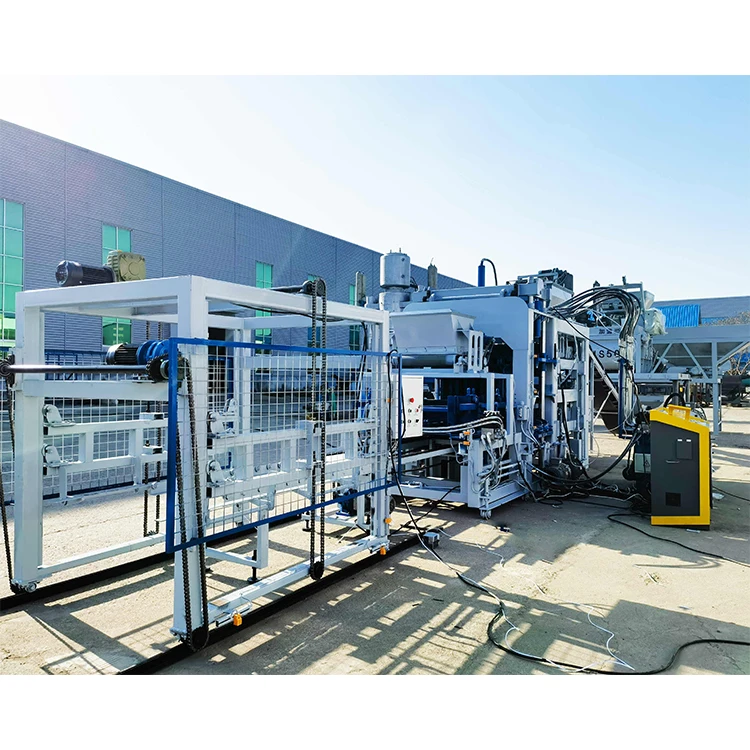
Matched System Approach — The QT4-18 is specified alongside its moulds, pallets, and handling equipment as one integrated line, so buyers avoid the gap between standalone press quotes and actual daily output.
Technical Specifications
| Parameter |
Value |
| Model |
QT4-18 |
| Product Type |
Automatic Hollow Block Making Machine |
| Host Machine Power |
27.5 kW |
| Moulding Cycle |
15 s (basis not stated in source — confirm block format, material, thickness) |
| Vibration Force |
40 kN |
| Mixer Model |
JS500 |
| Pallet Size |
1020 × 570 mm |
| Dimension of Host Machine |
7100 × 1600 × 2610 mm |
| Weight of Host Machine |
5 T |
| Voltage |
380 V (frequency to be confirmed against target market) |
| General Water Consumption |
4 T per day |
| Workers Required |
3–4 |
| Workshop Area |
150 m² |
| Theoretical Productivity |
(basis not stated in source — confirm block format and mix design) |
| Control System |
(to be confirmed — PLC or manual operation) |
| Automation Level |
(to be confirmed) |
| Mould Change Time |
(to be confirmed) |
| Hydraulic Pressure |
(to be confirmed) |
| Stacking Method |
(to be confirmed) |
Application Suitability
| Application |
Material or Output |
| Hollow block production |
Cement, sand, crushed stone aggregate |
| Solid block production |
Cement, fly ash, stone dust blends |
| Paving block production |
High-density concrete with fine aggregate |
| Construction site block manufacturing |
On-site mixing with locally sourced aggregate |
| Small to medium block plant operations |
Daily output scaled to regional building demand |
Why Cycle-Time Claims Need a Block Format Attached
A 15-second cycle only means something when tied to a specific block size, mix design, and pallet configuration.
Many buyers receive quotations that highlight cycles per hour without disclosing which block format that number assumes. When the actual product is a thicker hollow block or a dense paver, the real output can fall noticeably short of the quoted figure. The automatic block making machine for sale in this tier is positioned for buyers who need honest capacity planning before signing a contract, not optimistic projections that collapse at commissioning [NEED_CITE: typical discrepancies between quoted and actual block machine output].

Where the QT4-18 Sits in the Full Machine Range
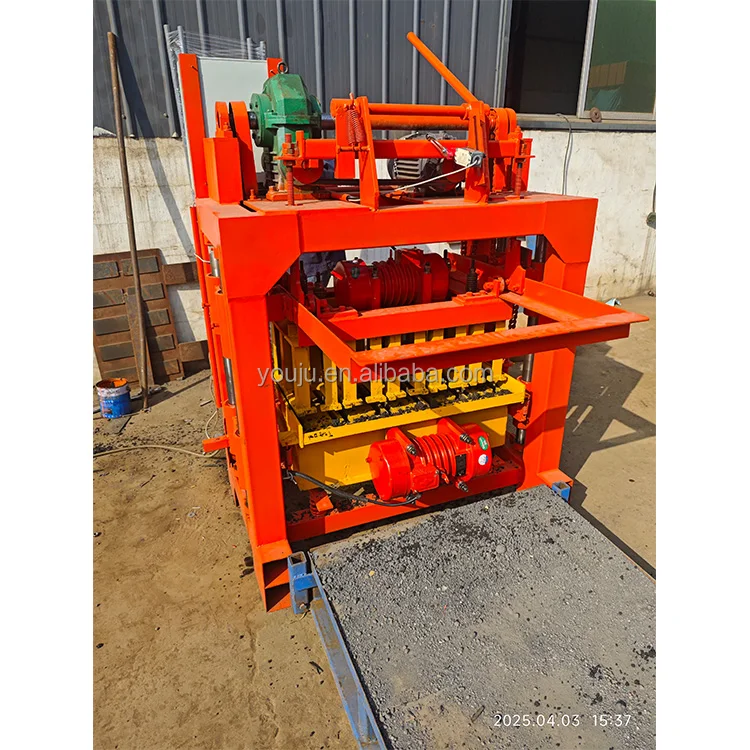
The QT4-18 occupies the mid-tier of the stationary automatic block making machine range. It targets entrepreneurs setting up a first block plant and building material distributors adding hollow and solid block formats to an existing catalog. Buyers comparing this tier against semi-automatic models will find higher throughput and reduced manual handling, while those eyeing higher-capacity automatic lines should weigh whether their daily volume justifies the larger footprint and investment.
Matching the Machine Tier to Your Project Deadline
Construction contractors producing blocks on their own site often face a choice between a stationary automatic machine and a mobile egg-laying unit. The QT4-18 suits projects where a fixed production area is available and output must sustain a steady supply across multiple building phases. Its 150 m² workshop requirement means site planners need to allocate curing and stacking zones beyond the press itself [NEED_CITE: block plant layout planning for stationary machines].
Reading the Numbers That Actually Matter
The 40 kN vibration force and the hydraulic pressure rating together determine the density and compressive strength of the finished block. If the local aggregate is lightweight volcanic stone, for example, vibration parameters must be adjusted to achieve target strength — a configuration step that happens before shipment, not after. The 1020 × 570 mm pallet size must align with the buyer’s existing curing racks and forklift capacity; a mismatch here means either replacing handling equipment or redesigning the curing area. The 27.5 kW host machine power and JS500 mixer pairing ensures continuous material supply without bottlenecking the press at rated cycle speed.
The Hidden Cost of Skipping Configuration Checks
When voltage, frequency, and PLC display language are not confirmed before production, the machine can sit idle on arrival while electricians source transformers or operators struggle with unfamiliar interface text. Similarly, a pallet specification chosen without regard to the buyer’s curing area leads to manual restacking and lost output hours every shift. These are not machine defects — they are configuration oversights that turn a commissioning week into a commissioning month [NEED_CITE: common causes of block machine commissioning delays].
What Buying Through This Range Delivers
Block machinery is the sole focus here, so the QT4-18 is never sold as a standalone press. The machine, mould, pallet, and handling equipment are specified as one matched system. Configuration is set against the buyer’s actual mix design and local aggregate rather than a catalog default. Mould design covers the formats the buyer’s market actually sells, including custom drawings. Automation level is selectable, allowing a buyer to start at this tier and move to higher automation later. Installation support includes operator training so the crew can manage mould changes and daily maintenance independently.
Documentation & Verification
- Line layout and capacity calculation stating the block format assumed for the QT4-18 cycle time
- Machine specification sheet confirming voltage, frequency, and control language for your market
- Mould drawing and format list matching the block types your buyers actually purchase
- Pallet specification cross-referenced with your existing curing rack dimensions
- Factory test record run on a mix design representative of your local aggregate
Installation, Commissioning & Support
- Foundation must support the 5 T host machine weight plus dynamic vibration loads across the 7100 × 1600 mm footprint
- Electrical supply must deliver 380 V with adequate amperage for the 27.5 kW host motor and JS500 mixer simultaneously
- Host machine ships partially dismantled for container loading; reassembly and alignment verified on-site
- First production run includes parameter tuning for vibration force and cycle timing against your local mix
- Operator training covers mould change procedure, pallet handling, and daily wear-part inspection routines
What to Prepare Before Requesting a Quote
Provide the specific block formats your market demands, including dimensions and target compressive strength. Share a sample or description of your locally available aggregate and cement type so the configuration can be matched before quotation. Confirm your site voltage, frequency, and preferred control language, along with the dimensions of any existing curing area and handling equipment.
Frequently Asked Questions
Q: How does the QT4-18 output tier compare to semi-automatic and higher-capacity automatic models?
A: The QT4-18 sits in the mid-range, offering higher throughput and less manual handling than semi-automatic models while requiring a smaller footprint and investment than high-capacity automatic lines. It suits first-time plant setups and moderate daily output targets. Buyers can upgrade automation levels later as demand grows.
Q: What block formats and mould options are available for this machine?
A: The QT4-18 supports hollow blocks, solid blocks, and paving blocks through interchangeable moulds. Cycle time varies by format and block thickness, so capacity calculations should always state the assumed block type. Custom mould designs can be produced from buyer drawings to match local market requirements.
Q: What automation level does this tier provide?
A: This tier provides automatic operation for the core pressing cycle. Pallet feeding, stacking method, and upstream batching configuration can be selected to match the buyer’s budget and labor availability. An upgrade path to higher automation with automatic stacking and cubing is available for future expansion.
Q: How do I confirm voltage and control language before shipment?
A: Provide your site voltage, frequency, and preferred PLC display language during the quotation stage. These parameters are locked in before production begins, and the factory test record will confirm correct electrical configuration. This prevents commissioning delays caused by transformer sourcing or unfamiliar interface text.
Q: What plant footprint do I need to plan around the QT4-18?
A: The host machine requires a workshop area of approximately 150 m², but the total site must also accommodate raw material storage, the JS500 mixer, pallet return paths, and curing racks sized for the 1020 × 570 mm pallet. Plan forklift access routes around the curing zone to avoid manual restacking.

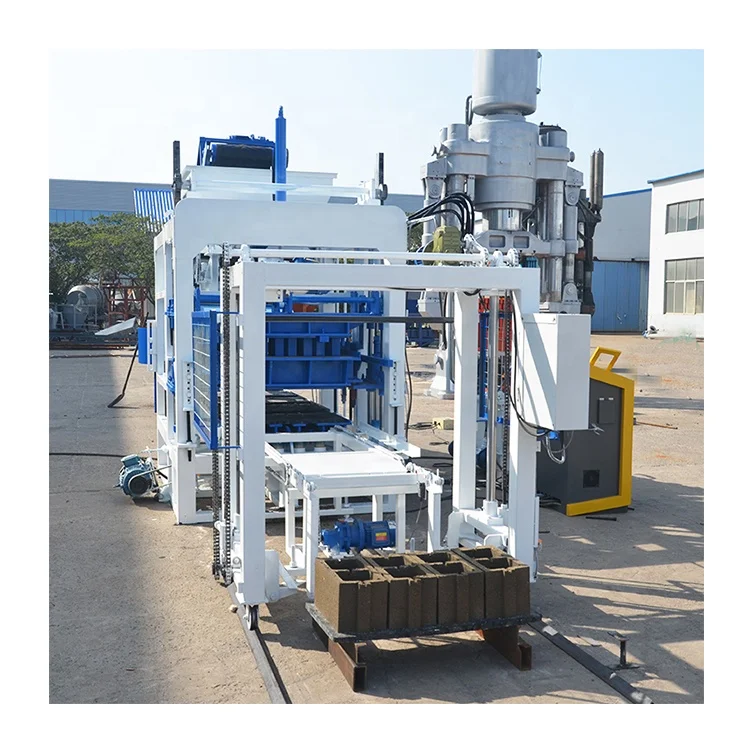
 Stationary block machine