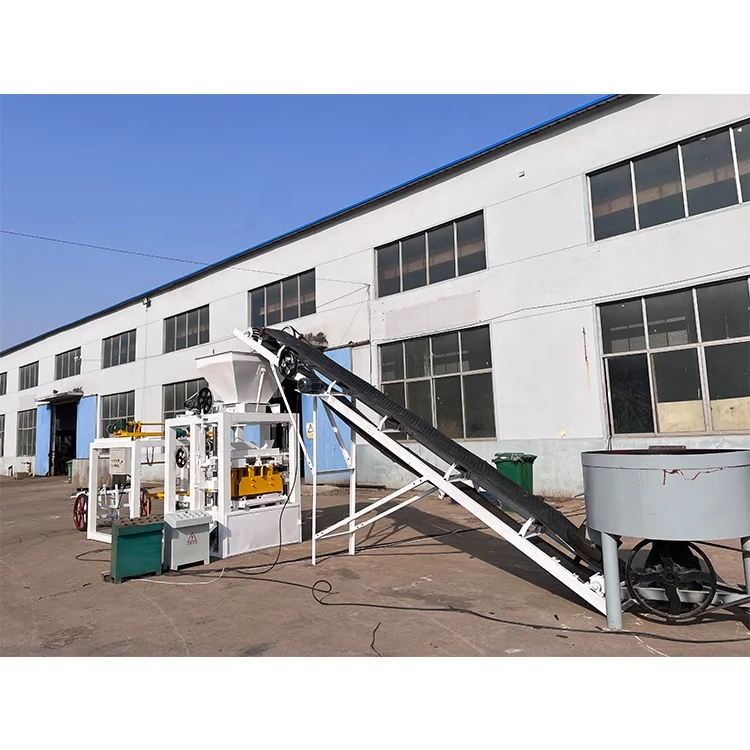
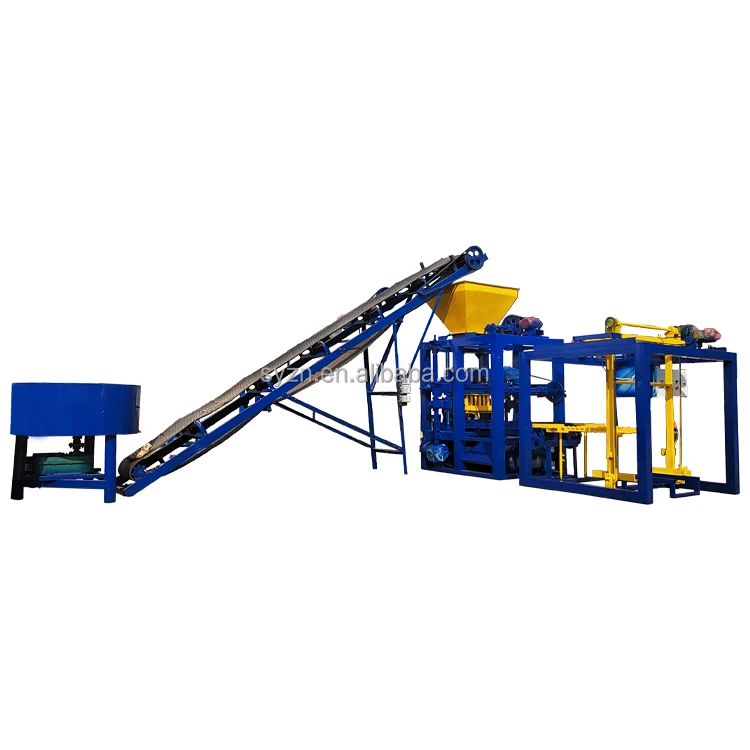
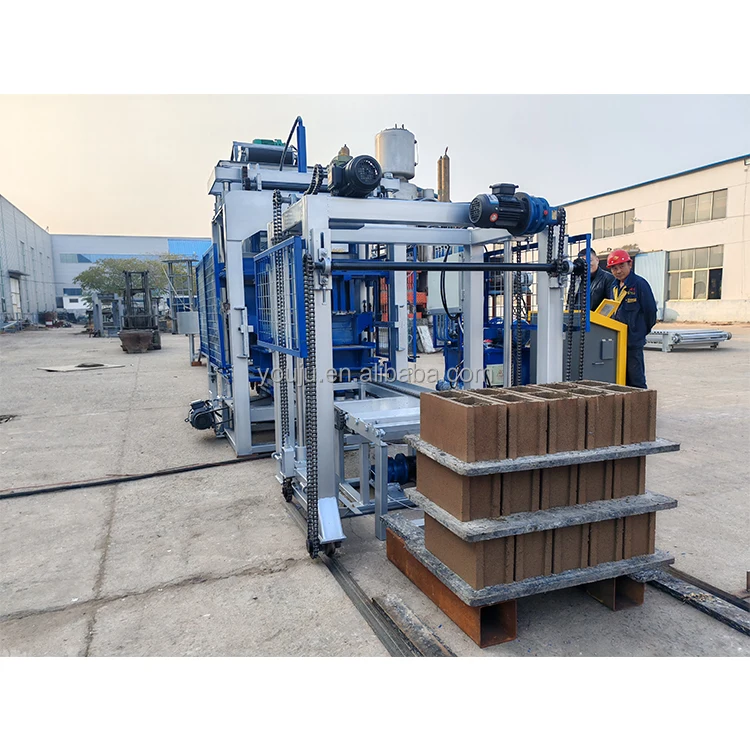
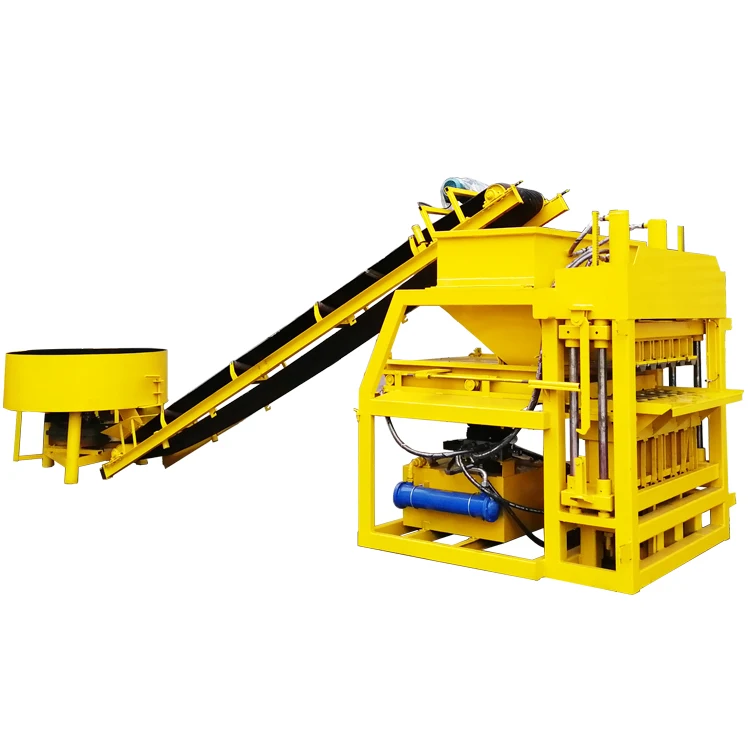
Single focus on block machinery — machine, mould, pallet and handling are specified together so the QT4-15 operates as a matched system rather than assembled from separate suppliers.
Technical Specifications
| Parameter |
Value |
| Model |
QT4-15 |
| Product Type |
Stationary Hydraulic Block Making Machine |
| Host Machine Power |
27.5 kW |
| Moulding Cycle |
15 s (basis to be confirmed per block format) |
| Overall Dimensions (L×W×H) |
7100 × 1600 × 2610 mm |
| Pallet Size |
1020 × 570 mm |
| Net Weight |
5 T |
| Vibration Force |
40 kN |
| Vibration Mode |
Table and mould vibrating together, frequency and brake cancellation |
| Feeding System |
Swing-type cutting device, low-frequency feeding, high-frequency vibrating |
| Mixer Model |
JS500 |
| Motor Brand |
Siemens |
| Voltage |
380 V (confirm 50/60 Hz for destination market) |
| Control System |
Computer controlled directional vibration (PLC brand/language to confirm) |
| Required Workers |
3–4 |
| Workshop Area |
150 m² |
| General Water Consumption |
4 T/day |
| Automation Level |
Semi-automatic (upgradable) |
| Standards |
CE (declaration available where applicable) |
Application Suitability
| Application |
Material or Output |
| Hollow block production |
Crushed stone, cement, sand and fly ash blends for load-bearing and partition walls |
| Solid block production |
Dense aggregate mixes for foundation and structural masonry |
| Paving block production |
Fine-graded sand and cement for pedestrian and light-traffic surfaces |
| Kerbstone and interlocking brick |
Coarse aggregate with cement for roadside and landscape formats |
| On-site contractor production |
Locally sourced aggregate for housing and development project supply |
What the QT4-15 Block Machine Manufacturer Quotation Often Leaves Out
A 15-second cycle on a hollow block does not translate to the same output on paving blocks or kerbstones.
When I was commissioning machines across West Africa, I watched buyers receive their QT4-15 stationary block making machine for sale and immediately calculate daily revenue from a cycle figure that assumed a standard hollow block. The moment they switched to a thicker paving block, the cycle stretched and the daily count dropped noticeably. The gap between quoted capacity and real output is where most first-time block plants lose confidence in their investment. [NEED_CITE: typical cycle variation across hollow, solid and paving block formats]

Where the QT4-15 Sits on the Stationary Range
The QT4-15 occupies the mid-tier of our stationary block machine lineup, positioned between smaller semi-automatic units for workshop-scale output and high-capacity fully automatic lines. Buyers stepping up from mobile or egg-laying machines find this tier gives them a fixed plant footprint with a defined worker count, while still leaving room to add automatic stacking and cubing as their market matures. For a first stationary block plant, the 150 m² workshop requirement and 3–4 worker configuration set a manageable starting point.
Matching the Line Around the Press
A stationary block making machine for sale is only as productive as the stations feeding and clearing it. The JS500 mixer must deliver consistent batches at a rate that keeps the QT4-15 hopper charged without material sitting and losing workability. Pallet feeding, curing rack handling and block cubing must all cycle within the press timing so the machine is never left waiting. When any station lags, the press sits idle and the quoted cycle becomes irrelevant to actual daily output. [NEED_CITE: line balancing principles for concrete block production]
Reading the Specs That Shape Block Quality
The 40 kN vibration force works together with hydraulic pressure to compact the concrete mix inside the mould box. If the vibration is strong but the hydraulic pressure is low, the block surface may look dense while internal voids remain — a problem that only shows up during a compressive strength test. The swing-type cutting device in the hopper distributes material evenly before the vibration begins, which matters for formats with thin webs such as hollow blocks where uneven fill causes weak corners. Table-and-mould vibration with brake cancellation stops residual energy from cracking freshly pressed blocks as the mould lifts. The 1020 × 570 mm pallet size must align with the curing racks and forklifts already in the buyer’s yard; a mismatch means buying new handling equipment or losing pallets to damage on undersized forks.
The Cost of Skipping Configuration Checks
I once arrived at a site in South Asia where the QT4-15 had been running for weeks with the PLC display in a language the operators could not read. Settings were changed by trial and error, and block density drifted from shift to shift. Voltage mismatches cause similar problems — a machine wired for 50 Hz running on a 60 Hz supply will cycle faster but the vibration frequency and braking timing fall out of sync, producing blocks that crack during curing. These are not warranty issues; they are configuration gaps that a pre-production checklist prevents. [NEED_CITE: voltage and frequency standards by export market]
Why Source the QT4-15 Here
Block machinery is our single focus, which means the QT4-15 is never quoted as a bare press with pallets and moulds left to chance. We set the configuration against your actual mix design and local aggregate so the vibration force and hydraulic pressure produce the block strength your market requires. Moulds are designed for the formats that sell in your region, including custom drawings when standard formats do not match local building codes. Automation is selectable — the QT4-15 can start at semi-automatic and accept automatic stacking and cubing later, protecting your initial investment. Every machine ships with installation support, operator training and a wear parts list so the first replacement does not halt production.
Documentation & Verification
- Line layout showing QT4-15 footprint within the 150 m² workshop area
- Capacity calculation stating which block format the 15-second cycle assumes
- Mould drawing and format list for hollow, solid and paving blocks
- Voltage, frequency and PLC display language confirmation before production
- Factory test record and packing photographs provided before dispatch
Installation, Commissioning & Support
- Foundation plan matched to the 7100 × 1600 mm machine footprint and 5 T weight
- Dedicated circuit sized for 27.5 kW host power plus JS500 mixer draw
- Dismantling and container loading plan for the stationary frame and hydraulic unit
- First-run commissioning with cycle timing verified on the buyer’s block format
- Operator training covering PLC navigation and mould change procedure
- Wear parts list including hydraulic seals, vibration bearings and mould springs
Preparing Your Inquiry
To move from a general QT4-15 block machine manufacturer search to a firm configuration, share the block formats your market sells and the daily output you need for each. Tell us your local aggregate type, available workshop dimensions and the voltage and frequency at your site. If you already have curing racks and forklifts, send the pallet dimensions they accept so the 1020 × 570 mm pallet can be confirmed or adjusted before production begins.
Frequently Asked Questions
Q: What block format does the QT4-15 cycle time assume, and how does daily output change across formats?
A: The 15-second cycle is typically quoted for a standard hollow block. Switching to thicker paving blocks or kerbstones extends the cycle because the vibration must compact a denser cross-section. We provide a capacity calculation that states the assumed format so buyers can compare real output across the products they actually sell.
Q: How does the QT4-15 plant footprint compare to smaller and larger tiers?
A: The QT4-15 needs roughly 150 m² of workshop space, which sits between compact semi-automatic machines for small workshops and high-capacity automatic lines that require substantially more floor area for curing racks and cubing stations. This makes it suitable for first stationary plants with defined expansion plans.
Q: Can I start with the QT4-15 and add automatic stacking later?
A: Yes. The QT4-15 can be configured at semi-automatic level with manual pallet handling and stacking, then upgraded to automatic pallet feeding, stacking and cubing as production volume grows. The machine frame and control architecture support this progression without a full replacement.
Q: What voltage, frequency and control language options are available?
A: The standard voltage is 380 V, and frequency must be confirmed as 50 Hz or 60 Hz for the destination market. The PLC display language is set before production to match the operators on site. Confirming these details early avoids commissioning delays after the machine arrives.
Q: How does the 1020 × 570 mm pallet size work with existing curing racks and forklifts?
A: Pallet dimensions must match the curing rack spacing and forklift fork width already in the buyer’s yard. If the existing equipment was set up for a different pallet size, we adjust the pallet specification or recommend handling adjustments before the machine ships to avoid costly replacements on arrival.

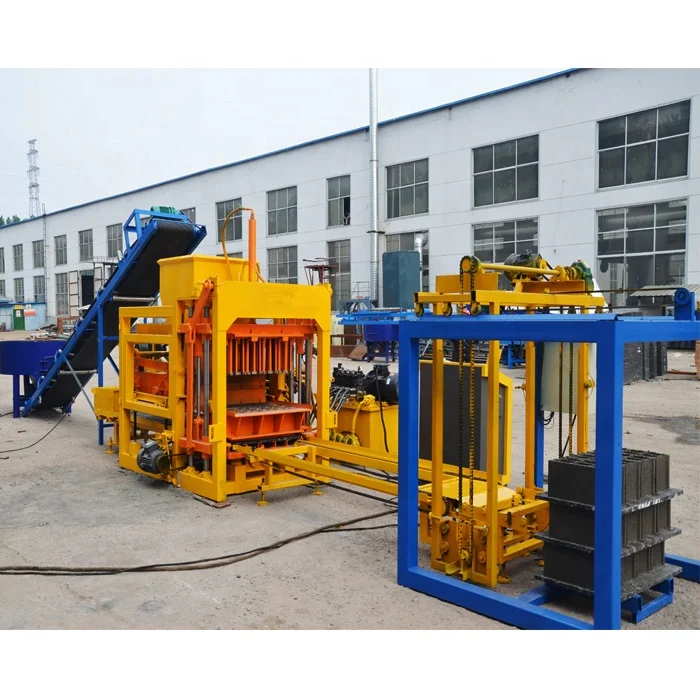
 Stationary block machine