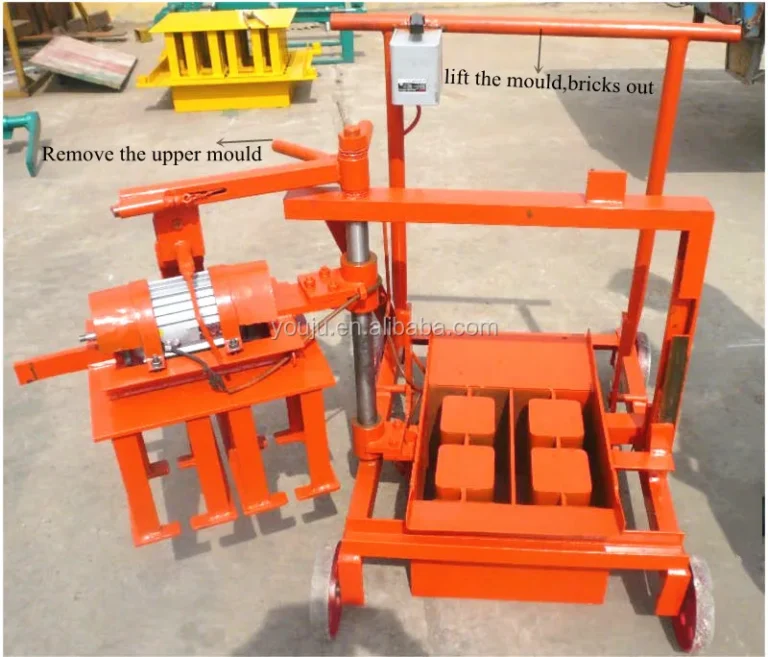
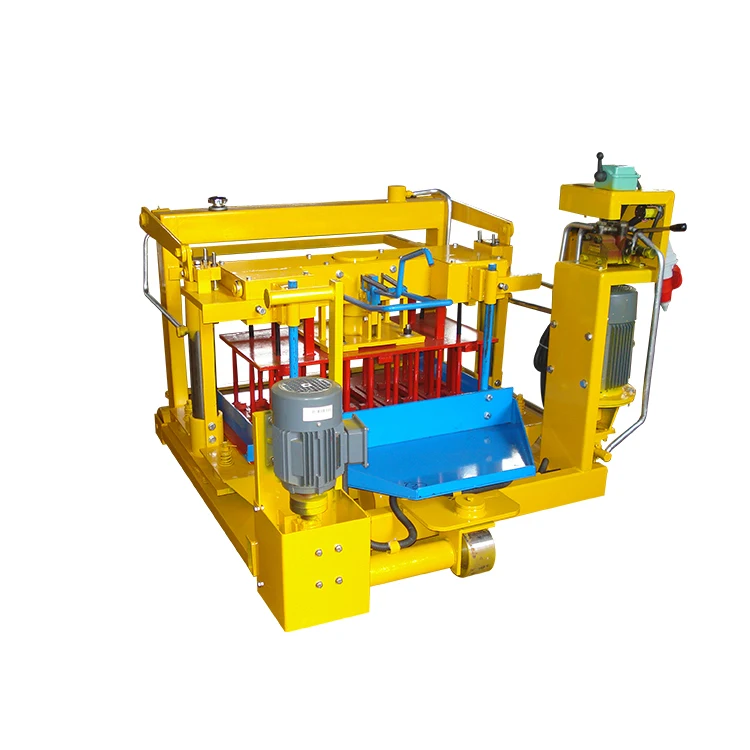
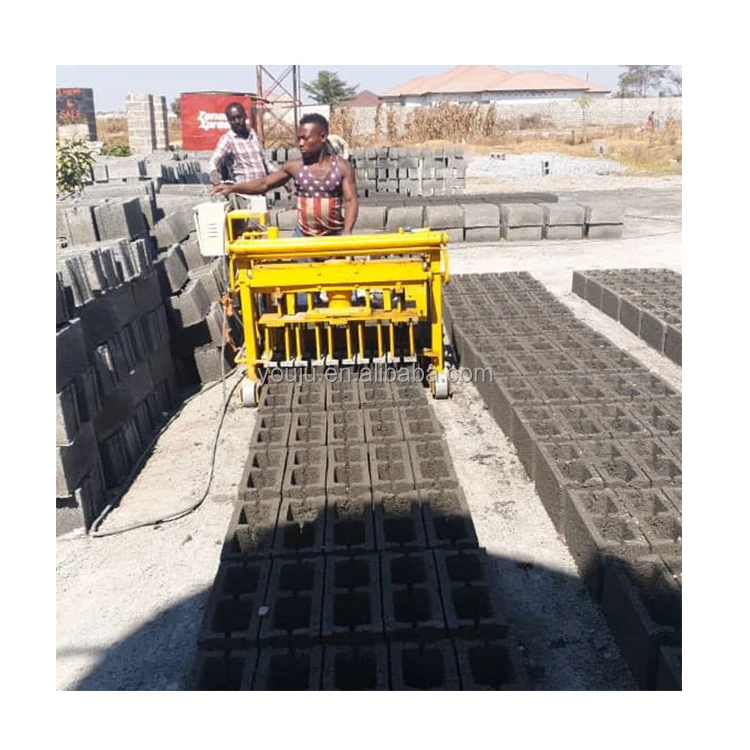
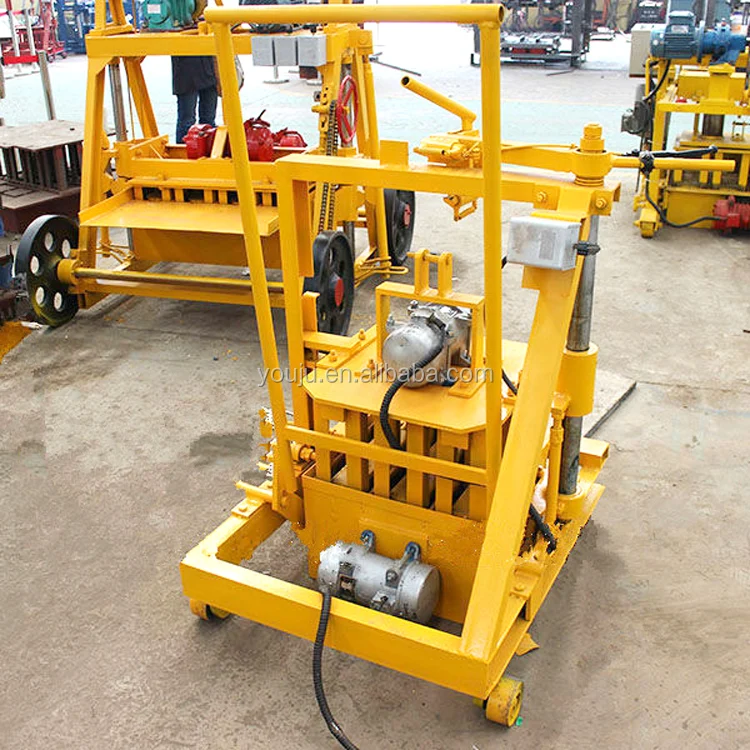
Matched System Design — Shiyue supplies the QMY6-25 mobile block making machine with its moulds, vibration settings, and hydraulic steering configured as one integrated unit rather than separate components sourced independently.
Technical Specifications
| Parameter |
Value |
| Model |
QMY6-25 |
| Product Type |
Mobile Egg-laying Concrete Block Making Machine |
| Main Vibration Form |
Three-dimensional excitation |
| Vibration Frequency |
3200 Hz |
| Overall Power |
9.6 kW |
| Moving Method |
Automatic movement with hydraulic steering |
| Overall Dimensions (L×W×H) |
2000 × 2100 × 1650 mm |
| Moulding Cycle |
25–30 seconds |
| Pallet Requirement |
No pallet required (egg-laying type) |
| Output Capacity |
1080 pcs/hour (based on 400×200×200mm hollow block) |
| Output Capacity |
1260 pcs/hour (based on 400×150×200mm hollow block) |
| Output Capacity |
1620 pcs/hour (based on 400×120×200mm solid block) |
| Output Capacity |
1800 pcs/hour (based on 400×100×200mm solid block) |
| Block Format Compatibility |
Hollow blocks, solid blocks (various sizes) |
| Automation Level |
Semi-automatic (single-operator capable) |
| Power Source |
Motor engine (electric) |
| Voltage & Frequency |
(basis not stated in source — confirm with buyer site requirement) |
| Control System |
(basis not stated in source — confirm PLC or relay logic) |
| Warranty |
1 year (excluding spare parts) |
| Assembly State |
Fully assembled, mobile unit |
Application Suitability
| Application |
Material or Output |
| On-site housing project block production |
Hollow and solid concrete blocks using local aggregate, sand, and cement |
| Small-scale block plant startup |
Standard hollow blocks from crushed stone and cement mix |
| Remote construction site supply |
Solid concrete blocks produced directly at the project location |
| Building material distributor trial run |
Paving bricks and multicellular bricks before investing in a stationary line |
| Entrepreneur first block plant |
Various hollow and solid formats to test local market demand |
What "8,600 Blocks per Shift" Actually Requires on Site
A mobile block machine only reaches rated output when the ground is flat, the mix is consistent, and the operator keeps pace with the cycle.
When I first quoted a QMY6-25 to a contractor building a housing development, I told him the shift output based on the 400×200×200mm hollow block figure. He was producing on a graded gravel yard with a mix that contained a lot of local river sand with high clay content. The blocks came out weaker than expected, and his actual daily count fell well short of the capacity table. That is the gap between a catalogue number and what a QMY6-25 mobile block making machine for sale actually delivers on your ground. [NEED_CITE: effect of clay content in sand on concrete block compressive strength]

Where the QMY6-25 Sits in the Full Machine Range
The Shiyue range spans from small mobile units through semi-automatic stationary presses up to high-capacity fully automatic lines with pallet return systems and automatic cubing. The QMY6-25 occupies the mobile egg-laying tier — it lays blocks directly on the ground and moves forward on its own wheels, requiring no pallets, no curing racks, and no fixed plant infrastructure. This makes it the entry point for buyers who need to produce blocks at a job site or start a first plant with minimal site preparation.
Understanding What Mobility Costs and What It Saves
A mobile block machine trades the high output and consistency of a stationary automatic line for flexibility and low overhead. There are no pallets to purchase, maintain, or store. There is no conveyor system, no pallet return mechanism, and no stacking station to install. The trade-off is that each block format runs at the cycle speed the operator can manage, and the ground surface becomes your curing area. For a contractor who needs blocks at a remote project or an entrepreneur testing market demand before committing to a full plant, that trade-off is often the right call. [NEED_CITE: typical site preparation requirements for egg-laying block machines]
Reading the Vibration and Power Specs
The three-dimensional vibration excitation at 3200 Hz is what compacts the concrete mix inside the mould cavity. Higher frequency means faster consolidation, which shortens the cycle to 25–30 seconds per mould. The 9.6 kW overall power covers both the vibration motors and the hydraulic steering system — there is no separate hydraulic pump station as you would find on a stationary press. The automatic movement with hydraulic steering lets one operator guide the QMY6-25 across the production yard without a second person pushing or pulling. The moulding area is defined by the machine dimensions of 2000 × 2100 mm, so your production yard needs to be flat concrete at least that wide with room to turn.
The Ground You Walk On Becomes Your Production Floor
With an egg-laying machine, the quality of your curing surface directly affects block quality. Uneven ground produces blocks with uneven bases that may crack during curing or stack poorly. A contractor who sets up on compacted earth without a concrete slab will see more breakage than one who pours a level pad first. The QMY6-25 weighs enough that soft ground can cause it to settle or tilt mid-cycle, affecting dimensional consistency across the shift. [NEED_CITE: concrete block curing surface preparation standards]
Why Sourcing from a Machinery-Focused Supplier Matters
Shiyue builds block machinery as its single product focus, which means the QMY6-25 is not assembled from generic components and resold. The vibration frequency, mould cavity dimensions, and hydraulic steering are specified together so the machine produces consistent blocks across the formats listed in its capacity table. Moulds are designed in-house for the block sizes your local market actually sells, and custom mould drawings from buyers can be accommodated. Voltage and control language are confirmed before production starts, preventing the delay that happens when a machine arrives on site and the control panel is in the wrong language. Installation support and operator training are included, and wear parts lists are provided so you know what to stock before the first mould change is due.
Documentation & Verification
- Line layout showing the QMY6-25 operating footprint with block format assumptions noted
- Machine specification sheet confirming 9.6 kW power, 3200 Hz vibration, and overall dimensions
- Mould drawing and format list covering every block size the QMY6-25 accepts
- Voltage and control language confirmation signed off before production begins
- Factory test record on your specified block format before dispatch
- Operation and maintenance manual with wear parts and mould replacement list
Installation, Commissioning & Support
- Flat concrete pad required, minimum area to accommodate 2000 × 2100 mm machine footprint plus turning radius
- Dedicated electrical circuit matching confirmed voltage and frequency for the 9.6 kW total load
- Machine ships fully assembled — no on-site mechanical assembly required, only mould installation
- First-run commissioning covers cycle timing adjustment and hydraulic steering calibration on your ground
- Operator training on mould change procedure, mix consistency judgment, and daily maintenance checks
- Wear parts list provided with recommended stock quantities for hydraulic seals and vibration motor components
Before You Request a Quote
To size the QMY6-25 correctly for your project, we need to know which block formats you intend to produce and the dimensions of each. Tell us what local aggregate and sand are available at your site, including whether river sand with clay content is involved. Confirm your site voltage and frequency, and let us know the production yard area you have available so we can advise on layout.
Frequently Asked Questions
Q: How is the QMY6-25 capacity verified, and which block format does each output figure assume?
A: Every output figure in our capacity table states the exact block format it was measured on. For example, 1080 pieces per hour is based on the 400×200×200mm hollow block at the standard 25–30 second cycle. Different formats have different mould cavity counts, so a solid block will show a higher hourly number than a hollow block on the same machine.
Q: Where does a mobile egg-laying machine sit compared to semi-automatic and automatic tiers?
A: The QMY6-25 is at the mobile end of the range, requiring no pallets and no fixed plant. Semi-automatic stationary machines add pallet handling and higher output, while automatic lines include pallet return, stacking, and cubing. Buyers typically start mobile for low-investment or on-site work, then move to stationary as volume grows.
Q: What site footprint and ground conditions are needed for the QMY6-25 to operate?
A: The machine itself occupies 2000 × 2100 mm, but you need a flat concrete pad extending well beyond that for the egg-laying path and curing area. The ground must be level and firm enough to support the machine weight without settling during the vibration cycle, or block dimensional consistency will suffer.
Q: What voltage and control display language should be confirmed before shipment?
A: The QMY6-25 runs on electric motor power, and voltage and frequency must match your local grid. The control display language — whether English, French, Spanish, or another — must be specified before production. Confirming these before shipment avoids commissioning delays when the machine arrives on your site.

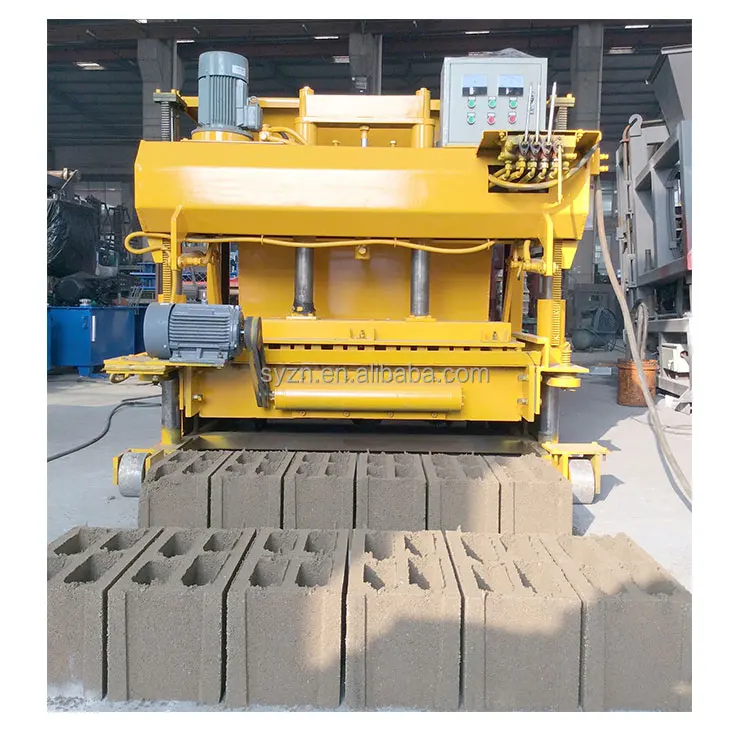
 Mobile block machine