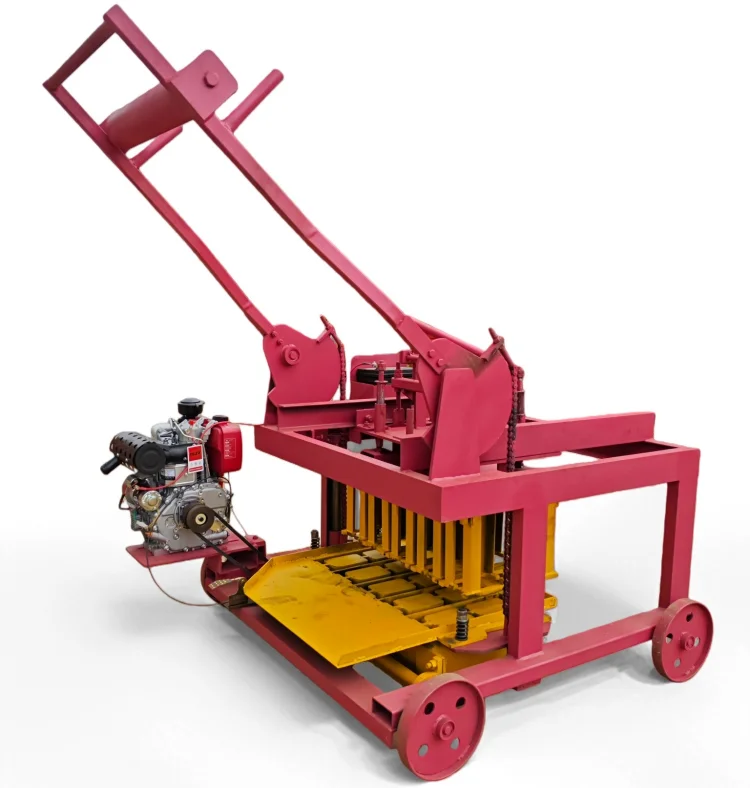
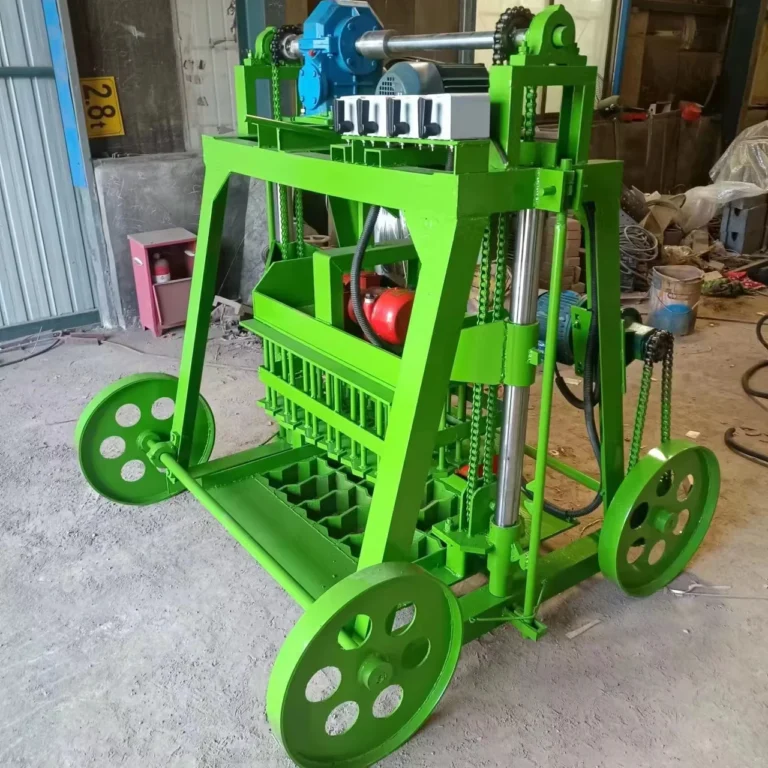
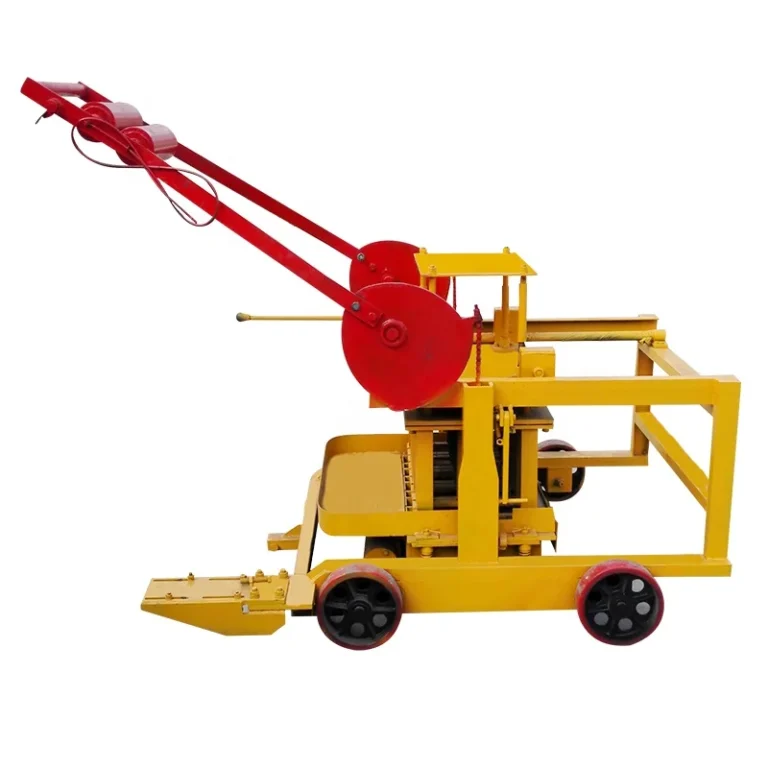
Matched Mould and Press — Every QMJ4-45 egg-laying machine ships with moulds specified against your local aggregate and target block size, not pulled from a catalogue default.
Technical Specifications
| Parameter |
Value |
| Product Type |
Mobile Egg-Laying Block Making Machine |
| Model |
QMJ4-45 |
| Molding Capacity |
4 pcs/mould (based on 400×200×200mm hollow block) |
| Molding Cycle |
40–45 seconds |
| Vibration Frequency |
2400 r/min |
| Vibration Method |
Mold vibration |
| Demold Method |
Manual |
| Turning Method |
Manual |
| Power Source |
Diesel / Petrol engine |
| Total Power |
6 kW |
| Automation Level |
Manual / egg-laying (no fixed plant required) |
| Productivity |
2600–4000 pcs/day (basis not stated in source — confirm block format and material) |
| Pallet Requirement |
Not required (egg-laying operation on flat ground) |
| Certification |
CE |
| Warranty |
One year for the whole machine |
Application Suitability
| Application |
Material or Output |
| On-site hollow block production for building contractors |
Crushed stone, river sand, cement, and local aggregate blends |
| Remote housing projects without grid power |
Engine-driven operation on diesel or petrol fuel |
| First-stage block plant for new entrepreneurs |
Hollow blocks in 400×200×200, 400×150×200, and 400×120×200 mm formats |
| Paving brick and standard brick runs |
Compatible with optional moulds for solid and interlocking formats |
What "3000 Blocks per Day" Actually Means on a Job Site
Daily output figures only hold weight when the block format, mix design, and shift length are spelled out alongside them.
Catalogue sheets for mobile block making machines frequently quote a single daily number without revealing whether it assumes a 400×120×200mm hollow block or a thicker 400×200×200mm unit. The difference between those two formats can swing realistic output by a wide margin over an eight-hour shift. [NEED_CITE: block format impact on daily output calculation] Buyers who have committed to a project deadline based on an unqualified capacity figure often find their crew working overtime to cover the shortfall, or worse, facing penalty clauses from the main contractor.
Where the QMJ4-45 Sits in the Full Range
The QMJ4-45 occupies the entry tier of the mobile block machine lineup. It is designed for contractors and entrepreneurs who need to produce hollow blocks directly on a construction site without investing in a fixed batching plant, conveyor system, or curing chamber. The engine-driven power source means the machine can operate in areas where grid electricity is unreliable or entirely absent.
Ground Conditions and Site Footprint
Unlike semi-automatic or fully automatic tiers that demand a poured concrete foundation, a roofed curing area, and a forklift-compatible pallet circuit, this egg-laying machine requires only a flat, compacted surface. The operator pushes the unit forward after each cycle, leaving the freshly formed block on the ground to cure in place. This eliminates pallet costs entirely but shifts the requirement onto ground preparation — a smooth, level concrete apron or well-compacted earth is necessary to prevent block deformation during the laying process. [NEED_CITE: ground preparation standards for egg-laying block machines]
Reading the Specs That Matter on Site
The 2400 r/min mold vibration frequency works in tandem with manual demolding to consolidate the concrete mix within the 40–45 second cycle. Vibration force is transferred directly through the mould cavity rather than through a separate vibration table, which keeps the total power draw at 6 kW — a figure low enough to run from a small portable generator if the diesel engine is reserved purely for the press mechanism. The three documented hollow block formats (4, 5, and 6 pieces per mould) each carry their own cycle and daily output assumption, and any additional format such as paving bricks or interlocking pavers will have a different pieces-per-mould count that must be confirmed before the mould is manufactured.

The Cost of Overlooking the Power Source Question
Choosing an electrically driven model for a site with unstable voltage or no grid connection at all leads to commissioning delays that can stretch into weeks while a generator is sourced and wired. Even when a generator is available, mismatched frequency or phase configuration can damage motor windings before the first block is produced. [NEED_CITE: voltage and frequency standards by export market] Engine-driven variants like the QMJ4-45 remove this variable entirely, but they introduce a separate maintenance discipline around fuel filtration, oil changes, and air filter cleaning that operators accustomed to electric presses may not anticipate.
Why Source This Mobile Tier Here
Block machinery is the single focus of this facility, so the QMJ4-45 is specified as part of a matched system — engine, mould, and vibration assembly — rather than assembled from unrelated component suppliers. Mould design is carried out against the buyer’s target block format and local aggregate characteristics, not selected from a standard shelf. The automation level is deliberately kept at manual for this tier, but the same manufacturer produces semi-automatic and fully automatic lines, so a buyer who outgrows egg-laying production can transition to the next tier with compatible pallet sizes and mould mounting patterns. Documentation including hydraulic and electrical schematics, a factory test record run on the buyer’s specified block format, and an operation manual in the required language ships with every unit.
Documentation & Verification
- Factory test record run on your specified hollow block format and mix before dispatch
- Mould drawing and format list confirming cavity dimensions for each block size ordered
- Engine specification sheet with fuel consumption data and recommended service intervals
- Operation and maintenance manual in the buyer’s required language
- CE declaration with scope covering the machine and supplied mould set
Installation, Commissioning & Support
- Flat, compacted ground surface required — no poured foundation needed for the 6 kW egg-laying unit
- Diesel or petrol engine arrives pre-filled with break-in oil; first oil change due after initial run-in period
- On-site commissioning includes mould alignment check and vibration frequency verification at operating temperature
- Operator training covers cycle pacing, manual demolding technique, and mould change procedure for alternate formats
- Wear parts list supplied with recommended replacement intervals for vibration springs and mould liners
- Spare mould inventory planning based on the buyer’s daily output target and block format rotation
What to Include with Your Inquiry
To configure the right mobile block making machine for your project, provide the target block format and dimensions, the daily volume you need to sustain over the project timeline, and the type of aggregate available locally. If the site has no grid power, confirm fuel availability so the engine specification can be matched. Details on ground conditions and ambient temperature range help determine whether any auxiliary equipment or mix adjustments are required before the machine ships.
Frequently Asked Questions
Q: How is the daily capacity of the QMJ4-45 calculated, and which block format is it based on?
A: The documented daily outputs are based on an eight-hour shift with specific hollow block formats: approximately 3000 pieces for 400×200×200mm, 3500 for 400×150×200mm, and 4500 for 400×120×200mm. Each figure assumes a consistent mix, trained operators, and uninterrupted material supply. If your target format differs from these three, a separate capacity calculation must be prepared.
Q: What ground conditions does the QMJ4-45 require compared to semi-automatic tiers?
A: This egg-laying machine needs only a flat, compacted surface — a concrete apron or well-graded and rolled earth. Semi-automatic tiers require a poured foundation, pallet return circuit, and a covered curing area sized for the daily output volume. The mobile tier eliminates pallets entirely but places higher demands on ground smoothness to prevent block damage.
Q: Which block formats and moulds are included, and can additional formats be added later?
A: The standard productivity table covers three hollow block sizes. Additional formats such as paving bricks, interlocking pavers, or solid bricks require separate moulds that can be designed and supplied based on your market requirements. Mould mounting patterns are standardized so that new formats can be fitted without machine modification.
Q: What is the investment and automation difference between this tier and the next semi-automatic tier?
A: The QMJ4-45 operates entirely manually with engine-driven vibration, requiring no fixed plant infrastructure. The next semi-automatic tier introduces a stationary press with pallet feeding, a mixer, and a basic conveyor, increasing capital outlay and site footprint substantially while reducing per-block labor. The transition point typically occurs when daily volume consistently exceeds what manual egg-laying can sustain.
Q: How are engine-driven models commissioned, and what operator training is provided?
A: Commissioning covers engine start-up procedures, vibration frequency verification under load, and test runs on the buyer’s specified block format using locally sourced aggregate. Operator training addresses cycle pacing, manual demolding technique, mould change steps, and the engine maintenance schedule. A maintenance manual with service intervals and a wear parts list are provided in the required language.

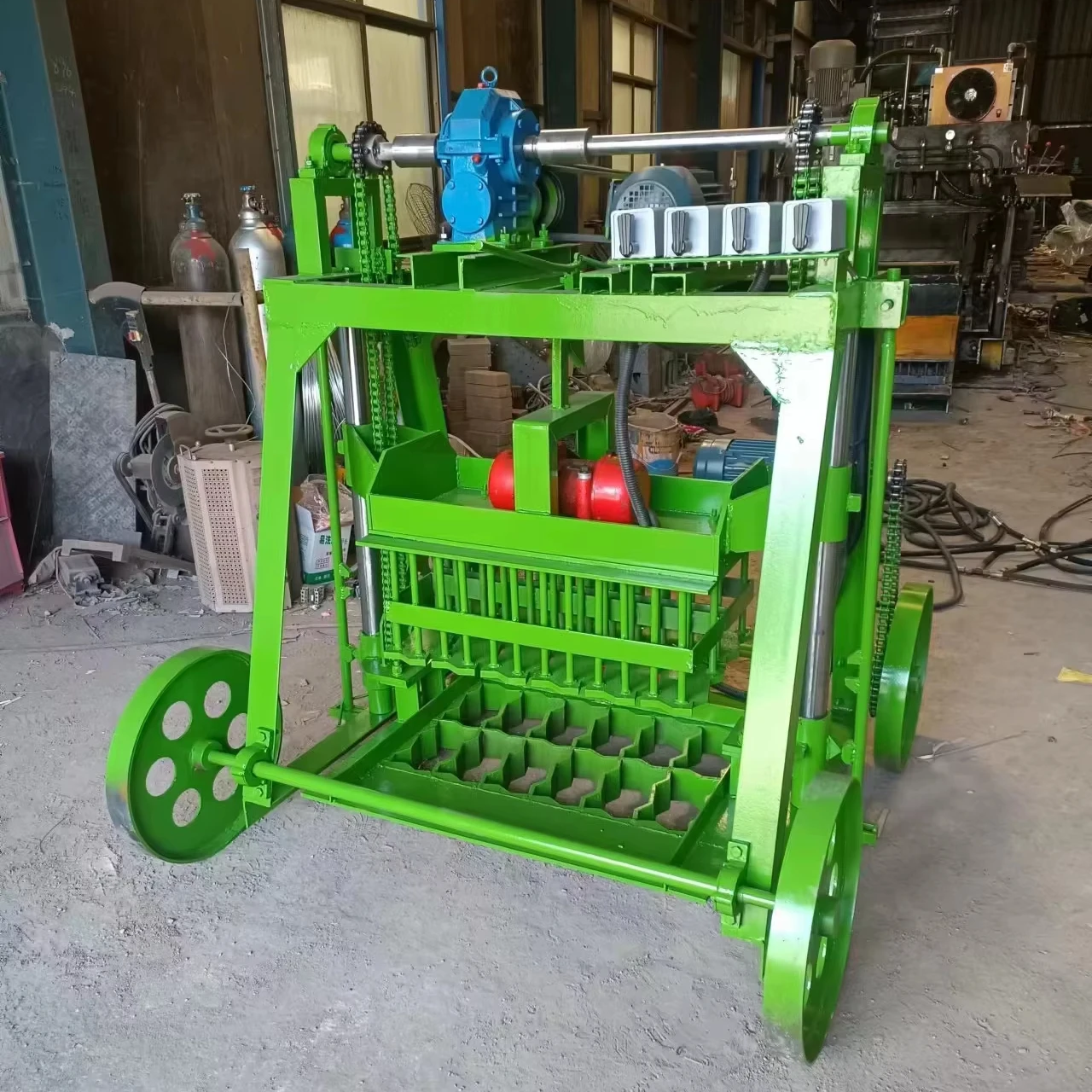
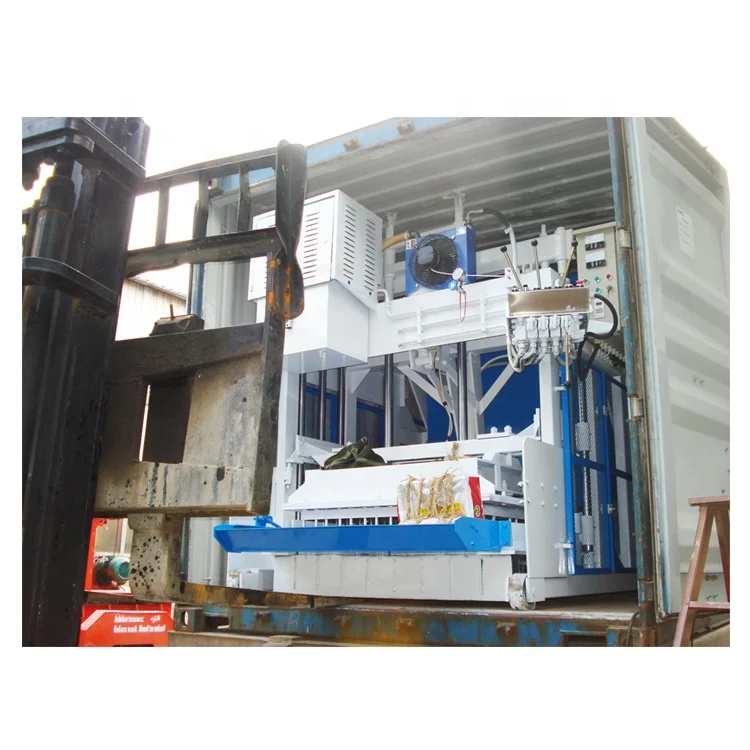 Mobile block machine