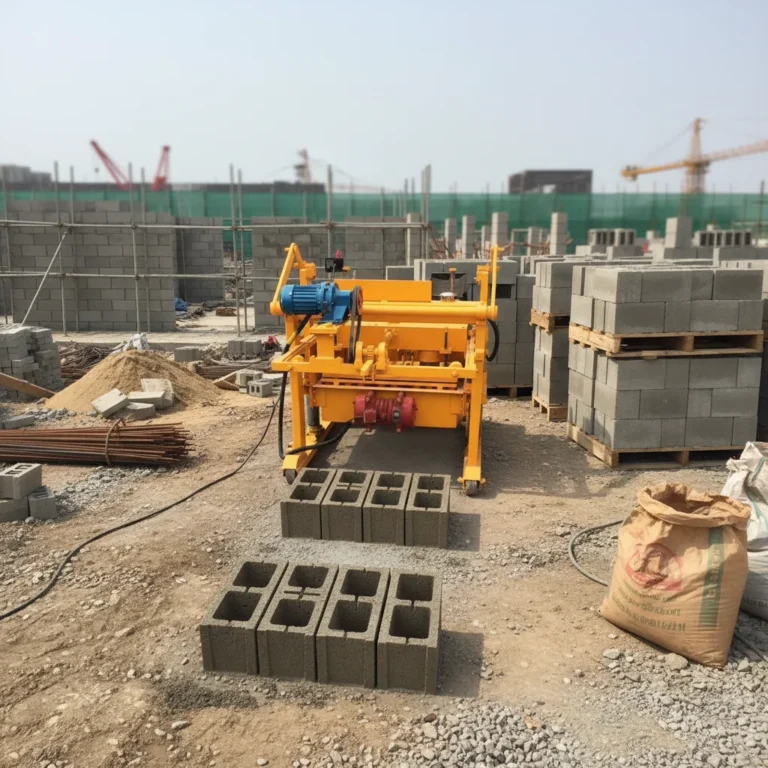
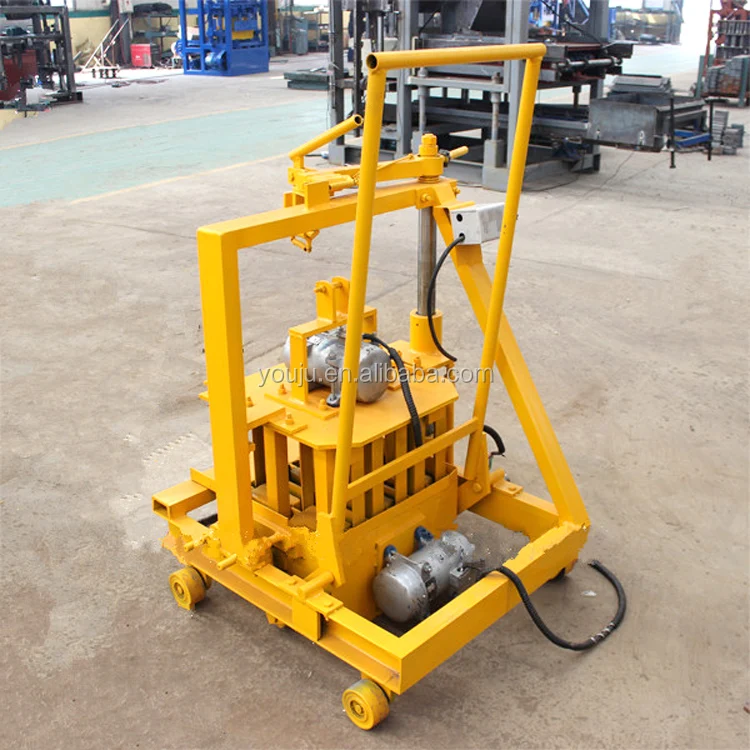
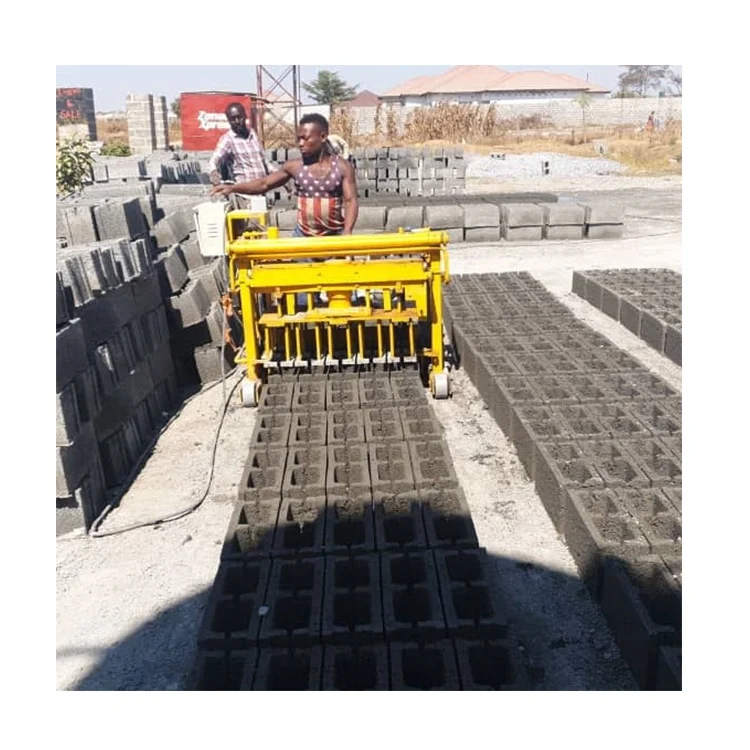
Matched System Approach — every QMJ4-45 we ship is configured with the right mould, engine and vibration setting for your actual block format and local aggregate, not pulled from a generic catalogue.
Technical Specifications
| Parameter |
Value |
| Model |
QMJ4-45 |
| Product Type |
Mobile Egg Laying Block Making Machine |
| Molding Capacity |
4 pcs/mould for 400×200×200mm hollow block |
| Vibration Frequency |
2400 r/m |
| Molding Cycle |
45 s |
| Forming Method |
Mold vibration |
| Demold Method |
Manual |
| Turning Method |
Manual |
| Total Power |
6 kW |
| Power Source |
Diesel or petrol engine |
| Automation Level |
Manual operation, mobile egg-laying type |
| Pallet Requirement |
None — blocks deposited directly on ground |
| Output: 400×200×200mm hollow block |
~3000 pcs/day (8 hours) at 4 pcs/mould, 40–45 s cycle |
| Output: 400×150×200mm hollow block |
~3500 pcs/day (8 hours) at 5 pcs/mould, 40–45 s cycle |
| Output: 400×120×200mm hollow block |
~4500 pcs/day (8 hours) at 6 pcs/mould, 40–45 s cycle |
| Certification |
CE |
Application Suitability
| Application |
Material or Output |
| On-site hollow block production for construction contractors |
Cement, crushed stone, local sand or aggregate |
| First block plant setup by entrepreneurs |
Standard concrete mix with locally sourced raw materials |
| Housing project block supply during build phase |
Hollow blocks in 400×200×200, 400×150×200 and 400×120×200mm formats |
| Paving brick and standard brick production on existing cement yards |
Interlocking and multicellular brick formats via mould change |
What "4,000 Blocks per Day" Actually Means for a Mobile Block Machine Manufacturer
Daily output only holds true when the block format, cycle time and local mix are all stated together.
I used to run vibration and pressure checks on the test bench before crating. Later, on project sites across the Middle East, I watched contractors buy a mobile egg-laying machine rated at a headline output figure, run it on fine desert sand without adjusting the water-to-cement ratio, and find their real production falling far short. The QMJ4-45 is no different — its daily output depends entirely on which hollow block format you run, what your local aggregate looks like, and how consistent your mix stays across batches [NEED_CITE: aggregate grading impact on block density and cycle time]. As a mobile block machine manufacturer, we state output per format rather than a single headline number.

Where the QMJ4-45 Sits in the Full Machine Range
The QMJ4-45 occupies the entry tier of our mobile egg-laying range. It is designed for buyers who need block production without investing in a fixed plant, pallet circulation system or batching infrastructure. For a contractor producing blocks on a single job site, or an entrepreneur testing market demand before committing to a larger line, this mobile block machine manufacturer model keeps the initial capital outlay minimal while still delivering consistent hollow block output.
Comparing Mobile, Semi-Automatic and Automatic Tiers
Moving up from the QMJ4-45, a semi-automatic stationary machine adds pallet feeding, a mixer and basic stacking — raising daily output but also requiring a dedicated plant footprint, a curing area and electrical infrastructure. A fully automatic line brings PLC control, automatic cubing and higher throughput at a significantly larger investment [NEED_CITE: typical plant footprint and investment comparison across automation tiers]. The QMJ4-45 removes the pallet requirement entirely, making it the right starting point for buyers whose site conditions or project duration do not justify a fixed installation.
How Vibration Frequency and Mould Pieces Shape Real Output
The QMJ4-45 operates at 2400 r/m vibration frequency, which is matched to the mould cavity count for each block format. A 400×200×200mm hollow block mould carries 4 cavities per cycle at a 40–45 second molding cycle, producing roughly 3000 pieces over an 8-hour shift. Switching to a 400×120×200mm mould increases cavities to 6 per cycle, raising output to approximately 4500 pieces per day — but only if the operator maintains the same cycle discipline and mix consistency. The twice-vibration molding core consolidates the concrete around the mould walls more evenly than single-pass vibration, which matters when local aggregate includes poorly graded fines that can leave voids in the block wall.
The Hidden Cost of Ignoring Site Preparation
An egg-laying machine deposits wet blocks directly onto the ground, which means the surface must be level, firm and clean. I have seen sites where contractors ran a mobile machine over soft or uneven soil, and the first few rows of blocks slumped or cracked before curing even began [NEED_CITE: ground preparation standards for egg-laying block machines]. Skipping ground preparation or assuming any flat area will work cancels out the advantage of eliminating pallets — and no amount of vibration adjustment compensates for an unstable laying surface.
Why Source This Machine as a Matched System
Block machinery is our single focus, which means the QMJ4-45 arrives with its mould, engine and vibration settings specified together rather than assembled from separate suppliers. We configure the machine against your actual mix design and target block format, not a catalogue default. Mould design is available for the formats your market sells, including custom drawings. Automation level is selectable across our range, so a buyer starting with the QMJ4-45 can move to a semi-automatic line later. Installation support and operator training are included to bring your crew up to speed on cycle discipline and mould change procedure.
Documentation & Verification
- Line layout and capacity calculation stating block format assumed per output figure
- Machine specification sheet confirming engine type, power rating and vibration frequency
- Mould drawing and format list showing available block sizes and pieces per mould
- Engine-only confirmation where no electrical control applies to this model
- Factory test record on your target block format before dispatch
- Operation and maintenance manual with wear parts and mould replacement list
Installation, Commissioning & Support
- Level, compacted ground area required for egg-laying operation with no pallet system needed
- Diesel or petrol engine eliminates the need for site electrical infrastructure or dedicated circuits
- Machine arrives assembled and ready for first-run after engine oil and fuel fill
- On-site commissioning covers mould alignment, vibration check and first-cycle block inspection
- Operator training on manual demold technique, turning procedure and cycle timing
- Mould and wear parts list provided with recommended first-order quantities
Before You Send Your Inquiry
To match the right machine and mould configuration, we need your target block format and dimensions, your estimated daily output requirement, and the type of local aggregate and sand available at your site. If you are comparing this mobile tier against a semi-automatic or automatic line, let us know your available plant area and whether you already have pallet handling or curing infrastructure in place.
Frequently Asked Questions
Q: How is daily output calculated, and which block format does each figure assume?
A: Each output figure on the QMJ4-45 is tied to a specific hollow block size, cavity count per mould and cycle time. For example, the 400×200×200mm format runs 4 cavities per mould at a 40–45 second cycle, yielding approximately 3000 pieces over an 8-hour shift. Output changes when you switch moulds or when mix consistency varies across batches.
Q: What site preparation is needed for egg-laying operation without pallets?
A: The ground surface must be level, firm and free of loose debris. A compacted soil base or existing concrete yard works well. Uneven or soft ground causes blocks to slump or crack immediately after demolding. No pallet investment is required, but the laying area must be maintained throughout production.
Q: Where does the QMJ4-45 sit compared to semi-automatic and automatic tiers?
A: The QMJ4-45 is the entry tier — manual operation, no pallets, no fixed plant. Semi-automatic machines add pallet feeding and a mixer for higher throughput but require a dedicated footprint and electrical supply. Automatic lines bring PLC control and stacking. Buyers choose based on project duration, site conditions and available capital.
Q: Can I upgrade from this mobile machine to a stationary plant later?
A: Yes. Mould formats you already use on the QMJ4-45 can carry over to a stationary machine if the pallet size and mould mounting system are matched during the initial specification. The block formats and mix knowledge you develop on the mobile machine inform the configuration of a larger line.
Q: What engine options are available and how do I match fuel type to my site?
A: The QMJ4-45 is available with diesel or petrol engine options. Fuel choice should match what is readily available and affordable at your project site. Diesel is more common on construction sites with existing equipment fleets, while petrol may suit smaller operations with limited fuel storage.

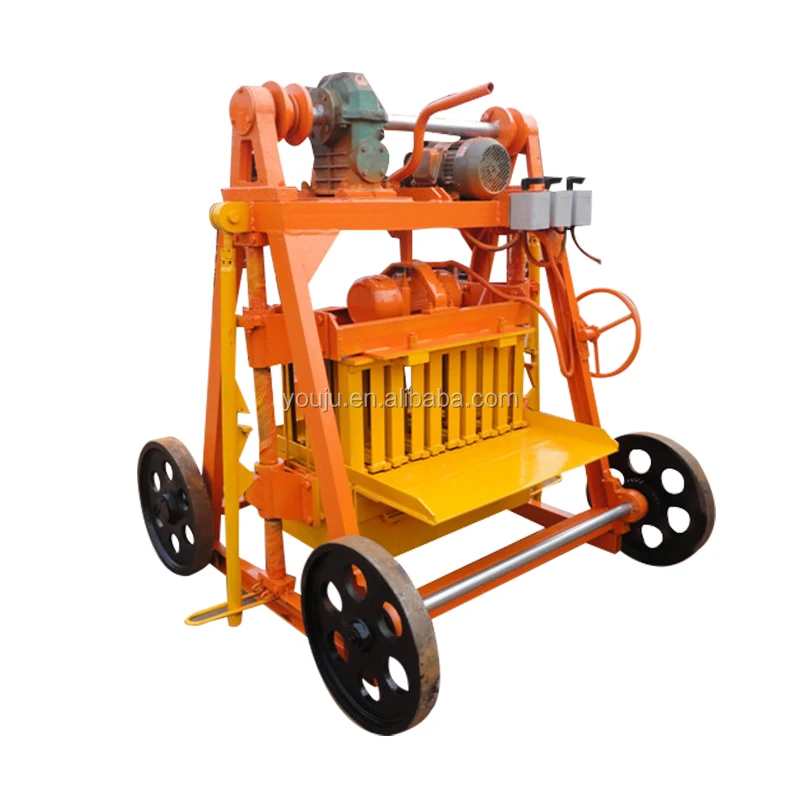
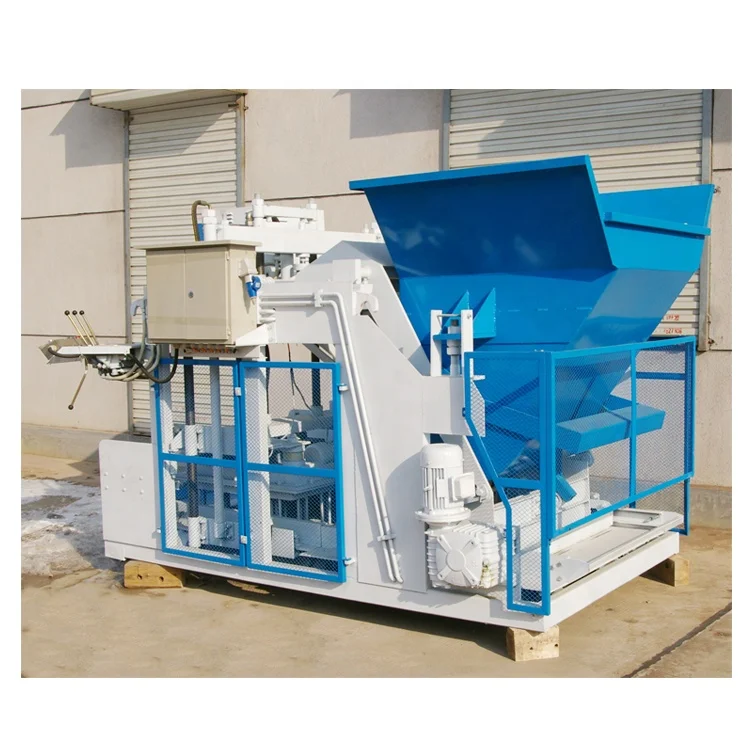 Mobile block machine